thermo exam 1
 Call Kai
 Learn
Learn Practice Test
 Spaced Repetition
 Match
Match Flashcards
 Knowt Play
 Podcast
1/65

There's no tags or description
Looks like no tags are added yet.
Name | Mastery | Learn | Test | Matching | Spaced | Call with Kai | Chat |
|---|
No analytics yet
Send a link to your students to track their progress
66 Terms
define the extent of reaction (ξ)
numerical value in mols
describes the change in moles for products and reactants
single value for all products and reactants of a reaction at any given time
ξ = |Δn|/v where n is moles of the reaction species and n is its stoichiometric coefficient
what does it mean when ξ = 0?
reaction has not begun
all concentrations are at initial values
is ξ extensive or intense?
extensive
depends on the amount (or size) of the matter
if the scale of a reaction was doubled, ξ would be twice as large for any given value of t
an intensive property of the reaction would be the percent completion, which is independent of the reaction scale
what is the relationship for mols of reactants and products, respectively, at time t, given ξ?
products: n = n0 + vξ
reactants: n = n0 - vξ
where v is the stoichiometric coefficient for the given reaction species.
as the extent of a reaction increases, the mols of its products __
increase
as the extent of a reaction increases, the mols of its reactants __
decrease
how is the rate of change in moles of products and reactants described with respect to time?
(d/dt)n = ± v (d/dt)ξ
+ for products
- for reactants
how is concentration measured?
amount/volume
mol/dm³
mol/L
what is the conversion from mlc/cm³ to mol/dm³?
(mlc/cm³) × (mol/6.022×10²³ mlc) × (10cm/dm)³
1dm³ = 1L = 10cm³
how is the rate of change in concentration of products and reactants described with respect to time?
(1/v) (d/dt)[I] = ± (1/V) (d/dt)ξ
+ for products
- for reactants
where V is the volume of the reaction species
and v is its stoichiometric coefficient
what equations define the rate of a reaction (v)?
v(t) = (1/V) (d/dt)ξ = - (1/v) (d/dt) [R] = (1/v) (d/dt) [P]
how is the rate of reaction (v) measured?
concentration/time
mol⋅dm-³⋅s-1
starting from the rate law v = k[A]m[B]n, solve for the units of the rate constant (k)

what are the units of the rate constant (k) for 0th, 1st, 3/2th, 2nd, and 3rd order reactions?
0th: concentration/time = mol⋅dm-3⋅s-1
1st: /time = s-1
3/2th order: concentration-1/2/time = mol-1/2⋅dm3/2⋅s-1
2nd: concentration-1time-1 = mol-1⋅dm3⋅s-1
3rd: concentration-2time-1 = mol-2⋅dm6⋅s-1
describe the method of isolation
method to determine the order of each reactant (m and n)
involves maintaining a large excess of one reactant for the entire duration of the experiment,
while the concentration of the other reactant is changed to see how it effects the rate
for v = k[A]m[B]n, k[A]m becomes roughly constant, and the rate is directly proportional to [B]n
list the drawbacks of the method of isolation
excess concentration of one of the reactants may not be possible for solubility reasons
reaction may be too fast for excess concentration to effect the rate
describe the method of initial rates
involves controlling the reactants’ initial concentrations
then measure the rate of reactant consumption or product generation very soon after reactants are mixed
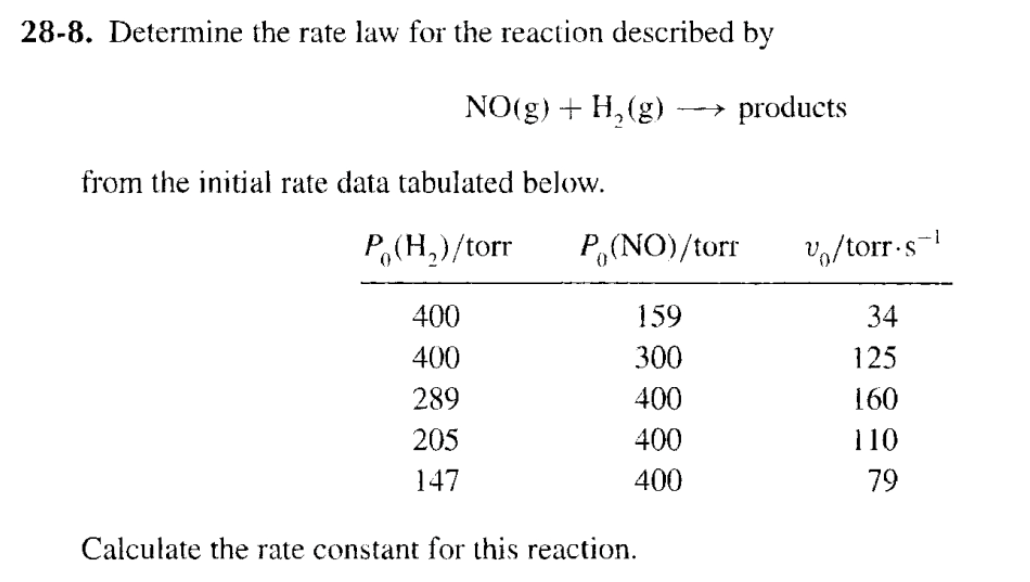
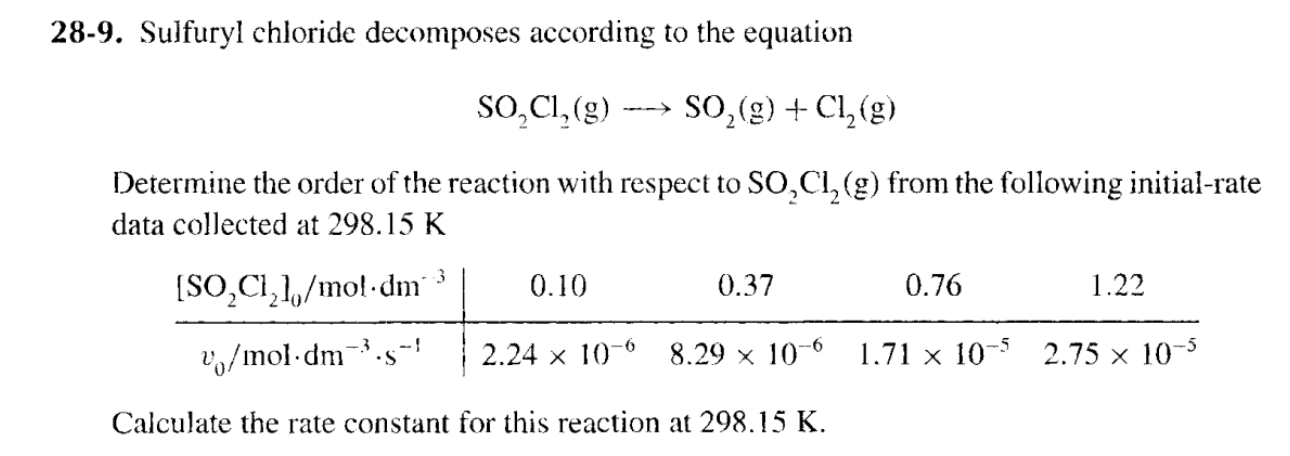
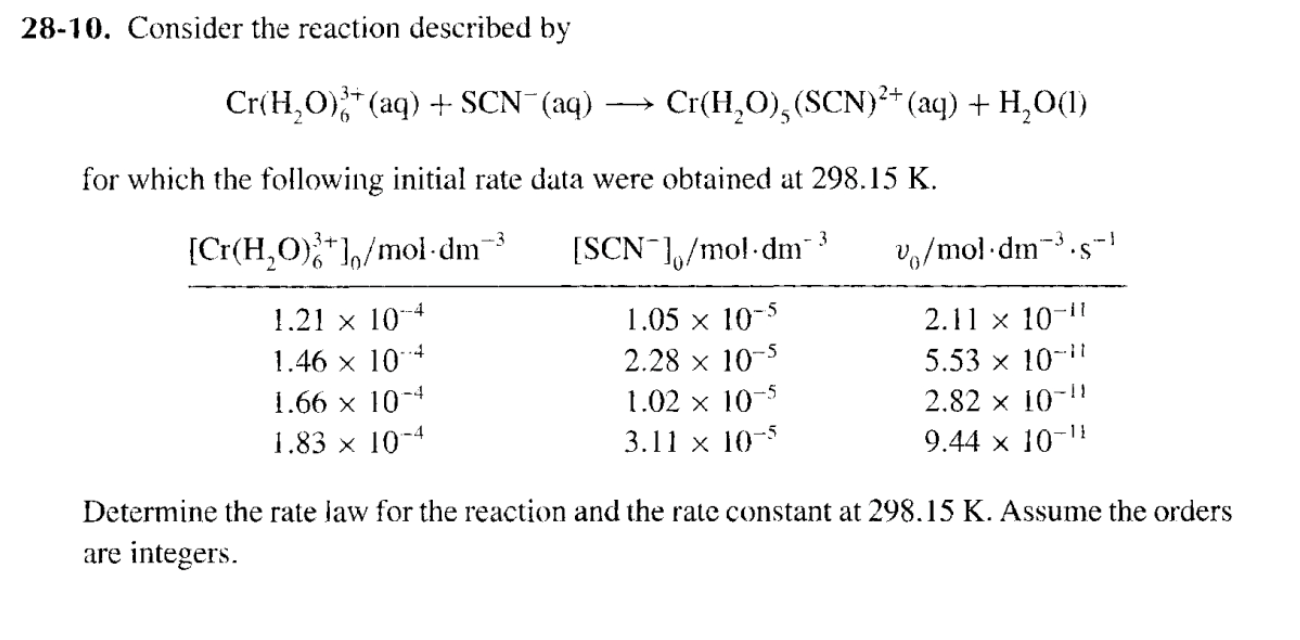
assume this concentration is the initial concentration at t=0 [ ]0
repeat of multiple relative amounts of the reactants
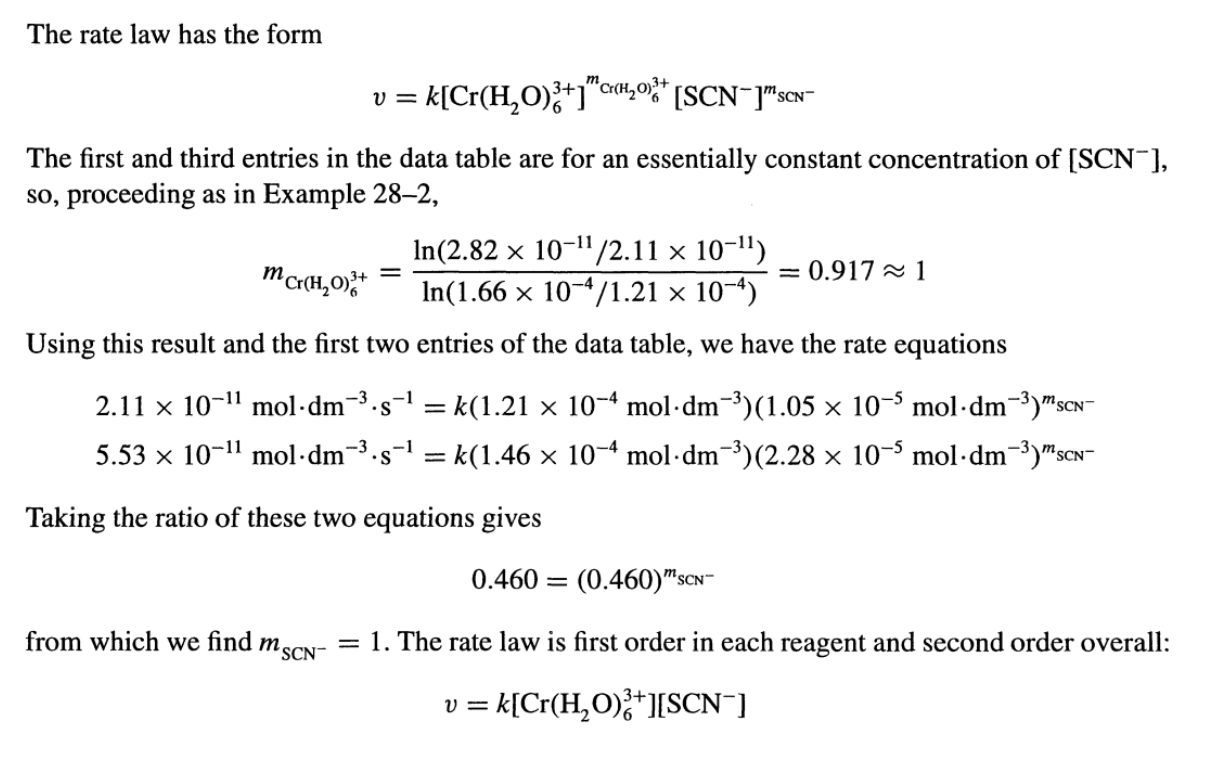
derive the equation used to find the order of a reactant in the method of initial rates
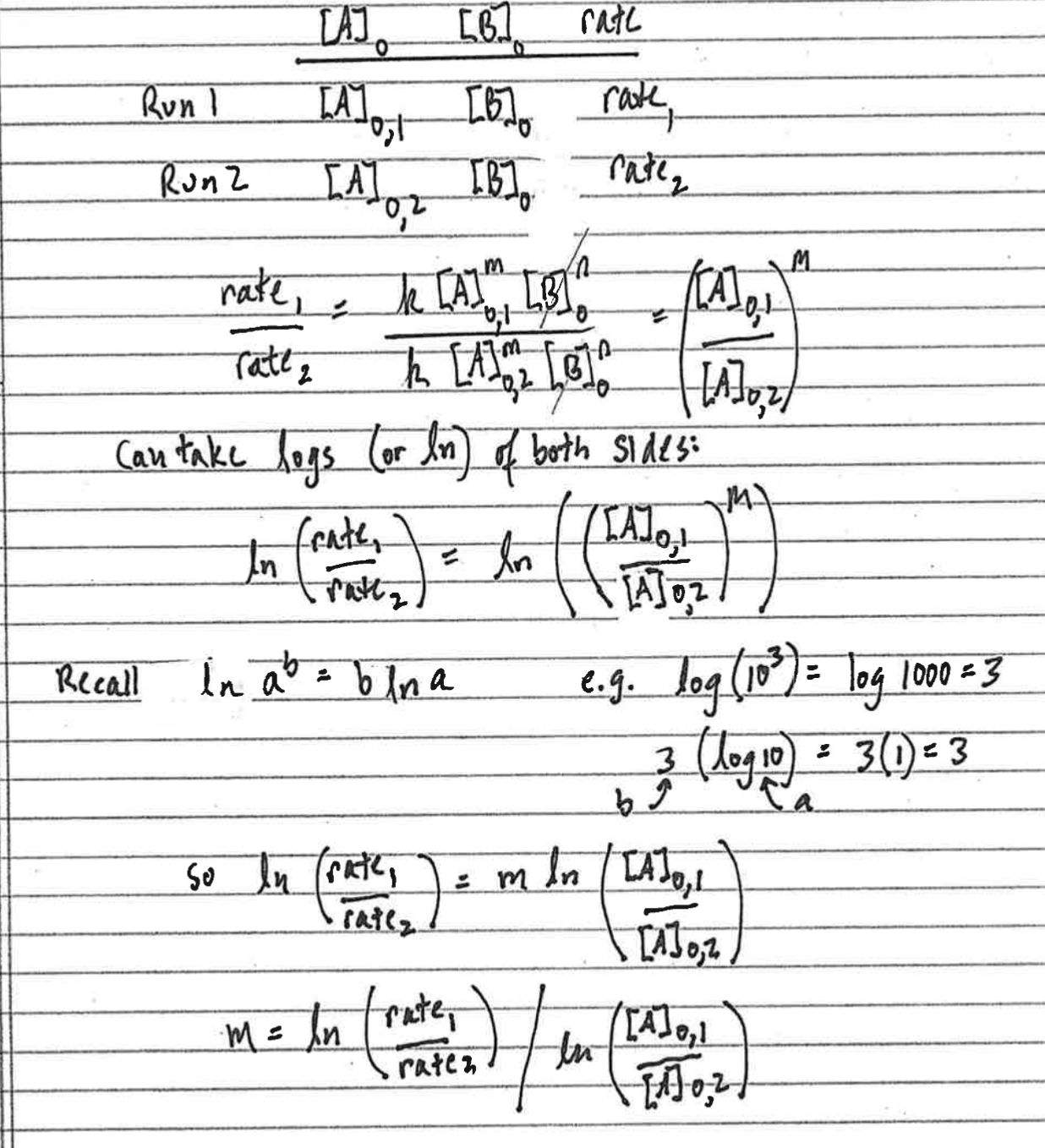
what is the equation used to find the order of a reactant in the method of initial rates?
m = (ln(rate1/rate2))/((ln[A1])/ln[A2]))


graph the reactant and product concentration vs time for a zero, first, and second order reaction. how would the first and second order graphs change for a higher or lower k value?
for a larger k, the reaction happens much faster
the reactant curve has a sharper drop and reaches zero in less time,
while the product curve rises much faster
for a smaller k, the reaction happens much slower
the reactant curve declines very gradually over a longer period, while
the product curve rises slower
product concentrations mirror the reaction concentrations

derive the integrated rate law for a first order reaction

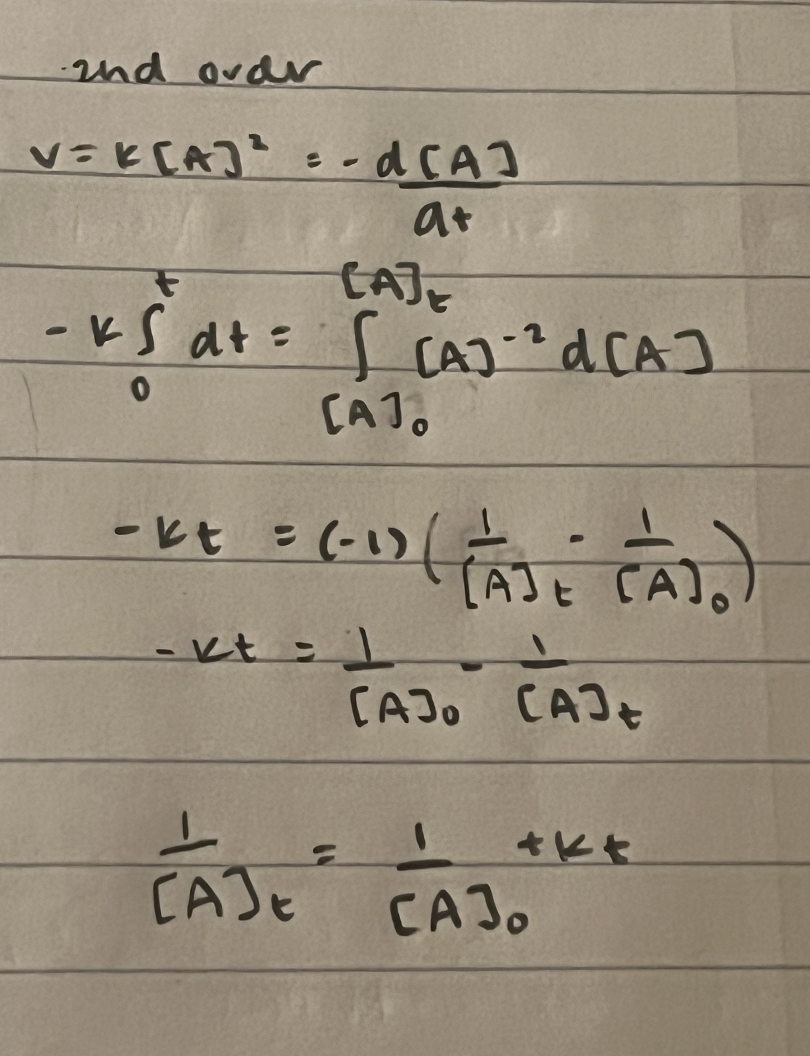
derive the integrated rate law for a second order reaction
how would you make the plots of concentration vs time a straight line in the case of a first or second order reaction? how would you determine the rate constant?
first order: plot the ln(concentration)
second order: plot 1/concentration
in both cases, the rate constant (k) is equal to the slope of the line (Δy/Δx)
derive the half life equation for a first order reaction
*independent of concentration

what is the relationship between the half-life (t1/2) and the rate constant (k) for a first order reaction?
inversely proportional (t1/2 = 0.693/k)
as reaction gets quicker (big k), half life gets shorter (little t1/2)
as reaction gets slower (little k), half life gets longer (big t1/2)
describe the relationship between the decrease in concentration and half life (t1/2), as shown on a graph for a first order reaction
t1/2 : [A]0 to (1/2)[A]0
t1/2 : (1/2)[A]0 to (1/4)[A]0
t1/2 : (1/4)[A]0 to (1/8)[A]0
t1/2 : (1/8)[A]0 to (1/16)[A]0





derive an expression for the time-dependent behavior of the product concentration in a first order reaction

derive the half-life equation for a second order reaction
1/[A]0k = t1/2
*does depend on concentration
describe the relationship between the decrease in concentration and half life (t1/2), as shown on a graph for a second order reaction
1t1/2 : [A]0 to (1/2)[A]0
2t1/2 : (1/2)[A]0 to (1/4)[A]0
4t1/2 : (1/4)[A]0 to (1/8)[A]0
8t1/2 : (1/8)[A]0 to (1/16)[A]0
how is the equilibrium constant defined for a first order reaction?
kc = [P]eq/[R]eq = k1 / k-1
plot the graph of initial to equilibrium concentrations of products and reactants vs time for a first order reaction
can divide [A]/[A]0 quantity at equilibrium by [B]/[A]0 quantity at equilibrium to solve for the equilibrium constant (kc)
![<ul><li><p>can divide [A]/[A]<sub>0</sub> quantity at equilibrium by [B]/[A]<sub>0</sub> quantity at equilibrium to solve for the equilibrium constant (k<sub>c</sub>)</p></li></ul><p></p>](https://assets.knowt.com/user-attachments/9e4a825a-b593-4bdd-a268-66f8c4d0aa0b.png)
when is the relaxation method preferred to the isolation or initial rate method?
for reactions where the half-life is much shorter than the time to mix the reagents
describe the relaxation method, including how to determine if a reaction is first order, endothermic, or exothermic
a reaction is allowed to reach equilibrium
the temperature is quickly (almost instantaneously increased a few degrees)
this changes the equilibrium constant, therefore changing the concentrations of products and reactants as the system reaches its new equilibrium (relaxes)
spectrometry is used to measure the new concentrations
the time it takes to reach the new equilibrium is called relaxation time
if changing the concentrations has no effect on concentration time, it is indicated to be a first order reaction
Using L’Chatlier’s Principle,
if the concentration of products increases, it is indicated to be an endothermic reaction (heat is a reactant —> drives =ium to products)
if the concentration of reactants increases, it is indicated to be an exothermic reaction (heat is a product —> drives =ium to reactants)
derive the Arrhenius equation from d(lnk)/dT = Ea/RT2

define the terms Ea and A in the Arrhenius equation
Ea refers to the activation energy
the minimum amount of chemical energy colliding reactant molecules must possess for a chemical reaction to occur
like an energy “hump” or barrier
units: kJ/mol
A is the pre-exponential factor
it represents the total frequency of collisions that must occur between reactant molecules that have the correct spacial alignment to react
based on how often the molecules bump together, and
a steric factor (how likely the specific molecules are to be well-aligned)
same units as the rate constant (k)
draw two reaction coordinate diagrams, each illustrating the meaning of activation energy and enthalpy (∆H). draw one endothermic and one exothermic diagram.

use the equation sheet to write an equation for Ea in terms of two values of k, their respective temperatures, and constants.
Ea = ln(k2/k1)*R*(T1T2/T2 - T1)
use the equation sheet to write an equation for T2 in terms of two values of k, T1, Ea, and constants.
rewrite the Arrhenius equation so it may be graphed as a straight line. graph the equation and note the slope and y-intercept.
ln(k) = ln(A) - Ea/(RT)
plot ln(k) vs 1/T
slope is -Ea/R
y-intercept is ln(A)

describe the difference between elementary and complex reactions
elementary reactions: occur in a single-step, no intermediates
rate law can be derived from the reaction coefficients
complex reactions: multiple steps long, intermediates
rate law cannot be derived from the reaction coefficients
what is meant by the "molecularity" of an elementary reaction?
unimolecular = 1 reactant
bimolecular = 2 reactants
termolecular = 3 reactants
draw forward and reverse arrows to identify complex and elementary reactions

describe the principle of detailed balance
for every elementary step in a reaction, kc = k1/k-1
not necessarily true for the reaction as a whole
write the [P][P]/[R][R] out for each elementary step and multiply them
result with canceled intermediates and exponent repeats is = to the overall rate constant
for a complex reaction, can draw it out stepwise and sum the reactants
describe the "steady state approximation"
assumes rate of formation is equal to the rate of consumption of an intermediate, such that d[I]/dt = 0
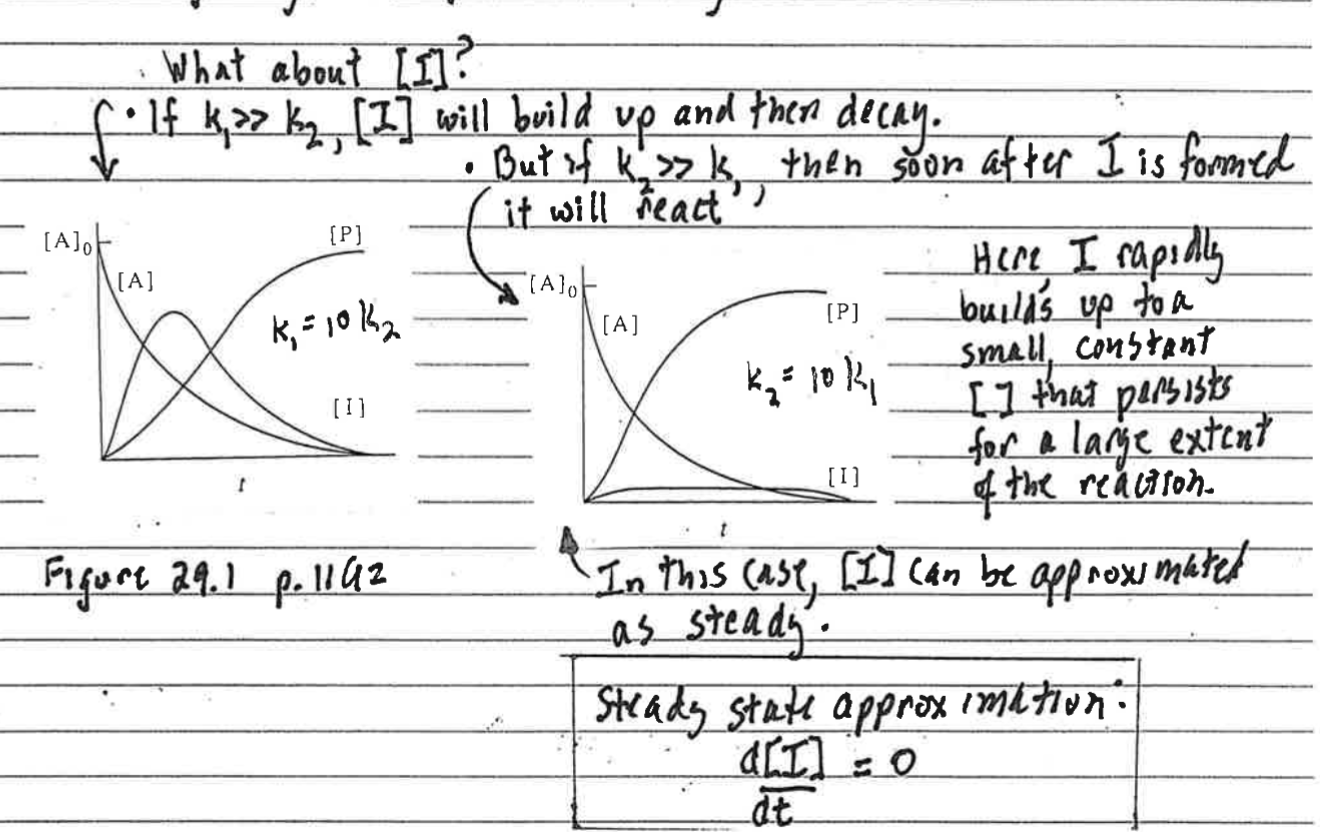
draw graphs of the concentrations of reactant, product, and intermediate for different relative magnitudes of k1 and k2 , and identify in which case it is appropriate to apply the steady state approximation
if k1 is much larger than k2, then the intermediate will build up and slowly be consumed
SSA does not apply
if k2 is much larger than k1, then the concentration of the intermediate will be roughly constant
SSA does apply
How to write the rate law for a 2-step reaction in which the first step is rate-determining (as in
HW question 4).
use the stoich from the reactants in the first step, as if ti were the entire reaction
How to write the rate law for a 2-step reaction in which the first step reaches a rapid equilibrium and the second step is rate-determining (as in HW question 10).
unanswered
if a proposed mechanism agrees with the observed rate law for a reaction, does that necessarily mean that the mechanism is correct?
no
different pathways may yield the same overall rate law
if a proposed mechanism does not agree with the observed rate law for a reaction, does that necessarily mean that the mechanism is incorrect?
yes
describe the Lindemann mechanism for unimolecular reactions, such as isomerization and dissociation
unanswered
apply the steady state approximation the case of the Lindemann mechanism
unanswered
What is the reason that these processes (Lindemann mechanism) appear bimolecular at low enough pressure?
unanswered
under what concentration conditions are first order or second order behavior observed for the Lindemann mechanism?
unanswered
draw (or interpret) a graph of the rate constant (k) as a function of concentration, covering both the unimolecular and the bimolecular regions
unanswered

given a series of steps in a chain reaction, identify the various steps (initiation, propagation, inhibition, termination)
unanswered
what is meant by the "chain length"
unanswered