MSE 2001 Exam 1 Terms - Electrical/Magnetic/Optical/Thermal
 Call Kai
 Learn
Learn Practice Test
 Spaced Repetition
 Match
Match Flashcards
 Knowt Play
1/54

There's no tags or description
Looks like no tags are added yet.
Name | Mastery | Learn | Test | Matching | Spaced | Call with Kai | Chat |
|---|
No analytics yet
Send a link to your students to track their progress
55 Terms
Maximum Service Temperature
maximum “useable” temperature for a material.
How might heated material fail?
melt, sag, break, corrode, decompose
Heat Capacity
the energy required to raise the temperature of a material by 1K
Thermal Conductivity
the rate at which heat flows through a material given a known temperature gradient
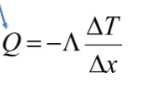
What law is this?
Fourier’s Law
Fourier’s Law
the rate of heat transfer through a material is proportional to the negative temp gradient and the area perp to the heat flow.
What materials are most conductive?
pure metals
What materials are least conductive?
gases
Thermal Diffusivity
an estimate of how quickly a material will heat up when a heat source is applied; describes transient heat flow
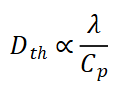
What equation is this?
Thermal diffusivity
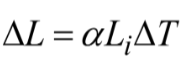
What does this formula represent?
Thermal Expansion
Thermal Expansion Coefficient (a)
change in volume of a material with change in temperature
Electrical Conductivity
how quickly electrons travel through the materials
Electrical Resistivity
the impediment to electron flow
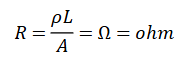
What performance parameter does this equation represent?
electrical resistance
What is a Dielectric?
an electrical insulator
What is an electrode?
an electrical conductor
What is the function of a capacitor?
store electrical energy by separating charge

What does this design equation represent?
capacitance

What does this ε term represent?
permittivity of free space

What does k represent?
dielectric constant
What are the two important material properties for a Capacitor?
dielectric constant and resistivity
Dielectric Constant
how much charge can be stored
Capacitor Resistivity
how long you can store energy without the capacitor discharging
Piezoelectricity
a cross-property combining both the electrical and mechanical response of a material.
Piezoelectrics
electrical insulators that support an internal applied voltage to function
Piezoelectric Effect
applying a mechanical strain to get a voltage
Electrostriction
applying a voltage and get a mechanical strain
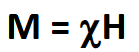
What does this equation represent?
Magnetization
Magnetization (M)
the material’s response to an applied magnetic field (H)
Magnetic Susceptibility (X)
a property of a material that is a mathematical function of the magnetic field (H)
What are some examples of magnetic materials?
ferromagnets and ferrimagnets
What are examples of non-magnetic materials?
paramagnets, diamagnets, antiferromagnets
Soft Magnetic Materials
magnetize when applied to a magnetic field and demagnetize when removed.
Hard Magnetic Materials
magnetize when applied and removed from a magnetic field.
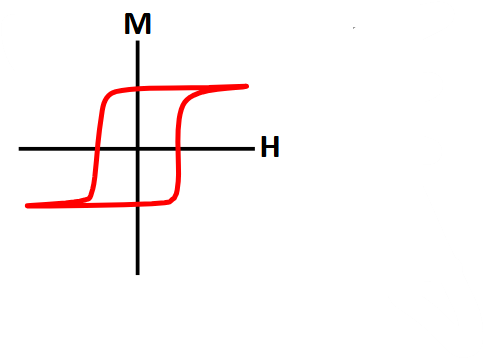
What material does this plot represent?
Hard Magnets
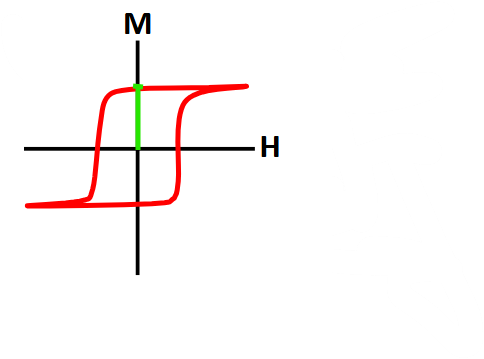
What is does the green line represent on this plot?
remanent magnetization
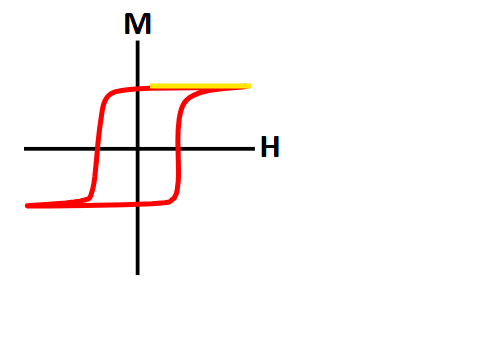
What does the yellow line represent on this plot?
saturation magnetization
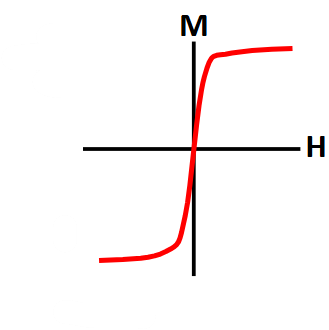
What material does this plot represent?
soft magnets
Saturation Magnetization
maximum magnetization that a material can obtain when placed under a magnetic field
Remanence (Remanent Magnetization)
how much magnetization remains after you remove the magnetic field
Coercive Field
magnetic field required to demagnetize a magnetic material.
Curie Temperature
temperature above which a permanently magnetized material loses its magnetization.
What can happen to the light when it is incident on a material?
transmitted, reflected, or absorbed
Reflectivity
% incident light that is reflected by the material’s surface
Absorptivity
% of incident of light that is absorbed by the material
Transmissivity
% of incident of light that is transmitted through the material and exits on the other side
What do reflectivity, absorptivity, and transmissivity depend on?
wavelength of incident light and the angle of incidence
Introducing roughness on surface so that the incoming light can?
increase reflection
Polarization of Light
light consists of an electric and a magnetic field oscillating perpendicular to one another
Polarization Direction
direction in which the electric field is oscillating
Light is linearly polarized in what direction?
z-direction
Randomly Polarized Light
light waves with electric fields in all directions
Polarizer
a material that can make light linearly polarized when passing through
Refractive Index
the ratio of the velocity of light in a vacuum to the velocity of light traveling in a material.