Imperfections in Solids
 Call Kai
 Learn
Learn Practice Test
 Spaced Repetition
 Match
Match Flashcards
 Knowt Play
1/30

There's no tags or description
Looks like no tags are added yet.
Name | Mastery | Learn | Test | Matching | Spaced | Call with Kai | Chat |
|---|
No analytics yet
Send a link to your students to track their progress
31 Terms
what does Polycrystalline mean
metal has grains in all direction
Uniform properties in all directions
Uniform grain distribution
Uniform texture
define Anisotropic
properties of metal vary with direction
Some directions are stronger than others
There is a preferential orientation for strength
If all grains are elongated in one direction = that direction is stronger
e.g. BCC iron
define Isotropic
Grains are randomly oriented
All directions are equally strong
No orientation preference for strength
compare Single crystal vs Polycrystals
single = are anisotropic
polycrystals = can be anisotropic or isotropic
steps in metal solidification
Nucleation
Formation of stable nuclei
Atoms go around and look for budies
When critical mass is reached
either Homogenous nucleation or Heterogenous nucleation
Growth of nuclei
Formation of grain structure
When stable nuclei cool and grow
Grains are blocked by grain boundaries of other grains so their growth size is limited by it
what is Homogenous nucleation
Most simple
Metal provides atoms
Atoms join together to form nuclei
When critical size is reached = nuclei form into crystals
Below critical size = embryo
If it can't reach critical size, nucleus gets dissolved
As crystals cool, they grow and form grains
what is Heterogenous nucleation
Nucleation in a liquid on the surface of a structural material
-> called nucleating agent
-> used mainly in industry
Slow atoms join together to form nucleus
Nucleating agent reduces critical size needed to form crystals
When critical size is reached = crystal forms
Nucleating agent means that less cooling is required to form grains
define Equiaxed grains
roughly the same size in all directions
Same property in all directions
Want fine, uniform grains in steel structures
define Columnar grains
elongated grains
Grains grow towards heat
Stronger in one direction
what are the Types of imperfections
Point defects
Vacancies
Interstitial atoms
Substitutional atoms
Linear defects
Dislocations
Planar defects
Grain boundaries
Point defects: vacancies
Vacant atomic site in atom
-> i.e. Missing atom
Distortion in plane makes a vacancy
More common than other point defects since it requires less energy to make
Point defects: Self-Interstitial atoms
Extra atoms positioned in atomic sites
-> i.e. Extra atom
Less common since it requires energy to insert an atom
Point defects: Substitutional
Impurity and host have similar atomic properties
Follow Hume-Rothery rule:
Similar atomic radius
∆r = <15%
Similar electronegativity
Similar valence electron number
Same crystal structure
E.g. bcc + bcc
Atoms of impurity fill vacancy of host = increase atomic density = stronger material
Fill in missing atoms
E.g. Copper in nickel
Point defects: Interstitial
Impurity has a smaller atomic size than host
Low concentration of impurity = uniform distribution in A
Small atoms fill interstitial sites -> small spaces in between atom
Property of alloy is still similar to host
Second Phase Materials
what are they
how do they form
High concentration of impurity greater than differential solubility % = forms 2nd phase particle
Excess of impurity in host
Forms a different metal with different chemical composition and crystal structure
Calculating equilibrium concentration
The stable number of atomic flaws that minimizes the material's total free energy at a specific temperature
Varies with temperature
Is unitless

What is differential solubility
Determines the percentage of impurity that can be dissolved in the host
E.g. Cu in Ni -> 100% solubility
Only 1 phase material
Can have around 50% Cu and 50% Ni
E.g. Cu in AL -> 19.6%
>20% Cu = won't penetrate crystallographic plane and fill vacancies
Creates two phased material
Smaller differential solubility for interstitial than substitutional atoms
Interstices are more cramped
Too many interstitial atoms = causes crystal structure to bulge
Interstitial atoms apply too much force on other atoms
Causes distortion in material
Calculating differential solubility
weight %
atom %

Average atomic weight of an alloy
Ca = % of material A
Cb = % of material b

Average density of an alloy

How to calculate whether an alloy is simple, FCC, BCC or HCP structure
write equation for average density
write equation for average atomic weight
use theoretical density equation and rearrange for no. of atoms
avg density = (no. atoms x avg atomic weight) ÷ (avogadros number x volume of cell)
If no. of atoms =
1 → simple
2→ BCC
4 → FCC
6 →HCP
What are linear defects
One dimensional defects where atoms are misaligned
Slip between crystal planes when dislocations move, causing plastic deformation
Before load = no dislocation
After load = dislocation
Force causes bonds across the slipping plane to break and be remade
Since load causes the grains to shift direction
Useful since they slow down deformations in structure
Generally we have both types at the same time
types of linear defects
Edge dislocation
Screw dislocation
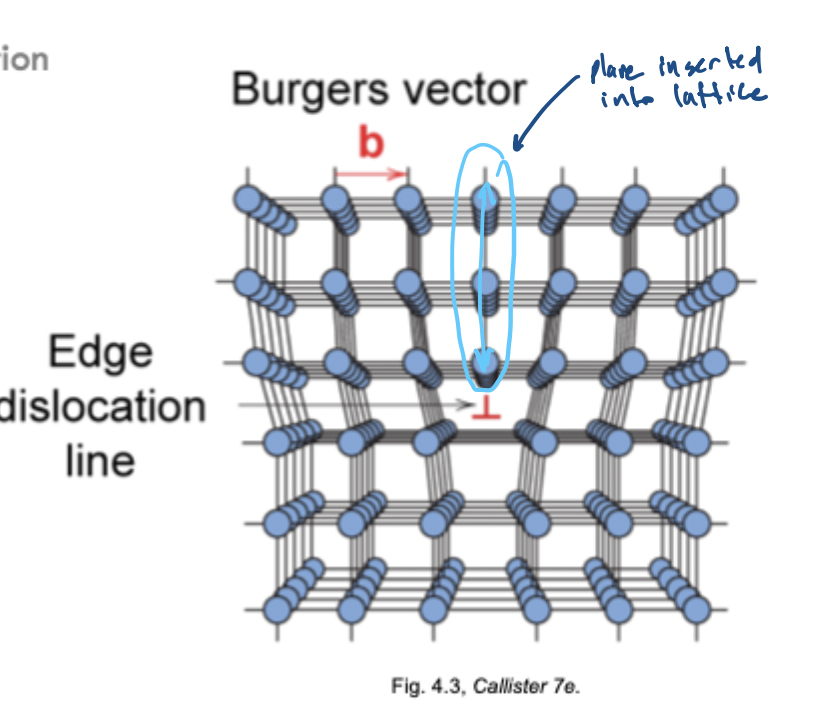
what is an edge dislocation
Extra half plane of atoms inserted into a crystal structure
i.e. Another plane penetrates the lattice and stops half way
Burger's vector is perpendicular to dislocation line
What is a screw dislocation
Spiral planar ramp due to shear deformation
Torsion (twist) in a plane due to load
Burger's vector is parallel to dislocation line

What structures do dislocations happen more often in
Prefer close-packed plans and directions
BCC = less dislocation prone since lower APF
FCC and HCP = more dislocation prone due to higher APF
What are planar defects
Grain boundaries → Region between crystals
Normally rough
Has a different alignment
Disordered
Low density
Where crystals interact
High mobility, diffusivity and chemical reactivity
Types of grain boundaries
Twin boundary
Stacking faults
What are twin boundaries
Atom is between a grain boundary and is shared between crystals
• Can use electron diffraction to find grain orientation
• Colour represents direction of grain
• One colour = uniform orientation + undeformed
• Shading in a grain = deformation
○ Smaller grains are more stable
○ Larger grains often undergo deformation

What is a stacking fault
A plane is missing
Stacking fault vs edge dislocation in a microscope
-> stacking fault can be seen in more easily
-> edge dislocation needs an electron microscope

Types of microscopy techniques + uses
optical microscope
grain boundaries
grain size
scanning electron microscope (SEM)
Grain boundaries + orientation
Twin boundaries -> backscattered electron diffraction
transmission electron microscope (TEM)
Stacking faults
Dislocations
X-ray diffraction
Crystal structure