Oral Histology - Salivary Glands
 Call Kai
 Learn
Learn Practice Test
 Spaced Repetition
 Match
Match Flashcards
 Knowt Play
1/74

There's no tags or description
Looks like no tags are added yet.
Name | Mastery | Learn | Test | Matching | Spaced | Call with Kai | Chat |
|---|
No analytics yet
Send a link to your students to track their progress
75 Terms
Protective function of saliva
- lubricant via glycoprotein
- barrier against noxious stimuli; microbial toxins and minor traumas
- washing non-adherent and acellular debris
- formation of salivary pellicle
- saliva coats all surfaces with mucin-rich secretions providing protective diffusion barrier against mechanical, thermal, chemical and microbial damage
salivary pellicle
- thin
- acellular
- organic film that forms on any type of surface upon exposure to saliva
saliva is a barrier against ______ stimuli, _______ toxins, and minor ______
noxious, microbial, traumas
saliva coats all surfaces with _____-rich secretions providing protective _________ barrier against _________, ______, _______, and microbial damage
mucin, diffusion, mechanical, thermal, chemical
buffering of saliva is via
phosphate ions and bicarbonate
buffering bacteria require specific ____ conditions; plaque microorganisms produce ______ from sugars
pH, acids
salivary pellicle is a ______________ film that forms on teeth and is pivotal in many physiological processes of the mouth
proteinaceous
Salivary pellicles protect teeth against tooth _____________ by dietary acids
demineralization
the presence of the salivary pellicle is fundamental for oral health; its absence from the mouth shows an increase in the risk of (3):
caries, gingivitis, periodontitis
digestive function of saliva
- amylase (starch) and lipase (fat) breakdown
- helps to form the food bolus
antimicrobial function of saliva
- lysozyme
- lactoferrin
- IgA
lysozyme
hydrolyzes cell walls of some bacteria
lactoferrin
binds free iron and deprives bacteria of essential element
IgA
agglutinates microorganisms
saliva functions in antiviral function via (2)
mucins, cystatins
saliva has an antifungal function via
histatins
saliva helps maintain tooth integrity via
calcium and phosphate ions - ionic exchange with the tooth surface and remineralization
saliva helps with taste by
- solubilizing food substances that can be sensed by receptors
- trophic effect on receptors
saliva helps prevent caries via
proline rich proteins that induce enamel mineralization
composition of saliva
- 99.5% water
- 0.2% inorganic
- 0.3% organic
the organic constituents of saliva
- enzymes (-ase)
- immunoglobulins
- mucous glycoproteins
- traces of albumin
- polypeptides
the pH of saliva is around ____-____
6.7-7.5
parotid saliva varies over a (lesser/greater) range than the average pH of saliva
greater
the pH of saliva depends on the ___________ concentration
bicarbonate
initially, saliva is _______ as is formed in the acini, but becomes __________ as it travels through the duct network and enhances taste
isotonic, hypotonic
the viscosity of saliva is _____________; it exhibits different viscosities at different rates of shear and has __________ properties
non-newtonian, visco-elastic
viscous behavior changes with time after secretion because of its non-newtonian properties and ______________ degradation of mucous glycoproteins by bacterial enzymes
post-secretory
gases found in saliva include
- oxygen
- CO2
- nitrogen
inorganic substances in saliva include
- sodium
- calcium
- potassium
- bromide
- chloride
- fluoride
- bicarbonate
- phosphate
enzymes found in saliva include
- amylase (ptyalin)
- lysozyme
- lingual lipase
- maltase
- phosphatase
- carbonic anhydrase
- kallikrein
other organic substances found in saliva include
- mucin
- albumin
- proline-rich proteins
- lactoferrin
- IgA
- blood group antigens
- free amino acids
- non protein nitrogenous substances like urea, uric acid, creatinine, xanthine, hypoxanthine
glucose is present in saliva during
diabetes mellitus
types of glands include
- simple alveolar (acinar)
- simple branched alveolar
- compound alveolar (acinar)
- simple tubular
- simple coiled tubular
- simple branched tubular
- compound tubular
- compound tubuloalveolar
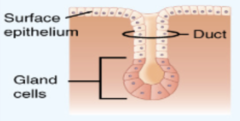
simple alveolar/acinar glands
- not in adults
- stage in development of simple branched glands
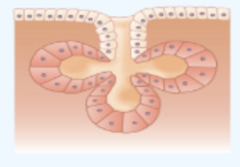
simple branched alveolar glands
sebaceous (oil) glands
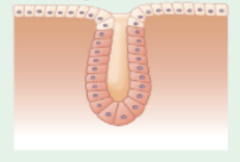
simple tubular glands
intestinal glands
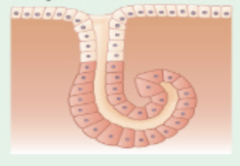
simple coiled tubular glands
merocrine sweat glands
simple branched tubular glands
- gastric glands
- mucous glands of esophagus, tongue, duodenum
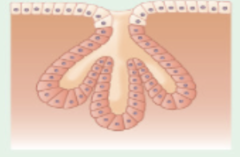
compound alveolar/acinar
mammary glands
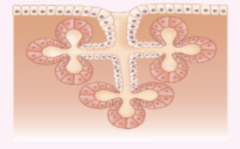
compound tubuloalveolar glands
- salivary glands
- glands of respiratory passages and pancreas
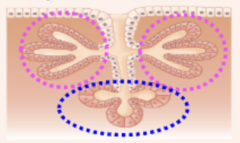
compound tubular glands
- mucous glands in mouth
- bulbourethral glands in male reproductive system
- in testes (seminiferous tubules)
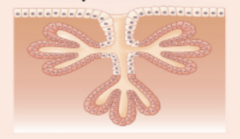
at around the 7-8th month in utero, __________ cells begin to develop around the ductal system
secretory
secretory cells differentiate from a separate pool of cells than do the _______ cells, giving each type of cell unique characteristics
ductal
secretory cells are classified as either
mucous cells or serous cells
mucous cells
- more thick, viscous secretion
- show clear cytoplasm because it mostly contains mucopolysaccharides which do not retain common dyes (lightly stained)
- mucigen droplets
- secretory endpieces composed of these have tubular configuration
- in cross section, tubules appear round with these cells surrounding a large, central lumen
- nucleus is flat and peripheral
- protect and lubricate
- most prominent feature is the accumulation in the apical cytoplasm of large amounts of secretory product which compresses the nucleus and ER against the basal cell membrane
- large Golgi complex basal to mass of secretory granules
- ER and other organelles limited mainly to basal cytoplasm of cell
- mostly sublingual gland
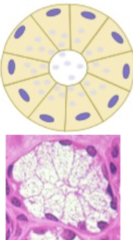
mucous end pieces in major salivary glands and some minor salivary glands have serous cells associated with them in the form of _______ covering the mucous cells at the end of the tubule
demilune
the secretory material of mucous cells gives an ________ appearance to the supranuclear cytoplasm
empty
like serous cells, mucous cells are joined by
a variety of intercellular junctions
like serous cells, mucous cells lack ___________ __________ except for those covered by demilune cells
intercellular canaliculi
serous cells
- thin, watery, proteinaceous secretion
- show more dark cytoplasm due to high enzymatic content with amylases as the most abundant enzymes (enyzmatic action)
- typically spherical, 8-12 cells surrounding a small, central lumen
- central, rounded nucleus with indistinct cell boundaries
- pyramidal cells with a broad base and narrow apex
- spherical nuclei are located basally
- numerous secretory granules in which macromolecular components of saliva are stored, and present in apical cytoplasm
- zymogen granules in cyto
- parotid gland
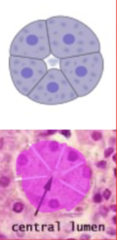
the basal cytoplasm of serous cells contain
- numerous cisternae of RER
- converge on a large Golgi complex located just apical or lateral to the nucleus
the granules of serous cells may
- have a variable appearance
- increase in density as their content condenses, eventuall forming mature secretory granules
where do you find serous demilune
- only in the mixed gland
- crescent, half moon shaped clusters of serous cells
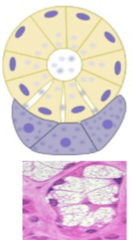
pure serous end piece
- less cells, lumen smaller than mucous one
- relatively central nucleus
- picks up darker pink color when staining
mucous endpiece
- more tubular
- nucleus is pushed into the basal layer
- canal/opening is much wider
- will pick up lighter shade of pink when staining
serous travels from
intercalated duct > striated duct > excretory duct
mucin end pieces only stain
dark purple; acid-Schiff stain
all salivary glands are compound
tubulo-alveolar glands
structure of salivary gland
- consists of series of branched ducts terminating in spherical or tubular secretory end pieces/acini
- main excretory duct that empties into the oral cavity divides into smaller interlobar and interlobular ducts that enter lobes and lobules of the gland
- predom intralobular ductal component is striated duct, playing major role in modification of primary saliva produced by secretory end pieces
- connecting striated ducts to secretory end pieces are intercalated ducts, which branch 1 or 2 times before joining individual end pieces
- lumen of end piece is continuous with intercalated duct
major salivary glands make up ___% of total secretion
90
minor salivary glands make up ___% of total secretion
10
3 major salivary glands
- parotid (25%)
- submandibular (60%)
- sublingual (5%)
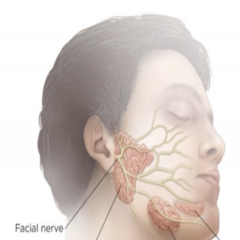
minor salivary glands
- glossopalatine
- labial, lingual, palatal
- mucous glands in the cheek that spread in the oral cavity except at the gingiva and anterior part of the hard palate
parotid
- largest encapsulated salivary gland
- pure serous in adults
- no serous demilunes
- 25% salivary volume
- CN VII (Facial) gives rise to 5 terminal branches within this gland
- main duct is Stenson's duct
- may be able to see the orifice in your own mouth in the cheek
submandibular
- second largest major salivary gland in size
- provides most of the total salivary volume (60%)
- mixed but predominately serous
- main duct is Wharton's duct, which opens at the sublingual caruncle on floor of mouth adjacent to base of lingual frenulum
- small proportion of mucous acini can be seen in ligher spots among serous acini
- gland and duct share 3 principal nerves: lingual, hypoglossal, facial
sublingual
- smallest major salivary gland
- mixed, predominately mucous
- 5% total salivary volume
- instead of a single large duct, have row of smaller ducts: Bartholin's duct
- ducts open into the mouth along top of transverse ridge on floor of mouth
- supplied by fibers that originate in CN VII (Facial)
minor salivary glands include
- labial (superior, inferior) - lips
- buccal - cheek
- glossopalatine - anterior faucial pillar, glossopalatine fold
- palatine - hard and soft palate, uvula
- lingual - anterior tongue, circumvallate papillae, posterior tongue
labial and buccal minor glands are
mixed, predominantly mucous secretion
glossopalatine and palatine minor glands are
pure mucous
lingual minor glands are
- anterior, circumvallate papillae/Von Ebner's glands: mixed, predominately mucous
- posterior: pure mucous
cllinical considerations
- with age, loss of gland tissue occurs
- gradual reduction of 30-60% in acinar volume of major glands
- viruses can infect and replicate in salivary gland cells and shed into saliva (CMBV, EBV, HPV 6 and 7)
- viral infections like mumps, bacterial infections of individual glands may cause inflammation and result in painful edema
- ductal obstruction may result from siaoliths (stones) in most commonly submandibular duct
- glands may be affected by benign/malignant tumors
- glucose in saliva may affect plaque metabolism
- autoimmune disease after tissue/organ transplantation may cause salivary tissue destruction, thus reduced salivary flow
- function may be affected by individuals with AIDS, rates of flow decreased, lower level of secretory immunoglobulins
- parotid gland enlargement may occur because of lymphadenopathy, lymphoepithelial cysts
- pathologic changes in glands may be observed in cystic fibrosis
Xerostomia
- frequent clinical complaint
- loss of function or reduction in volume may lead to oral dryness
- dries oral tissues and loses protective function of salivary buffers, proteins, mucins
- tissues more susceptible to infections and speech, eating, swallowing difficulty
- side effect of medications
- drugs may cause central/peripheral inhibition of secretion
- destruction of gland tissue is cause of this
- radiation therapy for head and neck cancer can cause this
- highly sensitive to deleterious effects of radiation
- chemo treatment for cancer or bone marrow transplantation may reduce function
- autoimmune disease (Sjogren's syndrome) may cause progressive loss of function from invasion of lymphocytes into gland, destruction of epithelial cells
- sipping water or artificial saliva may help
- pilocarpine may help (parasympathomimetic drug)
xerostomia infection susceptibility include
- Candidiasis
- Periodontal disease
- Lichen Planus
- Burning mouth
- Aphthous ulcers
- Dental caries
diagnostics
- trace amounts of biochemicals in blood serum that filter into mouth
- HIV and cancer has proteins and substances linked to them from serum to saliva
- inc concentrations of these compounds make saliva potentially promising diagnostic fluid with advantages over blood
- advances in science of oral fluid diagnostics lead to ID of disease signature patterns of candidate biomarkers
- increase knowledge of proteome, microbial composition, antimicrobial and enyzmatic activities
salivaomics
- integrated analysis of multiple large scale molecular readouts from important biological fluid
- genomics, epigenomics, transcriptomics, proteomics, microbiomics, metabolomics
- biopsy from saliva