Seizure Disorders
 Call Kai
 Learn
Learn Practice Test
 Spaced Repetition
 Match
Match Flashcards
 Knowt Play
1/30

There's no tags or description
Looks like no tags are added yet.
Name | Mastery | Learn | Test | Matching | Spaced | Call with Kai | Chat |
|---|
No analytics yet
Send a link to your students to track their progress
31 Terms
Seizure Phases…
Prodrome phase
Change in behavior/mood
AUra
Ictal “Seizure Phase”
Postictal phase
Confusion, weakness, behavioral changes
Seizure Classification…
Focal
Focal MOTOR
Automatisms
Atonic (loss of muscle tone)
clonic
Focal NONMOTOR
Autonomic
Behavior arrest
cognitive/emotional/sensory
Generalized Classifcation…
Motor
Tonic-clonic
Myoclonic
NON-Motor
Absence
Causes of Seizures
Stroke/CVD - vascular seizure
Infection - CNS infection
Metabolic Disorders:
Hyponametric (low Na+)
Hypoglycermic
Drug withdrawal
Barbituates
Benzodiazepines
Alcohol
Hyperventilation, Genetics, Head Trauma, Sleep Deprivation, Dehydration
Drug-Indued Seizures
Antibiotics
Fluoroquinolones
Meropenem/Ertapenem
Chemotx - alkylating agents
Psychostimulants - amphetamines
Meperidine - active excitotoxic metabolite
Antidepressants - TCA, Bupropion
Antipsychotics
Xanthine Derivatives
Theopylline
Caffeine
Generalized Tonic-Clonic Treatment…
→ first line: sodium valproate
CI in women of childbearing potential
levetiracetam (KEPPRA) or Lamotrigine for these individuals
→ second line: topiramate, zonisamide
→ third line: clobazam, perampanel
Generalized Myoclonic Treatment…
→ first line: sodium valproate
CI in women of childbearing potential
Levetiracetam for these individuals
→ second line: topiramate, levetiracetam
Absence Seizures:
petit-mal seizures
Blank look/brief staring
Unresponsive
Quick return with no confusion afterwards
Absence Seizure Drug Selection
Ethosuximide
Lamotrigine
Valproic Acid
Focal Seizures:
One hemisphere impacted
Patient can be aware (consciousness)
Contralateral impact (left, right)
Focal Seizure Drug Selection
Lamotrigine, Levetiracetam (KEPPRA), Oxcarbazepine
Second: Carbamazepine, Lacosamide, Topirmate
Gabapentin, Zonismade, Phenobarbital
Which seizure types do these agents WORSEN?
Carbamazepine, Oxcarbazepine,Eslicarbazepine
Worsens absence
Worsens myoclonic
Phenytoin
Worsens absence
Worsens myoclonic
Phenobarbital
ONLY worsens absence
Carbamazpeine, phenytoin, and oxcarbazepine can provoke status epilepticus
Valproate (Depakene/Depakote)
→ stimulates glutamic acid decarboxyclase, blocks Ca++ channel, suppresses Na+ voltage gates
90% protein bound there those with low albumin levels have MORE free drug available
USE: broad spectrum anticonvulsant
ADR:
GI (use ENTERIC COATED DEPAKOTE and/or give with food)
Hematologic: THROMBOCYTOPENIA (therefore CBC baseline needed)
Aspirin use warning
Idiosyncratic hair loss
Weight gain
Black box warning: FETAL RISK, pancreatitis, hepatotoxicity
Valproate Drug Monitoring:
→ target blood/trough levels 50-100 mcg/mL
DDI: Lamotrigine
Carbapenems DECREASE Valproate concentrations (seizure inducing risk)
Lamotrigine (Lamictal)
→ inhibits voltage-dependent Na+ channels
USE: wide spectrum
Focal seizure
Lennox-gastaus syndrome
Generalized tonic-clonic seizures
Absence seizures
Bipolar depression
ADR:
Black box warning: rash (benign), steven johnsons syndrome
Best avoided with slow titration up
Lamotrigine Dosing
Patients taking valproic acid products
25 mg every other day
Patients NOT taking enzyme-inducing
25 mg/day
50 mg/day every 1-2 weeks with goal range of 225-375 mg/day
Patients taking EIAED monotherapy → estradiol, carbamazepine
50 mg/day (start at higher dose)
EIAED stands for Enzyme-Inducing Antiepileptic Drug. These are a specific class of anti-seizure medications that "rev up" or accelerate the liver’s metabolic enzymes. Common examples of EIAEDs include:
Carbamazepine (Tegretol)
Phenytoin (Dilantin)
Phenobarbital
Primidone (Mysoline)
Levetiracetam (KEPPRA)
→ common monotx for AED activity
Minimal drug-drug interactions
MOA: binds synaptic vesicle proteins (SV2A)
500 mg BID start, 3000 mg/day maintenance, 4500 mg for acute seizure treatment
PO dose = IV dose
MOOD and Behavorial changes… AVOID IN PSYCHOSIS
Topiramate (TOPAMAX)
Inhibition of voltage gated Na+ channels
Enhances GABA-mediated chloride influx
Glutamate antagonist
DDIs: CY219 inhibitor, CYP3A4 inducer
Carbazepmine, valproate, and phenytoin all decrease topiramate levels
ADR:
Metabolic acidosis risk
Acute: hyperventilation, fatigue, anorexia
Chronic: nephrolithiasis, osteomalacia
Difficulty concentrating and word recall
paresthesia/tingling
Weight loss
Zonisamide (Zonegran)
Inhibition of Na+ channels, Ca++ channels
Similiar to topirmate
USE: focal (partial) seizures but can be used for absence, myoclonic
Contains SULFA = avoid in sulfa-allergy patients
Perampanel (Fycompa)
Non competitive antagonist of ionotropic AMPA glutamate receptor (NOVEL)
ADE: CNS effects, behavior changes (hostility agression, BLACK BOX WARNING)
Narrow Spectrum Antiseizure Medications
Primarily used for focal-onset seizures including ones that evolve to bilateral convulsive seizures
Carbamazepine
Eslicarbazepine
Oxcarbazepine
Phenobarbital
Phenytoin
Primidone
Phenytoin (Dilantin)
Various seizure types, status epilepticus, post head trauma/surgery
Inhibition of voltage Na+ channels
Pregnancy risk: crosses placenta → fetal hydantoin syndrome increased risk of midline defects
Folic acid supplementation necessary for use during pregnancy
Phenytoin ADR:
CNS if dose overshoot…
Far lateral nystagmus
Ataxia
Stupor
Coma/Death (100 mcg/mL)
Osteomalacia
Gingival Hyperplasia
Macrocytic anemia (B12)
Phenytoin Kinetics
Absorption: oral loading doses
Distribution: HIGHLY PROTEIN BOUND > 90% bound
Influenced by albumin concentrations
More FREE drug in those with impaired renal function (decrease dose)
LESS FREE drug in those with obesity (increase dose)
Metabolism: Parahydroxylation
Excretion
ASM Therapeutic Drug Monitoring…Drug Levels
Carbamazepine:
4-12 mg/L
Phenytoin:
10-20 mg/L
FREE Phenytoin:
1-2 mg/L
Valproic Acid:
50-100 mg/L
Phenytoin Non-Linear Kinetics
→ at therapeutic serum concentrations elimination is ZERO-ORDER kinetics
Enzymatic metabolism
Non-linear relationship between serum concentration and drug dose
Vmax and Km
Small changes in daily dose may result in large changes in serum concentrations
The closer you are to your target concentration, the smaller your dose adjustment should be
Carbamazepine (Tegretol)
Voltage dependent Na+ channel blockers
Genearlized tonic-clonic seizures
Partial seizures (focal)
Bipolar mania
Trigeminal neuralgia
ADR: CNS, GI, hyponatremia
BBW: agranulocytosism, PREGNANCY FETAL DEFECTS
Autoinduction-Carbamazepine…
Pharmacokinetic cannibal
Is substrate of CYP3A4
Is inducer of CYP3A4
Will induce its own metabolism at the start
CAN WORSE ABSENCE SEIZURES
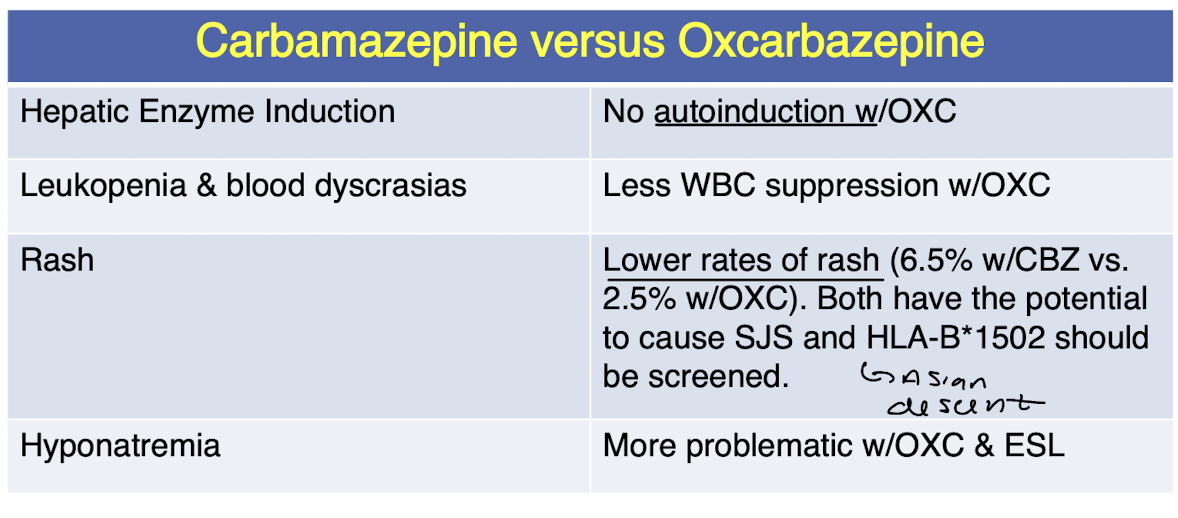
Carbamazepine vs. Oxcarbazepine
NARROW SPECTRUM ANTICONVUSLANTS FOR FOCAL onset SEIZURE TX…
Not used as monotherapy for generalized seizures…
Gabapentin
Lacosamide
Pregabalin
Tiagabine
Pregabalin vs Gabapentin…
Pregab does not have increased dose resistance like gabapentin does…

NICHE NOVEL ANTICONVUSLANTS
Ethosuximide-absence seizures
Felbamate; broad spectrum agent of last resort
Ethosuximide (Zarontin)
Blocks Ca++ channels
Indicated for absence seizures ONLY
ADRS:
Lupus like reaction
Aplastic anemia
Hepatotoxicity
Felbamate (Felbatol)
→ last line for refractory seizures
NMDA modulation
ADR: life threatening blood dyscrasia, hepatotoxicity
Management of Status Epilepticus
0 - 5 minutes - stabilization phase
5 - 20 minutes - initial therapy
Parenteral benzodiazepine is initial choice
IM Midazolam
IV Lorazepam
IV Diazepam
20 - 40 minutes - second therapy phase (IF persisting)
IV fosphenytoin
IV valporic acid
IV levetiracetam
40 - 60 minutes - third therapy, no clear evidence
Pentobarbital, propofol (anesthetic agents)
Benzodiazepine Seizure Use:
Status epilepticus
Lorazepam/Diazepam/Midazolam
Refractory seizures
Clobazam (Onfi)
Myoclonic seizures
Conazepam (Klonopin)
Phenobarbital and Primidone
prolonged GABA Cl- channel openings
→ pheno still used in neonatal seizures
→ primidone is pro-drug of phenobarb
Barbituates…
CYP450 Inducer
HEAVY CNS ADEs