EngMaths - Week 1 - Complex Numbers
 Call Kai
 Learn
Learn Practice Test
 Spaced Repetition
 Match
Match Flashcards
 Knowt Play
1/19

There's no tags or description
Looks like no tags are added yet.
Name | Mastery | Learn | Test | Matching | Spaced | Call with Kai | Chat |
|---|
No analytics yet
Send a link to your students to track their progress
20 Terms
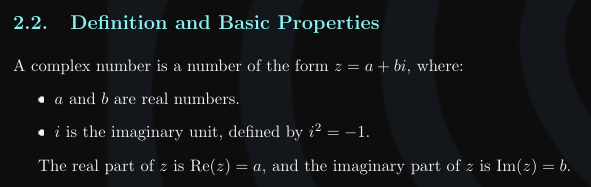
Describe what is meant by a complex number
z = a + bi
a and b are real
i is imaginary, i² = -1
Re(z) = a
Im(z) = b
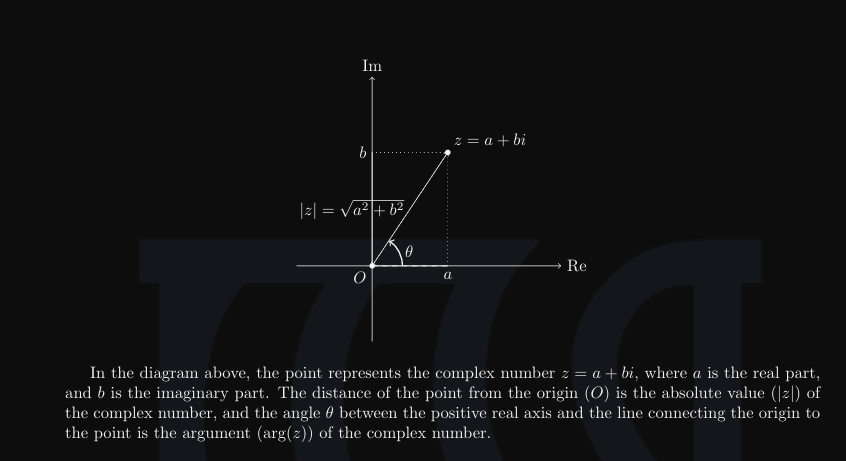
Describe how an imaginary number is described graphically
Im is the y-axis
Re is the x-axis
z is the modulus
|z| = sqrt (a² + b²)
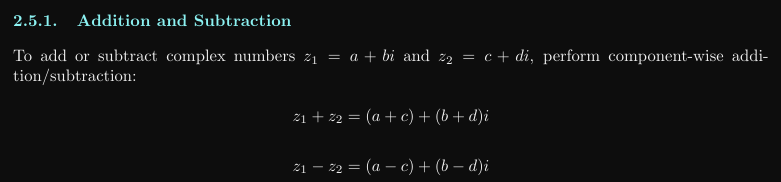
Describe the addition and subtraction of complex numbers z1 (a + bi) and z2 (c + di)
z1 + z2 = (a + c ) + (b + d)i
z1 - z2 = (a - c ) + (b - d)i
Describe the multiplication of complex numbers z1 (a + bi) and z2 (c + di)
z1 · z2 = (a + bi) + (c + di)
(a · c) + (a · di) + (bi · c) + (b · d · i²) [i² = -1]
(a · c) + (- b · d) + (a · d + b ·c)i
(ac−bd) + (ad+bc)i
![<ul><li><p>z1 · z2 = (a + bi) + (c + di)</p><ul><li><p>(a · c) + (a · di) + (bi · c) + (b · d · i²) [i² = -1]</p></li><li><p>(a · c) + (- b · d) + (a · d + b ·c)i</p></li><li><p>(ac−bd) + (ad+bc)i</p></li></ul></li></ul><p></p>](https://assets.knowt.com/user-attachments/1880957e-4936-4f4f-be49-98ae8621f81f.png)
Describe the division of complex numbers z1 (a + bi) and z2 (c + di)
1 / z2 = 1 / (c + di) x [ (c - di) / (c - di) ]
c / (c² + d²) - d / (c² + d²)i
z1 / z2
z1 · 1 / z2 = z1 · ( c / (c² + d²) - d / (c² + d²)i
(a + bi) · ( c / (c² + d²) - d / (c² + d²)i
( ac / (c² + d²) + bd / (c² + d²) + ( ac / (c² + d²) - bd / (c² + d²)i
z1 / z2 = [ ac + bd / (c² + d²) ] + [ ac - bd / (c² + d²)i ]
![<ul><li><p>1 / z2 = 1 / (c + di) x [ (c - di) / (c - di) ]</p><ul><li><p>c / (c² + d²) - d / (c² + d²)i</p></li></ul></li><li><p>z1 / z2</p><ul><li><p>z1 · 1 / z2 = z1 · ( c / (c² + d²) - d / (c² + d²)i</p></li><li><p>(a + bi) · ( c / (c² + d²) - d / (c² + d²)i</p></li><li><p>( ac / (c² + d²) + bd / (c² + d²) + ( ac / (c² + d²) - bd / (c² + d²)i</p></li></ul></li><li><p>z1 / z2 = [ ac + bd / (c² + d²) ] + [ ac - bd / (c² + d²)i ]</p></li></ul><p></p>](https://assets.knowt.com/user-attachments/b3d8fb8a-b3d4-4743-b7db-0a079c6ca980.png)
State what is meant by the conjugate of z (a + bi)
bar z = a - bi

state what bar bar z is
bar bar z = z

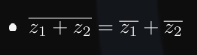
state what bar (z1 + z2) is
bar (z1 + z2 ) = bar z1 + bar z2
state what bar (z1 · z2) is
bar (z1 · z2) = bar z1 · bar z2
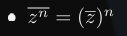
state what bar (z^n) is
bar (z^n) = (bar z) ^ n

state what z + bar z is
a + bi + a - bi = 2a

state what z - bar z is
z - bar z
a + bi - a + bi = 2bi

state what z · bar z is
z · bar z = (a + bi) · (a - bi) = a² + b²

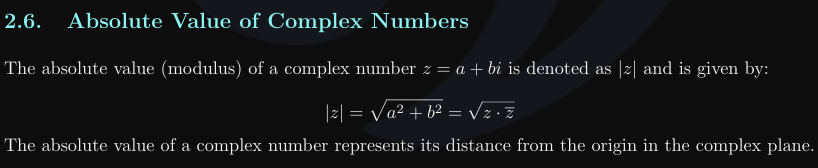
State what is meant by the absolute value of a complex number
modulus of a complex number
distance from the origin to that complex number
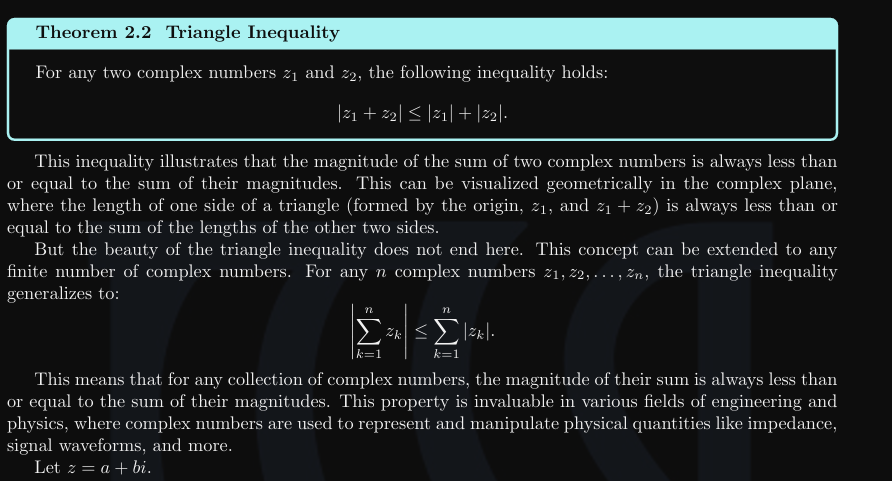
Describe what is meant by the triangle inequality
the magnitude of the sum of two complex numbers is always less than or equal to the sum of the magnitudes of the complex numbers
can be used for any number of complex numbers
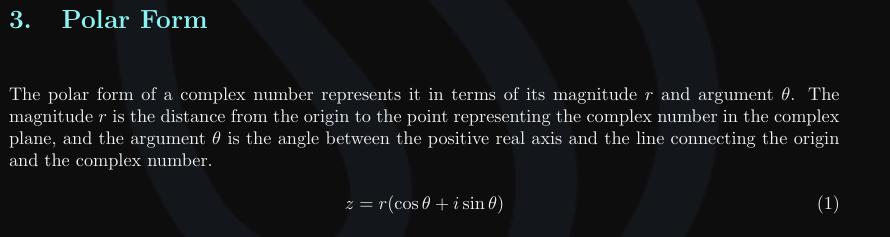
Describe what is meant by the polar form of a complex number
z = r(cos x + isin x )
x is the angle of z to the real axis
r is the magnitude of z
Describe how to convert a complex number into its polar form
r = |z| = sqrt ( a² + b² )
theta = arctan ( b / a )
a = rcos theta
b = rsin theta
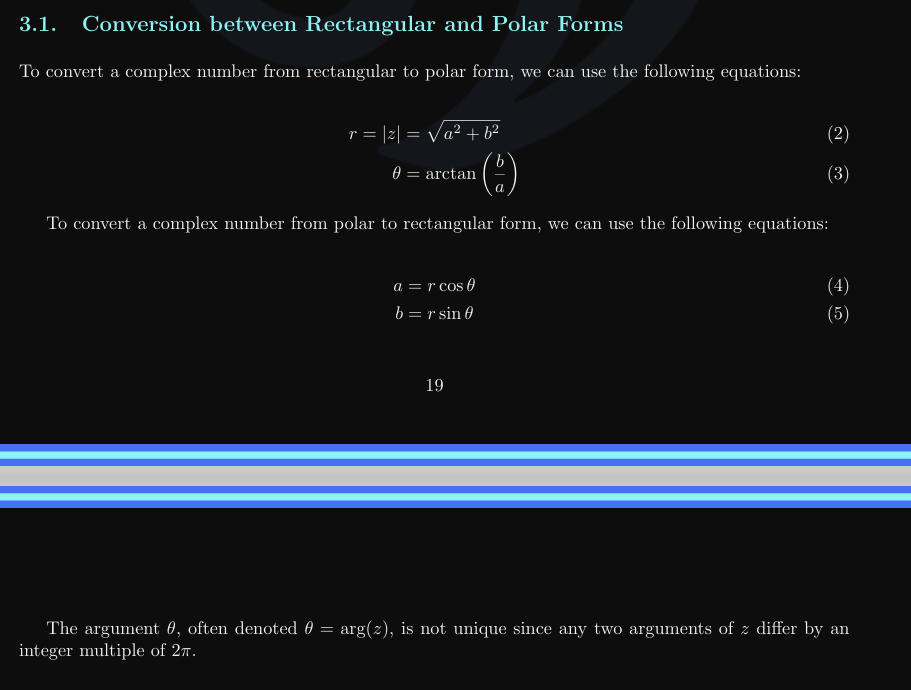
Describe how to calculate the principal argument
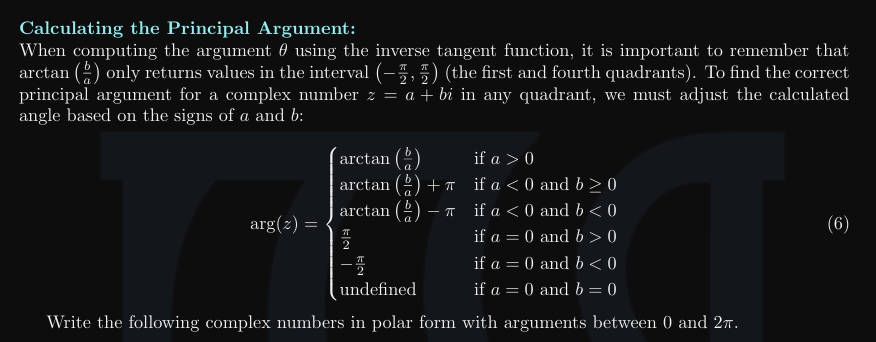
Describe multiplication and division in polar form
z1 * z2
arg(z1 * z2) = arg(z1) + arg(z2)
|z1 * z2| = r1r2
z1 / z2
arg ( z1 / z2) = arg(z1) - arg(z2)
|z1 / z2| = r1 / r2
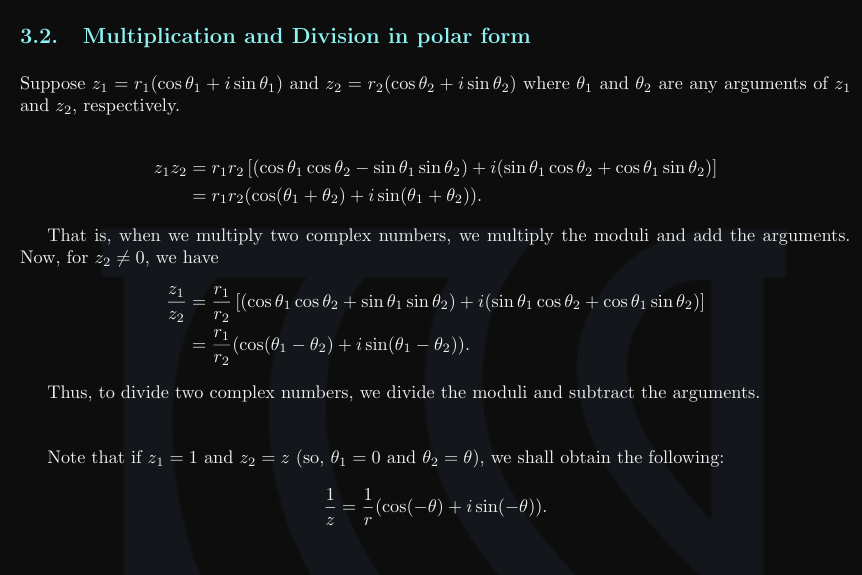
Describe de Moivre’s formula
z = r( cos x+ isin x )
z^n = [r(cos x + isin x) ]^n
r^n (cos ( nx) + isin (nx) )
|z|^n = |z^n|
arg(z^n) = n arg (z)
![<ul><li><p>z = r( cos x+ isin x )</p></li><li><p>z^n = [r(cos x + isin x) ]^n</p><ul><li><p>r^n (cos ( nx) + isin (nx) )</p></li></ul></li><li><p>|z|^n = |z^n|</p></li><li><p>arg(z^n) = n arg (z)</p></li></ul><p></p>](https://assets.knowt.com/user-attachments/84480b42-c6bd-444b-8ebe-4c553d659418.png)