Neurons, neurotransmitters and synaptic transmission
 Call Kai
 Learn
Learn Practice Test
 Spaced Repetition
 Match
Match Flashcards
 Knowt Play
1/24

There's no tags or description
Looks like no tags are added yet.
Name | Mastery | Learn | Test | Matching | Spaced | Call with Kai | Chat |
|---|
No analytics yet
Send a link to your students to track their progress
25 Terms
the nervous system has two main components
The peripheral nervous system is a communication system, carrying inputs (eg messages from your senses) and outputs (eg messages to tell your muscles to move). Your central nervous system is the data processing system: it processes all the inputs and works out what your responses are going to be, then sends the output message.
Neuron
A specialised cell which carries signals in the nervous system
Neurotransmitter
A chemical which transmits a signal from one neuron to the next
Synapse
The gap between two neurons
STRUCTURE OF A NEURON
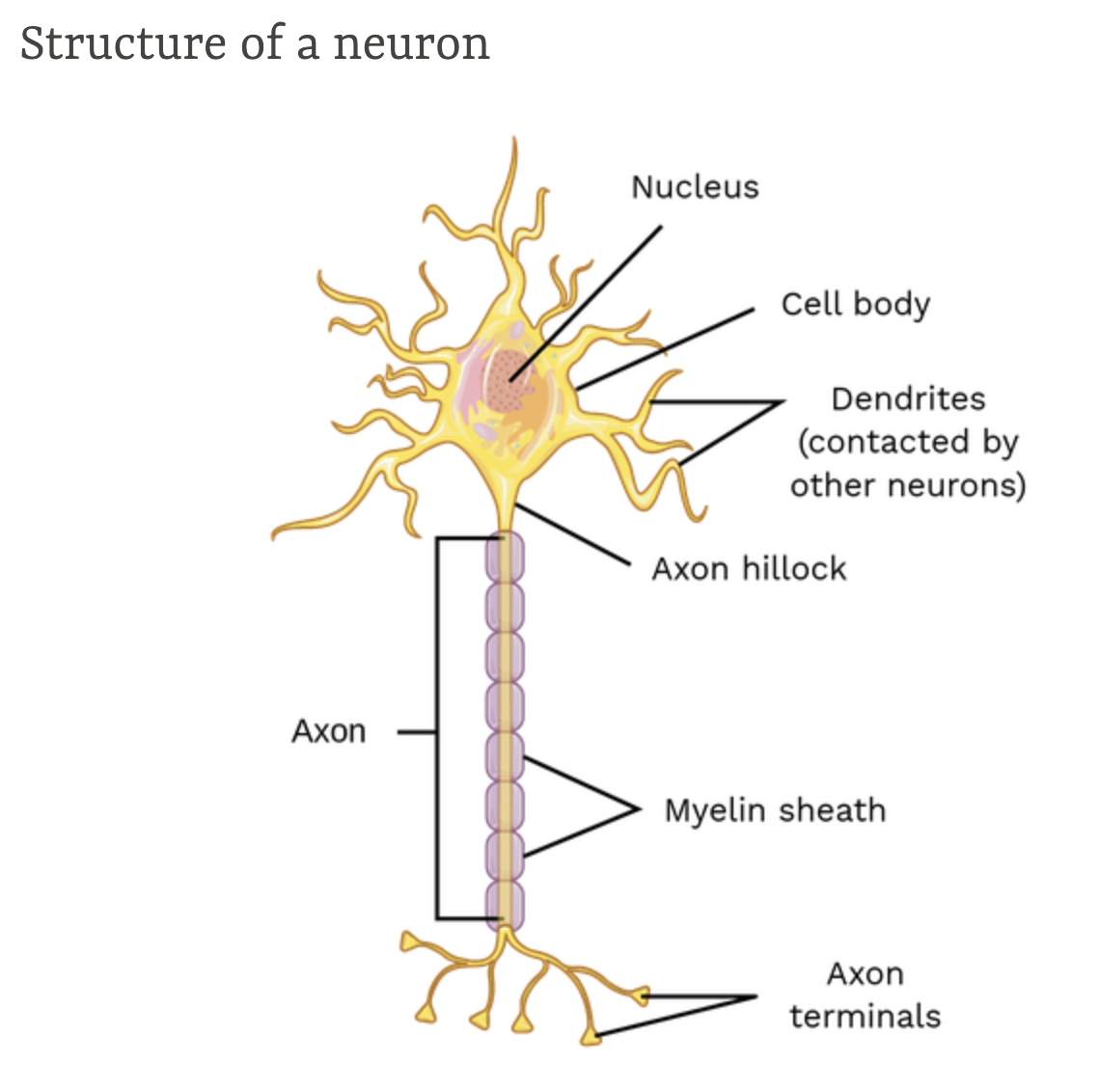
How neurons work:
From top to bottom: the dendrites at the top would all have synaptic connections from lots of other neurons. An electrical impulse would be sent along the axon, top to bottom, to the axon terminals. The axon terminals would all have synaptic connections with dendrites of other neurons. Thus neural pathways are formed. The last neuron in the pathway connects to a muscle or gland and the message is actioned.
Cell body
This is the part of the cell that contains the nucleus with its genetic information.
Axon
An axon is a long, tail-like structure which joins the cell body at a specialized junction called the axon hillock. Many axons are insulated with a fatty substance called myelin. Neurons generally have one main axon.
Dendrites
Dendrites branch out from the cell body. Like antennae, dendrites receive and process signals from the axons of other neurons. Neurons can have more than one set of dendrites, known as dendritic trees. How many they have generally depends on their role.
Myelin sheath
Myelin is a fatty substance that acts an electrical insulator. This electrical insulation also speeds up the transmission of the electrical signal.
Nodes of Ranvier
Periodic gaps in the insulating sheath (myelin) on the axon of certain neurons that serves to facilitate the rapid conduction of nerve impulses.
Terminal buttons / axon terminals / presynaptic knobs / presynaptic regions
the small bulbous ends of an axon. When an electrical signal arrives, they release chemicals called neurotransmitters.
Sensory neuron
These neurons provide ‘input’ from the rest of your body to your central nervous system – information from your senses (eyes, ears, pressure, temperature, balance, etc) about your external and internal environments.
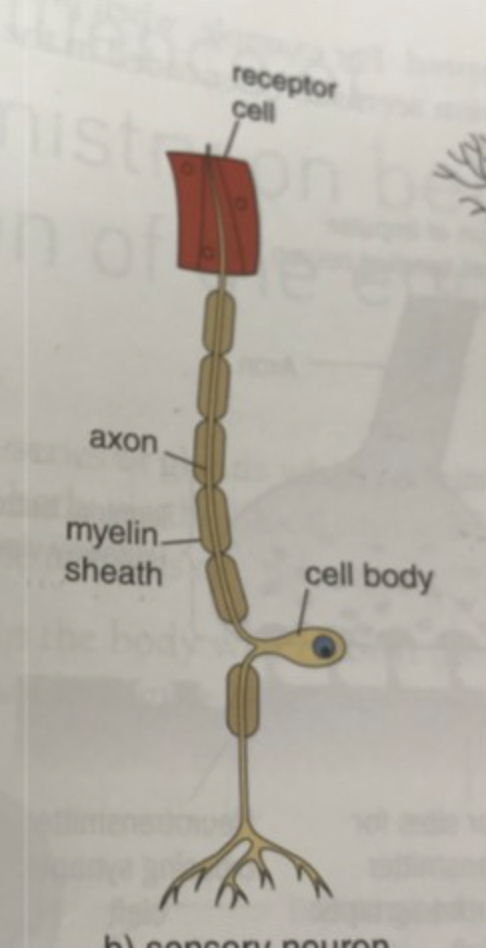
sensory neurone structure
It doesn’t have dendrites – instead, it has some kind of sensory receptor, for example pressure receptors in the skin - this is where all the sensory information is collected and sent to the CNS.
Its cell body is off to one side, out of the way, so that the electrical impulse can be conducted as fast as possible straight to the CNS.
Motor neuron
This neuron has its cell body in the CNS, and its axon projects outside the CNS. The message will go to a voluntary muscle, an involuntary muscle, or a gland. These are called effector organs. This is how the CNS controls the rest of your body. For example, motor neurons make your muscles contract and relax, so that you can move.
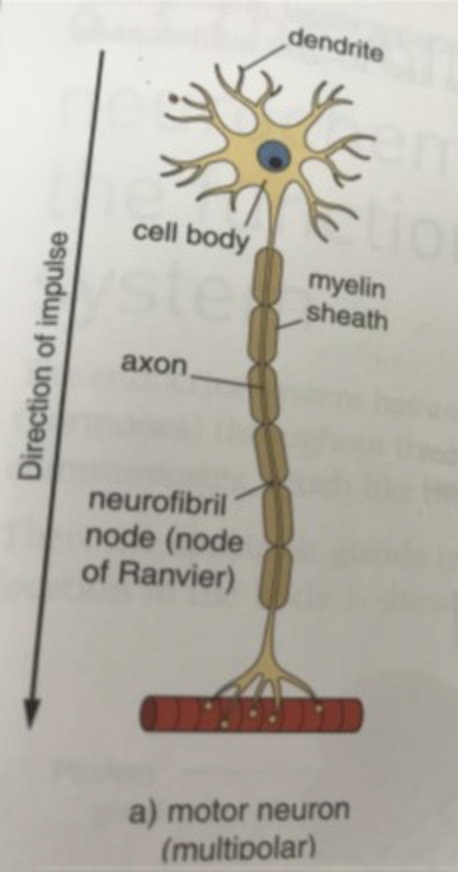
Motor neuron structure
The terminal buttons of the motor neuron are closely connected to something – this is because its role is to change the activity of a muscle or gland.
To do this it needs to communicate directly with that muscle or gland.
Relay neuron
These carry messages from one part of the CNS to another. They do not project outside the CNS – ie they are found only in the spinal cord and the brain.
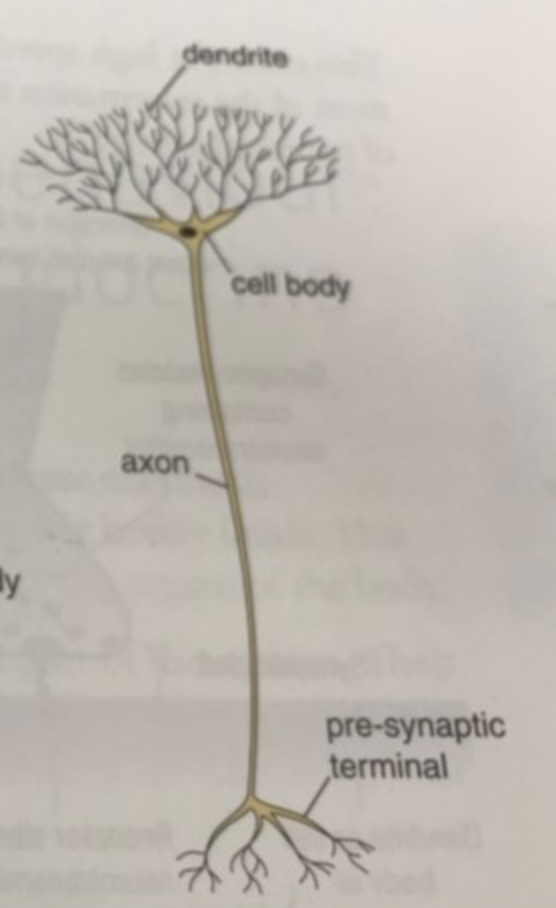
Relay neuron structure
Very different from the other two neurons
It has complex branches at each end. This allows for complex interconnections and neural pathways within the CNS.
It does not have any myelin or nodes of Ranvier. Remember – myelin’s function is to increase the speed of electrical impulses. Relay neurons don’t need myelin because they are short cells, so their signals will only need to be carried a short distance within the CNS, therefore they don’t need myelination to speed up their signals.
Synaptic transmission
Because of synapses, the transmission of neural signals can be controlled. In addition, new synaptic connections can form.
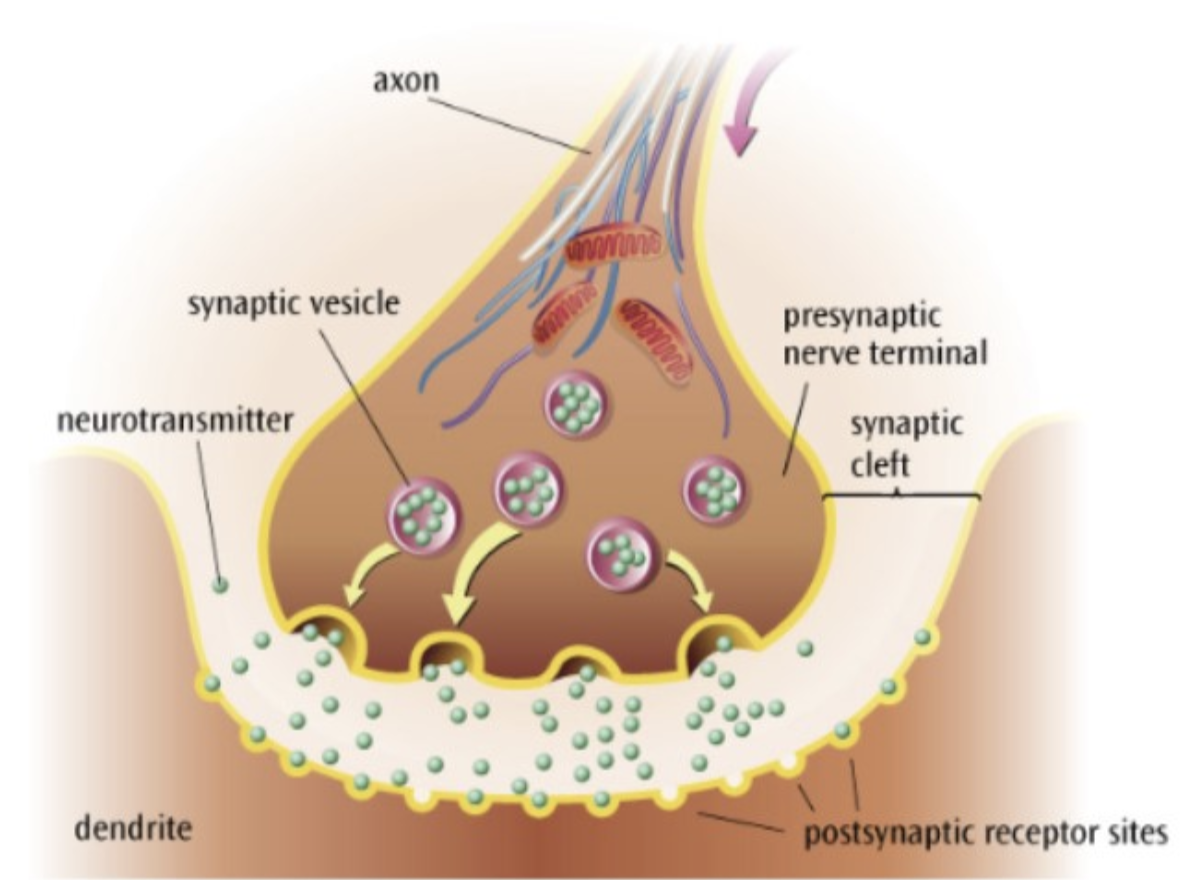
An electrical signal arrives at the end of the presynaptic neuron. This causes the presynaptic neurone to release its neurotransmitters. Neurotransmitters diffuse across the cleft. When they get to the postsynaptic neurone they will bind there. The postsynaptic neuron will thus have received the signal. It may or may not generate a new electrical impulse.
Exam question: Outline the structures and processes involved in synaptic transmission. (6)
Information is carried by neurons as electrical impulses (sometimes called action potentials). These electrical impulses travel the length of the neuron, all the way along its axon to its branching ends, which are called axon terminals.
In a functional nervous system, information needs to pass between neurones, but each neurone does not physically touch the next – there is a gap between neurons called a synapse.
Synaptic transmission is how neurons communicate.
The presynaptic neuron contains vesicles (sacs) full of chemical neurotransmitters, next to the presynaptic membrane. These are just stored and do not do anything until an electrical impulse reaches the axon terminal.
Then, the neurotransmitters are released into the synaptic cleft. The neurotransmitters diffuse across the synapse and bind to receptors on the postsynaptic membrane.
This changes the postsynaptic membrane in some way – either by exciting it (eg dopamine), to encourage it to generate a new action potential, or by inhibiting it (eg serotonin), to make it less likely to generate a new impulse.
Synaptic transmission diagram
Excitation and inhibition
To make a working nervous system, only two forces are necessary: excitation and inhibition.
Excitatory signaling from one cell to the next makes the latter cell more likely to fire. Inhibitory signalling makes the latter cell less likely to fire.
Why do we need two forces? Well, sometimes the CNS needs to create a response, and sometimes it needs to suppress a response.
How are excitation and inhibition involved in synaptic transmission:
A postsynaptic neuron has lots of dendrites: it has synaptic connections from lots of different presynaptic neurons
Every synapse releases one type of neurotransmitter only – either excitatory or inhibitory.
If the synapse’s neurotransmitter is excitatory, then the post synaptic neuron is more likely to fire an impulse.
If the neurotransmitter is inhibitory then the post synaptic neuron is less likely to fire an impulse.
The excitatory and inhibitory influences are summed. Consider this situation: a neuron has nine other neurons converging on it. They won’t all be active at once. But, say seven of those synapses are active: if five of the seven are excitatory and two of them are inhibitory, the postsynaptic neuron will generate a new electrical impulse, and send an impulse further along the pathway. If, on the other hand there are six synapses active and four of those are inhibitory – the postsynaptic neuron will not fire.
The postsynaptic neuron will only generate an impulse if excitation > inhibition.
Vocab/phrasing: Whether the postsynaptic neuron generates a new impulse is determined by the summation of inhibitory and excitatory signals it is receiving – if overall it is excitatory then an electrical impulse will be generated.
Why is it crucial to have a balance between excitation and inhibition
The balance between neural excitation and neural inhibition is crucial to healthy cognition and behaviour. A brain dominated by excitation would only be capable of exciting itself in repeated bursts of activity, similar to an epileptic seizure. A brain dominated by inhibition would only be capable of quiet whispers of activity, with little synchronization necessary for meaningful communication between brain areas.
Example
A simplistic example to illustrate: coughing. You only cough if signals are sent along motor neurons from the CNS to the chest muscles. You may have a few excitatory messages from your airways – there is a tickle, you need to cough. You may also have inhibitory messages from higher areas of the brain – don’t cough, people will think you have covid, or don’t cough because you’re in an exam, or don’t cough because last time you made a weird noise, or don’t cough get a drink instead. If inhibition messages (don’t cough) outweigh excitation messages (do cough), you will suppress the response and motor neurones will not send a ‘cough’ output to the chest muscles. However if your airways get more and more irritated there will be lots more excitatory messages. Once excitation outweighs inhibition, you will cough.