ACIS 2116 exam 1
 Call Kai
 Learn
Learn Practice Test
 Spaced Repetition
 Match
Match Flashcards
 Knowt Play
1/108

There's no tags or description
Looks like no tags are added yet.
Name | Mastery | Learn | Test | Matching | Spaced | Call with Kai | Chat |
|---|
No analytics yet
Send a link to your students to track their progress
109 Terms
which of the following statements is false?
manufacturing costs include direct materials, direct labor, and MOH
indirect labor is included in MOH
Raw materials include direct materials and exclude indirect materials
direct labor can be easily traced to indvidiual units of product
raw materials include direct materials and exclude indirect materials
cost classifications used for preparing financial statements include
variable cost and fixed cost
direct cost and indirect cost
product cost and period cost
relevant cost and irrleveant cost
product cost and period cost
cost classifcations used for decision making include
variable cost and fixed cost
direct cost and indirect cost
product cost and period cost
relevenat and irrelevant cost
relevant and irrelevant cost
Which of the following statements is true with respect to a contribution format income statement?
it subtracts varaibale expenses from sales to deribe a contribution margin
which of the following statments is true with respect to the cost of goods sold equation
cost of goods sold= behinning merchandise inventory+ purchases- ending merchandise inventory
Which of the following statments is false?
conversion costs include MOH
prime costs include direct labor
conversion costs include direct labor
prime costs include MOH
prime costs include MOH
Which of the following statements is true?
Product costs and variable costs are synonyms.
Product costs are excluded from the calculation of gross margin.
Product costs are included in inventory as reported on the balance sheet.
Product costs include sales commissions and advertising.
product costs are included in inventory as reported on the balance sheet
If sales are $100,000, fixed expenses are $30,000, and variable expenses are $50,000, then the contribution margin must be:
50,000
If sales are $100,000, fixed expenses are $30,000, and the contribution margin is $40,000, then the net operating income must be:
10,000
If the conversion costs are $70,000, direct labor costs are $20,000, and direct material costs are $40,000, then the manufacturing overhead must be:
50,000
Assume that a company purchased a piece of equipment five years ago for $250,000. Now the company is deciding whether to replace this piece of equipment with a newer model. In this "keep or replace" decision, the purchase price of the old piece of equipment is an example of a:
sunk cost
Assume the following information for a merchandising company:
Sales | $ 500,000 |
|---|---|
Variable selling expenses | $ 25,000 |
Cost of goods sold | $ 350,000 |
Fixed administrative expenses | $ 50,000 |
Fixed selling expenses | $ 40,000 |
Variable administrative expenses | $ 5,000 |
What is the company's gross margin?
150,000 bc sales-cogs
Which of the following statements is false when considering cost behavior within the relevant range?
A variable cost varies, in total, in direct proportion to changes in the level of activity.
The variable cost per unit varies inversely with changes in the level of activity.
A fixed cost remains constant, in total, regardless of changes in the level of activity.
The average fixed cost per unit varies inversely with changes in the level of activity.
the variable cost per unit varies inversley with changed in the level of activity
Which of the following statements is false when considering cost behavior within the relevant range?
The total amount of a variable cost will change as the level of activity changes.
A variable cost is constant if expressed on a per unit basis.
A fixed cost varies, in total, in direct proportion to changes in the level of activity.
The average fixed cost per unit varies inversely with changes in the level of activity.
3. A fixed cost varies, in total, in direct proportion to changes in the level of activity.
Assume the following information for a merchandising company:
Number of units sold | 20,000 |
|---|---|
Selling price per unit | $ 30 |
Variable selling expense per unit | $ 3 |
Variable administrative expense per unit | $ 2 |
Fixed selling expenses | $ 30,000 |
Fixed administrative expenses | $ 50,000 |
Beginning merchandise inventory | $ 24,000 |
Ending merchandise inventory | $ 19,000 |
Merchandise purchases | $ 340,000 |
What is the net operating income?
75,000 bc
sales: 20,000 X 30= 600,000
COGS: 24,000+340000-19000= 345,000
variable expense: 20,000 x (3 +2) = 100,000
fixed expenses: 30,000 + 50,000= 80,000
so net opp: 600,000-345000-100000-80000=75000
A company's relevant range of production is 10,000 to 15,000 units. When it produces and sells 12,000 units, its unit costs are as follows:
| Amount per Unit |
|---|---|
Direct materials | $ 7.00 |
Direct labor | $ 4.00 |
Variable manufacturing overhead | $ 1.50 |
Fixed manufacturing overhead | $ 5.00 |
Fixed selling expense | $ 3.50 |
Fixed administrative expense | $ 2.00 |
Sales commissions | $ 1.00 |
Variable administrative expense | $ 0.50 |
If 11,000 units are produced, what is the total amount of indirect manufacturing costs incurred to support this level of production?
76500 because indirect= variable MOH + fixed MOH
variable= 11000 X 1.50= 16500
Fixed= 12000 X $5= 60000
16500 +60000=76500
A company's relevant range of production is 10,000 to 15,000 units. When it produces and sells 12,000 units, its unit costs are as follows:
| Amount per Unit |
|---|---|
Direct materials | $ 7.00 |
Direct labor | $ 4.00 |
Variable manufacturing overhead | $ 1.50 |
Fixed manufacturing overhead | $ 5.00 |
Fixed selling expense | $ 3.50 |
Fixed administrative expense | $ 2.00 |
Sales commissions | $ 1.00 |
Variable administrative expense | $ 0.50 |
What is the incremental cost incurred if the company increases production from 12,000 to 12,001 units?
$14 because 7+4+1.50=12.50
Assume the following information:
Direct materials |
| $ 70,000 |
|---|---|---|
Direct labor |
| $ 48,000 |
Variable manufacturing overhead | $ 13,000 |
|
Fixed manufacturing overhead | 25,000 |
|
Total manufacturing overhead |
| $ 38,000 |
Variable selling expense | $ 15,000 |
|
Fixed selling expense | 20,000 |
|
Total selling expense |
| $ 35,000 |
Variable administrative expense | $ 8,000 |
|
Fixed administrative expense | 12,000 |
|
Total administrative expense |
| $ 20,000 |
What is the total variable manufacturing cost?
131,000 bc 70,000+48,000+13,000
Assume that a manufacturing company incurred the following costs:
Direct labor | $ 90,000 |
|---|---|
Advertising | $ 40,000 |
Factory supervision | $ 35,000 |
Sales commissions | $ 15,000 |
Depreciation, office equipment | $ 4,000 |
Indirect materials | $ 5,000 |
Depreciation, factory building | $ 20,000 |
Administrative office salaries | $ 1,000 |
Utilities, factory equipment | $ 2,500 |
Direct materials | $ 105,000 |
Insurance, factory | $ 6,000 |
Property taxes, factory | $ 7,000 |
What is the total variable cost pertaining to the units produced and sold?
217,500 because 90,000+105,000+5,000+2,500+15,000
Assume that a manufacturing company incurred the following costs:
Direct labor | $ 90,000 |
|---|---|
Advertising | $ 40,000 |
Factory supervision | $ 35,000 |
Sales commissions | $ 15,000 |
Depreciation, office equipment | $ 4,000 |
Indirect materials | $ 5,000 |
Depreciation, factory building | $ 20,000 |
Administrative office salaries | $ 1,000 |
Utilities, factory | $ 2,500 |
Direct materials | $ 105,000 |
Insurance, factory | $ 6,000 |
Property taxes, factory | $ 7,000 |
If the information above pertains to 1,000 units of production, what is its average manufacturing cost per unit?
270.50 per unit bc 90,000+35,000+5,000+20,000+2,500+105,000+6,000+7,000= 270500
then 270500/1000 units
Which of the following statements is false regarding job-order costing?
It is used in situations where many different products, each with unique features, are produced each period.
It is used for manufacturing companies, but not service companies.
It accumulates each job’s costs on a job cost sheet.
It can be used to calculate a job’s unit product cost.
it is used for manufacturing companies, but not service companies
Which of the following statements is true regarding job-order costing?
It is used in situations where many different products, each with unique features, are produced each period.
It is used for manufacturing companies, but not service companies.
It relies on a predetermined overhead rate to apply direct material cost to units of product.
It relies on a predetermined overhead rate to apply direct labor cost to units of product.
it is used in situations where many different products, each with unique features, are produced each period.
Which of the following statements is true regarding absorption costing?
It assigns all manufacturing costs, both fixed and variable, to units of product.
A predetermined overhead rate includes:
estimated total manufacturing overhead cost in the numerator.
Which of the following statements is true regarding the formula used in normal costing for applying overhead cost to a specific job?
The predetermined overhead rate is multiplied by the actual amount of the allocation base used by the job.
Which of the following statements is true regarding the formula Y = a + bx?
Y = The estimated total manufacturing overhead cost.
A job-order costing system that relies on normal costing will:
Assign actual direct materials and direct labor costs to jobs.
A unit product cost includes:
actual direct labor cost used by the job
Assume the following:
Estimated fixed manufacturing overhead for the coming period of $200,000
Estimated variable manufacturing overhead of $2.00 per direct labor hour
Estimated direct labor-hours to be worked in the coming period of 55,000 hours.
The predetermined plantwide overhead rate for the period is closest to:
$5.64 because (200000/55000)+2
Assume the following:
Estimated fixed manufacturing overhead for the coming period of $200,000
Estimated variable manufacturing overhead of $2.00 per direct labor hour
Actual manufacturing overhead for the period of $320,000
Actual direct labor-hours worked of 54,000 hours
Estimated direct labor-hours to be worked in the coming period of 55,000 hours.
The amount of overhead applied to production during the period is closest to:
304,560 because 5.64 (from previous question) X 54000
Assume the following:
Actual machine-hours worked during the period of 54,000 hours
Estimated machine-hours to be worked during the coming period of 55,000 hours
Manufacturing overhead applied to production during the period of $432,000
Estimated fixed manufacturing overhead of $330,000.
The estimated variable manufacturing overhead cost per machine-hour is closest to:
2.00 because
applied OH= 432000/ 54000=8
fixed OH= 330000/55000=6
varaible OH= 8-6=2
Assume the following:
Actual machine-hours worked during the period of 54,000 hours
Manufacturing overhead applied to production during the period of $432,000
Estimated fixed manufacturing overhead of $330,000
Estimated variable manufacturing overhead cost per machine-hour of $2.00.
The estimated amount of the allocation base (machine-hours) is closest to:
55,000 because 330000/6 (from previous question) =55,000
Assume the following:
Actual machine-hours worked during the period of 54,000 hours
Estimated machine-hours to be worked during the coming period of 55,000 hours
Manufacturing overhead applied to production during the period of $432,000
Estimated fixed manufacturing overhead of $330,000.
The estimated total variable manufacturing overhead cost is closest to:
110,000 bc variable MOH= 2 (from previous question) so 2(55,000)
Assume the following:
A company’s plantwide predetermined overhead rate is $13.00 per direct labor-hour
Its job cost sheet for Job X shows that this job incurred direct materials and direct labor charges of $500 and $360, respectively.
If Job X’s total job cost is $1,094, how many direct labor-hours were worked on this job?
18 bc
1094-500-360=234
234/13=18
Assume that a company pays a 5% sales commission. Also, assume the job cost sheet for Job X:
It used 18 direct labor-hours and incurred direct materials and direct labor charges of $500 and $360
Its unit product cost is $27.35.
If Job X contained 40 units, then what is the plantwide predetermined overhead rate per direct labor-hour?
13 bc
40 X 27.35= 1094 total job cost
1095-500DM-360DL=234 overhead
234/18= 13 per direct labor hour
Assume that a company pays a 5% sales commission. Also, assume the job cost sheet for Job X:
It used 18 direct labor-hours and incurred direct materials and direct labor charges of $500 and $360
Its total job cost is $1,094.
What is the plantwide predetermined overhead rate per direct labor-hour?
13
At the beginning of the year, a company estimated that 20,000 direct labor-hours would be required for the period’s estimated level of production. The company also estimated $140,000 of fixed manufacturing overhead cost for the coming period and variable manufacturing overhead of $1.50 per direct labor-hour. The company incurred actual manufacturing overhead costs of $180,000 and it actually worked 20,000 direct labor-hours during the period.
Assume that Job X used 16 direct labor-hours. How much manufacturing overhead would be applied to Job X?
$136 bc
140,000/20,000= $7 fixed overhead per hour
$7+1.50 varaible OH= 8.50 DLH
8.50X16=136
At the beginning of the year, a company estimated that 20,000 direct labor-hours would be required for the period’s estimated level of production. The company also estimated $140,000 of fixed manufacturing overhead cost for the coming period and variable manufacturing overhead of $1.50 per direct labor-hour.
Assume that Job X used $200 in direct materials, $288 of direct labor, and 16 direct labor-hours. What is the total job cost for Job X?
624 bc
overhead applied= 16 X 8.50 (previous question)=136
total job cost= 200DM + 288 DL +136OH = 624
At the beginning of the year, a company estimated a predetermined plantwide overhead rate of $8.50 per machine-hour. Job X used 16 machine-hours and it was charged $200 and $288 for direct materials and direct labor, respectively. What is the total job cost for Job X?
$624 (goes with previous question)
Assume a company had no jobs in progress at the beginning of July and no beginning inventories. It started and completed only two jobs during July—Job Y and Job Z. The company uses a plantwide predetermined overhead rate based on direct labor-hours. The following additional information from the month of July is available for the company as a whole and for Jobs Y and Z:
Estimated total fixed manufacturing overhead | $ 13,000 |
|---|---|
Estimated variable manufacturing overhead per direct labor-hour | $ 1.00 |
Estimated total direct labor hours to be worked | 2,000 |
Total actual manufacturing overhead costs incurred | $ 12,800 |
| Job Y | Job Z |
|---|---|---|
Direct materials | $ 13,000 | $ 8,000 |
Direct labor cost | $ 21,000 | $ 7,500 |
Actual direct labor hours worked | 1,400 | 500 |
How much manufacturing overhead was applied to Job Y?
10500 bc
13,000/2000=6.50 fixed OH/hour
6.50+1.00= variable OH= 7.50 per DLH
Job y: 1400 hours X 7.50= 10500
Assume a company had no jobs in progress at the beginning of July and no beginning inventories. It started and completed only two jobs during July—Job Y and Job Z. The company uses a plantwide predetermined overhead rate based on direct labor-hours. The following additional information from the month of July is available for the company as a whole and for Jobs Y and Z:
Estimated total fixed manufacturing overhead | $ 13,000 |
|---|---|
Estimated variable manufacturing overhead per direct labor-hour | $ 1.00 |
Estimated total direct labor hours to be worked | 2,000 |
Total actual manufacturing overhead costs incurred | $ 12,800 |
| Job Y | Job Z |
|---|---|---|
Direct materials | $ 13,000 | $ 8,000 |
Direct labor cost | $ 21,000 | $ 7,500 |
Actual direct labor hours worked | 1,400 | 500 |
What is the total job cost for Job Z?
19250 bv
Job Z overhead= 500 X 7.50= 3750
total job cost= 8,000+7500+3750=19,250
ssume a company started and completed numerous jobs during July—one of which was Job Z. The company uses two departmental predetermined overhead rates. The rate in the Machining Department is based on machine-hours and the rate in the Assembly Department is based on direct labor-hours. The following additional information from the month of July is available for the company as a whole and for Jobs Z:
| Machining | Assembly |
|---|---|---|
Estimated total fixed manufacturing overhead | $ 48,000 | $ 30,000 |
Estimated variable manufacturing overhead per machine-hour | $ 1.50 |
|
Estimated variable manufacturing overhead per direct labor-hour |
| $ 2.00 |
Estimated total machine-hours to be used | 12,000 |
|
Estimated total direct labor hours to be worked |
| 10,000 |
Job Z | Machining | Assembly |
|---|---|---|
Direct materials | $ 650 | $ 700 |
Direct labor | $ 200 | $ 900 |
Machine-hours | 40 |
|
Direct labor-hours |
| 60 |
What is the total job cost for Job Z?
2970
Machining OH rate = ($48,000 ÷ 12,000) + $1.50 = $5.50/MH
Assembly OH rate = ($30,000 ÷ 10,000) + $2.00 = $5.00/DLH
Applied OH = (40 × $5.50) + (60 × $5) = $520
DM = $650 + $700 = $1,350
DL = $200 + $900 = $1,100
Total job cost = $1,350 + $1,100 + $520 = $2,970
Assume a company has two manufacturing departments – Assembly and Fabrication. The company considers all of its manufacturing overhead costs to be fixed costs. The first set of data below is budgeted data for the company as a whole that was estimated at the beginning of the year. The second set of data below is actual data for the company as a whole that was derived at the end of the year. The third set of data relates to one particular job completed during the year– Job Z.
Budgeted Data | Assembly | Fabrication |
|---|---|---|
Manufacturing overhead costs | $ 300,000 | $ 400,000 |
Direct labor hours | 25,000 | 15,000 |
Machine hours | 10,000 | 50,000 |
Actual Data | Assembly | Fabrication |
|---|---|---|
Manufacturing overhead costs | $ 330,000 | $ 380,000 |
Direct labor hours | 27,000 | 16,000 |
Machine hours | 10,500 | 48,000 |
Job Z | Assembly | Fabrication | ||
|---|---|---|---|---|
Direct labor hours | 10 | hours | 2 | hours |
Machine hours | 1 | hour | 7 | hours |
If the company uses a plantwide approach for applying overhead to production with direct labor-hours as the allocation base, how much manufacturing overhead would be applied to Job Z?
210 bc
total budgeted OH: 300,000+400,000=700,000
total budgeted Direct labor hours: 25,000 +15,000= 40,000
700,000/40,000=17.50 per DLH
Job z uses: 10+2=12 DLH
12 X 17.50= 210
Assume a company has two manufacturing departments – Assembly and Fabrication. The company considers all of its manufacturing overhead costs to be fixed costs. The first set of data below is budgeted data for the company as a whole that was estimated at the beginning of the year. The second set of data below is actual data for the company as a whole that was derived at the end of the year. The third set of data relates to one particular job completed during the year– Job Z.
Budgeted Data | Assembly | Fabrication |
|---|---|---|
Manufacturing overhead costs | $ 300,000 | $ 400,000 |
Direct labor hours | 25,000 | 15,000 |
Machine hours | 10,000 | 50,000 |
Actual Data | Assembly | Fabrication |
|---|---|---|
Manufacturing overhead costs | $ 330,000 | $ 380,000 |
Direct labor hours | 27,000 | 16,000 |
Machine hours | 10,500 | 48,000 |
Job Z | Assembly | Fabrication | ||
|---|---|---|---|---|
Direct labor hours | 10 | hours | 2 | hours |
Machine hours | 1 | hour | 7 | hours |
Assume the company uses departmental predetermined overhead rates. It uses direct labor-hours as the allocation base in Assembly and machine-hours as the allocation base in Fabrication. How much manufacturing overhead would be applied from both departments to Job Z?
176
assembly: 300,000/25,000= $12/ direct labor hour
job z: 10 X 12= $120
Fabrication: 400,000/50,000=$8/ machine hours
job z: 7 X $8 = $56
total overhead applied= 120+56=176
Which of the following is not one of the three inventory accounts reported on the balance sheet?
COGS
Which of the following statements is false?
Work in process inventory is included in the balance sheet.
Work in process inventory includes direct materials used in production.
Work in process inventory includes direct labor costs.
Work in process inventory includes actual manufacturing overhead costs assigned to jobs worked on during the period.
Work in process inventory includes actual manufacturing overhead costs assigned to jobs worked on during the period.
The cost of goods manufactured is:
the amount transferred from Work in Process to Finished Goods.
The cost of goods manufactured includes:
applied manufacturing overhead, but not actual manufacturing overhead.
The journal entry to record the purchase of raw materials includes:
a debit to Raw Materials.
The journal entry to record the requisition of direct materials for use in production includes:
a debit to Work in Process.
The journal entry to record indirect labor used in production includes:
a debit to Manufacturing Overhead.
The journal entry to record manufacturing overhead applied to production includes:
a debit to Work in Process
The journal entry to dispose of underapplied or overapplied overhead will never include which of the following accounts?
Raw Materials
Raw materials used in production is calculated using which of the following equations?
Beginning raw materials inventory + Purchases of raw materials − Ending raw materials inventory
The total manufacturing costs to account for within a schedule of cost of goods manufactured is calculated using which of the following equations?
Beginning work in process inventory + Total manufacturing costs added to production
Overapplied or underapplied overhead is computed:
at the end of the period
If a company has overapplied overhead, then the journal entry to dispose of it could possibly include:
a credit to Cost of Goods Sold
The unadjusted cost of goods sold is calculated using which of the following equations?
Beginning finished goods inventory + Cost of goods manufactured − Ending finished goods inventory
Which of the following statements is true for a company that maintains beginning and ending work in process and finished goods inventories?
If the company closes its underapplied overhead entirely to Cost of Goods Sold it will cause net operating income to be lower than the net operating income reported if the company had closed its underapplied overhead proportionally to Work in Process, Finished Goods, and Cost of Goods Sold.
Assume the following information from a schedule of cost of goods manufactured:
Total manufacturing costs to account for | $ 230,000 |
|---|---|
Ending work in process inventory | $ 72,000 |
What is the cost of goods manufactured?
158,000 bv
230000-72000
Assume the following information from a schedule of cost of goods manufactured:
Beginning work in process inventory | $ 30,000 |
|---|---|
Direct materials used in production | $ 50,000 |
Direct labor | $ 60,000 |
Total manufacturing costs to account for | $ 230,000 |
Ending work in process inventory | $ 72,000 |
What is the manufacturing overhead applied to work in process?
90,000 because
230,000-30,000 beginning wip= 200,000 manufacturing costs added
200,000-50,000DM-60,000DL= 90,000 overhead
Assume the following information from a schedule of cost of goods manufactured:
Beginning work in process inventory | $ 30,000 |
|---|---|
Direct materials used in production | $ 50,000 |
Manufacturing overhead applied to work in process | $ 90,000 |
Total manufacturing costs to account for | $ 230,000 |
Ending work in process inventory | $ 72,000 |
What is the direct labor cost?
60,000 bc
230,000-30,000-50,000-90,000= 60,000
ssume the following information from a schedule of cost of goods manufactured:
Cost of goods manufactured | $ 158,000 |
|---|---|
Beginning work in process inventory | $ 30,000 |
Direct materials used in production | $ 50,000 |
Manufacturing overhead applied to work in process | $ 90,000 |
Total manufacturing costs to account for | $ 230,000 |
What is the ending work in process inventory?
72,000 bc
230,000-158,000=72,000
Assume the following information from a schedule of cost of goods manufactured:
Beginning raw materials inventory | $ 7,000 |
|---|---|
Purchases of raw materials | $ 60,000 |
Raw materials used in production | $ 52,000 |
What is the ending raw materials inventory?
15,000 bc
7,000 + 60,000 -52,000 = 15,000
Assume the following information from a schedule of cost of goods manufactured:
Beginning raw materials inventory | $ 7,000 |
|---|---|
Purchases of raw materials | $ 60,000 |
Ending raw materials inventory | $ 15,000 |
What is the raw materials used in production?
52,000 bc
7,000 +60,000 -15,000 =52,000
If the raw materials inventory balance increased by $8,000 during the period and the raw material purchases were $60,000, then what is the raw materials used in production?
52000 bc
60,000 -8,000 =52000
If the work in process inventory balance decreased by $11,000 during the period and the total manufacturing costs added to production are $200,000, then what is the cost of goods manufactured?
211000 bc
200,000+ 11,000 decrease in WIP= 211000
Assume the following:
Sales | $ 240,000 |
|---|---|
Overapplied overhead | $ 7,000 |
Cost of goods manufactured | $ 180,000 |
Beginning finished goods inventory | $ 10,000 |
Ending finished goods inventory | $ 14,000 |
Selling and administrative expenses | $ 33,000 |
What is the net operating income?
38,000 bc
unadjusted cogs = 10,000 +180,000 -14,000 =176,000
overappplied OH (decreases cogs): 176000-7000= 169000
net operating income= 240000-169000-33000=38000
Assume the following:
Net operating income | $ 38,000 |
|---|---|
Overapplied overhead | $ 7,000 |
Cost of goods manufactured | $ 180,000 |
Beginning finished goods inventory | $ 10,000 |
Ending finished goods inventory | $ 14,000 |
Selling and administrative expenses | $ 33,000 |
What is the sales?
240000 bc
adjusted cogs= (10000+18000-14000)-7000=169000
Sales= 38000 NOI +169000 COGS + 33000 s and a
Assume the following from a schedule of cost of goods manufactured:
Purchases of raw materials | $ 38,000 |
|---|---|
Indirect materials used in production | $ 7,000 |
Beginning raw materials inventory | $ 10,000 |
Ending raw materials inventory | $ 14,000 |
Total manufacturing costs added to production | $ 80,000 |
Actual manufacturing overhead costs incurred | $ 34,000 |
Manufacturing overhead applied to production | $ 32,000 |
What is the direct labor cost?
21,000
raw materials= 10,000+38,000-14,000= 34,000
direct materials= 34,000-7,000=27000
80,000-27000DM-32000OH= 21000 dl
Assume the following from a schedule of cost of goods manufactured:
Beginning work in process inventory | $ 10,000 |
|---|---|
Ending work in process inventory | $ 14,000 |
Beginning raw materials inventory | $ 3,000 |
Ending raw materials inventory | $ 6,000 |
Purchases of raw materials | $ 38,000 |
Indirect materials used in production | $ 4,000 |
Direct labor | $ 17,000 |
Manufacturing overhead applied to production | $ 32,000 |
What is the cost of goods manufactured?
76,000
COGM= 10000 + 80000 (total manufacturing costs) -140000
Assume that a company uses direct labor dollars as the allocation base to compute its predetermined plantwide overhead rate of 140%. Also, assume the following information from the company’s schedule of cost of goods manufactured, schedule of cost of goods sold, and its income statement:
Direct labor | $ 65,000 | Actual manufacturing overhead | $ 84,000 |
|---|---|---|---|
Cost of goods manufactured | $ 260,000 | Selling and administrative expense | $ 85,000 |
If the beginning finished goods inventory was $10,000, the ending finished goods inventory was $2,000, and net operating income was $8,000 then what is the sales?
354000
Assume the following:
Estimated total manufacturing overhead cost = $100,000
Estimated total amount of the allocation base = 20,000 direct labor hours
The total direct labor hours actually worked during the period = 21,000
Manufacturing overhead is overapplied by $2,000.
What is the total amount of actual overhead costs incurred during the period?
103,000
POHR= 100,000/20,000=5 per DLH
Applied OH= 21,000 X 5= 105,000
overapplied by 2,000 means applied OH is 2,00 more than actual OH
105000-2000=103000 actual overhead
Assume the following:
Estimated direct labor hours used to calculate the predetermined overhead rate = 20,000
The manufacturing overhead applied to production = $105,000
The total direct labor hours actually worked during the period = 21,000.
What is the estimated total manufacturing overhead cost for the period?
100,000
applied OH rate= 105,000/21,000=$5 per DLH
estimated total MOH= 5 X 20,000= 100,000
Which of the following journal entries properly records the cash payment of $45,000 in direct labor wages and $12,000 of indirect labor wages?
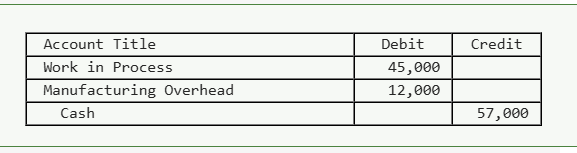
Which of the following journal entries properly records the cost of goods manufactured for the period of $57,000?

Which of the following statements is false regarding the Manufacturing Overhead T-account?
Actual overhead expenses are recorded on the debit side of the account.
Applied overhead is recorded on the credit side of the account.
At the end of each accounting period, its ending balance is reporting on the asset side of the balance sheet.
It accumulates actual variable and fixed overhead expenses.
At the end of each accounting period, its ending balance is reporting on the asset side of the balance sheet.
Which of the following statements is true regarding the accounting for depreciation on office equipment?
The depreciation charge increases the balance in the Accumulated Depreciation account.
If a company recorded the following transaction—closed underapplied overhead to cost of goods sold—then which of the following statements is true?
The Retained Earnings account would decrease.
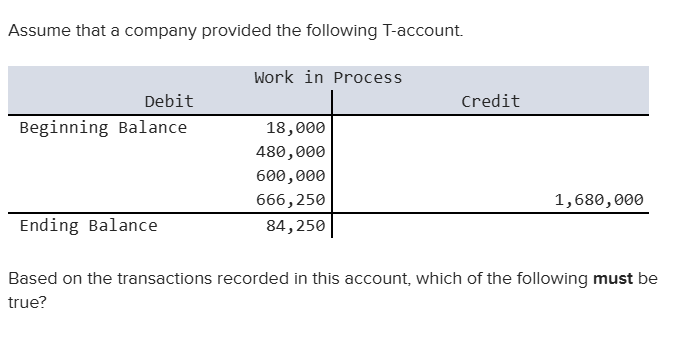
the cost of goods manufactured must be 1,680,000
Assume that a company uses direct labor dollars as the allocation base to compute its predetermined plantwide overhead rate of 130%. Also, assume the following information from the company’s schedule of cost of goods manufactured:
Direct labor | $ 60,000 |
|---|---|
Direct materials used in production | $ 160,000 |
What is the total manufacturing cost added to production?
298,000
applied overhead= 60,000 X 130%= 78,000
total manufacturing cost= 160,000DM+60,000DL+78,000 OH=298000
Assume the following:
Purchases of raw materials | $ 38,000 |
|---|---|
Beginning raw materials inventory | $ 10,000 |
Ending raw materials inventory | $ 14,000 |
Direct materials used in production | $ 30,000 |
What was the amount of indirect materials used in production?
4,000
total raw materials used= 10,000 +38,000-14,000=34,000
indirect= 34,000- 30,000 direct materials= 4000
Which of the following is not an underlying assumption of cost-volume-profit analysis?
net operating income is constant
Which of the following is not an underlying assumption of cost-volume-profit analysis?
Selling price is constant.
Variable cost per unit varies inversely with changes in the level of activity.
In multiproduct companies, the mix of products sold remains constant.
Total fixed costs are constant within the relevant range.
Variable cost per unit varies inversely with changes in the level of activity.
The contribution margin ratio equals:
(Sales − variable expenses) ÷ sales
A cost-volume-profit (CVP) graph contains three lines. Which of the following is not explicitly depicted by one of those three lines?
Total contribution margin
In a cost-volume-profit (CVP) graph, the intersection of the total sales line and the total expense line represents which of the following?
The break-even point
In a cost-volume-profit (CVP) graph, the vertical distance between the total expense line and the fixed expense line represents which of the following?
The total variable expenses
Whats the formula for net operating income
Contribution margin − fixed expenses = net operating income
Assume the following:
sales = $200,000
unit sales = 10,000
the contribution margin ratio = 25%
net operating income = $10,000
Given these four assumptions, what is the total Contribution margin
The total contribution margin = $50,000 ✅
$200,000 × 25% = $50,000
Assume the following:
sales = $200,000
unit sales = 10,000
the contribution margin ratio = 25%
net operating income = $10,000
Given these four assumptions, what is the total fixed expense
The total fixed expenses = $40,000 ✅
CM = $200,000 × 25% = $50,000
Fixed expenses = $50,000 − $10,000 NOI = $40,000
variable expenses = $300,000
unit sales = 10,000
the contribution margin ratio = 25%
net operating income = $10,000
What is the total sales
The total sales = $400,000 ✅
Variable expense ratio = 100% − 25% = 75%
Sales = $300,000 ÷ 75% = $400,000
selling price per unit = $30
variable expense per unit = $18
total fixed expenses = $45,000
Given these three assumptions, the unit sales needed to achieve a target profit of $6,000 is:
4,250 units ✅
CM per unit = $30 − $18 = $12
Units needed = ($45,000 + $6,000) ÷ $12 = 4,250 units
Total sales = $180,000
the contribution margin ratio = 40%
total fixed expenses = $45,000
Given these three assumptions, the margin of safety is:
Margin of safety = $67,500 ✅
Break-even sales = $45,000 ÷ 40% = $112,500
Margin of safety = $180,000 − $112,500 = $67,500
Total sales = $200,000
breakeven sales = $120,000
total fixed expenses = $50,000
Given these three assumptions, the margin of safety percentage is:
Margin of safety percentage = 40% ✅
Margin of safety = $200,000 − $120,000 = $80,000
Margin of safety % = $80,000 ÷ $200,000 = 40%
contribution margin = $150,000
net operating income = $15,000
sales increase by 10%
Given these three assumptions, net operating income will increase by:
Net operating income will increase by $15,000 ✅
$150,000 contribution margin × 10% = $15,000 increase
So new NOI would be $30,000.
SO increase by 100%
Assume the following information:
| Amount | Per Unit |
|---|---|---|
Sales | $ 300,000 | $ 40 |
Variable expenses | 112,500 | 15 |
Contribution margin | 187,500 | $ 25 |
Fixed expenses | 40,000 |
|
Net operating income | $ 147,500 |
|
The dollar sales to break-even is:
Dollar sales to break-even = $64,000 ✅
CM ratio = $187,500 ÷ $300,000 = 62.5%
Break-even sales = $40,000 ÷ 62.5% = $64,000
Assume the following information:
| Amount | Per Unit |
|---|---|---|
Sales | $ 300,000 | $ 40 |
Variable expenses | 112,500 | 15 |
Contribution margin | 187,500 | $ 25 |
Fixed expenses | 40,000 |
|
Net operating income | $ 147,500 |
|
The dollar sales to attain a target profit of $200,000 is:
Dollar sales needed = $384,000 ✅
CM ratio = $187,500 ÷ $300,000 = 62.5%
Target sales = ($40,000 + $200,000) ÷ 62.5% = $384,000
Assume the following information:
| Amount | Per Unit |
|---|---|---|
Sales | $ 300,000 | $ 40 |
Variable expenses | 112,500 | 15 |
Contribution margin | 187,500 | $ 25 |
Fixed expenses | 40,000 |
|
Net operating income | $ 147,500 |
|
The unit sales to attain a target profit of $200,000 is:
Unit sales needed = 9,600 units ✅
CM per unit = $25
Units = ($40,000 + $200,000) ÷ $25 = 9,600 units
Assume the following information:
| Amount | Per Unit |
|---|---|---|
Sales | $ 300,000 | $ 40 |
Variable expenses | 120,000 | 16 |
Contribution margin | 180,000 | $ 24 |
Fixed expenses | 60,000 |
|
Net operating income | $ 120,000 |
|
If the selling price per unit increases by 10% and unit sales drop by 5%, then the best of estimate of the new net operating income is:
original units = $300,000 ÷ $40 = 7,500 units
New selling price = $40 × 1.10 = $44
New unit sales = 7,500 × 95% = 7,125 units
New sales = 7,125 × $44 = $313,500
New variable expenses = 7,125 × $16 = $114,000
New NOI = $313,500 − $114,000 − $60,000 = $139,500 ✅
Correction: the answer is $139,500.