Microbial Control
 Call Kai
 Learn
Learn Practice Test
 Spaced Repetition
 Match
Match Flashcards
 Knowt Play
1/47

There's no tags or description
Looks like no tags are added yet.
Name | Mastery | Learn | Test | Matching | Spaced | Call with Kai |
|---|
No analytics yet
Send a link to your students to track their progress
48 Terms
Sterilization
Removing and destroying all microbial life.
Commercial Sterilization
Killing microbes/endospores in canned goods without damaging food quality.
Sterilant
Agent for sterilizing (ex.heat)
Disinfection
Destroying harmful microorganism on inanimate surfaces/objects
Antisepsis
Destroying harmful microorganisms from living tissue.
Degerming
Mechanical removal of microbes from limited area (ex. handwashing)
Sanitization
Lowering microbial counts to safe levels (ex. dishwasher)
Biocide/Germicide
Treatment that kills microbes
Biostasis
Inhibiting, not killing, microbes
Effectiveness of antimicrobials depends on :
Number of microbes
Environment (organic matter, temp., biofilms)
Time
Microbial characteristics
Actions of microbial agents :
Damages plasma membrane
Damages proteins/enzymes
Damages nucleic acids
Thermal Death Point (TDP)
Lowest temp at which all cells in a liquid culture dies in 10 minutes
Thermal Death Time (TDT)
Minimum time for all bacteria in liquid culture to be killed at particular temp.
Decimal Reduction Time (DRT) / D value
Amount of minutes it takes to kill 90% of a specific population of bacteria at given temp.
Dry Heat
Kills by oxidation (ex. flaming, incineration, hot air)
Types of Moist Heat
Boiling
Autoclave
Pasteurization
Boiling
Disinfection, water penetrates material quicker than dry heat; kills most vegetative cells.
Autoclave
Sterilization, steam under pressure; 121 C at 15 psi for 15 minutes will kill all except prions.
Pasteurization
Reduce spoilage organisms and pathogens in milk/juice
High-temp short time pasteurization (HTST)
72 C for 15 seconds ; heat resistant organisms survive, but unlikely to cause disease
Ultra-high temp pasteurization (UHT)
140 C for 4 seconds ; sterilize milk, creamer, and juice to make them shelf stable
High-efficiency particulate air filter (HEPA)
Remove microbes >0.3 micrometer in diameter
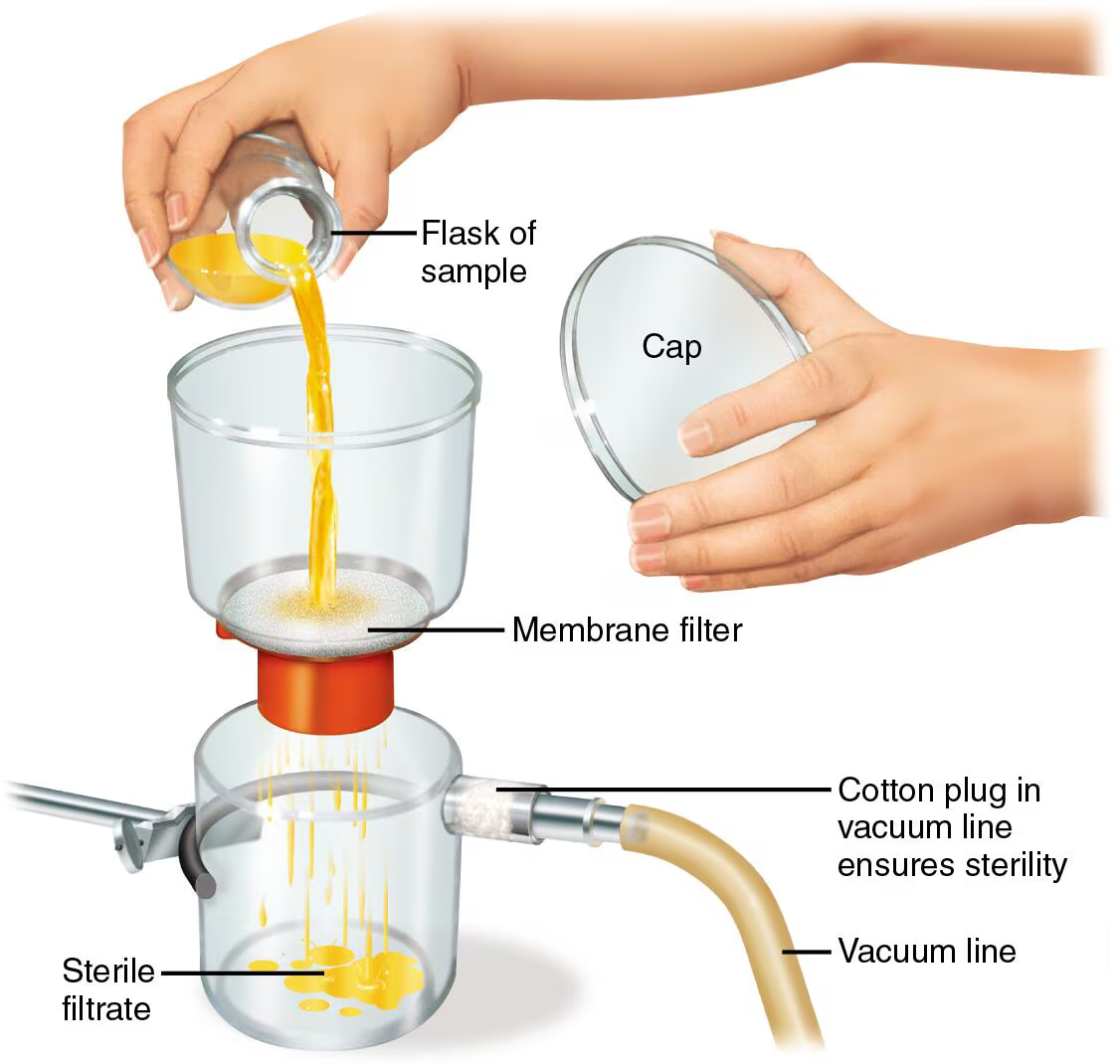
Membrane filter
Removes microbes >0.05-0.22 micrometer ; can filter viruses and large proteins
Types of cold bacterial controls :
Refrigeration
Deep-freezing
lyophilization (freeze-dry)
Desiccation
Removal of water ; microorganisms cannot grow or reproduce until water resumes
Osmotic Pressure Microbial Control
Creates hypertonic environment that cause plasmolysis (cell shrinking)
Ionizing Radiation
Ionizes water to create reactive hydroxyl radicals ; high energy, shorter wavelength, more penetration. Damages DNA
What is ionizing radiation used for?
Sterilization of medical and lab equipment and preservation of food.
Gamma Rays
Type of ionizing radiation ; penetrates deeply, but takes hours to sterilize
High Energy Electron Beams
Type of ionizing radiation ; less penetration, but takes seconds to sterilize
Nonionizing Radiation
Damages DNA by making thymine dimers ; good for surfaces.
Thymine Dimers
Inhibit correct replication of DNA during cell replication.
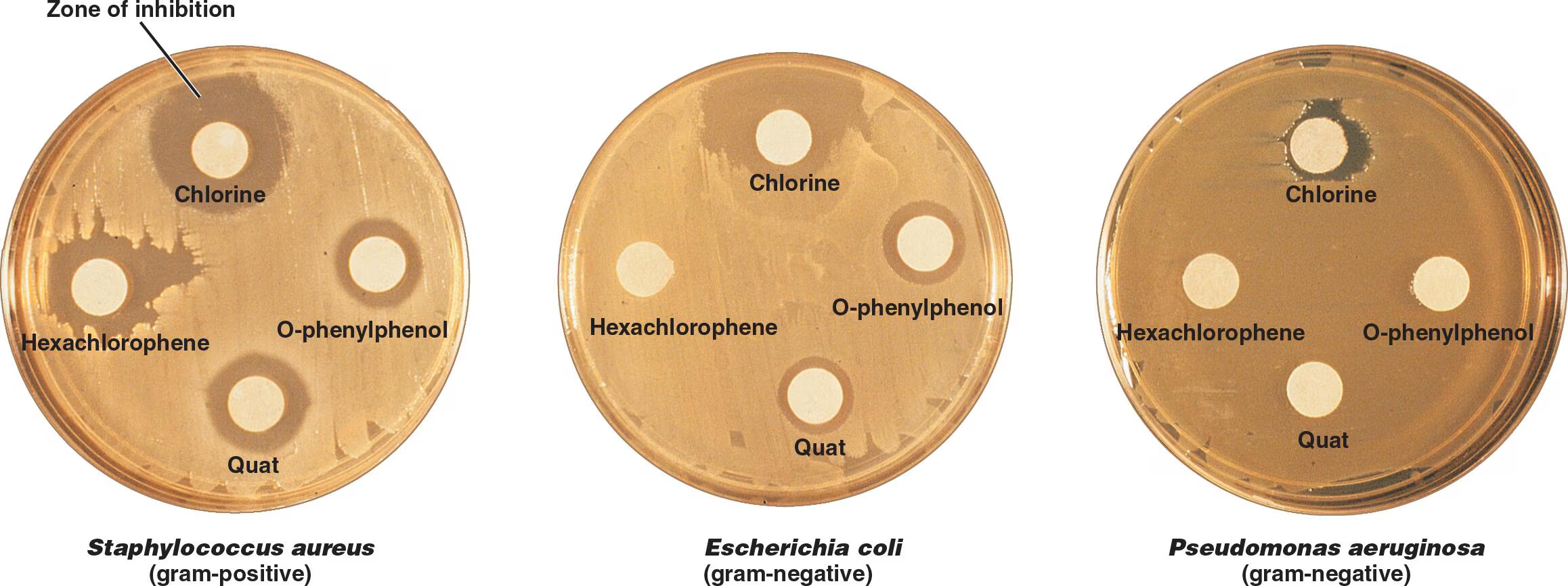
Disk-diffusion Method
Disk of filter paper gets soaked with chemical and then placed on agar plate; clear halo shows inhibition
Effectiveness of chemical microbial controls depends on :
Concentration of disinfectant
Organic matter present
pH
Temp
Time
Phenol and Phenolics
Injure lipids of plasma membrane and cause cell leakage ; remain active in presence of organic matter. Ex. lysol
Biguanides
Disrupts plasma membrane ; effective against gram neg/pos bacteria and envelopes viruses. Ex. Chlorhexidine used in surgical hand scrubs and pre-op skin prep.
Halogen Types
Iodine : most effective antiseptic
Chlorine : disinfectant that shuts down cellular enzyme systems (ex. bleach)
Alcohol
Denatures proteins and dissolve lipids ; no effect of endospores or enveloped viruses.
Heavy Metals
Denatures proteins ; effective in small amounts. Ex. zinc chloride in toothpaste
Oligodynamic Action
Ability to exert antimicrobial activity in small amounts
Soap
Cause microbial destruction due to sudden alkalinity on skin surface.
Aldehydes
Inactivate proteins by cross-linking with functional groups
Formalin
Used for preserving tissue specimen ; type of aldehydes
Glutaraldehyde
Liquid chemical sterilizing agent ; used on equipment that can’t be autoclaved
Alkylation
Replace hydrogen atoms of a chemical group with a free radical ; gas used for heat sensitive materials
Ethylene Oxide
Gas used to sterilize large pieces of equipment ; needs sealed chamber
Chlorine Dioxide
Used for fumigation and surface disinfection
Peroxygen
Oxidizing agents