M20 LEC 6 - Overview of Host Immune Response
0.0(0)
Studied by 11 people Call Kai
 Learn
Learn Practice Test
 Spaced Repetition
 Match
Match Flashcards
 Knowt Play
Card Sorting
1/130

Earn XP
Description and Tags
131 Terms
1
New cards
Neutrophil
The nosy one
2
New cards
Macrophage
The hungry one
3
New cards
Dendritic cells
The spy
4
New cards
Neutrophil
The ninja
5
New cards
Immunis
Where the word "immune" came from and means "exempted"
6
New cards
Immunology
Study of immune systems in all organisms
7
New cards
Autoimmune system
The immune system fights the cells or some cells of the body causing autoimmune diseases like systemic lupus, cytokine storm, some forms of arthritis, and erythematosus
8
New cards
Hematopoiesis
Formation and development of blood cells
9
New cards
Haima
This means "blood"
10
New cards
Poiein
This means "to form/make"
11
New cards
Bone marrow
Where hematopoiesis occurs from birth throughout lifetime
12
New cards
True
There is little amount of hematopoiesis in the lymph nodes
13
New cards
1 billion to 1 trillion
Healthy adult persons produce new blood cells a day at this number
14
New cards
Pluripotent stem cell
Where all different types of blood cells come from
15
New cards
55%
Percent of plasma in the human blood
16
New cards
45%
Percent of cellular elements in the human blood
17
New cards
95%
Percent of erythrocytes in the cellular elements in the human blood
18
New cards
Myeloid lineage
The cells belonging to _______ _______ are involved in the innate immune response; some cells here are also involved in the transport of gas and clotting
19
New cards
Lymphoid lineage
Most of the cells of the _______ _______ are responsible for adaptive/acquired immune response
20
New cards
Granulocytic
Type of stem cell that gives rise to eosinophils, basophils, and neutrophils
21
New cards
Lymphocytic
Type of stem cell that gives rise to natural killer cell, T cell, and B cell
22
New cards
10 trillion
Average number of lymphocytes in the human body
23
New cards
Lymphocytes
Continuously circulates in the lymph and blood and migrates in tissue spaces and lymphoid organs; small cells that have slightly visible cytoplasm around a single nucleus
24
New cards
Natural killer cells
5-10% of the lymphocytes that circulates the body; large non-phagocytic lymphocytes that are capable of killing abnormal host cells
25
New cards
Cytotoxic
Natural killer cells are considered functionally _______ because they kill cells that are infected with viruses or tumors
26
New cards
False
T or F: Natural killer cells need to recognize antigens presented on the target cell
27
New cards
Perforin
This chemical perforates the surface of the cell and damages the target cell's membrane, resulting in its death
28
New cards
Granzyme
This chemical is an apoptosis inducer and is triggered by a healthy normal process in the body
29
New cards
FS (CD95)
This chemical is also involved in programmed cell death other than granzyme
30
New cards
B lymphocytes (B cells)
Described as bone marrow residents that have hair-like projections on their surfaces; synthesizes immunoglobulin molecules
31
New cards
Plasma cells & memory cells
Two types of B cells that arise when these B cells mature
32
New cards
Bursa of Fabricius
A lymphoid organ in birds where B cells were first discovered
33
New cards
Plasma cell
This type of mature B cell is the factory for antibodies
34
New cards
True
T or F: Plasma cells have a large cytosol and a small nucleus
35
New cards
2-3 hours
Lifespan of plasma cells in vivo
36
New cards
T lymphocytes (T cells)
Cells of the lymphoid lineage that migrate to and differentiate in the thymus
37
New cards
Help B cells produce antibodies; regulate the immune response
Two functions of T cells
38
New cards
Bone marrow
Origin of T cell
39
New cards
Bone marrow
Origin of B cell
40
New cards
Thymus
Where T cells mature
41
New cards
Bone marrow; Peyer's patches
Where B cells mature
42
New cards
Monocytes
Mononuclear cells that circulates in the blood
43
New cards
Macrophage
The term used to refer to monocytes once they become tissue residents
44
New cards
Antigen processing and presentation, T cell activation, phagocytosis
Function of monocytes and macrophages
45
New cards
Endothelium
After 1 to 2 days of staying in circulation, monocytes cross the _______ to enter tissues and become macrophages
46
New cards
8.4 hours
Half-life of monocytes
47
New cards
True
T or F: The nucleus of the macrophage is slightly bigger than the nucleus of the monocyte
48
New cards
Pseudopodia
Projections of macrophages that become more pronounced when monocytes become macrophages
49
New cards
True
T or F: Phagolysosomes are only found in macrophages
50
New cards
Osteoclast
Type of macrophage from monocyte that resides in the bone
51
New cards
Alveolar macrophage
Type of macrophage from monocyte that resides in the lung
52
New cards
Kupffer cell
Type of macrophage from monocyte that resides in the liver
53
New cards
Histiocyte
Type of macrophage from monocyte that resides in connective tissues
54
New cards
Microglia
Type of macrophage from monocyte that resides in the brain
55
New cards
Portals of entry
Dendritic cells are found throughout the body, but especially in _______ ___ _______
56
New cards
Dendritic cells
Actively engulf cells and foreign particles in their environment
57
New cards
Innate
Type of immunity that dendritic cells play an importance in
58
New cards
T cell activation, antigen/foreign body transport to lymph nodes, antigen presentation, manipulation
4 functions of dendritic cells
59
New cards
Langerhans cells
Type of dendritic cell found in the skin
60
New cards
Circulating dendritic cell
Type of dendritic cell found in myeloid and plasmacytoid
61
New cards
Interstitial dendritic cell
Type of dendritic cell found in lungs, liver, intestines, and the heart
62
New cards
Interdigitating dendritic cell (Tip: interdigi"T" -> T cell areas and thymic)
Type of dendritic cell found in T cell areas of lymph nodes and the thymic medulla
63
New cards
Granular leukocytes
White blood cells that contain cytoplasmic granules; frontliners during the immune response
64
New cards
Amines
This component of basophils can be stained by basic dyes
65
New cards
Basic proteins
This component of eosinophils can be stained by acidophilic or eosinophilic dyes
66
New cards
Basic proteins and amines
This component of neutrophils can be stained by neutral staining
67
New cards
Eosinophil
What type of granular leukocyte is shown in the picture?
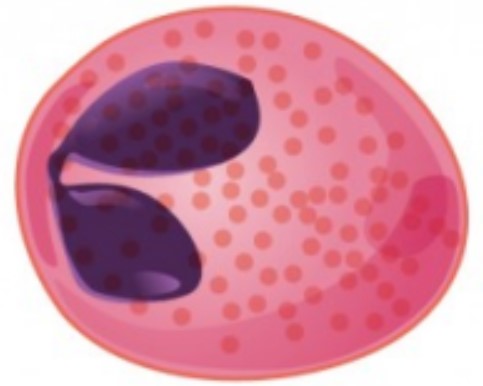
68
New cards
60%
Neutrophils comprise this percent of the peripheral blood leukocytes
69
New cards
Polymorphonuclear
Neutrophils are also known as _______
70
New cards
2 to 5
Number of segments of the nucleus in neutrophils
71
New cards
7 hours
Half-life of neutrophils
72
New cards
Phagocytosis
Main function of neutrophils
73
New cards
Acute infection
If there is an excessive number of neutrophils in the body, this is indicated
74
New cards
Juvenile forms and metamyelocytes
When reserves of the segmented neutrophils in the bone marrow are depleted, the number of these two increase in circulation
75
New cards
Lactoferrin & lysozyme
Direct microbial agents that are produced by neutrophils
76
New cards
Leukotrienes & prostaglandins
Mediates vascular functions and are produced by neutrophils
77
New cards
Myeloperoxidase
Supports oxidized antimicrobial functions and are produced by neutrophils
78
New cards
Bilobed
Basophils and mast cells are this type of cell based on the number of their lobes
79
New cards
Vasoactive amines
Once basophils and mast cells granulate, they release these and are associated with an allergic reaction
80
New cards
Mast cells
Tissue resident forms of basophils
81
New cards
Fc receptors of IgE
Mast cells contain these receptors
82
New cards
Type 1
Type of hypersensitivity response associated with allergic reactions
83
New cards
Bilobed
Eosinophils are this type of cell based on the number of their lobes
84
New cards
Participate in parasitic infections, secrete cytokines, involved in allergic reactions and inflammation
3 functions of eosinophils
85
New cards
Initial barrier
Immune system's protection from microbial invasion that is usually composed of mechanical, chemical, and biological barrier
86
New cards
Innate immune system
Immune system's protection from microbial invasion that performs when the barriers are compromised; antigen non-specific; e.g. epithelial cells, phagocytic cells, dendritic cells, cytokine
87
New cards
Adaptive immune system
Immune system's protection from microbial invasion that supports the innate immune system in defending from microbes; antigen-specific
88
New cards
Humoral immunity
Principle defense mechanism against extracellular microbes and their toxins; mediated by antibodies produced by B lymphocytes
89
New cards
Cell-mediated or cellular immunity
Defense against intracellular microbes such as viruses and some bacteria; mediated by T lymphocytes
90
New cards
Toll-like receptor 9
Polices the host cells; once antigens infiltrate the body, these receptors monitor and reports them, alerting the immune response of the presence of these foreign bodies
91
New cards
Skin
Inhospitable to microbes
92
New cards
Stratum corneum
Outermost epidermal layer and the cells of this layer provides a water-tight barrier, preventing dehydration
93
New cards
Epithelium
Lines the body's cavities that are in contact with the environment
94
New cards
Cilia of the epithelial lining
Aids in cleaning the respiratory tract by expelling the secretions with trapped microbes and particles outward through sneezing and coughing
95
New cards
Urination
Helps in inhibiting movement of microbes from the environment into the bladder and kidneys
96
New cards
Catheter
If an individual has this and is placed in the body for a long time, the protective mechanism of urination may be disrupted or compromised
97
New cards
Acidic secretions of the vagina; microcidal molecules
The female urogenital tract is important as it contains or is protected by these that are secreted by the mucous membranes
98
New cards
~5
pH of the skin
99
New cards
1.0 to 3.0
Normal pH of the stomach
100
New cards
4.4 to 4.6
Normal pH of the vagina