Chemistry Chapter 23 (Inorganic Chemistry)
 Call Kai
 Learn
Learn Practice Test
 Spaced Repetition
 Match
Match Flashcards
 Knowt Play
1/38

There's no tags or description
Looks like no tags are added yet.
Name | Mastery | Learn | Test | Matching | Spaced | Call with Kai | Chat |
|---|
No analytics yet
Send a link to your students to track their progress
39 Terms
Physical Properties of Transition metals
They are
Hard
Strong
Shiny
High melting point
High electrical and heat conductivity
Chemical Properties of Transition metals
They all have 4s electrons as their outer shell, so they have similar chemical properties
Not a trend in properties like across s- and p- block elements
4 characteristic properties of transition metals
Their ions are colored (compounds are not white solids/colorless solutions)
They can form complex ions
They exhibit catalytic activity (behave as catalysts)
They have variable oxidation states
Why can transition metals act as catalysts?
Due to their varied oxidation states
n/c
n/c
What is a transition metal?
They are elements which can form stable ions which have a partly filled d orbital
Are all d-block elements transition metals?
No
What 2 elements in the d-block (period 3) are not considered transition metals?
Scandium (Sc) and Zinc(Zn)
What is the ion for scandium?
Sc3+
What is the ion for zinc?
Zn2+
Which other ion does not exhibit transition metal properties and why?
Cu+
It has a white colored compound
It has a filled d- orbital
What is a complex ?
A molecule or ion, consisting of a central metal atom or ion, with a number of molecules or ions(ligands) surrounding it
When is a complex ion formed?
If the overall complex is charged and the charge is spread over the whole ion
What is a ligand?
Molecule or ion that forms a co-ordinate (dative) bond with a transition metal by donating a pair of electrons to the bond
What is one key feature all ligands must have?
They must have a lone pair of electrons which donates to the metal ion
What type of bond do ligands form with the metal ion?
A ligand forms dative bond(s) with the central metal ion
What is a monodentate ligand?
An atom, ion, or molecule that forms one dative covalent (coordinate) bond with a central metal ion by donating one pair of electrons
What are 4 examples of monodentate ligands?
Cl-
H2O
NH3
CN-
What is a bidentate ligand?
Atom, ion, or molecule that forms two dative covalent (coordinate) bond with a central metal ion by donating two pairs of electrons
Why do bidentate ligands behave the way they do?
It is because they contain 2 atoms which each have a lone pair of electrons
What are 2 examples of bidentate ligands?
1,2-diaminoethane (H2NCH2CH2NH2)
Ethanedioate (C2O42-)
(Examples of these complexes shown in the images)
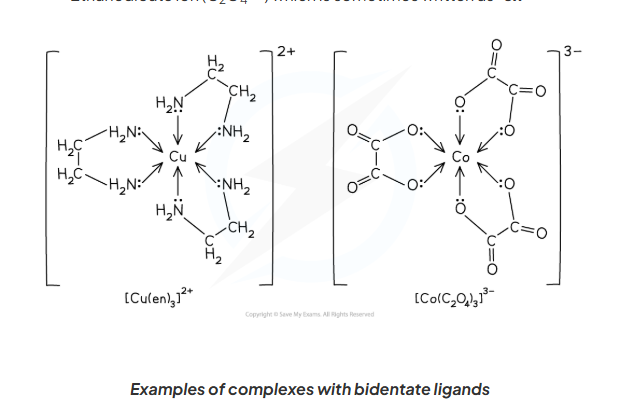
What are the other names for the 2 common bidentate ligands
1,2-diaminoethane (H2NCH2CH2NH2) → ‘en’
Ethanedioate ion (C2O42- ) → ‘ox’
Common example of a multidentate ligand
EDTA4- (Ethylenediaminetetraacetic acid)
What is co-ordination number?
The total number of dative (coordinate) bonds formed between the central metal ion and its surrounding ligands
What does coordination number determine?
It determines the 3D shape of the compound
What is a ligand similar to?
A nucleophile
What is a Lewis base?
An electron pair donor
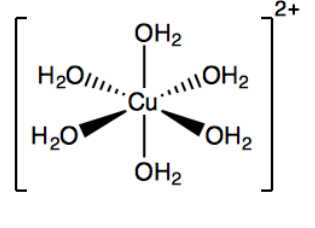
Draw the complex ion: [Cu(H2O)6]2+
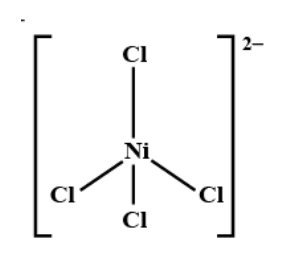
Draw the complex ion: [NiCl4]2-
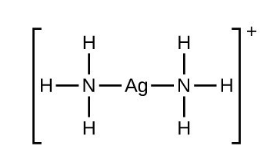
What type of complex is [Ag(NH3)2]+ ?
Linear Complex
Draw the complex: [Ag(NH3)2]+
What reagent is [Ag(NH3)2]+ used in?
Tollens Reagent
Why do the energy levels of the electrons of a transition metal in complex split?
This is due to the interference from the lone pairs of electrons donated by the ligand bonded to the central metal ion. The ligands repel electrons on the central metal ion, causing those electrons to have a higher energy level while the other electron’s energy levels are lowered
Why do transition metals have coloured ions?
It is because when ligands surround the central metal ion, the energy levels of the d- orbital electrons split
Electrons in the lower energy d orbitals can absorb a certain wavelength of visible light energy and be
excited.
The energy gap in the d orbitals is ΔE = hc/λ and corresponds to a wavelength in the visible spectrum
We see the light transmitted (which is not absorbed) so see the complementary colour of the absorbed light (the light is not emitted)
Why do only transition metals form coloured ions?
All transition metal ions have partly filled d
orbitals
So they have at least one space for a d electron to
move to AND they have at least one d electron able to be excited
Complexes of non-transition metals are colourless e.g. Al, Ca, Mg, Zn and Sc