plant science lec 4
 Call Kai
 Learn
Learn Practice Test
 Spaced Repetition
 Match
Match Flashcards
 Knowt Play
1/48

There's no tags or description
Looks like no tags are added yet.
Name | Mastery | Learn | Test | Matching | Spaced | Call with Kai | Chat |
|---|
No analytics yet
Send a link to your students to track their progress
49 Terms
endoreduplication
continuing to make extra chromosomes without divinding
what are some ideas on the plant body plan
flexible layout, can mix and match leaves and other organs, change shape in response to environment
Embryogenesis
process that lays down the basic body plan
how many parts is the plant body plan divided into
2
Apical-basal
the axis (stem) decides if it is the top or the bottom
Radial pattern
tissues decide if they are internal or external
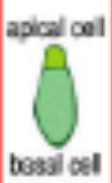
what does the first division cause/establish
polarity
what does the polarity in plant cells help with
allows cells to know where in a body of a plant they go
which part of a plant does most of the early cell division
the apical cell (top)
protoderm
early divisions of plant cell development
what does the basic cell form
suspensor
suspensor
attaches embryo to ovule and provides nourishment
what is formed after the protoderm is formed
ground meristem
ground tissue
fills most the plant and provides support and storage
procambium
becomes plant vasculature
meristems
undifferentiated cells that make new tissues
what are the three primary meristems
protoderm, ground meristem, procambium
what do protoderm, ground meristem, procambium eventually become
epidermis, ground tissue, vascular tisssues
cotyledons
first pair or set of leaves formed
what is the first organ that can be seen in plant development
cotyledons
what is the heart stage
the emergence of cotyledons
what is the torpedo stage
elongation of embryo, stem becoming discernable
what is the difference between cell division in the early and later stages of embryogensis.
at the beginning all cells divide and at the end it remains restricted to the apical meristems. (shoot and root)
WUSCHEL-RELATED HOMEOBOX (WOX) genes
establish apical-basal polarity
PIN-FORMED (PIN) auxin transporters
distribute auxin
WOX2
promotes apical fate
WOX8/WOX9
promote basal fate
Auxin is a key plant hormone, involved in
polarity
Monocots
have a single cotyledon and a meristem on the side
Single cotyledon called a
scutellum
parts of a seed
embryo, endosperm, seed coat
Seed coat
hard covering derived from the outer surface (integument) of the
ovule
caryopsis
ana entire fruit with the ovary wall included
Endosperm
is nutritive tissue
what happens in the maturation stage of a seed
Build up food reserves (starch, proteins, oils)
Desiccation (lose up to ~90% water)
Stop metabolism
Results in a seed ready to be dormant until favorable germination conditions
arise
germination
the sprouting of seeds
what are common environmental signals for germination
water, oxygen, temperature
what are the first steps of germination
Seed rehydrates
Activation of enzymes to digest food
Cell enlargement and division
what are the two types of germination
quiescent, dormant
Quiescent
will germinate whenever conditions are good
Dormant
seeds ignore good conditions until particular needs are met
what can be used to promote germination
gibberellic acid
what are the second steps of seed germination
Primary root (the embryo’s root) emerges
Develops lateral roots (roots that branch off of the primary root)
Develops root hairs (single-celled structures that do the actual absorption)
primary root
embryo’s root
lateral root
roots that branch off of the primary root
root hairs
single-celled structures that do the actual absorption
epigeous
emerge on soil
hypogenous
emerge below the soil