Membrane Transport (bio test 3)
 Call Kai
 Learn
Learn Practice Test
 Spaced Repetition
 Match
Match Flashcards
 Knowt Play
1/15

There's no tags or description
Looks like no tags are added yet.
Name | Mastery | Learn | Test | Matching | Spaced | Call with Kai | Chat |
|---|
No analytics yet
Send a link to your students to track their progress
16 Terms
passive transport
no energy required
active transport
energy required
what falls under passive transport?
simple diffusion
osmosis
facilitated diffusion
what falls under active transport?
molecular active transport
primary active transport
bulk transport
exocytosis
endocytosis
receptor-mediated endocytosis
phagocytosis
pinocytosis
concentration gradient
direction of flow (of molecules) in passive transport (high → low)
molecules naturally travel down their gradient — from an area of higher concentration to an area of lower concentration — until they reach equilibrium, requiring no energy expenditure from the cell
simple diffusion
Small molecules move directly through the lipid bilayer; no transport protein required
examples: oxygen, carbon dioxide, nitrogen, water, dye (mostly small nonpolar substances)
NO CHARGES!
no energy required
osmosis
Diffusion of water specifically (low solute/high) water → high solute/low water concentration
no energy required
facilitated diffusion
Uses channel/carrier proteins to move substances down gradient
examples:
glucose: too big, needs channel to move
charged substances
water: uses aquaporins so it can move efficiently as a small polar substance
amino acids
ions
no energy required
molecular active transport
Uses transport proteins and ATP to move substances against their concentration gradient
energy required
primary active transport
Direct ATP use; protein pumps
energy required
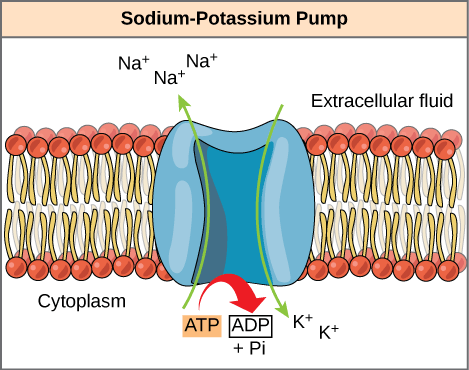
bulk transport
Uses vesicles to move large amounts/or a large item in/out of the cell
energy required
exocytosis
Vesicles fuse with the membrane to export materials
also used to build plasma membrane and cell wall
energy required
endocytosis
Membrane engulfs materials to form vesicles that bring them into the cell
energy required
receptor-mediated endocytosis
Specific uptake using receptors and coated vesicles
cholesterol
energy required
phagocytosis
‘Cell eating’ — engulfs large solid particles (bacterium)
add digestive enzymes to the vesicle to destroy
energy required
pinocytosis
‘Cell drinking’ — engulfs extracellular fluid; dissolves substances
energy required