Lecture 4 Bryophytes
 Call Kai
 Learn
Learn Practice Test
 Spaced Repetition
 Match
Match Flashcards
 Knowt Play
1/21

There's no tags or description
Looks like no tags are added yet.
Name | Mastery | Learn | Test | Matching | Spaced | Call with Kai | Chat |
|---|
No analytics yet
Send a link to your students to track their progress
22 Terms
Bryophytes
Non-vascular land plants
Bryophyte life cycle
*conspicuous gametophyte and sporophyte

Name the bryophyte lineages
Hornworts, liverworts, and mosses
Why are bryophyte lineages controversial?
Some think bryophytes are a clade, while others do not.
A monophyletic bryophyte is…
increasingly supported.
Describe bryophyte characteristics
-No true roots, stems, or leaves → homoplasy
-Move water via osmosis
-No strong support tissue
-Signaling proteins for dessication tolerance
-Most abundant in moist habitats but are very resilient
-Mostly small (no vascular system)
-Minerals can be distributed throughout body via diffusion
Hornworts
-~100 extant species
-Look like small horns
-Contain one chloroplast
-Sporophyte grows from basal meristem
-Permanently open stomata on sporophyte
-Symbiotic relationship with cyanobacteria that live within internal cavities
-Many symbiotic relationships
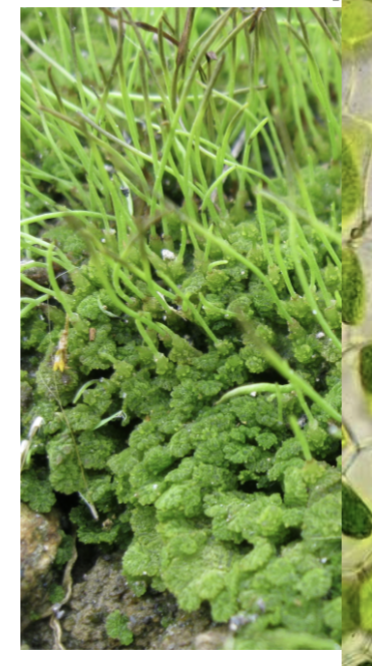
Mosses
-~15,000 extant species
-Have hydroids (die and leave channel through which water can move)
-Sporophyte attached and dependent on gametophyte
-Sporophyte unbranched
-Many have stomata on capsules
-Peristome teeth aid dispersal

Peristome teeth
-Hygroscopic
-Allow gradual dispersal of spores
What is an ecologically significant moss? Why?
Peat moss → carbon sinks that regulate the global climate; low-oxygen conditions prevent things from fully decomposing
Liverworts
-Green, flat leaf-like gametophytes
-Growth occurs at apex of plant
-Sporophyte remains attached to larger gametophyte
-Reproduce asexually and sexually
-No internal water conduction
-No true stomata
-Gemmae for asexual reproduction
Morphology supports the hypothesis that:
Mosses + liverworts form a natural group.
Liverwort sporophytes
-Stalk (seta) + capsule (the sporangium)
-Sporophyte attached to gametophyte and dependent on it
-Seta elongates by cell elongation throughout its length
-Sporangia split along sutures
Hygroscopic elaters
Assist in spore dispersal by flexing in response to humidity
Sporangia
Structures that produce and contain spores
Liverwort adaptations
-Rhizoids: Anchor plant, water absorption
-Large surface area for absorption
-Gemma cups allow asexual reproduction
Mosses adaptations
-Rhizoids
-Sporophyte = foot, seta, capsule
-Peristome teeth
→ Mosses can reproduce and disperse without sporophyte living independently
Hornworts adaptations
-Foot embedded in gametophyte
-House nitrogen-fixing cyanobacteria
-Rhizoids
Bryophytes are ___ dominant.
gametophyte
Bryophytes are ____ for fertilization.
water-dependent

How did Penny Chisolm’s lab identify Perchlorococcus?
Fluorescence of chlorophyll in seawater

Which traits identify mosses from other plants?
Land plants lacking vascular tissue