Physics, A2 : Forces (Newtons Law)
 Call Kai
 Learn
Learn Practice Test
 Spaced Repetition
 Match
Match Flashcards
 Knowt Play
1/13

Earn XP
Description and Tags
forced haha
Name | Mastery | Learn | Test | Matching | Spaced | Call with Kai |
|---|
No analytics yet
Send a link to your students to track their progress
14 Terms
Newtons first law
object will remain at constant velocity unless there are any other external (net forces) acting on it
Newtons second law
Acceleration is directly proportional to the external force, and inversely proportional to its mass
(ΣF = ma)
Newtons third law
All actions have equal, and opposite forces
Eg. Mg = -N
N - normal force is always perpendicular to its surface
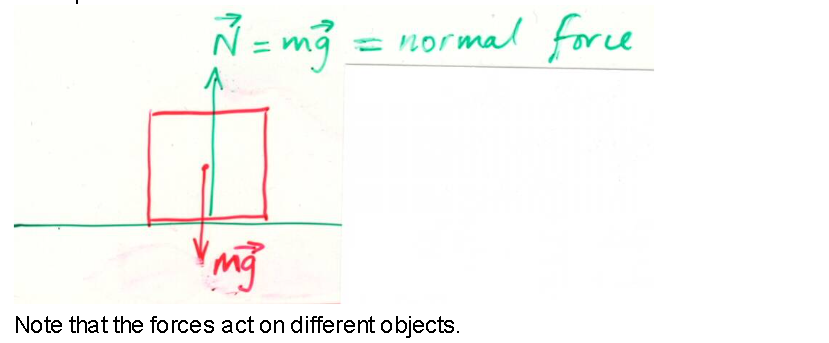
Free body diagrams
Free body diagrams consist only of forces, and their directions
(m, mg, N, T, are examples of forces)
Friction
The force acting opposite to the the external, normal( not up tho) force
due to microscopic roughness of two surfaces, or local adhesion.
Types of friction
Static friction = the friction when the object is at rest(fs =<μsN)
Dynamic/Kinetic friction = friction when objest is moving(fk=μkN)
μ = coefficient
More force needed to make the object move when it is static, than when the object is already moving.

Air resistance(freefall)
As the speed of the falling object increases, so does the friction
when friction force = speed of the falling object, the speed becomes terminal(constant)
Tension
Tension only pulls away from the object
When theres one rope, theres one tension
if the pulley is smooth (the object is perfectly stationary on a rope) - tension is the same as its opposite force)

two or more objects with a mass connected by rope(something with tension)
their speed, acceleration is going to be the same, when their mases are combined, as theyre considered as a system.
if the lower mass object doesnt have its own force, it relies on tension(T IS F of lighter object)
Find the net force of each object first, to solve the questions.
Angled forces
angled forces in the x axis are F cos()
angled forces in y axis are F sin()
Also finding the right angle triangle and using SOHCAHTOA can help
frequency
how many full ciruclar revolution does the object make in a second
(measured in Hz: hertz)
f = 1/T
T = time period it takes to make a full revolution
Angular speed
speed that is at an agle in the circular motion, (labelled as ω(omega))
ω = v/r (so v = ωr)
ω = 2π/T
works only when talking about centripedal forces
the “weightless” effect
weightless effect means that the person experiences the moment when he doesnt feel any force pushing him down nor up.
which means that F = 0.
if for example theres a Force of collision of the passanger and the seat (Fc = mg + mv²/r)
then it means that 0 = mg + mv²/r
so equals to mg = mv²/r
first things to think about when talking about centripedal forces
think about mv² / r, if not, then the GPE and KE