chem 3ii3 part 1
 Call Kai
 Learn
Learn Practice Test
 Spaced Repetition
 Match
Match Flashcards
 Knowt Play
1/130

There's no tags or description
Looks like no tags are added yet.
Name | Mastery | Learn | Test | Matching | Spaced | Call with Kai | Chat |
|---|
No analytics yet
Send a link to your students to track their progress
131 Terms
structure of the periodic table; (3)
elements are listed in atomic number (# neutrons)
rows=periods, columns=groups
can be divided into four blocks
transition metal (iupac definiton)
atom with incomplete d subshell, or is complete
d block metals are groups _ and divided into _,_,_,_
3-12, 3d,4d,5d,6d
alternative version of periodic table #1
lanthanides are La-Yb, and come after the s block and before the d-block
Lu and Lr are apart of d-block
alternative version of periodic table #2
lanthanides are Ce-Lu, and come after the s block and before the d-block
La and Ac are apart of d-block
La starts d-block, then f-block, then d block back, etc
common periodic table…
no distinctiomn between alternative versions
light transition metals?
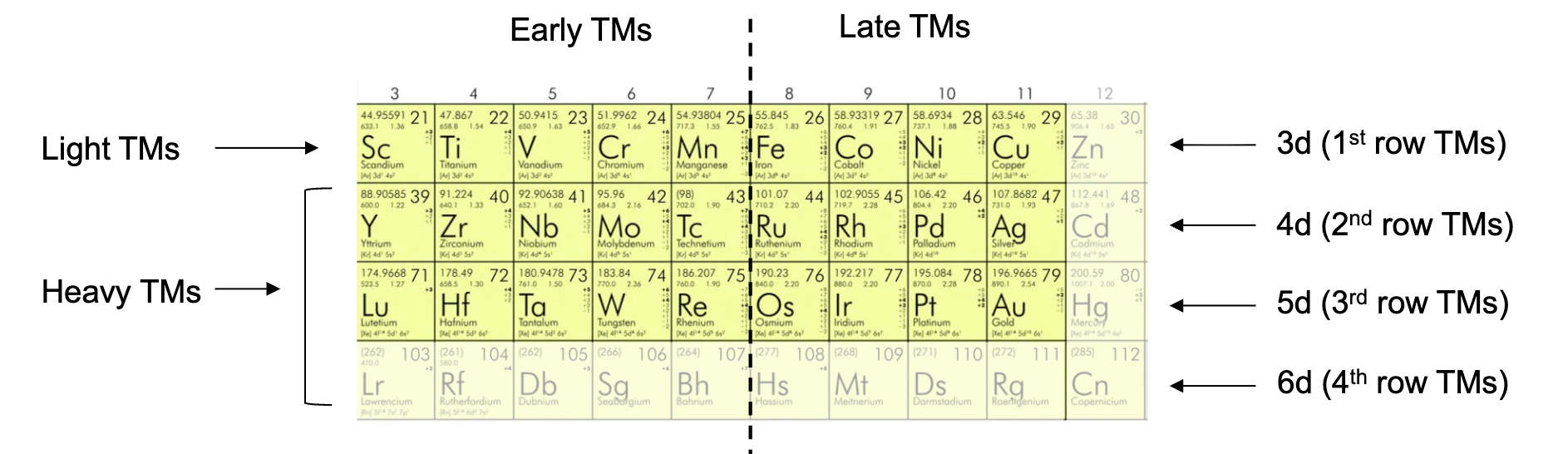
heavy transition metals?
early?
late?
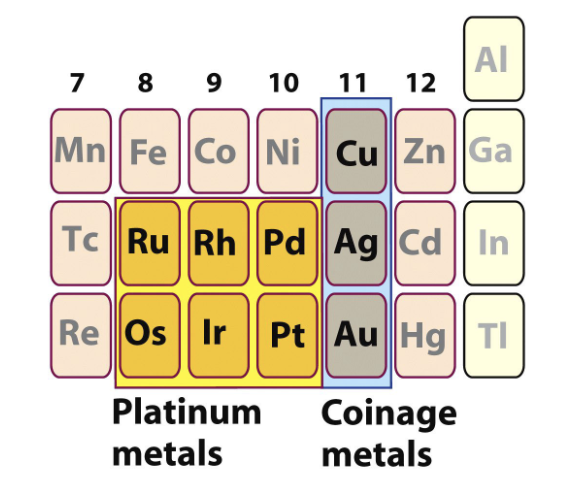
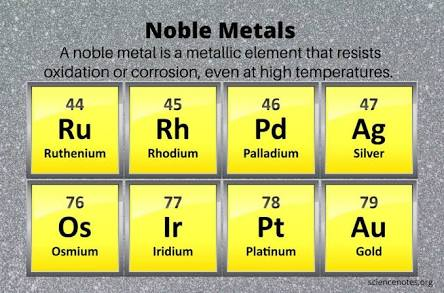
noble metals?

late TMs, 2nd (4d) and 3rd (5d) row
do not react with H+ in normal conditions
ag, au, pt, rh, ir used for jewelery
resist corrosion, oxidation, and tarnish when exposed to air, moisture, or heat
coinage and platinum metals
aqua regia significance?
NO₃ (NO₃⁻) oxidizes Au → Au³⁺.
HCl (Cl⁻) complexes Au³⁺ as [AuCl₄]⁻, stabilizing it.
Shows that noble ≠ unreactive: Au is hard to oxidize, but aqua regia is strong enough to dissolve it.
nobel prize

which are naturally occuring?
3d-5d EXCEPT Tc (made using cyclotrons, used in medical diagnosis), since highly radioactive
which are radioactive?
6d, Tc
elements made in nuclear reactors in limited quantities (few atoms)
t1/2=ms-s

which are naturally occuring?
all lanthanides except Pm
which are radioactive? fun fact?
all An EXCEPT Th and U
fun fact: all elements after 83 bismuth are radioactive
all elements formed by
related processes within stars
atomic number relationship with abundance
heavier = less abundant
what is the most abundant TM?
fe, on our planet and in sun
what is the heaviest natural element?
uranium
actinides apart from Th and U are
products of nuclear reactions, have short lifetimes and do not accumulate
th can be naturally isolated as _ from _
th02 from monazite or thorite
Ac and Pa can be formed (in tiny amts) from
decay of Th and U
recovery of d-block elements
early tms and 1st row tms (light), oxides are preferred
late tms and some 2nd and 3rd row tms around middle of PT, sulfides are prefered
iron production Blast furnace purpose
: Reduce iron ore to Fe using CO, while limestone converts SiO₂ impurities into removable slag.
applications of d-block metals
Structural: Fe, Cr, Ti, Cu, Zn → steels, alloys, construction, implants.
Physical properties: Cu/Ag/Au → electrical conductors; Nd₂Fe₁₄B → magnets; LiCoO₂/LiFePO₄ → batteries.
Catalysts: Fe → Haber-Bosch; V₂O₅ → H₂SO₄ production; Pt/Rh/Pd → car catalytic converters.
Medicine: Pt compounds → anticancer drugs; Tc-99m → medical imaging; Au compounds → arthritis treatment.
lanthanides are very similar in , this has implications on _
physical properties
separating lanthanides, getting pure lanthanides
main ores to recover lanthanides are
monazite and bastnaesite
thorium isolation
Treat monazite with NaOH: Rare-earth phosphates react to form rare-earth oxides Ln2O3, which precipitate.
2. Add HCl: Ln2O3 dissolves to form soluble LnCl3, while ThO₂ remains as a solid.
Key idea: ThO₂ is separated from the lanthanides because it does not dissolve in the acid under these conditions.
lanthanides are considered REE because
hard to get in its pure form, Not because of scarciry
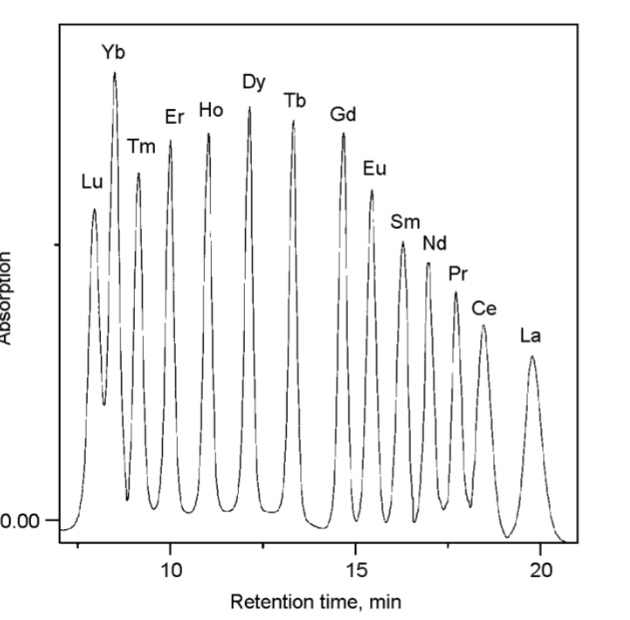
lanthinides can be separated through _. explin
ion exchange chromatography
Lanthanide cations are separated using a negatively charged resin and EDTA.
Smaller Ln3+ ions have higher charge density → bind EDTA more strongly → larger Kf.
Stronger EDTA binding pulls the ion into solution rather than onto the resin → smaller ions elute first.
economic importance of lanthanides
Catalytic converters: CeO₂ helps store/release O₂ and improves conversion of CO and NOₓ.
Magnets: Nd, Sm → strong permanent magnets.
Electronics/optics: Used in screens, LEDs, lasers, and optical devices.
Batteries: La-based materials → rechargeable NiMH batteries.
Medicine: Used in MRI contrast agents and medical imaging.
purpose of catalytic converter?
reduce harmful pollutants in car exhaust.
rare earth metals are mostly produced by
china
uranium enrichment: ores, _ treatment, purification, recovery, yellowcake?
Uranium extraction:
Ores: Pitchblende contains UO2, U3O8, UO3; uraninite is mainly UO2.
Acid treatment: Converts uranium oxides into soluble uranium salts.
Purification: Ion exchange separates uranium from impurities, including radioactive decay products.
Recovery: Uranium is precipitated/recovered as uranium oxides or salts.
Yellowcake: Purified uranium oxide, commonly U3O8.
U-235 and U-238
isotopes of uranium → same protons, different neutrons.
U-235
absorbs a neutron → becomes unstable → fission → releases energy + ~2–3 neutrons
nuclear power
uses the heat/thermal energy from fission to generate electricity.
u-238
usually does not fission after absorbing a neutron → can eventually form Pu-239.
uranium enrichment
UF6 is a volatile material (b.p. 56.5 oC).
• Centrifugation or semipermeable membranes can be used to (partially) separate 235UF6 from 238UF6
thermal diffusion
Uses a hot and cold surface to separate uranium isotopes.
Lighter 235U moves toward the hot side.
Heavier 238U moves toward the cold side.
Used historically, but later replaced by gaseous diffusion.
EMIS
Electromagnetic isotope separation (EMIS): uranium is vaporized → ionized → accelerated.
A magnetic field deflects the ions by different amounts because of their different masses.
The isotopes therefore land at different collection points.
The Calutron was the large-scale machine used during WWII to produce some 235U.
gaseous diffusion
UF₆ gas is forced through semipermeable membranes.
The lighter 235UF6 molecules pass through slightly faster than 238UF6.
Repeating this process gradually enriches 235U.
It was important during the Cold War but has largely been replaced by centrifugation.
centrifuge enrichment w uranium
UF₆ gas is spun at very high speed in a centrifuge.
Heavier 238UF6 moves toward the outer wall.
Lighter 235UF6 concentrates closer to the center.
The 235U-rich gas is collected → enriched uranium.
multiple centrifuge cycles to keep enriching
part b
lets go
basic properties of transition metals: electronegativity
increases fron left to right generally
governed by effective nuc. charge, # electrons and their location
electronegativity of tms.
more electropositive than carbon (2.55)
gold is an exception, since its comparable (2.54)
group 3-4 and f-block are strongly electropositive
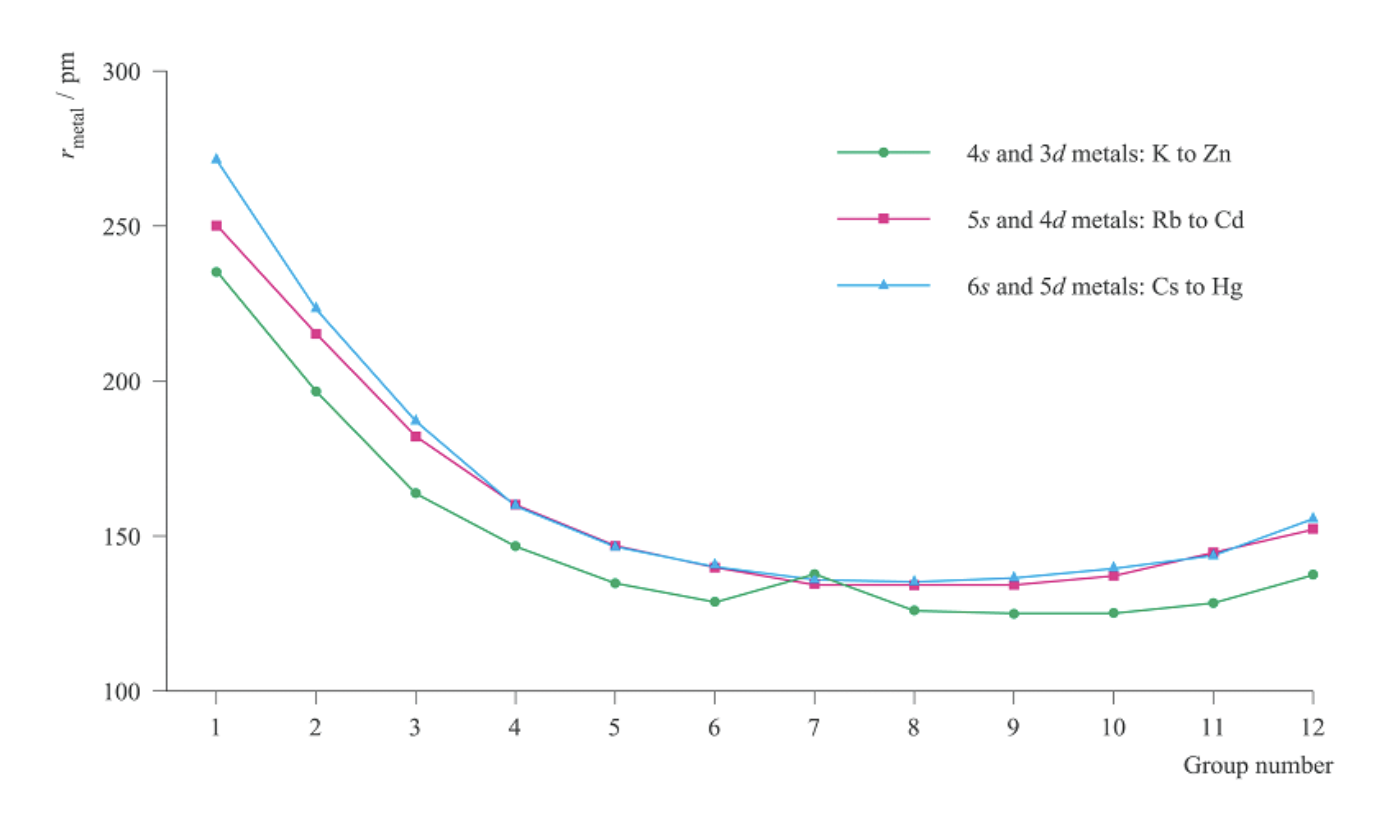
basic properties - metallic radii
decreases from left to right (3-8/9)
past group 9, there is more electron-electron repulsion due to the increase in e- number
1st row smaller than 2nd row
2nd row larger bc of higher n d-shell
3rd row similar in size because of lanthanide contraction
what is lanthanide contraction?
the steady decrease in the size of atoms and ions across the lanthanide series caused by the poor nuclear shielding of diffuse (narrow lobes, empty space) 4f electrons.
all d-block elements are:
metals
transition metals vs d-block elements
All transition metals are d-block elements, but not all d-block elements are transition metals.
because all d-block elements are metals, they
have high electrical and thermal conductivity
TM melting points and boiling points
in general, they are quite high
increase towards middle of d-block, and then drop off

which metal has the highest MP and BP?
W (tungsten)
MP: 3422°C
BP: 5550°C
what is metallic bonding?
Metallic bonding is the attractive force between positive metal ions and a shared, free-moving "sea" of outer-shell electrons
Why is metallic bonding strongest around Group 6?
Electrons first fill bonding orbitals, strengthening metallic bonding. Once those are filled, additional electrons enter antibonding orbitals, weakening bonding.
other MP BP trends
most groups, mp and bp increase down the group
expeption: grp 12 (zn, cd, hg)
hg is liquid at rt
what r oxidation states?
charges tm ions
would have if bonding were completely ionic
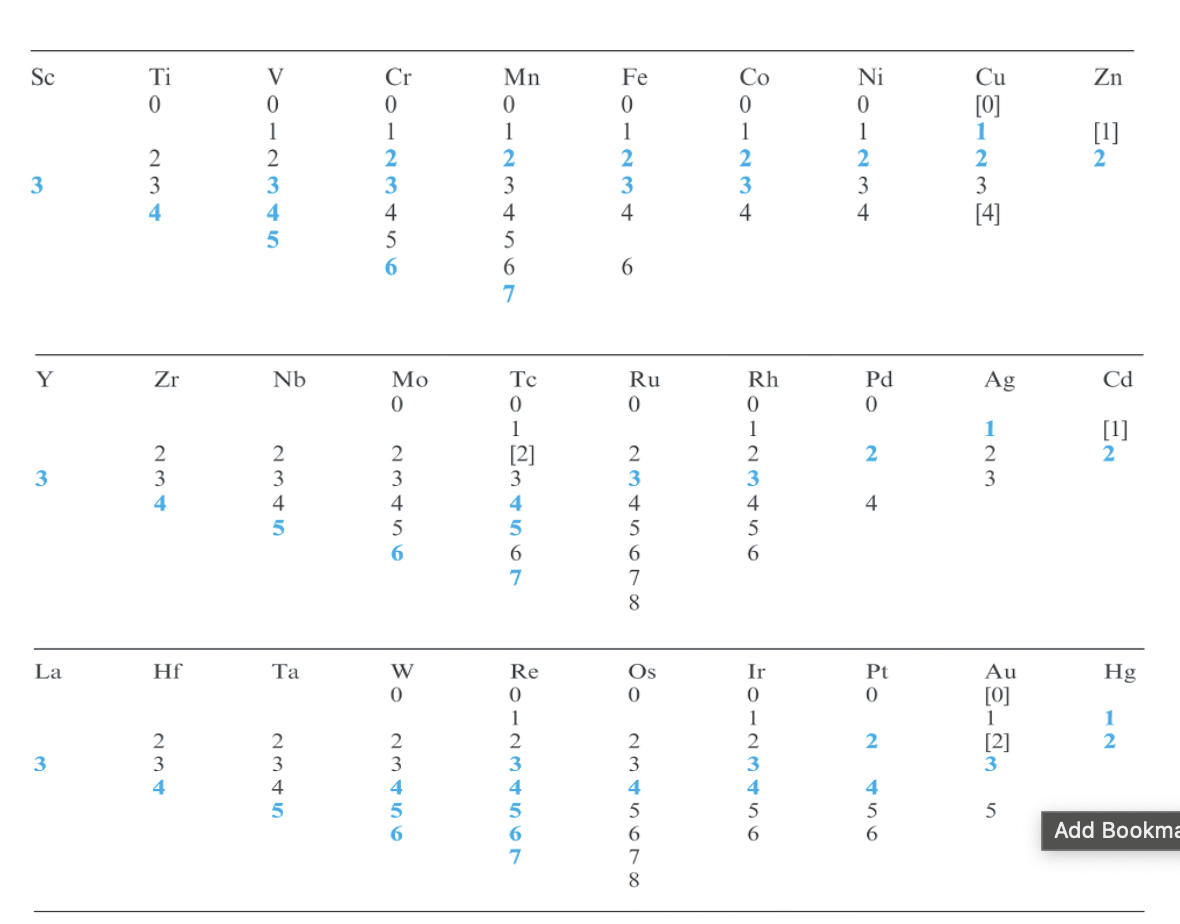
Why can transition metals have multiple oxidation states?
Their s and d electrons are close in energy, so different numbers of these electrons can participate in bonding or be lost.
→ This allows transition metals to have multiple oxidation states (e.g., Fe²⁺ and Fe³⁺).
Why do Groups 7–8 have the highest maximum oxidation states?
Electrons become increasingly difficult to remove, especially the tightly held 3d electrons. The energy required eventually becomes too high for the oxidation state to be chemically stabilized.
→ Having many valence electrons ≠ being able to lose all of them.
why are 2nd and 3rd row tms more able to reach high oxi states?
valence e- less tightly held
what are frost diagrams? y and x axis?
useful to compare thermodynamic favourability (relative stability) of various oxidation states for an element or between different elements
specific to conditions like pH
x-axis: Oxidation number, N
• y-axis: νEo (also written as nEo or ΔGo/F), which is proportional to change in free energy for oxidation of the metal to the cation
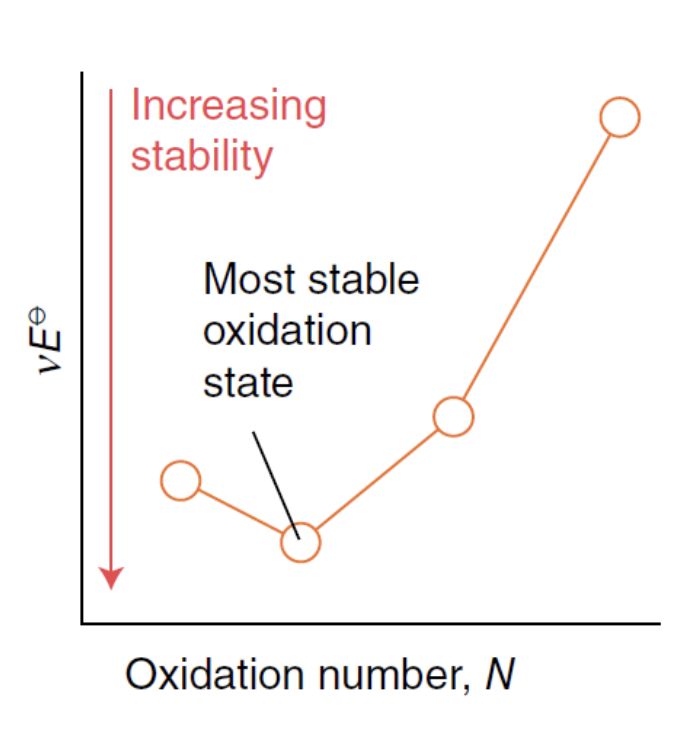
how to interpret frost diagrams?
cations far down diagram are more stable then m0
higher up are less stable, and good oxidation agents (good at getting reduced, receiving e)
most stable is bottommost point
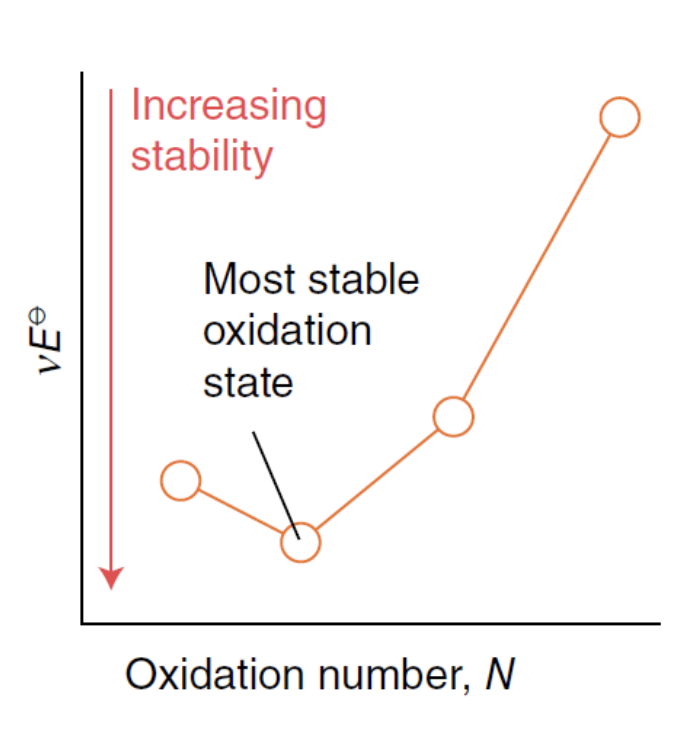

the adjacent oxidation states are more stable in comparison, and so splitting into the two is thermodynamically favourable
whats disproportionation?
When the same substance is both oxidized AND reduced in the same reaction.
thermodynamic explanation for disproportionation
Reduction of Mn 3+ to Mn2+ has ΔGred < 0
• Oxidation of Mn 3+ to Mn4+ has ΔGox > 0
• |ΔGred| > |ΔGox | and therefore overall
process is spontaneous because ΔG < 0
![<p>**** key points from frost circle diagram (1st row, 3d elements) [6]</p>](https://assets.knowt.com/user-attachments/41e5e2bc-9648-45c5-a7c1-1c12868e1e52.png)
**** key points from frost circle diagram (1st row, 3d elements) [6]
Early TMs easier to oxidize than late TMs
• For early 1 st row TMs (Sc-Cr), the most stable
oxidation state is 3+
• Later elements (Mn-Ni) prefer the 2+ oxidation
state
• The positive oxidation states of Cu are
unstable with respect to Cu metal
• With the exception of Cu(I), the 1+ oxidation
state is absent due to easy disproportionation
(2 MI M0 + MII )
• Some oxidation states can be predicted to be
prone to disproportionation (at least under the
conditions of this Frost Diagram

group 6 (Cr, Mo, W) key point:
Higher oxidation states are more stable
for 4d and 5d elements
d- and f-block metals react with _ to form _?
O2 to form oxides
What is "passivation"?
It is an effect where the oxide layer that forms usually protects the metal from further oxidation.
What are some industrial applications of passive oxide layers?
Galvanized steel and stainless steel.
____ metals do not react with O2
noble
tarnish on ag
Tarnish on Ag is Ag2S, resulting from the reaction with atmospheric H2S
the tarnish is not an oxide here
why are nobel metals unreactive?
they have strong intermetallic bonds and high ionization energies.
Why do d-block metals generally not react with (H_2O) at pH 7 in the absence of (O_2)?
At neutral pH, (H_2O) is not a strong enough oxidizing agent to make most d-block metals lose electrons.
→ No (O_2) = no strong electron acceptor → little/no metal oxidation.
What are the exceptions to d-block metal reactions with water?
Sc, Y, Lu, which slowly yield hydroxides and H
rxns w acid: How do Zn and Cu react differently with $HCl$?
Zn + 2HCl → ZnCl2 + H2 while Cu + HCl → no reaction.
How does copper react with concentrated nitric acid (4HNO_3)
Cu + 4HNO 3 → Cu(NO3) 2 + 2NO2 + 2H2O
noble metals reaction w acid.
they do not react with most inorganic acids
exception: Au
aqua regia
Aqua Regia (HNO 3(aq) + HCl(aq) 1:3)
– Au(s) + 4H+(aq) + NO 3-(aq) + 4 Cl-(aq) [AuCl4] -(aq) + NO(g) + 2 H2O(l)
example of noble metal reacting with acidWhat is the Schrödinger equation for a hydrogen-type atom?
What is the Schrödinger equation for a hydrogen-type atom?
HΨ = EΨ
What are the two components of the wavefunction Ψ = Rnl(r) Ylml(θ,φ)
Radial function ($R$): Electron density at different distances from the nucleus.
Angular function ($Y$): Shape and orientation of the orbital.
What do quantum numbers
n, l, and ml and ms stand for
n (Principal): Shell, size, and energy (1, 2, 3…).
l (Angular momentum/azimuthal): Orbital type (0=s, 1=p, 2=d, 3=f).
ml (Magnetic): Orbital orientation (-l to +l, eg. px,py,pz).
ms (Spin): Electron spin (+1/2 or -1/2).
How does the radial function change as distance from the nucleus increases?
It decays exponentially as (r) increases.

How does increasing (n) affect electron distance from the nucleus?
Higher (n) → slower decay → greater likelihood of finding the electron farther from the nucleus.
What is special about s orbitals at the nucleus?
For s orbitals, (R(0)≠0), so there is a nonzero probability of finding the electron at the nucleus.
What about non-s orbitals at the nucleus?
For p, d, and f orbitals, (R(0)=0) → zero probability at the nucleus.
What is a radial node?
A point (distance from the nucleus) where the wavefunction equals zero, (R(r)=0), so the electron probability is zero.

What does the radial distribution function describe?
The probability of finding an electron at a given distance from the nucleus, summed over all angles.
What does a maximum in the radial distribution function mean?
It shows the distance from the nucleus where the electron is most likely to be found.
What does every radial distribution plot have?
At least one maximum, representing a most-probable distance from the nucleus.
Why do orbitals with the same (n) have different energies in multi-electron atoms?
They have different penetration and shielding. More penetration → stronger attraction to the nucleus → lower energy.
What is penetration and shielding?
Penetration = how close an electron can get to the nucleus.
Shielding = inner electrons partially block the nucleus from outer electrons.
Why is (2s) lower in energy than (2p), and (3d) relatively high?
(2s) penetrates closer to the nucleus than (2p) → stronger attraction → lower energy. (3d) penetrates poorly and is highly shielded → weaker attraction → higher energy.
Why are the 4s and 3d orbitals so close in energy across the 1st-row transition metals (Sc–Zn)?
As nuclear charge (Z) increases, the 3d orbitals initially resist dropping in energy because they are poorly penetrating and strongly shielded. This creates a region where 4s and 3d are very close in energy.
K → Ca: (E_{4s} < E_{3d})
Sc → Zn: (E_{3d} < E_{4s}), but they remain very close in energy.
This close energy means 4s and 3d electrons can both be involved in bonding and ionization.
Similar close-energy effects occur for higher (nd) and (nf) orbitals.

What are the expected electron configurations of K and Ca?
K = ([Ar]4s^1)
Ca = ([Ar]4s^2)
These follow the expected filling order because 4s is lower in energy than 3d for K and Ca.
Why are transition-metal electron configurations not always predicted by the simple orbital-filling order?
In transition metals, 4s and 3d orbitals are very close in energy, so complex electron–electron interactions can change which arrangement is most stable. The s orbital is typically filled first, e.g. Sc = ([Ar]4s^2 3d^1).
What are the important exceptions to the usual transition-metal configurations, and what do they show?
Cr: ([Ar]4s^1 3d^5)
Cu: ([Ar]4s^1 3d^{10})
These are stabilized by particularly stable half-filled ((d^5)) and completely filled ((d^{10})) d subshells.
Other exceptions include Nb, Ru, Rh, and Pt, which cannot be explained as simply.
Takeaway: Simple filling rules cannot reliably predict every transition-metal electron configuration.
What is the general electron configuration of a transition-metal cation in a complex?
((n-1)d^m ns^0)
→ All valence electrons are in the ((n-1)d) orbitals, with no electrons in the (ns) orbital.