ATOC 3700 Exam 1, 2, & 3 Questions
 Call Kai
 Learn
Learn Practice Test
 Spaced Repetition
 Match
Match Flashcards
 Knowt Play
1/104

Earn XP
Description and Tags
CU Fall 2025 ATOC/GEOL 3700 Intro to Oceanography all midterm questions and answers study guide for final.
Name | Mastery | Learn | Test | Matching | Spaced | Call with Kai | Chat |
|---|
No analytics yet
Send a link to your students to track their progress
105 Terms
The longest continuous scientific oceanographic expedition was the __________ expedition.
Challenger
T/F. The Asthenosphere floats on top of the Lithosphere.
False
Which type of sediment covers the greatest area of the seafloor?
Biogenous
Who was responsible for the theory of continental drift?
Alfred Wegener
T/F. You would expect to find a thick layer of sediment on the seafloor near the edges of continents than near the top of a mid-ocean ridge.
True
The seafloor records past climates as sediment accumulates. About how far back in time can seafloor sediments allow us to reconstruct climate variations?
200,000,000 years
A poorly sorted layer of sediment is more likely found ________.
On a beach with vigorous wave activity
When classifying sediments by source, windblown dust is what type?
Terrigenous
The general location and direction of the great Polynesian migrations starting about 4000 B.C.E. was _________.
Eastward (west to east) across the Pacific Ocean
T/F. After an Earthquake, body waves (P & S) travel faster than surface waves.
True
The Himalayan mountain range is the result of a _______ plate boundary.
Convergent
The clumping together of small particles into larger masses that occurred during the formation of planets in our solar system known as ________.
Accretion
The sustained heat within Earth’s interior is attributed to ________.
Radioactive decay
Earth orbiting satellites called altimeters measure _______ to estimate the depths of the ocean.
Variations in the height of the ocean surface
Consider a mefest-sized iceberg, whose total mass is ten million kg. Like most icebergs, 10% of it is visible above the waterline. What would be the mass of the seawater being displaced by the iceberg?
Ten million kg
The global array of Argo floats is providing an unprecedented view of temperatures and salinity in what part of the ocean?
Surface and subsurface of the ocean
T/F. The theory of Continental Drift was met with strong skepticism by the scientific community until after the death of its originator.
True
What is the name of the ocean layer with a rapid change in temperature with depth?
Thermocline
What is the name of the ocean layer with a rapid change in density with depth?
Pycnocline
Rainfall causes sea surface salinity to ________.
Decrease
The regions of highest salinity are found ________.
In the subtropics (20-60 latitude)
What kind of bond causes water molecules to “stick” to one another?
Hydrogen
Melting frozen water requires bonds to _______, which requires _______ energy than required to evaporate liquid
Bend; less
What happens to liquid water just after it freezes?
Its density decreases
Refraction bends sound waves ________.
Away from the highest sound velocity
Hurricanes play an important role in the climate system by moving heat from the _______________.
Equator to the poles
Why do we have seasons on planet Earth?
The planet’s axis of rotation is tilted
Upwelling along the coast of California is part of the ________ circulation.
Wind-driven
Due to the Earth’s rotation, Ekman’s theory explains how the upper layer of water in the ocean is driven _______ of the wind in the Southern Hemisphere.
To the left
T/F. Upwelling can occur without a continental coastline.
True
Geostrophic currents are balanced by which two forces?
Coriolis and the pressure gradient force
The ocean is vertically stratified such that _________ increases with depth.
Water density
Which color of visible light is transmitted the deepest within the ocean?
Blue
Deep and bottom water masses are formed when surface water becomes dense enough to sink. How can surface water become dense enough to sink?
Surface temp of seawater decreases AND surface salinity increases
Earth recieves more energy from the Sun in the _______ because Earth is ________, which requires that the ocean and atmosphere move some heat towards the _________.
Tropics; a sphere; poles
The geostrophic current at some location is predictable if the ________ of the sea surface is known at that location.
Slope
If you observe cold surface water and high surface chlorophyll concentration along a continental coastline, you would suspect that the Ekman transport to be flowing _______ leading to _______.
Offshore; upwelling
When sea ice forms, the surrounding liquid water in the ocean is _______ than it was previously.
Saltier and more likely to sink
The SOFAR layer, where sound waves travel great horizontal distances, is a layer where the speed of sound is relatively ________.
Slow
A region of the ocean where Ekman transports are diverging will induce ________, a ________ thermocline, and a/an _________ sea surface height.
Upwelling; shallower; depressed
The thermocline circulation is mainly driven by dense water sinking from the surface. Which of the following is/are the main region(s) of deep water formation.
High-latitude North Atlantic Ocean AND Southern Ocean (coast of Antartica)
What is the name of the thin layer of the ocean that has light?
Photic zone
What does a wave period refer to?
The amount of time it takes for a wave to move a distance of one wavelength
According to the equilibrium theory of tides, what factors do you need to consider to determine the tides?
Position of Earth, Sun, and Moon
What is necessary to fuel a hurricane?
Warm sea surface temperatures (27C+), low wind shear
The ocean carbon pumps “pump” carbon downward away from the surface. Which of the three ocean carbon pumps do(es) not involve biological processes?
Solubility pump
Which is not a reliable criterion for distinguishing life from nonlife in the ocean?
Neither outward appearance nor presence of a backbone are reliable criterion for distinguishing life from nonlife in the ocean.
Diffusion, a form of passive transport, moves a substance from an area with ________ concentration toward an area with ________ concentration of that substance.
Higher to lower
According to Darwin’s take on natural selection, what type of traits are “selected” for?
Traits that make organisms better suited to their environment
What do we call the synthesis of organic material from inorganic substances by photosynthesis (or chemosynthesis)?
Primary productivity
In the trophic levels 1-5, each trophic level requires ________ as much mass in the trophic level below to sustain it.
10 times
The ever-useful Redfield ratio is the ratio between what?
Carbon, nitrogen, and phosphorus
What is the difference between plankton and nekton?
Plankton drift; nekton swim
T/F. Heterotrophs make their own food or energy by photosynthesis.
False
T/F. Chordates are one of the three domains of life.
False
Zooplankton eat primary producers, which makes them ________.
Primary consumers
What event enabled the proliferation of highly diverse forms of life starting ~2.5 billion years ago?
The oxygen revolution (oxygen began accumulating in the atmosphere)
Which zone has enough sunlight for vision but not photosynthesis?
Disphotic
Which of the following were not discovered until the 1980s, despite their huge abundance in the world ocean?
Cyanobacteria
The compensation depth is where respiration rate equals ________ rate.
Photosynthesis
T/F. All mammals are animals.
True
In modern marine biology, what is the main physical trait by we organize plankton?
Size
Hydrothermal vents are a likely place to find ________.
Chemosynthesis & Autotrophy
Recalling knowledge from Unit I, where would you likely find a hydrothermal vent?
Active spreading centers
In general, the euphotic zone extends deeper into the ocean in the ________.
Center of the great subtropical gyres
What determines the number and composition of the populations in a community?
All of the above
T/F. Both the generation of mutations and process of evolution by natural selection produce beneficial traits randomly.
False
T/F. When considering all living and fossil animals, invertebrates vastly outnumber vertebrates.
True
T/F. Fish can be found below the Euphotic zone.
True
T/F. All chordates are vertebrates.
False
A highly biological productive ocean surface appears chalky; what plankton is likely successful here?
Coccolithophores
What can increase the variation of genetic traits in a population?
Mutations
Marine communities that are stable and long lasting are known as ______ communities.
Climax
When two species have an interwoven lifestyle, biologists call this ______. This type of relationship can be helpful for both species, helpful for one species and neutral for the other, or helpful for one species and harmful for the other.
Symbiosis
The microbial loop is occasionally called the “black market economy of the food chain”. Why?
It is a microecosystem effectively separate from the “official” food chain because larger consumers are not able to separate these very very tiny organisms from the surrounding water.
Read the following passage and translate it into plain language by defining each of the six underlined elements. Then, indicate whether the complete passage TRUE or FALSE as written.
“Most phytoplankton are chemosynthetic heterotrophs”
False
What trait characterizes over 90% of all living and fossil animals? AND what are those animals that have this trait known as?
Soft bodied, lacks rigid internal skeleton; invertebrate
Which distribution is the rarest found in communities?
Uniform distribution
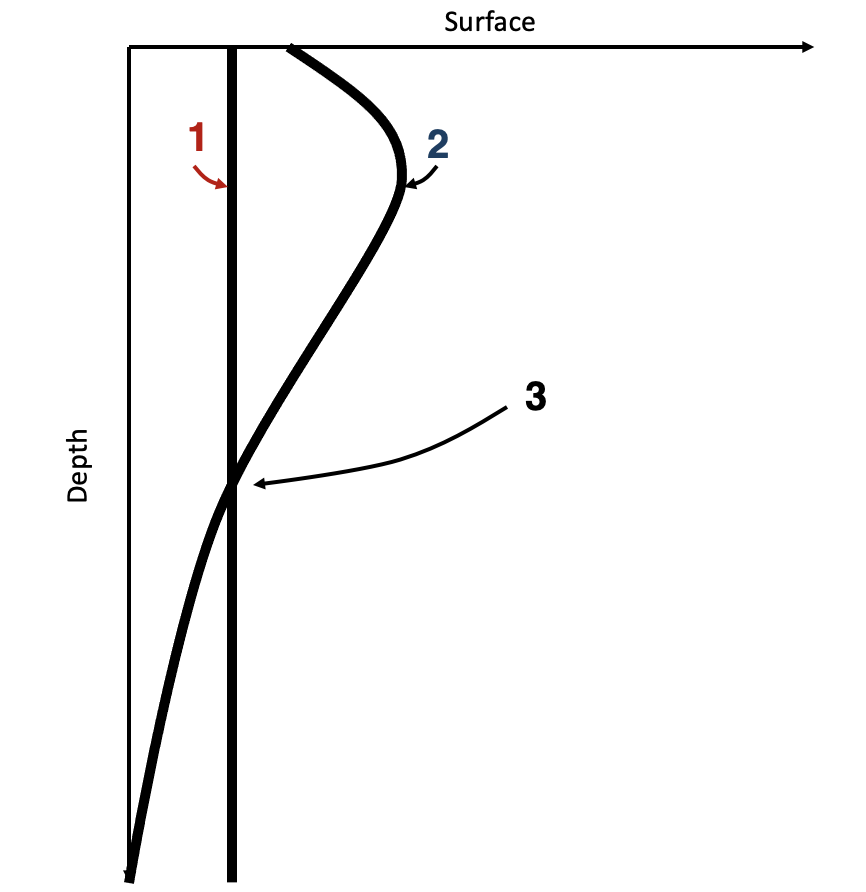
Consider the processes that determine compensation depth. What is process #2 in the plot below?
Photosynthesis
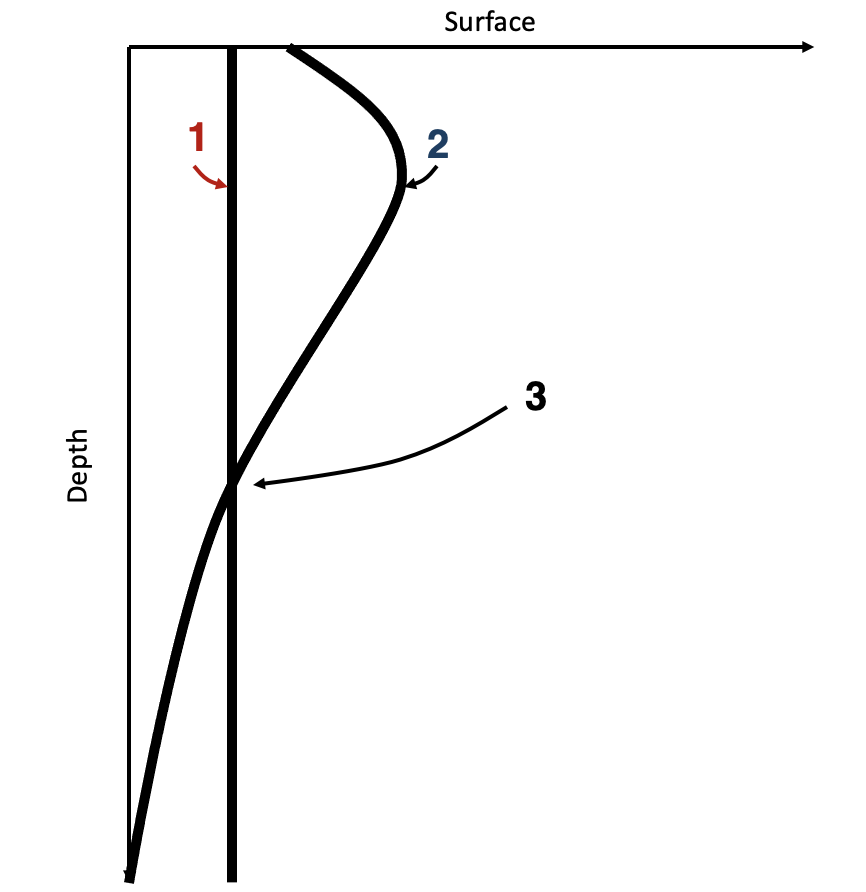
Consider the processes that determine compensation depth. What is process #1 in the plot below?
Respiration
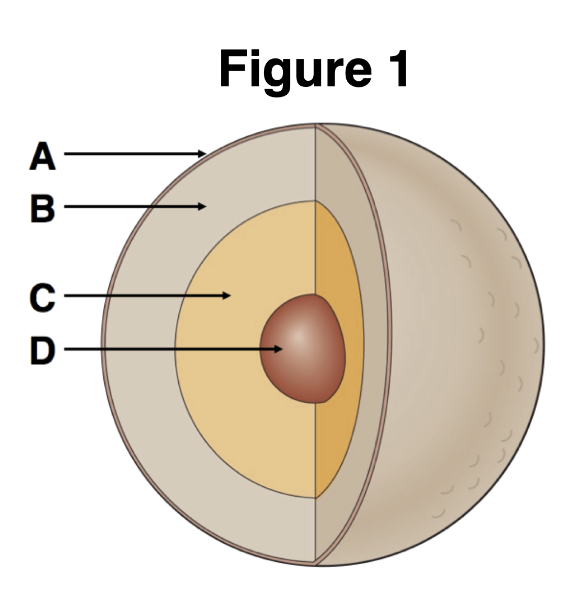
Which feature in the figure is called the mantle?
B
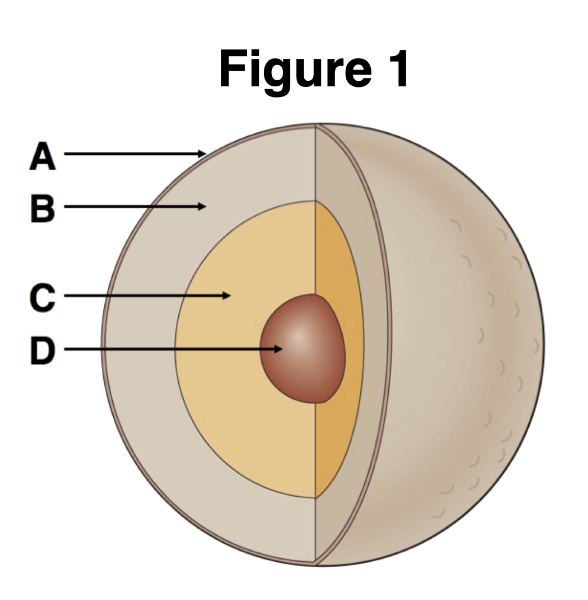
Which feature in the figure is comprised of liquid phase matter?
C
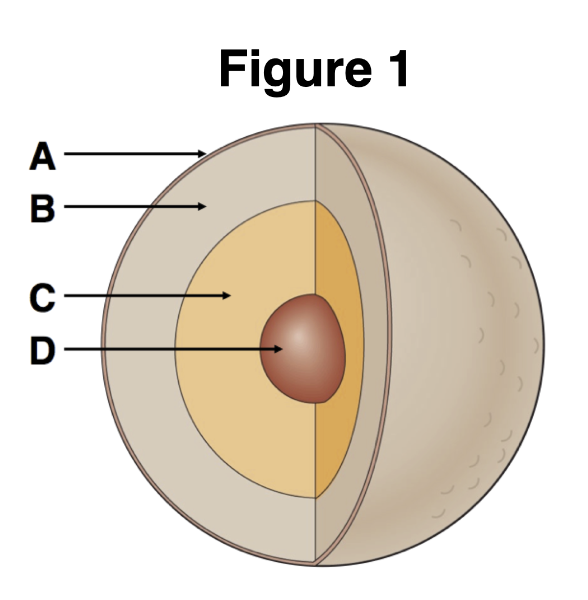
The layers of Earth identified in the figure are sorted by what property?
Density
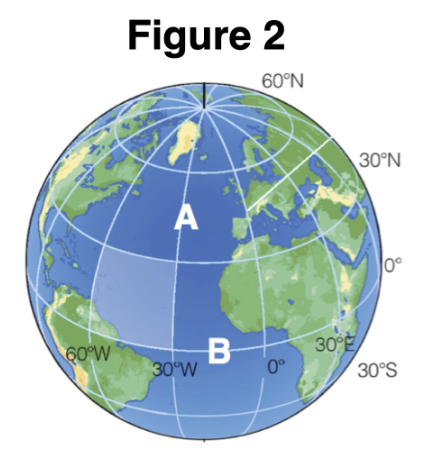
Which line in the figure represents a constant latitude?
Line B
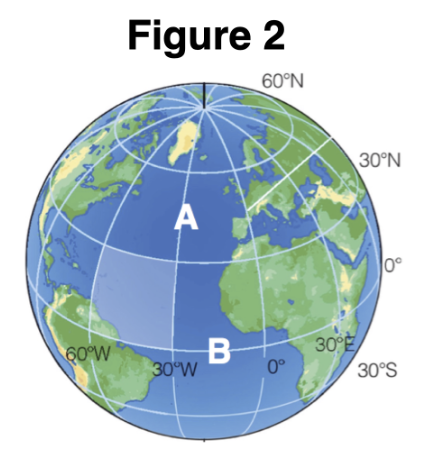
T/F. The distance or spacing btw neighboring lines of longitude is constant, no matter the latitude you are standing on.
False
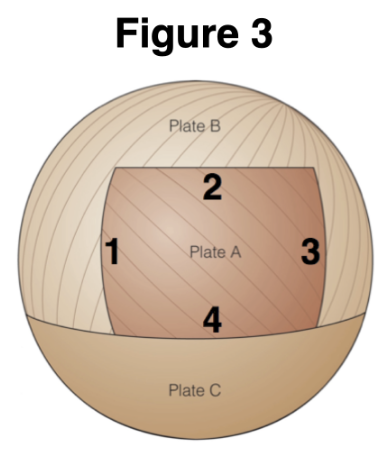
If Plate A in the figure is moved southward into Plate C, which plate boundary will be a divergent boundary?
Boundary 2
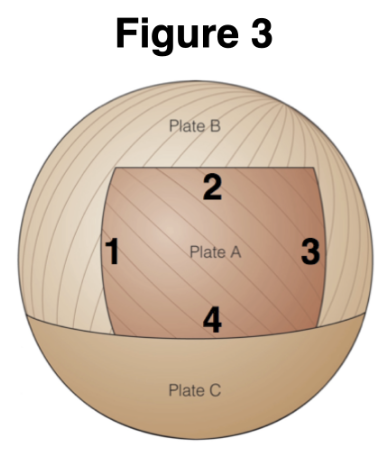
If Plate A is moved southward, how many transform boundaries will there be?
2
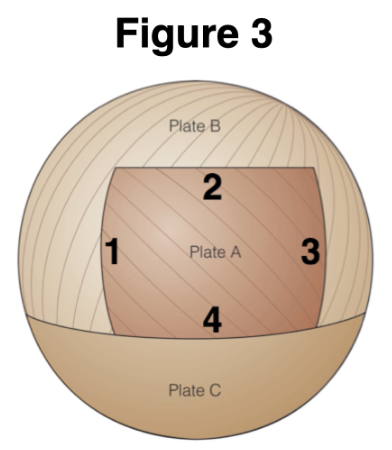
If Plate A is moved southward, will Plate A subduct beneath Plate C?
Unknown; need info on the densities of the plates
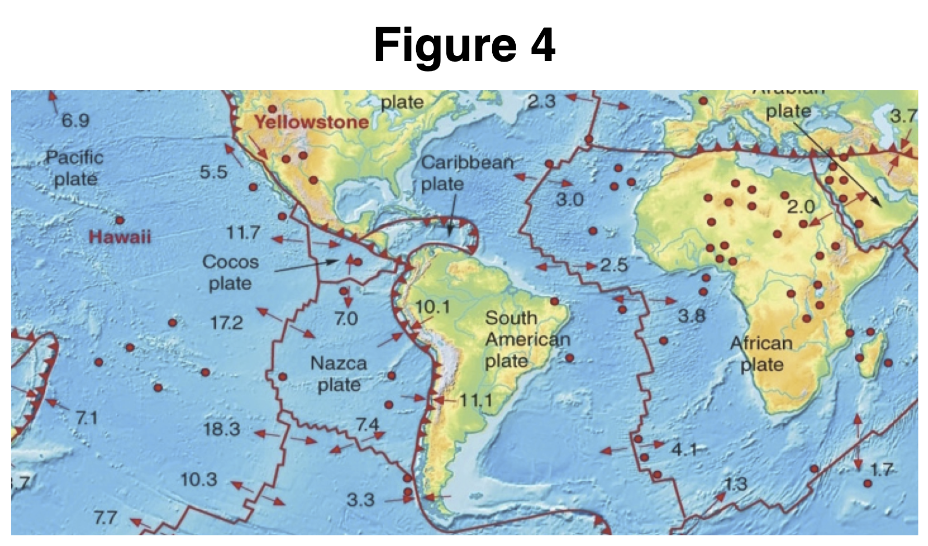
Which of the following does NOT describe the west coast of South Africa
Spreading center
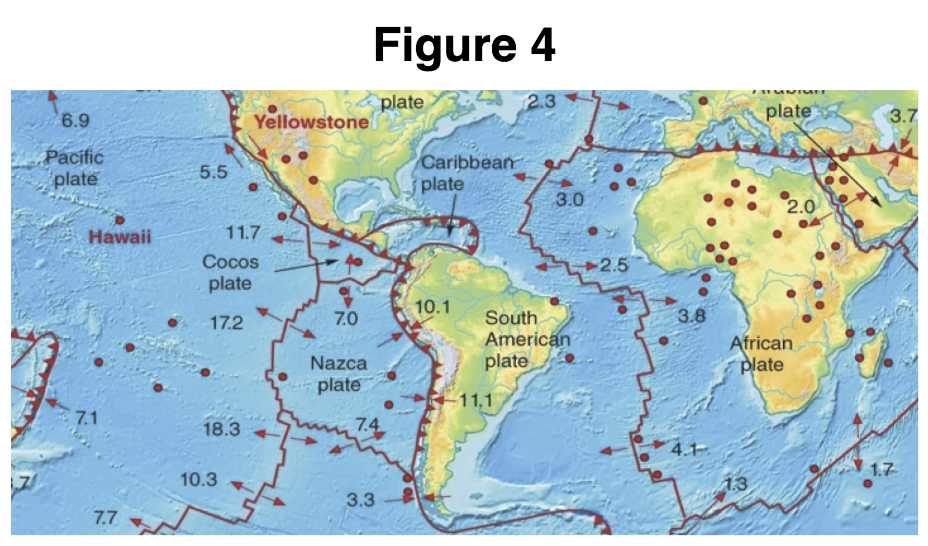
Which of the following statements is entirely TRUE of the plate boundaries running down the center of the Atlantic Ocean?
It is a divergent plate boundary with relatively young crust
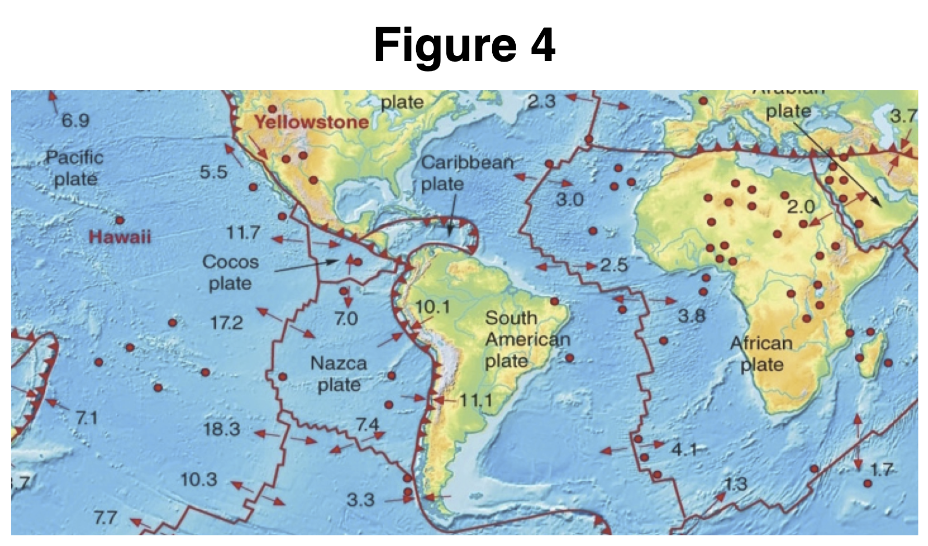
T/F. The eastern seaboard of the United States is an active margin
False
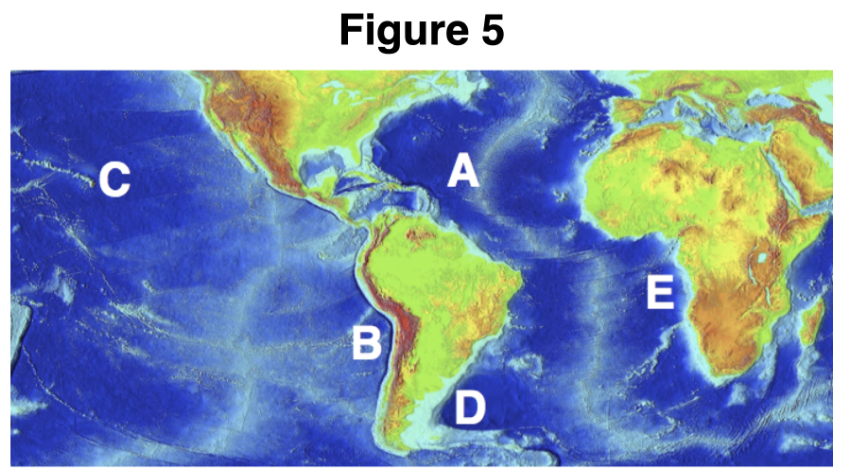
To the immediate west of which location can you find a hotspot island chain?
C
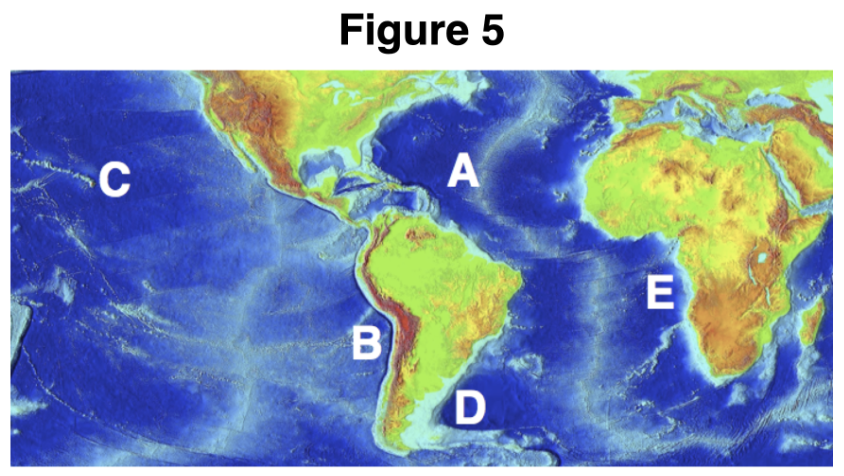
To the immediate west of which location can you find a broad continental shelf?
A
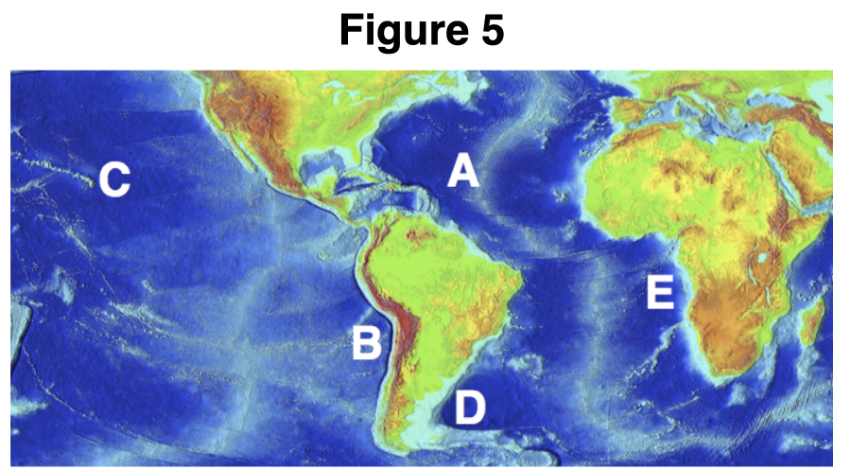
To the immediate east of which location can you find a convergent plate boundary and an active continental margin?
B
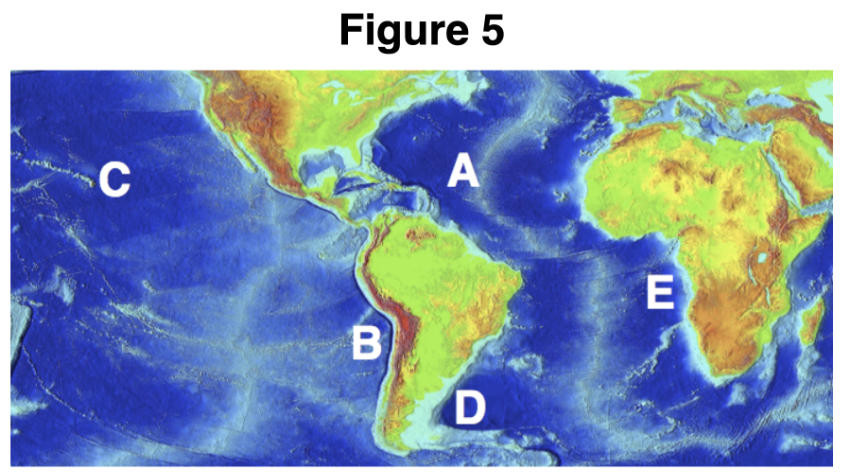
T/F. Locations D and E are both next to passive margins.
True
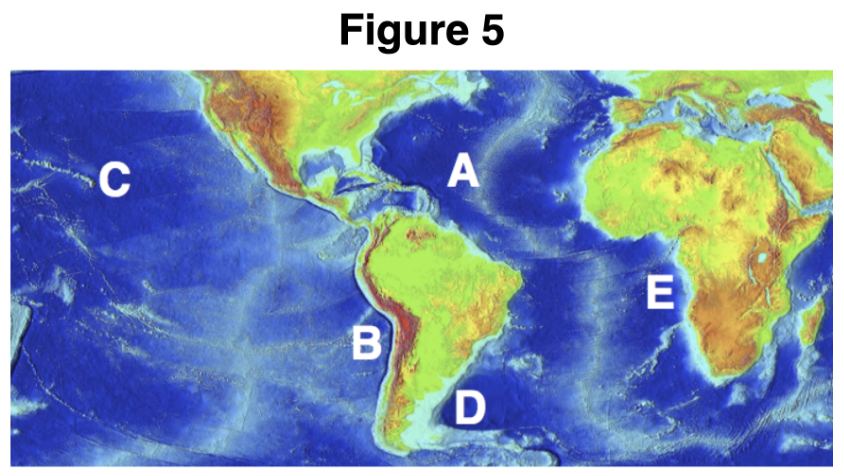
At which location (A or E) are you more likely to find older crust?
E
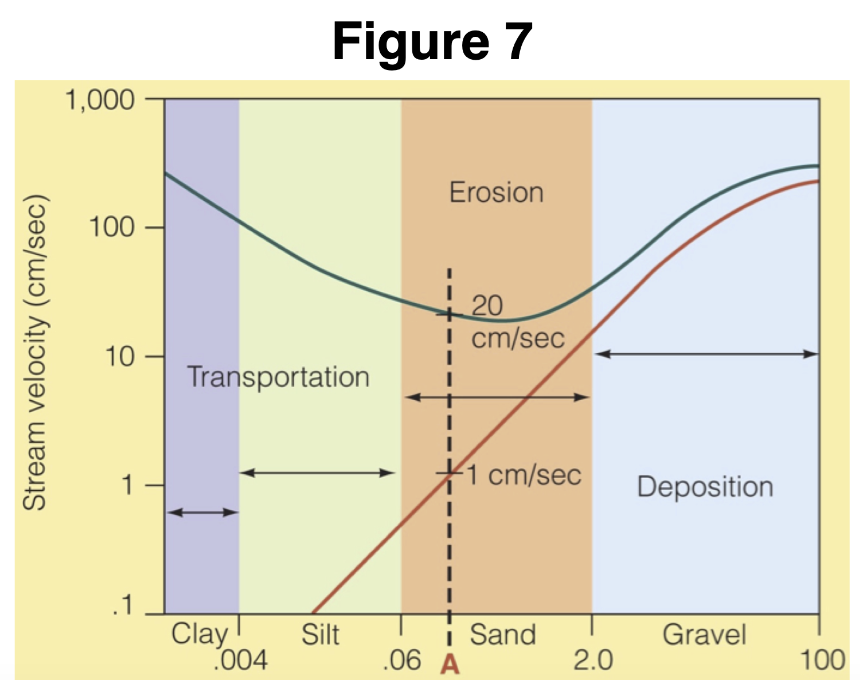
A large particle of gravel that is 10 mm in diameter will undergo ________ if the stream velocity is 1 cm/sec.
Deposition
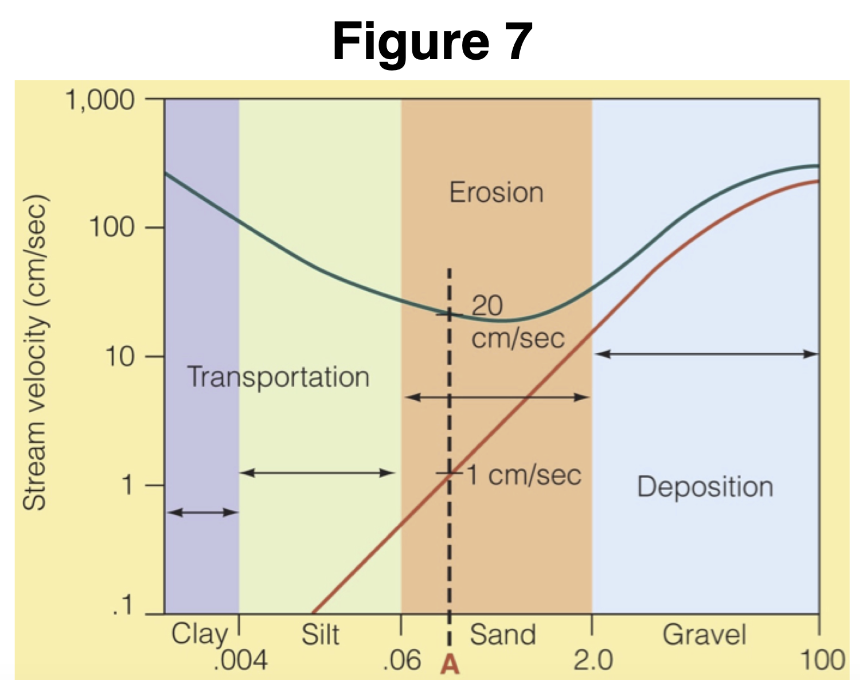
T/F A stream velocity of 100 cm/sec will cause erosion no matter what the particle size is.
False
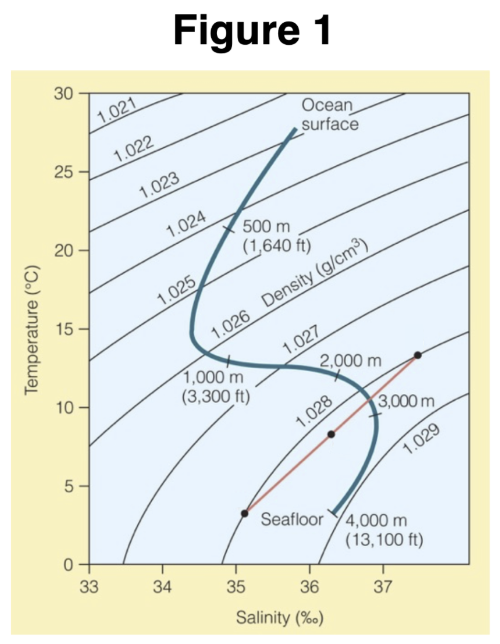
Which water mass characteristics will result in the lowest density?
Temp = 25C, salinity = 34%
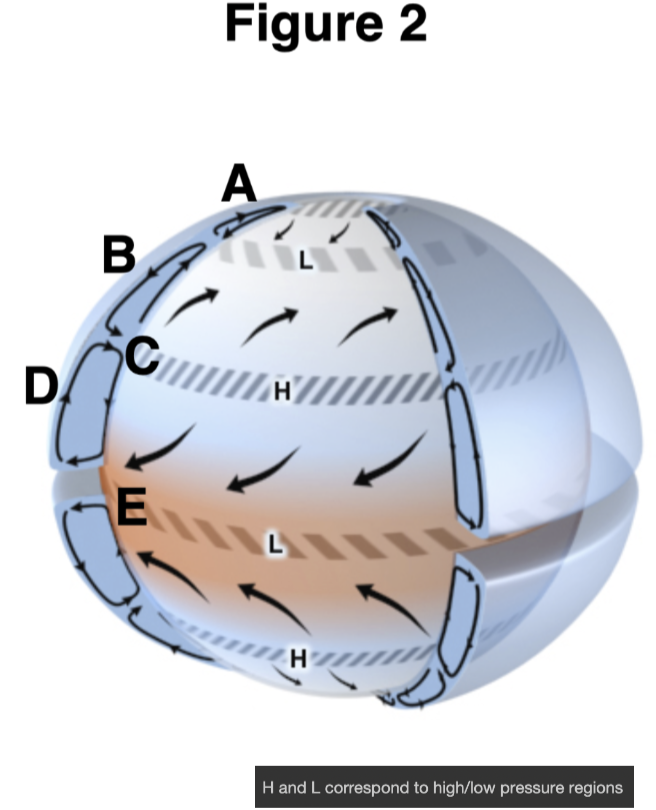
Which label corresponds to the Polar cell?
A