REG 1 - Federal Taxation of Individuals
 Call Kai
 Learn
Learn Practice Test
 Spaced Repetition
 Match
Match Flashcards
 Knowt Play
1/69

There's no tags or description
Looks like no tags are added yet.
Name | Mastery | Learn | Test | Matching | Spaced | Call with Kai | Chat |
|---|
No analytics yet
Send a link to your students to track their progress
70 Terms
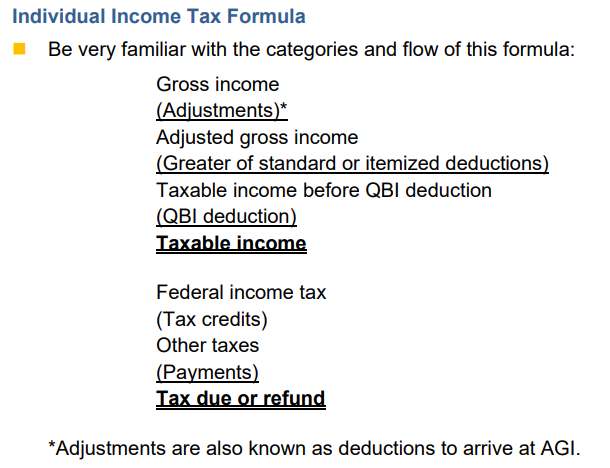
What is the individual income tax formula?
Gross income – Adjustments = Adjusted Gross Income (AGI)
minus greater of standard or itemized deductions
= Taxable income before Qualified Business Income (QBI)
minus QBI deduction
= Taxable income.
Federal Income Tax
minus tax credits
= Other taxes
minus payments
Tax due or refund
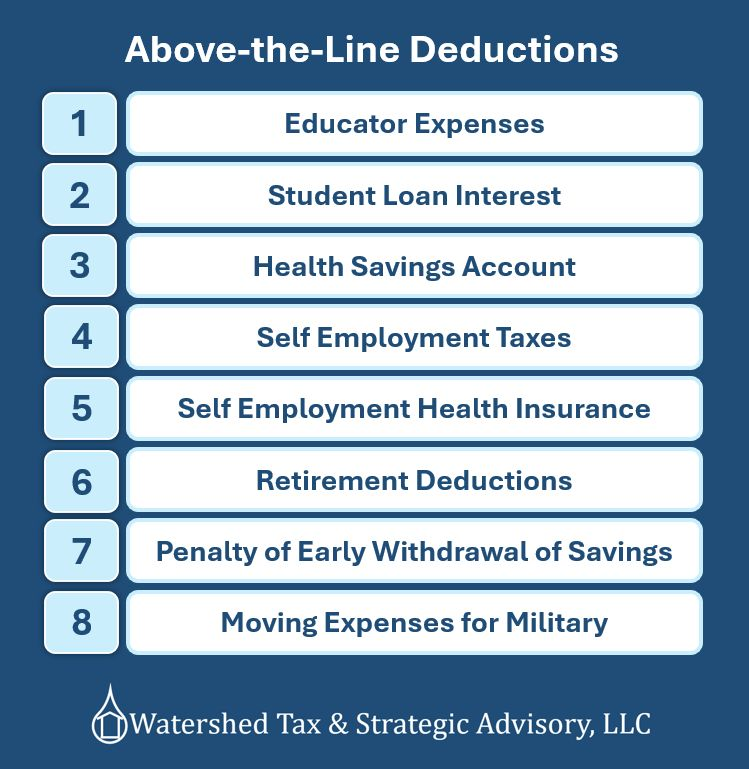
What are 11 “adjustments to gross income” or “above-the-line” deductions?
Deductions to arrive at AGI, available whether you itemize or not.
Examples:
Educator expenses – up to $300 per teacher ($600 MFJ).
Student loan interest – up to $2,500 per year.
Health Savings Account (HSA) contributions – up to $4,300 single / $8,550 family (2025).
Traditional IRA contributions – up to $7,000 (+$1,000 catch-up) if eligible.
50% of self-employment tax – automatic deduction for the self-employed.
Self-employed health insurance premiums – 100% deductible.
Contributions to self-employed retirement plans – SEP, SIMPLE, or Solo 401(k).
Penalty on early withdrawal of savings – like CDs.
Alimony paid – only for divorces finalized on or before 12/31/2018.
Moving expenses – only for active-duty military under orders.
Attorney fees – in certain discrimination or whistleblower cases.
What are the 5 types of individual filers?
Single – Unmarried or legally separated as of December 31.
Married Filing Jointly (MFJ) – Married couple combining income and deductions on one return.
Married Filing Separately (MFS) – Married but filing separate returns.
Head of Household (HOH) – Unmarried, pays the cost of keeping up a home for a qualifying person for >1/2 year.
Qualifying Surviving Spouse (Widow/Widower) – Spouse died within the last two years and taxpayer has a dependent child whom they have provided for for >1 year.
What is the criteria to determine if someone is a qualifying child? (CARES)
CARES → Qualifying Child
Close relative
Age limit (<19yo, or <24 if full-time student/disabled)
Residency & filing rules ( live with > ½ yr)
Eliminate gross income test (not required like for qualifying relative)
Support test (child can’t provide for themselves)
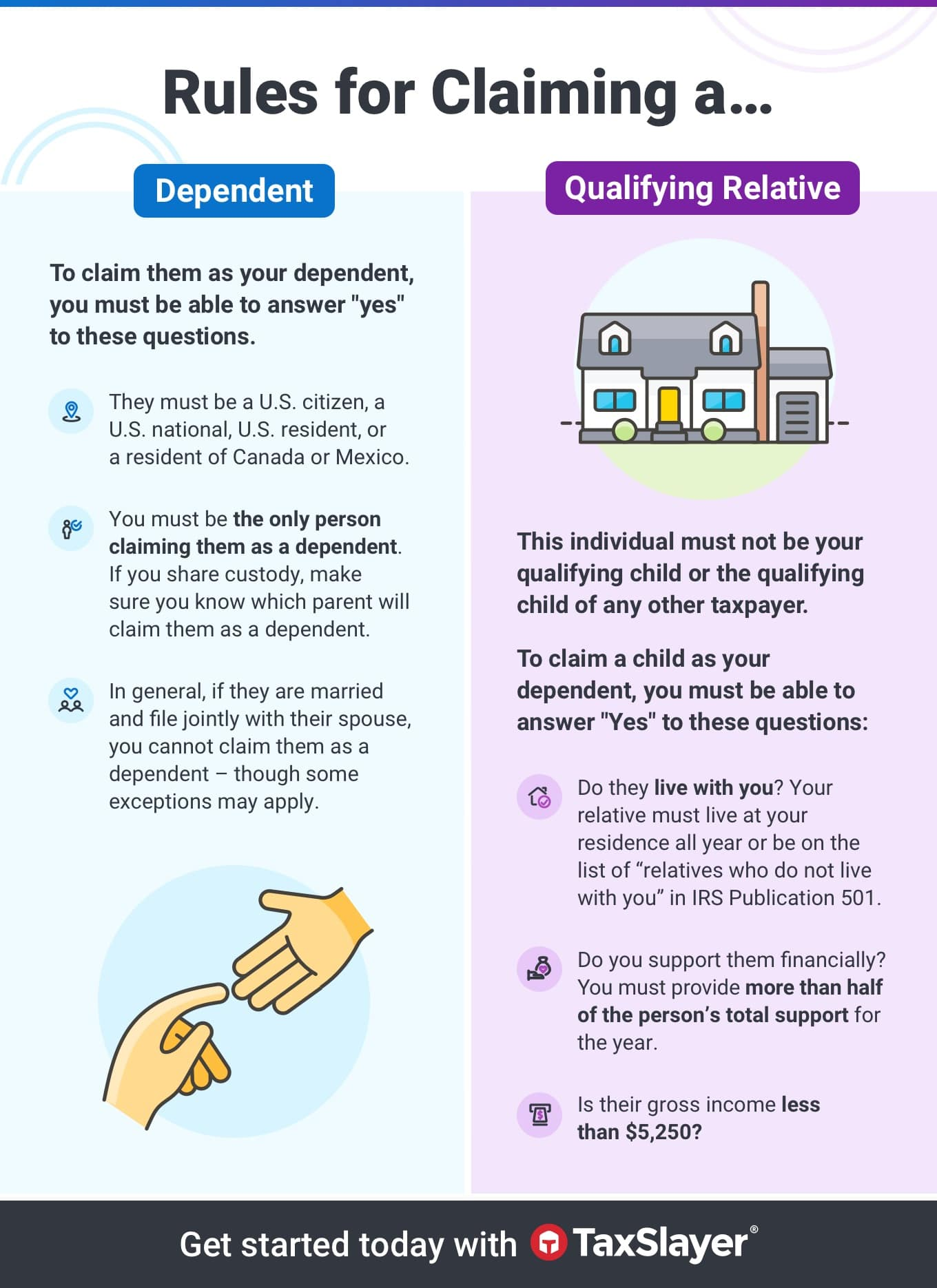
What is the criteria to determine if someone is a qualifying relative? (SUPORT)
SUPORT → Qualifying Relative
Support (provide > ½ )
Under gross income limit (ex: <$5050 for 2025)
Precludes joint return
Only citizens
Relative test
Taxpayer lives with individual >1 year
What is a multiple support agreement?
When two or more taxpayers together provide > 50% support; the one giving ≥ 10% may claim dependent if others agree.
File a form 2120
What’s the difference between realized gain and recognized gain?
Realized gain: The economic gain you calculate when property is sold (amount realized – adjusted basis).
Example: Sell stock for $12,000 with a $5,000 basis → $7,000 realized gain.
Recognized gain: The portion of the realized gain that is actually taxable after applying tax rules (exclusions/deferrals).
Example: Sell your personal residence with a $300,000 realized gain → you can exclude up to $250,000 (or $500,000 MFJ).
If you're single: Recognized gain = $300,000 – $250,000 = $50,000.
Even though $300K was realized, only $50K is recognized (taxed).
What are nontaxable fringe benefits?
Health insurance
Group-term life ≤ $50k
Education assistance
Adoption aid
Dependent care (up to limits).
What is nontaxable interest income?
Interest on state and local bonds; Series EE bonds if used for qualified education.
How are qualified dividends taxed?
At 0%, 15%, or 20% rates depending on taxpayer income level.
What portion of IRA distributions is taxable?
Earnings from deductible IRAs are taxable as ordinary income; principal is not.
What are the exceptions to the 10% IRA early withdrawal penalty (HIM DEAD TED)?
Homebuyer
Insurance (unemployed)
Medical > AGI floor, Disability, Education, Adoption or birth, Disaster, Terminal illness or death, Emergency, Domestic abuse.
When are state tax refunds taxable?
Only if you itemized last year and received a tax benefit.
Are unemployment and workers’ comp taxable?
Unemployment is taxable; workers’ comp is nontaxable.
How much of Social Security is taxable?
0%, 50%, or up to 85%, based on MAGI + ½ benefits.
What is included in business income on Schedule C?
Gross receipts minus ordinary and necessary expenses
50% of meals deductible
No entertainment.
Are self-employment taxes deductible?
50% of self-employment tax is an adjustment to AGI.
How are hobby losses treated?
Not deductible beyond income; profit 3 of 5 years creates business presumption.
How is rental income taxed?
Prepaid rent taxable when received
Personal residence rented < 15 days = tax-free.
What income flows through to individuals?
Partnership, LLC, and S corp income passes through and retains character.
What limits flow-through losses?
Tax basis limit + at-risk limit + excess business loss limit ($626k MFJ in 2025).
What are common adjustments for AGI?
Educator expenses, student loan interest, HSA, moving (for military), penalty on savings withdrawal, alimony (pre-2019), attorney fees, IRA contribution, ½ S/E tax, S/E health insurance.
What is the IRA contribution limit for 2025?
Lesser of earned income or $7,000 (+ $1,000 catch-up if 50+).
What are key itemized deductions?
Medical > 7.5% AGI
SALT limit $10k
Mortgage interest (HIPPE)
Charity within AGI limits
Casualty loss (federal disaster)
Gambling losses to extent of winnings
What taxes are not deductible (FIB)?
Federal income, Inheritance, Business and rental property taxes.
How is home mortgage interest limited?
Up to $750k of acquisition debt on first and second homes.
When are charitable contributions deductible?
Ceiling for deductions = Cash ≤ 60% AGI; ordinary income property ≤ 50%; LTCG property ≤ 30%.
Floor for deductions = 0.5%
When is the final federal income tax return due for a calendar-year decedent who died during the year?
April 15 of the year following the year of death. The final return is treated as if the decedent were still alive, so it follows the normal April 15 due date — no earlier than death and no later than the year after.
How do you determine the taxable portion of each annuity payment for a fixed-period (annuity-certain) annuity?
Use the exclusion ratio to find the nontaxable return of capital per payment:
Exclusion per payment = Investment in contract / Number of payments
Any amount received above this exclusion is included in gross income (taxable).
When does gain or loss arise on a sale of listed stock?
On the trade date.
Regardless of whether the taxpayer uses the cash or accrual method, a sale of stock or securities on an established securities market must be recognized on the trade date—not the settlement date.
Why it matters: Normally, a cash basis taxpayer recognizes income when cash is actually or constructively received. The sale of publicly traded stock is a key exception—gains/losses are recognized on the trade date even though cash hasn't yet been received and the settlement hasn't occurred.
How are alimony, child support, and property settlements taxed under a pre-2019 divorce decree?
Type | To Recipient | To Payor |
|---|---|---|
Alimony (cash, support purpose) | Taxable | Deductible |
Child support | Nontaxable | Nondeductible |
Property settlement | Nontaxable | Nondeductible |
Alimony must be: cash/cash equivalent, required by decree, end at recipient's death, separate households, no joint return, not designated otherwise.
Key traps:
Cash from property settlement ≠ alimony
Mortgage payments that survive recipient's death = property settlement, not alimony
Child support gets paid first if combined payments fall short
Mnemonic: "P-C-A" — only Alimony is taxable/deductible.
How are gambling winnings and losses taxed?
Winnings = fully taxable
Gambling losses deductible only up to winnings
Itemized deduction only
When is cancellation of debt (COD) taxable?
Debt forgiven = taxable income unless excluded (bankruptcy, insolvency, certain qualified situations).
When are scholarships taxable?
Used for tuition/required fees/books → nontaxable.
Used for room & board or payment for services → taxable.
Are life insurance proceeds taxable?
Death benefit generally nontaxable.
Interest earned after death is taxable.
Are gifts and inheritances taxable to the recipient?
No.
Income later earned from the property is taxable.
What is the Child Tax Credit?
Credit for a qualifying child under age 17. Partially refundable and phases out for high-income taxpayers.
What is the Credit for Other Dependents?
Nonrefundable credit for dependents who do not qualify for the Child Tax Credit (e.g., older children or qualifying relatives).
What is the Earned Income Tax Credit?
Refundable credit for low-income taxpayers based on earned income and number of qualifying children.
What is the Child and Dependent Care Credit?
Credit for expenses paid so the taxpayer can work or look for work while caring for a qualifying child or dependent
What is the American Opportunity Tax Credit?
Credit for undergraduate education expenses (first four years). Partially refundable.
What is the Lifetime Learning Credit?
Credit for qualified education expenses with no limit on years of education. Nonrefundable.
What is the Foreign Tax Credit?
Credit for foreign income taxes paid. Taxpayer generally chooses either a credit or an itemized deduction—not both.
What is the Retirement Savings Contribution Credit?
Credit for eligible low- and moderate-income taxpayers who contribute to an IRA or qualified retirement plan.
What is the Premium Tax Credit?
Refundable credit that helps eligible taxpayers pay health insurance premiums purchased through the Health Insurance Marketplace.
Match the tax credit to its purpose.
Child Tax Credit
Credit for Other Dependents
Earned Income Tax Credit
Child & Dependent Care Credit
American Opportunity Credit
Lifetime Learning Credit
Foreign Tax Credit
Retirement Savings Credit
Adoption Credit
Premium Tax Credit
Child Tax Credit → Qualifying child under 17
Credit for Other Dependents → Dependents not qualifying for CTC
Earned Income Tax Credit → Low-income workers
Child & Dependent Care Credit → Child/dependent care so taxpayer can work
American Opportunity Credit → Undergraduate education (first 4 years)
Lifetime Learning Credit → Any postsecondary education
Foreign Tax Credit → Foreign income taxes paid
Retirement Savings Credit → IRA/retirement contributions
Adoption Credit → Qualified adoption expenses
Premium Tax Credit → Marketplace health insurance premiums
Head of household requires _____ year living with.
Qualifying surviving spouse requires _____ year living with.
Head of household = Half year
Widow = Whole year
If $10K alimony gets reduced by 20% when a child turns 18, how much of the $10K is taxable?
$8K. If the payments are dependent on the child’s age, then the portion that is dependent is considered child care.
If you win a cash prize, what 2 things do you have to do in order to avoid getting taxed?
You cannot have entered into the competition or done something yourself to win the prize.
You must donate the money to another gov org or nonprofit
If you get a grant for tuition/fees for a bachelor or graduate program to pursue a degree, is that money taxable income?
No, not taxable as long as you are pursuing a degree
For cash-basis gross income in tax purposes, why do we specify, whether the income is “constructively received”? Why not just say when received?
Once the taxpayer has access to the funds, they need to claim it as gross income. This stops cash-method taxpayers from dodging taxes simply by refusing to pick up a check or asking an employer to delay writing it until the next year.
Is inheritance taxable?
No
How do you calculate how much life insurance benefits are taxable?
Only $50K of coverage is tax-free. The rest of the coverage premiums are taxable.
A painter and an accountant agree to trade their services. The painter provides services valued at $550, and the accountant provides services worth $500. What amount should the accountant report as income or expense?
$550 income for the accountant.
In the case of noncash income, the amount of income to be reported is the fair market value of the property or services received. The fair market value of any services rendered is irrelevant; thus, the difference between the fair market value of services received and the fair market value of services rendered does not result in additional income or expense.
series ee bond interest income is not taxable if you are using it for tuition. but what are some limitations?
you can’t be making more than (80K?) MAGI
if you have scholarships that are not included in gross income, those offset any benefit
after 1989, you have to be over 24 when you buy the series ee bond.
you have to be the sole owner
Example of divorce happens in 2014. The ex husband has to pay alimony and child support and ends up paying less than what’s due. How much alimony/gross income is recognized for ex wife?
Whatever is paid is first allocated to child support, then once that amount due is covered, the rest of the paid amount is considered alimony.
What are the differences between an S-Corp and an LLC?
Would sale of capital gains be counted as ordinary income in a partnership?
LTCG aren't ordinary income because they come from the sale of a capital asset (an investment), not from operations or work effort. "Ordinary income" has a specific tax meaning—wages, business income, interest, dividends, rents, etc.
The distinction matters because of how each is treated:
Preferential rates — LTCG gets taxed at 0%, 15%, or 20%, not the ordinary brackets. STCG, while sitting in the ordinary rate brackets, still isn't classified as ordinary income.
SE tax — Ordinary trade/business income is hit with 15.3% SE tax; capital gains are not.
Loss limitations — For individuals, net capital losses can only offset up to $3,000 of ordinary income per year, with the rest carried forward. Corporations can't deduct capital losses against ordinary income at all.
Netting process — Capital gains and losses go through their own three-tier netting (ST vs. LT, then against each other, then against ordinary income up to the $3K cap) before they ever touch the ordinary income line.
How much can a self-employed person deduct from their income for contributions to their IRA?
The maximum annual deductible amount for self-employed individuals to a SEP IRA is the lesser of $72,000 (2026) or 20 percent of net earnings. "Net earnings" is defined as net self-employment income minus 50 percent of self-employment (S/E) taxes.
What is the additional standard deduction amount available for ppl >65 yo?
$1650 extra per taxpayer. So if married, then $1650×2
When and why should you file an amended tax return (Form 1040-X)?
You file to correct significant mistakes or updates after your original return is submitted.
Top Reasons to File:
Income: Adding forgotten W-2s, 1099s, or side hustle money.
Status: Correcting your filing status (e.g., Single to Head of Household).
Dependents: Adding a missed child or removing an ineligible person.
Credits: Claiming a missed tax break like the Child Tax Credit.
Why do governments charge annual property tax on things people own? (Cars, boats, homes)
Property taxes are recurring taxes on ownership, not on income or purchases. They help fund local government services such as:
🏫 Public schools
🚒 Fire departments
👮 Police
🛣 Roads and infrastructure
📚 Libraries and parks
What are the steps for calculating a deductiblepersonal casualty loss?
Loss=lesser of FMV decrease or adjusted basis
Then:
Subtract insurance reimbursement.
Subtract $100 for each casualty.(intended to exclude small losses and simplify administration)
Add all remaining casualty losses for the year.
Subtract 10% of AGI once from the aggregate loss. (This ensures that only losses exceeding a significant percentage of the taxpayer’s income are deductible.)
The remaining amount is the itemized deduction.
Formula:
(Casualty loss−insurance−$100 per casualty)−(10%×AGI)
Remember: $100 applies per event; 10% of AGI applies once to the total.
How to calculate gambling loss deduction?
Calculate what is 90% of gambling losses
Only deduct the 90% up to the extent of gambling winnings.
What is the SALT deduction, and how do you take it?
SALT = State and Local Taxes paid by an individual.
Taken as an itemized deduction.
Includes:
Real estate taxes → e.g., annual property tax on your home.
Personal property taxes → e.g., annual value-based tax on a car or boat.
Either state/local income taxes OR sales taxes → choose one, not both.
Total SALT deduction is limited to $40,400 for 2026.
Why? These are taxes you already paid to state/local governments, so federal tax law allows a limited deduction when itemizing.
Key rule: A personal property tax must generally be based on the property’s value. Simply buying/owning a car doesn’t create a deduction.
Exam trap: Federal income taxes are not SALT.
What is the qualified vehicle loan interest deduction?
An additional deduction of up to $10,000 of interest paid on a qualifying loan used to purchase a vehicle for personal use.
Not an itemized deduction → available whether you itemize or take the standard deduction.
Vehicle’s original use must begin with the taxpayer → think new car, not used car.
Vehicle’s final assembly must occur in the U.S.
Subject to income limitations.
Why? This is a special exception to the normal rule that personal interest is nondeductible.
Exam trap: You’re deducting the interest, not the car payment/principal.
Think: New + U.S.-assembled + personal use = loan interest may qualify.
When is interest on a home equity loan deductible?
Home equity loan interest is an itemized deduction only when the borrowed money is used to buy, build, or substantially improve the home securing the loan.
Improve the home → deductible as home mortgage interest.
Personal use → not deductible (e.g., vacation, credit card debt, personal expenses).
Why? Personal interest is generally nondeductible; it qualifies only when the debt is treated as acquisition indebtedness related to the home.
The debt is subject to the overall $750,000 home mortgage debt limit.
Exam shortcut: Ask “What was the borrowed money used for?” Not simply, “Was the house used as collateral?”
What items are included and excluded from Qualified Business Income (QBI) when calculating the Section 199A QBI deduction?
✅ Included in QBI
Ordinary business income from a sole proprietorship, partnership, S corporation, or LLC
❌ Excluded from QBI
Interest income
Dividend income
Capital gains and losses
Guaranteed payments to partners
Reasonable compensation paid to S corporation shareholders
Wage income
Memory Trick:
QBI = Regular business profit only.
Investment income and compensation payments do not count
What are the 2026 taxable income thresholds for the Qualified Business Income (QBI) deduction, and why do they matter?
Filing Status | Threshold | Phase-Out Ends |
|---|---|---|
Single / HOH | $201,750 | $276,750 |
MFJ | $403,500 | $553,500 |
MFS | $201,775 | $276,775 |
✅ Below the threshold:
Generally entitled to the full 20% QBI deduction
No W-2 wage/property limitations
SSTB restrictions do not apply
⚠ Within the phase-out range:
Wage/property limitations begin to apply
SSTB deduction begins to phase out
❌ Above the phase-out range:
SSTBs lose the deduction entirely
Non-SSTBs are subject to full wage/property limitations
Memory Trick:
"2026: Think 202K Single, 404K MFJ."
CPA Exam Tip:
The first step in a QBI problem is often to compare the taxpayer's taxable income before the QBI deduction to the applicable threshold
What are the safe harbor rules to avoid theunderpayment of estimated tax penalty forindividuals?
Pay the lesser of:
90% of the current year's tax liability, OR
100% of the prior year's tax liability (paid in fourequal installments)
If prior year AGI > $150,000, the prior-year safe harborbumps to 110%.