Bio180Physio - Lec2 Energy Metabolism
 Call Kai
 Learn
Learn Practice Test
 Spaced Repetition
 Match
Match Flashcards
 Knowt Play
1/7

There's no tags or description
Looks like no tags are added yet.
Name | Mastery | Learn | Test | Matching | Spaced | Call with Kai | Chat |
|---|
No analytics yet
Send a link to your students to track their progress
8 Terms
Explain how energy is stored in the body (3 ways)
stored under skin as fat
store other energy from carbohyrates→glucose→glycogen→ store in liver, will be the first resort for burning energy
glycogen in muscle can not be converted to supply other body parts
Why can’t we eat ATP directly? Explain reason, ATP structure, and the alternative way to get ATP
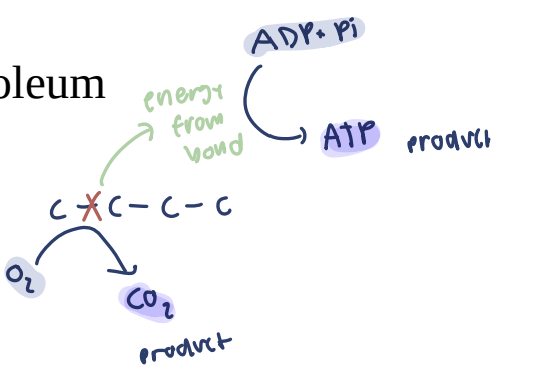
atp too unstable to eat directly → eat carbohydrates and lipids, oxidizing carbon chain to make ATP
where is glycolysis happening
in cytosol → extract energy from glucose
what are the two processes happening in the mitochondria
citric acid cycle → in the matrix
oxidative phosphorylation → across inner membrane
both require oxygen and extract energy from carbohydrates/fats/proteins
draw glycolysis and summarize products
4 ATP (net 2 atp), 2 NADH / H+ (net 0)
anaerobic pyruvate → lactic acid → 2ATP
aerobic → pyruvate to citric acid cycle → 38 ATP
explain intermediate step
glycolysis → pyruvate
in mitochondria matrix, pyruvate and CoA make acetyl CoA (+NADH and CO2)
draw and explain citric acid cycle
In matrix, endless cycle, uses the acetyl CoA from the intermediate step
draw and explain oxidative phosphorylation
hydrogen from the NADH / H+ or FADH2, plus O2, makes H2O → is a reactive chain producing ATP