SIE Prep
 Call Kai
 Learn
Learn Practice Test
 Spaced Repetition
 Match
Match Flashcards
 Knowt Play
1/131

There's no tags or description
Looks like no tags are added yet.
Name | Mastery | Learn | Test | Matching | Spaced | Call with Kai | Chat |
|---|
No analytics yet
Send a link to your students to track their progress
132 Terms
What is selling shares that increase in price?
capital appreciation
What is a distribution of profits?
dividends
What is authorized stock?
the number of shares that the company is authorized to issue
What is issued stock?
authorized stock that has been sold to investors
What is outstanding stock?
all shares that a company has issued and are in hands of investors
What is treasury stock?
stock a corporation has issued then later bought back
Shares outstanding formula
issued shares-treasury stock
What is the market cap of large cap stocks?
excess of $10 billion
What is market cap for mid- cap stocks?
$2 billion to $10 billion
What is the market cap for small- cap stocks
$250 million to $2 billion
What do penny stocks trade for?
less than $5/share
What does SEC require in regard to penny stocks?
customers be given a copy of a risk disclosure document before the initial transaction
Regardless of activity in customers account, BD must provide what to customer regarding penny stock?
provide a monthly account statement to the customer indicating market value and # of shares as well as issuer name
Established customers are exempt from sustainability statement requirement but not from disclosure requirements in regard to penny stock if the customer:
#1 has held an account with the BD for at least a year
#2 has made at least 3 penny stock purchases of different issuers on different days
What does DERP stand for?
Declaration
Ex-dividend
Record
Payable
Which dates are typically the same
ex-date & record date
What dates are established by the company’s board?
declaration date, record date and payable date
What dates are established by a regulator like FINRA?
ex-dividend date
What is statutory voting?
Example 1: Shareholder owns 100 shares in a statutory vote
Statutory Voting | |
Board of directors: seat 1 | 100 |
Board of directors: seat 2 | 100 |
Board of directors: seat 3 | 100 |
What is cumulative voting?
Example 2: Shareholder owns 100 shares in a cumulative vote
Cumulative Voting | OR | Cumulative Voting | ||
Board of directors: seat 1 | 175 | Board of directors: seat 1 | 300 | |
Board of directors: seat 2 | 50 | Board of directors: seat 2 | 0 | |
Board of directors: seat 3 | 75 | Board of directors: seat 3 | 0 | |
What rights to information does common stockholders have?
right to receive an audited set of financial statements of company’s performance (form 10-k) made part of annual report
What are preemptive rights?
right to maintain their proportionate share of ownership in corporation
What are the financial benefits offered by owning common stock?
-capital gains
-income
-limited liability
Why include common stock in client’s portfolio?
-potential capital appreciation
-income from dividends
-hedge (protection) against inflation
What are the risks of owning common stock?
-value risk
-decreased or no dividend income
-low priority at dissolution
What is straight preferred (noncumulative) stock?
no special features, missed dividends are not paid to holder
What is cumulative preferred stock?
accrues payments due to its shareholders if dividends are reduced or suspended (unpaid dividends add up until paid)
What is callable preferred stock?
company can buy back from investor at its stated price after specified date
What is convertible preferred stock?
if the owner can exchange the shares for a fixed number of shares of the issuer’s common stock
What is adjustable rate preferred?
preferred stock issued with adjustable dividend rates
What is participating preferred stock?
offers owners an additional share of corporate profits after all other dividends are paid
What are the benefits of owning preferred stock?
-dividend preference
-priority at dissolution over common stock
What are the risks of owing preferred stock?
-purchasing power risk
-interest rate sensitivity
-decreased or no dividend income
-priority at dissolution (creditors are paid before)
How are ADR’s taxed?
-dividends paid to a U.S. investor may be subject to a withholding tax by the home country of the issuer
-any trading profits (capital gains) from the ADR would only be taxable in the U.S.
What are the risks associated with ADRs?
-currency and political risk
-voting and preemptive rights
What is rule 144 stock?
an SEC rule that sets the requirements for selling or purchasing restricted, unregistered or control stocks
What is restricted stock?
are those initially acquired by investors through some means other than a registered public offering
Restricted securities may not be sold by investors until they have been held (fully paid) for how long?
6 months
What is a restrictive legend?
when restricted stocks are issued, this will be on the certificate warning about the period restriction
The volume limitations on the number of shares that can be sold under rule 144 are the greater of (for control stock)
#1 1% of the outstanding shares of the company or
#2 the average weekly trading volume over the most recent 4 weeks
What are stock rights/ preemptive rights?
grants existing stockholders the opportunity to maintain their proportionate ownership in a company by buying the newly issued shares before the company offers them to the public
What is a rights offering?
allows stockholders to purchase common stock below the current market price to maintain ownership of shares
-given to existing shareholders
-allow one to purchase shares below current market value
What is a warrant?
certificate granting its owner the right to purchase securities from the issuer at a specified price
-bundled with other securities
-allows someone to purchase shares at a price that is above the current market value at the time the warrants were issued
What is the main difference between a warrant and a right?
a warrant is usually a long-term security that gives the investor the option of buying shares at a later date at the specified exercise price
What is a stock split?
a company divides each existing share of its stock into several new shares
-the total number of shares increases but the total value of all shares taken together remain the same
What is a forward split?
increases the number of shares and reduces the price without affecting the total market value of shares outstanding due to stock price being so high
-investor receives more shares but value of each share is reduced
-cost basis per share will decrease
What is a reverse split?
investors own fewer shares with a higher per share price due to stock price being low
What is a spin-off?
a corporation forms a subsidiary company out of some of the corporation’s assets and operations
-issues shares of newly formed corporation to shareholders of original company
What is a buyback?
company buys back its own outstanding shares in the open market from existing shareholders
Why would a company buyback shares?
reduces number of shares available and can increase value of shares available
What is a tender offer?
an offer to buy a security from the owners of the security (not through secondary markets)
What is the tax impact of stock splits and dividends?
never taxable because they result in receipt of additional shares
What is the tax impact of mergers, acquisitions, and spin-offs?
not taxable but cash portion is taxable as a capital gain or loss
What are the tax implications of buybacks and tender offers?
almost always all-cash offers and are treated as a sale of security resulting in taxable capital gain or loss
What should be included in notification of corporate actions?
-Title of the security
-Date of declaration
-Date of record for determining holders entitled to receive the distribution or to participate in the split
-Date of payment or distribution
-For a cash dividend—the amount to be paid
-For a stock dividend—the rate of the dividend (e.g., 10%)
-For a split (forward or reverse)—the rate of the distribution (e.g., 2:1, 3:2)
What is proxy solicitation?
offers to let a third-party vote the shares, like other shareholders, those wanting to take control of a company and activist investors seeking changes in the company
What are term bonds?
principal of the whole issue matures at once
What is a sinking fund?
a cash reserve to accumulate money to retire bonds at maturity
What are serial bonds?
schedule for portions of the principal to mature at intervals over a period of years until the entire balance has been repaid
What are balloon bonds?
maturity schedule that is hybrid of serial & term maturities
-issuer pays part of principal before final maturity date
-major portion is paid at final maturity
What is the coupon rate?
interest rate the bond issuer has agreed to pay the investor
What else is a coupon rate also called?
-stated yield
-nominal yield
What is accrued interest?
interest that has been earned or accumulated but has not yet been paid due to bonds trading between coupon payments
What is a bonds yield and what are the factors that relate to it?
measure of interest payments in relation to bond’s value
-bond’s
- rating-interest rates
-general interest rates
-time to maturity
What is the current yield?
measures a bond’s annual coupon payment relative to its market price
What is the current yield formula?
CY= annual coupon payment/ market price
What is a bond’s YTM?
reflects the annualized return of the bond if held to maturity
What is a bond’s YTC?
bond that may be redeemed by the issuer before maturity
What are yields measured in?
basis points which equal 1/100 or 1%
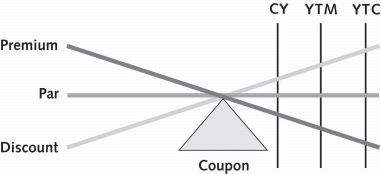
What is the relationship between price and yields?
-for a bond trading at a discount: coupon < CY < YTM < YTC
-for a bond trading at par: coupon = CY = YTM = YC
-for a bond trading at a premium: coupon > CY > YTM > YTC
What is a call feature and when would it generally be exercised?
allows an issuer to redeem a bond before maturity, typically when interest rates are falling
What is a put feature and when would it be exercised?
allows the investor to force the issuer to pay off the bond before it matures, typically when interest rates are rising
What are convertible bonds?
allows investor to convert the bond into shares of the issuer’s common stock
What does parity mean?
when the value of a convertible bond equals the value of the shares an investor would receive if the conversion feature were exercised
What is phantom income?
when you have to pay taxes on a zero-coupon bonds interest annually
What is the bond rating chart for Moody’s compared to Standard & Poor’s
Bond Ratings | ||
Moody's | Standard & Poor's | Description |
Aaa | AAA | Highest Grade |
Aa | AA | High Grade |
A | A | High Medium, a sound debt |
Baa | BBB | Medium, considered good |
Above: Investment Grade Debt Below: Non-Investment Grade, Speculative, High Yield, Junk | ||
Ba | BB | Fair, lower medium, some uncertainty |
B | B | Fair, somewhat speculative |
Caa | CCC | Speculative, weak |
Ca | CC | Very speculative, marked weakness |
No equivalent | C | Extremely speculative, default likely, may have declared bankruptcy |
C | D | Issue in default |
What are bonds rated in the top four categories called?
investment grade
What is the primary risk of owning a debt security?
default risk: when the issuer fails to pay interest or principal when due
What are types of secured debt? (debt that has collateral)
-mortgage bonds
-equipment trust certificates
-collateral trust bonds
What are types of unsecured debt?
-debentures
-guaranteed bonds
-income bonds
-subordinated debt
What are debentures?
term for an unsecured bond
-most senior (highest priority) of the unsecured debt obligations
What are guaranteed bonds?
the responsibility of the issuer but are further backed by a third party should the issuer default
What is the most common third-party guarantor?
parent company of an issuer
What is income bonds?
also called adjustment bonds, they only make interest payments when the company has enough income and the board authorizes the payments
What is subordinated debt or subordinated debenture?
these debt obligations are below debentures in order of seniority
What is the order of liquidation?
#1 secured debtholders
#2 unsecured debt (debentures) & general creditors
#3 subordinated debtholders
#4 preferred stockholders
#5 common stockholders
What are treasury bills (t- bills)
-t-bills are issued by the U.S. Treasury.
-t-bills are short-term debt obligations of the federal government.
-t-bills are issued weekly with maturities of 4, 6, 8, 13, and 26 weeks.
-t-bills are issued monthly with a maturity of 52 weeks.
-t-bills are issued at a discount and mature at par.
-the difference between the discount and par value is the interest payment.
-t-bills do not pay periodic interest; all interest is paid at maturity.
What are T- STRIPS?
securities that pay no periodic interest and are sold at a discount
What are treasury notes (t-notes)?
-intermediate-term direct debt
-t-notes are issued by the Treasury,
-t-notes have maturities from as short as two years to a maximum of 10 years,
-t-notes pay interest every six months (semi-annually), and
-at maturity, the investor receives the final semi-annual interest payment and the par value.
What are treasury bonds (t-bonds)?
-long-term direct debt
-T-bonds are issued by the Treasury,
-t-bonds have maturities greater than 10 years and up to 30 years,
-t-bonds pay interest every six months (semi-annually),
-at maturity, the investor receives the final semi-annual interest payment and the par value.
What are treasury receipts?
when BDs buy treasury securities, place them in trust at a bank and sell receipts against the principal & coupon payments
What are treasury inflation-protected securities (TIPS)?
-issued w/ maturities of 5,10 or 30 years
-fixed coupon rate
-pay interest every 6 months
-principal value of bond is adjusted every 6 months based on inflation
What is the farm credit system?
-national network of lending institutions that provides agricultural financing and credit.
-privately owned, government-sponsored enterprise
-raises funds through the sale of Farm Credit Debt Securities to investors.
-funds are made available to farmers through banks and Farm Credit lending institutions.
-the FCA, a government agency, oversees the system.
What is the government national mortgage association (GNMA or Ginnie Mae)
-government owned
-supports housing & urban development
-based on portfolio of mortgages
-creates a monthly payment that is part principal part interest (pass-through security)
What is the federal home loan mortgage corporation (FHLMC or Freddie Mac)?
-public corporation
-promote the development of a nationwide secondary market in mortgages
-packages mortgages into mortgage-backed securities for sale to investors
What is the federal national mortgage association (FNMA or Fannie Mae)
-publicly held corporation that provides mortgage capital
-purchases conventional insured mortgages from agencies
-packages them into mortgage-backed securities for sale to investors
What are general obligation municipal bonds?
-used to generate capital for infrastructure or property improvements
-projects do not produce capital so interest & principal is paid from taxes
-known as full faith and credit bonds
What are revenue bonds?
-used to finance a municipal facility that generates sufficient income to pay the bond
-utilities
-housing
-transportation
-education
-health
-industrial
-sports
What is the tax-equivalent yield formula?
tax free yield/ (100% - investors tax rate)