Art History 1303 - Speck - Blinn - Final Review
 Call Kai
 Learn
Learn Practice Test
 Spaced Repetition
 Match
Match Flashcards
 Knowt Play
1/243

There's no tags or description
Looks like no tags are added yet.
Name | Mastery | Learn | Test | Matching | Spaced | Call with Kai | Chat |
|---|
No analytics yet
Send a link to your students to track their progress
244 Terms
Ancient Sumer was not a unified nation but was made up of a dozen or so of these.
city-states
Which artwork is exceptional among surviving Egyptian artworks because it is commemorative rather than funerary in nature?
Narmer's Palette
The most conspicuous, preserved sculptural monuments of the Neo-Sumerian age portray the ensi of Lagash, Gudea, in which material?
diorite
The Sumerians built towering stepped platforms of mud bricks called what?
ziggurats
The Neolithic first emerges in which ancient location?
Near East
During the brief heretical episode of this ruler, profound changes occurred in Egyptian art. This change included: curving contours, long face, full lips, and heavy-lidded eyes. Which ruler was it?
Akhenaton
Which place may have served to predict both lunar and solar eclipses, and was aligned with the rising sun at the midsummer solstice?
Stonehenge
A number of prehistoric sculptures depict nude women, called what?
Venuses
Guarding the gate to Sargon's Palace were colossal limestone what?
monsters
New Kingdom architecture is dominated by grandiose temples, often built to honor pharaohs and queens, as well as gods. The most majestic of these royal mortuary temples was constructed for which female pharaoh?
Hatshepsut
The brick or stone mastaba, with sloping sides, was a standard type of tomb in early Egypt.
True
A bearded bull's head decorates the sound box of a Sumerian lyre.
True
A life-like head of a woman (possibly Inanna) carved from imported white marble, originally had inlaid eyes and eyebrows, and other attachments such as a wig and a beard.
False
In Egyptian tombs, the deceased were always exclusively represented in freestanding statuary.
False
Paintings of bears dominate the first chamber in the extensively decorated caves at Lascaux.
False
Sculptures created images of the deceased to serve as abodes for the Ka, should the mummies be destroyed.
True
At Gizeh, the three Great Pyramids were built in the course of 75 years, and they are symbols of the moon.
False
The oldest paintings in Africa were portable objects.
True
The most important source of knowledge about Persian art and architecture is the ceremonial and administrative complex on the citadel at Persepolis.
True
The site of Jericho, a plateau in the Jordan River valley, built the first known permanent stone fortifications.
True
putto
A cherubic young boy.
megalith
A large, roughly hewn stone used in the construction of monumental prehistoric structures.
block statue
In ancient Egyptian sculpture, a cubic stone image with simplified body parts.
twisted perspective
A convention of representation in which part of a figure is shown in profile and another part of the same figure is shown frontally.
stele
A carved stone slab used to mark graves or to commemorate historical events.
Please arrange the following Egyptian time periods/civilizations in Chronological order (earliest to latest).
1. Predynastic & Early Dynastic
2. Old Kingdom
3. Middle Kingdom
4. New Kingdom
5. First Millennium
A new ceramic technique invented by the Corinthians, which adorned vases with orientalizing animal friezes, is labeled by art historians as what?
Black Figure Painting
A Mycenaean life-size beaten gold mask and bronze dagger blades are both examples of what?
metal work
A masterpiece of Etruscan bronze-casting, found in 1553, that was greatly admired during the Renaissance is titled what?
Chimera of Arezzo
Which period of Greek sculpture exhibits a "baroque" exaggeration of form and emotional intensity?
Hellenistic period
Assess the uniqueness of the Harvester Vase:
The Minoan artist created a vibrant, moving group by using curving line and gesture to illustrate the 'riotous crowd singing and shouting.' The sculptor has also paid careful attention to the musculature and skeletal structure of the human body- one of the first instances of a sculptor showing a keen interest in this.
For the more affluent members of Minoan civilization, the walls of palaces and houses were painted with frescoes showing various aspects of Minoan life, as well as images taken from where?
nature
Following the destruction of the original temples by the Persians, what was rebuilt during the Age of Pericles to celebrate the accomplishment of Athens?
the Acropolis of Athens
Which "epic hero" was born in Pella, the capital of Macedonia, and is represented in a tesserae mosaic?
Alexander the Great
Large underground Etruscan burial chambers, carved out of natural rock, were the norm at which location?
Tarquinia
During the 7th and 8th centuries B.C.E., the Etruscans enriched by trade, were regarded as highly skilled what?
sea farers
The Greeks' insistence on proportional order guided their experiments with the proportions of temple plans.
True
In the Archaic period, the Greeks developed a monumental stone sculpture for the representation of life-size, nude, young women (kouroi), and life-size, clothed young men (korai).
False
The single most important change from the Archaic to Classical Greek period is the introduction of the weight-shift (contrapposto) stance in statues of standing figures, making them appear more relaxed and natural looking.
True
One of the most memorable portrayals of an animal in the history of world art is the Capitoline Wolf, a best-known later Etruscan statue.
True
The origin of the Etruscan people is not clear at all.
True
The kingdom of Pergamon was embellished with two important monuments commemorating the defeat of the invading Gauls: a statuary group set up on the city's acropolis, and a massive Ionic altar with a frieze showing the battle of the gods and giants.
True
Statuettes (mostly of nude women) that were carved and placed in graves on the Cycladic Islands in the third millennium B.C., are considered to be the first truly "modern" sculptures in recorded history.
True
The chambers in Etruscan tombs were carved to resemble the interiors of Egyptian palaces, and may also be decorated with painted stucco reliefs.
False
The territories controlled by the Etruscans coexisted, but never came together to form a true Etruscan nation or kingdom.
True
The exposure to Egyptian art and architecture in the late seventh century inspired Greek sculptors and architects to develop a new type of miniature figurative sculpture, and to design and build a new type of miniature temple architecture.
False
fibula
A decorative pin, usually used to fasten garments.
amphora
A two-handled jar used for general storage purposes, usually to hold wine or oil.
kouros
An Archaic Greek statuary type depicting a young man.
sarcophagus
A coffin, usually of stone.
corbeled vault
Formed by the piling of stone blocks in horizontal courses, cantilevered inward until the two walls meet in an arch.
Please arrange the following Greek time periods/civilizations in chronological order (earliest to latest).
1. Geometric
2. Archaic
3. Early Classical
4. High Classical
5. Late Classical
6. Hellenistic
Which building in Rome is a huge temple dedicated to all the gods, and one of the best preserved buildings of antiquity?
The Pantheon
The earliest illuminated book that contains illustrations of the New Testament is what?
The Rossano Gospels
Until the ninth century, the Church of Sant'Apollinare in Classe housed the body of who, who had suffered his martyrdom in Classe, Ravenna's port?
Saint Apollinaris
The earliest known mosaic of explicitly Christian content depicts Christ in the guise of which familiar pagan deity?
Sol Invictus
The new artistic center of the Eastern Roman Empire was:
Constantinople
Justinian's architects used what to transfer the weight from the great dome to the piers beneath, rather than to the walls?
pendentives
Which Colosseum could hold more than 50,000 spectators, was located beside the Colossus of Nero, and was one of Vespasian's first undertakings after becoming emperor?
The Flavian Amphitheater
The return of what best demonstrates the rejection of the iconoclastic viewpoint?
the painted icon
Who was Rome's first bishop and also the head of the long line of popes that extends to the present?
Peter
In 325 CE, Christianity became the official religion of the Roman Empire at where?
the Council of Nicaea
Some of the finest early icons come from Saint Catherine's Monastery at Mount Sinai.
True
The peace and prosperity Augustus brought to the Mediterranean world, and which prevailed for two centuries is known as the "Pax Romana."
True
Beginning under Trajan and Hadrian, and especially during the rule of the Antonines, the Romans began to favor burial over cremation, leading to a sudden demand for canopic jars.
False
Prior to Constantine, artists never depicted Christ as either the Good Shepherd or as a young teacher.
False
The formality of the poses of the Thessaloniki figures, as well as the ethereal golden background, became prominent features of Byzantine art.
True
Mosaics played an important part in Early Christian buildings, advertising the new faith in all its diverse aspects.
True
The domed church of Hagia Sophia in Constantinople is one of the supreme accomplishments of world architecture.
True
Christians in Rome buried their dead in subterranean networks of galleries and chambers called catacombs.
True
In the Early Byzantine Period, icons were often painted on two sides because they were intended to be carried in parades.
False
Trajan's giant commemorative column is decorated with a continuous spiral narrative frieze depicting Trajan's two successful campaigns against the Dacians.
True
choir
The space reserved for the clergy and singers in the church.
refectory
The dining hall of a Christian monastery.
apse
A recess, usually semicircular, in the wall of a Roman basilica or at the east end of a church.
nave
The central area of an ancient Roman basilica or of a church.
narthex
A porch or vestibule of a church, generally colonnaded or arcaded and before the central area.
Please arrange the following Roman time periods/civilizations in chronological order (earliest to latest).
1. Roman Republic
2. Early Empire
3. High Empire
4. Late Empire
After the Carolingian empire fell, the ____________, who controlled Austria, Germany and Lombardy, replaced it as the next unifying force in Western Europe during the early medieval period.
Ottonians
What saga recounts the funeral of the warrior lord Scyld, who was laid to rest in a ship set adrift in the North Sea overflowing with arms and armor and costly adornments.
Beowulf
What artwork, which recalls the historical narratives of ancient Roman art, shows the linear patterning and flat color of the Romanesque style?
The Bayeux Tapestry
During the 11th century, what did masons, using ashlar blocks joined by mortar, develop of monumental dimensions that allowed for clerestory windows?
groin vaults
In 793 who were the pagan traders and pirates who set sail from Scandinavia and landed in the British Isles?
Vikings
Some of the masterworks of Arabic calligraphy are found not in manuscripts, but on what?
walls
The birthplace of Gothic architecture is the choir of which church near Paris, where an innovative use of rib vaults resting on pointed arches was first introduced?
Saint-Denis
Following a fire in 1194, which cathedral was rebuilt using the crypt for the foundation of the new structure?
Chartres
Most extraordinary of all the Sutton Hoo finds is a Cloisonne what?
purse cover
Historians once referred to the thousand years (about 400-1400) between the dying Roman Empire's adoption of Christianity as its official religion and the rebirth (Renaissance) of interest in classical antiquity as what?
the Dark Ages
The rose window and tall lancets of Chartres Cathedral's north transept were the gift of Blanche of Castile, the Queen of France.
True
Romanesque painting shows no regional and stylistic diversity.
False
In Islamic artworks, it is common to find animals and human figures in ornamental or pictorial spaces in sacred buildings.
False
The cathedral complex at Pisa comprises a cathedral, a free-standing bell tower, and a baptistery.
True
Saint-Sernin is an example of the new church of the "pilgrimage type."
True
Ottonian sculpture includes examples of large-scale bronze reliefs and monumental figural sculpture in wood.
True
Geometry played both a symbolic and a practical role in Gothic art and architecture, and Gothic architects based their designs on the art of geometry.
True
In contrast to French desire for vertical height, English Gothic architecture at first is characterized by an emphasis on the horizontal, with a wide and squat facade and a long rectilinear plan.
True
An excellent example of the marriage between Christian imagery and the animal-interlace style of the North is the cross-inscribed carpet page of the Lindisfarne Gospels.
True
The sharply incised lines and ornamentation of the marble relief of Christ in Majesty at Toulouse is characteristic of pre-Romanesque ceramics.
False
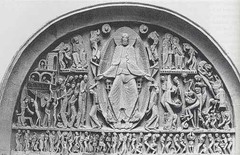
Gislebertus, Last Judgment, west tympanum of Saint-Lazare, Autun, France, ca. 1120-1135. Romanesque.
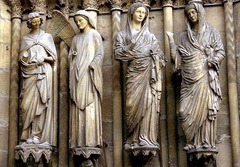
Annunciation and Visitation, jamb west façade, Reims Cathedral, Reims, France, 1230-1255. Gothic.