Dr. C's Chp. 2 MPJE
 Call Kai
 Learn
Learn Practice Test
 Spaced Repetition
 Match
Match Flashcards
 Knowt Play
1/94

There's no tags or description
Looks like no tags are added yet.
Name | Mastery | Learn | Test | Matching | Spaced | Call with Kai | Chat |
|---|
No analytics yet
Send a link to your students to track their progress
95 Terms
High abuse potential, high addiction potential, no medical use
CI
High abuse potential, high addiction potential, accepted medical use
CII
High psychological dependence potential or low/med physical dependence potential, accepted medical use
CIII
limited physical and psychological dependence, accepted medical use
CIV
Each CS Schedule has a _________ potential for abuse compared to the one above it. Ex: CII—> CIII
a. higher
b. lower
b.
To be considered a CV, diphenoxylate/atropine limit is <____mg/___mcg per dosage unit.
< 2.5mg/25mcg
FEDERALLY, what drug is exempt from being labeled a CS.
How does PA handle that?
FEDERALLY—> Fioricet (butalbital, APAP, caffeine) is exempt as a CS
PA —> Fioricet is a CIII
“Listed Chemicals” according to the FDA includes what?
Under federal law how are ephedrine, pseudoephedrine, and propanolamine
FEDERALLY, is pseudoephedrine a CS?
NO—> but there are sales restrictions
Pharmacies are allowed to compound with CS as long as the concentration does not exceed _____%
20
True or False: I am allowed to mix oxycodone tablets in simple syrup and sell it.
False—> if compounding a CS… must mix with another drug
True or False: A compounded narcotic prescription will never be a CIV or V drug.
true (only ever CII or CIII if <0.05%)
True or False: There are some exceptions where dispensers do NOT have to register with the DEA
false—> all manufacturers, distributors, or dispensers of any CS must register with the DEA
What is the frequency for DEA registration?
every 3 years
What form is used for DEA registration of DISPENSERS?
Form 224 for new, 224a for renewals
Formula for verifying a DEA #:
1+3+5
(2+4+6) X 2
Add step 1 + 2
Last digit of total should be identical to last digit of DEA #
If I am a manufacturer and distributor of CS, do I have to register twice with the DEA or can I do it under 1 form?
must register separately (note: each activity requires separate registration)
If Martin owns 3 independent pharmacies in the area is he allowed to register 1 DEA number for all 3 pharmacies or does each pharmacy require its own DEA registration?
SEPARATE registrations are required (think: separate locations= separate registrations)
Which of the following would have to register with the DEA?
a. patient picking up oxycodone
b. pharmacist that works at CVS
c. Shipping manager at a drug manufacturer
d. Narcotic treatment facility
d.
What is required for each transfer of a CII?
DEA Form 222 (THINK: C2 REQUIRES FORM 222)
Examples of when a pharmacist would use a Form 222:
order CII
sell/lend CII to other pharmacies/prescribers
borrow CII from other pharmacies
transfer CII back to wholesaler or reverse distributor
REVIEW: What are each of the following forms used for:
Form 222
Form 224
Form 41
Form 106
Form 107
Form 222= transfer of CII
Form 224= DEA dispenser registration
Form 41= destroying CS
Form 106= Theft or significant loss of CS
Form 107= Theft of significant loss of “listed chemicals” (sudafed)
REVIEW: What are the time frames associated with each of the following forms (exp dates, deadlines to fill out, etc.):
Form 222
Form 224/224a
Form 41
Form 106
Form 107
Form 222= expires after 60 days
Form 224= done initially for registration, then Form 224a every 3 years
Form 41= filled out with each CS destroyed
Form 106= 45 days
Form 107= 15 days
Who can sign a 222 form?
DEA registrant or POA
A 222 form is good for ____ days after it was executed.
60
Who keeps the hard copy of the Form 222?
The supplier/ the one providing the CS (usually manufacturers/distributors but could be a pharmacy if transferring a CS to another pharmacy or doctor)
Suppliers are required to report the acquisition and disposition of CII’s.
What are the 2 ways to do this?
ARCOS (electronic reporting system)
submit a copy of the 222 form directly to the DEA
The DEA allows e-ordering of CII’s through what?
CSOS (Controlled Substances Ordering System)
How long are CSOS certificates valid for?
3 yrs (same as DEA registration)
What are the 2 types of CSOS certificates?
CSOS admin cert —> for CSOS coordinators to communicate with the DEA (NOT FOR E-SIGNING)
sidenote: must have a least 1 CSOS coordinator appointed
CSOS signing cert—> needed for e-signing CII orders
How are CIII-CV substances ordered electronically?
normally aka no CSOS bs required
must have invoice (drug name, form, strength, # received, quantity, date, DEA info)
If a e-order for a CS is deemed invalid, how long must the order be kept for records?
2 years
Is an invalid CS order allowed to be modified/corrected and sent back?
NO—> MUST SEND NEW ORDER
Pharmacies do NOT have to be registered as a distributor for CS as long as what is followed?
total distributed is <5% of all total CS dispensed AND distributed
What reporting system is used for suspicious CS ORDERS?
SORS (note: DOES NOT APPLY TO DISPENSING ONLY ORDERING)
FEDERALLY—> what is really the only thing you can’t do when storing CS?
store them all together on one unsecured shelf (note: may be locked or dispersed)
For any theft or significant loss of CS what are the steps and times?
report to the DEA within 1 day
fill out Form 106 within 45 days
For any theft or significant loss of “listed chemicals” what are the steps and times?
report to the DEA prompty (no exact time frame)
fill out Form 107 within 15 days
What additional label requirement is required for CS when being dispensed to a patient? How does Federal Law differ from PA law?
must include federal transfer warning statement
federal law: CII-CIV
PA law: CII-CV
On-site destruction for a CS requires the use of what form?
Form 41
What are the 2 primary methods a pharmacy can use to get rid of CS?
Form 41- onsite disposal/destruction
Transfer via reverse distributor
If CII —> Form 222 (REVERSE DISTRIBUTER KEEPS ORIGINAL COPY)
If CIII-CV —> Invoice
Describe what being an authorized collector means:
optional program DEA registrants can be apart of
basically is for secure collection/take backs of CS that can then be destroyed on site or transferred out
key points: inside the “receptacle” aka the bin for collecting the CS is a bag with an inner liner. This inner liner has a unique #. AS SOON as the liner is removed from the bin, seal it immediately. Do not look/investigate the contents at ALL!
Does “waste” of a CS require Form 41?
NO! (happens when the dr. orders for admin to a patient and the CS isn’t entirely administered—> waste is created during the normal process of patient care)
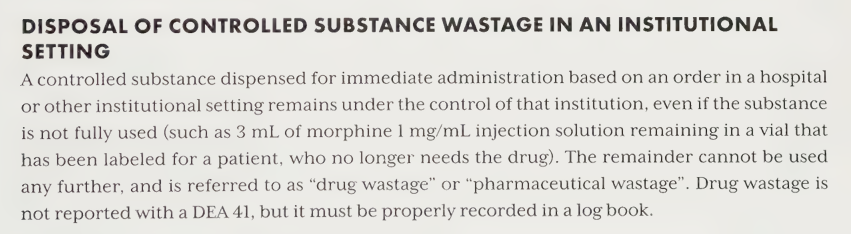
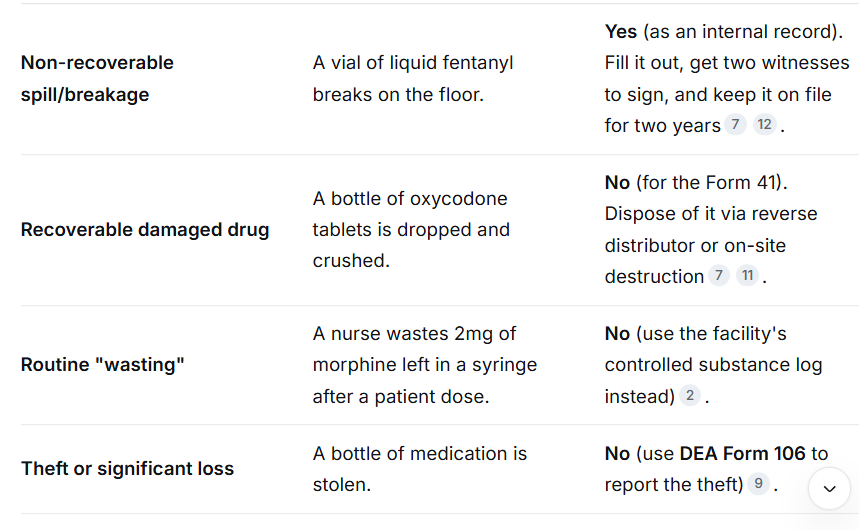
When to fill out Form 41 for a break or spill?
if the CS is NON-recoverable—> like a liquid spilling (recoverable would be something like a tablet falls on the floor and gets crushed)
Federal Law states that inventory for CS must be done when?
before the 1st day of business and every 2 years after
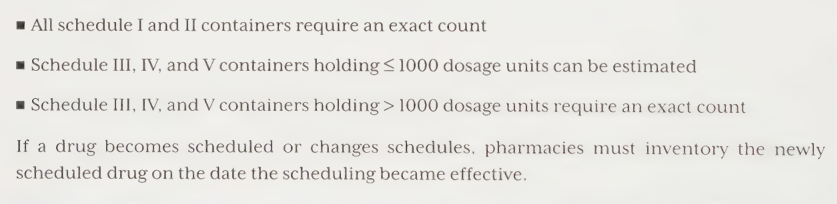
When does inventory for CS when is an exact vs. estimated count needed?
Exact: CIIs
Estimated: CIII-CVs unless the bottle >1000 then an exact count is needed
Federal law states records for CS must be kept for ____ years.
2
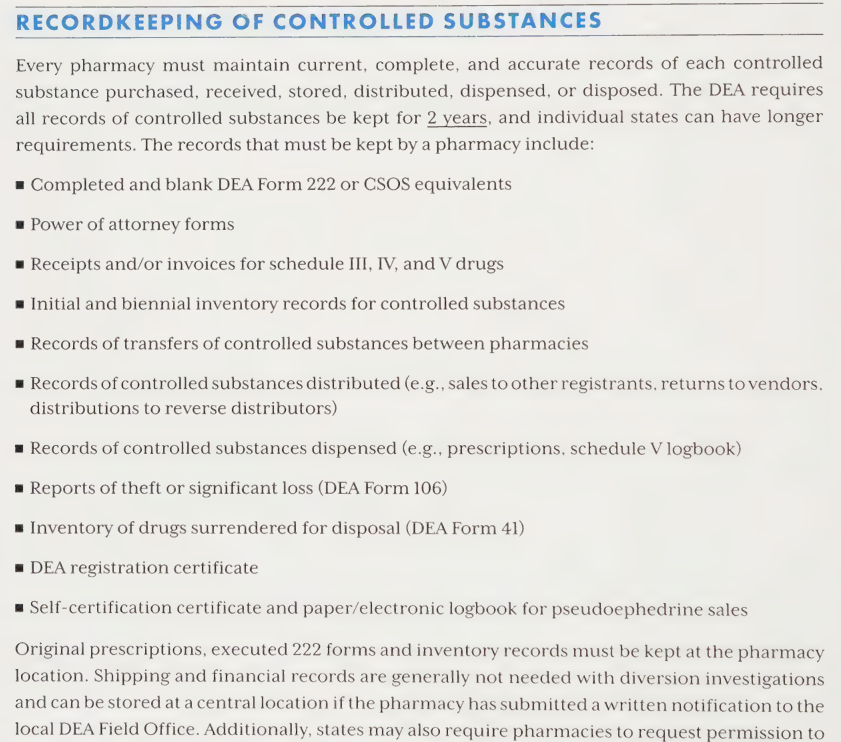
How must records for CS be kept?
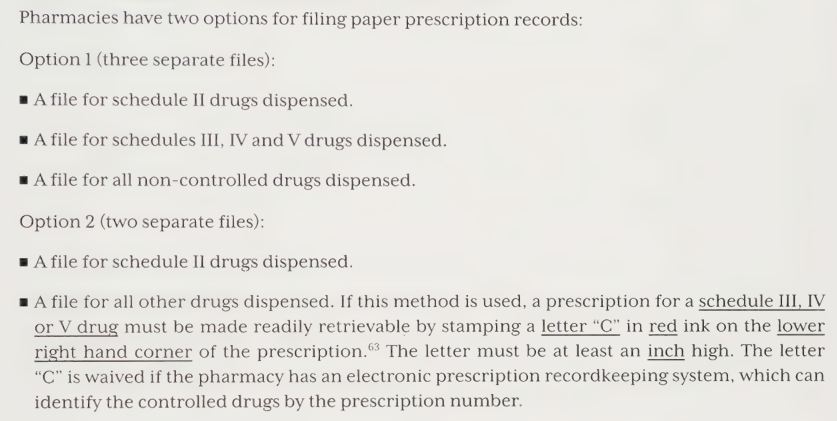
CII ALWAYS SEPERATE
CIII-V can be separate or together with other NS as long as they are readily available
stamped with the letter C in red ink
Central record keeping is allowed ______ days after notifying the DEA.
14
Central record keeping includes and excludes what?
includes: shipping records (ex: packing slips) and financial records (invoices)
excludes: DEA Form 222, inventory records, prescriptions
If there is an unresolvable red flag with a CS prescription, should the pharmacist dispense the medication?
NOOOOO (Even though it may be different in real life—> for exam purposes do not)
Who can prescribe is determined _________.
a. by the federal government
b. by the state government
b.
Can a pharmacist fill a CS from an out-of-state prescriber?
YES (but must verify/use judgement)
Can a pharmacist fill a CS for an out-of-country prescriber
NO
What can/can’t a designated agent do?
Can:
communicate CIII-V rx (*key word is “communicate” NO PRESCRIBING/NO AUTHORIZING)
prepare a written rx for the prescriber to sign
transmit a written CS rx by a prescriber by fax to a pharmacy
Can’t:
communicate CII rx —> INCLUDING EMERGENCY CII RX
There are exceptions to this rule, however in PA all CS prescriptions must be _____________.
a. written
b. faxed
c. verbal
d. electronic
d.
Exceptions to when an electronic prescription is not needed for a controlled substance:
(7 total)
Vets
Technology related issues/failure (includes prescribers not being set up electronically or could be an electrical outage)
ER prescribers and delaying the rx would harm the patient
LTCF
Hospice
PDMP is not required for the medication
Emergency in accordance w/ state or federal laws (ex: verbal emergency CII)
Written CS prescription requirements:
NO PRE/POST DATING
What does the prescriptions need:
Name, address of patient
Name, address, and DEA registration # of the practitioner
Drug name, strength, dosage form
Quantity
Directions for use
Others:
Prescriber's signature
Before filling--> pharmacist name, dispense date, quantity dispensed
When are verbal, faxed, or written prescriptions allowed for CIIs?
verbal: emergency only
fax: 3 exceptions
home-health care
LTCF
hospice
written: 7 exceptions (listed prior)
Vets
Technology related issues/failure (includes prescribers not being set up electronically or could be an electrical outage)
ER prescribers and delaying the rx would harm the patient
LTCF
Hospice
PDMP is not required for the medication
Emergency in accordance w/ state or federal laws (ex: verbal emergency CII)
When are verbal or faxed prescriptions allowed for CIII-CV?
BOTH ALLOWED!!!!!!!!! For faxes ensure prescribers original signature is there. no e-sig allowed.
How are INITIAL transfers for CS handled?
allowed? how many times?
which CS does it apply to? (CII? CIII? CIV? CV?)
what form if allowed? (written, verbal, oral, fax)
who can communicate the transfer if allowed?
YES allowed only for CIII-CV on a 1 time basis
only can be electronic
must be between two pharmacists
How are REFILL transfers for CS handled?
allowed? how many times?
which CS does it apply to? (CII? CIII? CIV? CV?)
what form if allowed? (written, verbal, oral, fax)
who can communicate the transfer if allowed?
YES allowed only for CIII-CV on a 1 time basis
can be any form—>fax, oral, written, electronic
must be between two pharmacists
In general is the transfer of a CII allowed at all?
NO
What is the primary difference between initial transfers and refill transfers?
for initial transfers the prescription can only be electronic, for refill transfers it can be any form
Transfer records for CS prescriptions must be kept for ___ years.
2
What is the expiration date for CS rx?
CII
CIII-CV
CII: 6 months from date written
CIII-CV: may be refilled up to 5 times for up to 6 months from date written
Are there quantity limits on CII prescriptions? exception?
no quantity limits —> 1 exception is for multiple rx written on the same day for the same patient 90 day max
There is no federal guidance on what a RPh can/can’t change on a rx.
What does PA say as far as guidance?
PA only has guidance on electronic CII rx
no changes to a CII rx
for CIII-CV can make changes with prescriber okay as long as the following is not missing:
patient name
drug name or quantity
prescriber signature
date
To get around the whole no refills on CII prescriptions, what can prescribers do?
write multiple rx on the same day
If a prescriber writes multiple CII prescriptions for the same patient on the same date what 2 rules MUST be followed?
90 day max
must have a “do not fill until XYZ date”
CII prescriptions are allowed to be faxed in what 3 situations?
home-infusion
LTCF
hospice
Verbal CII prescriptions are only allowed in emergencies.
Answer the following:
what are the quantity limits?
what info is required vs. missing?
what must the prescriber do after calling this in?
quantity limited to the duration to treat acute period
must have all necessary info - prescriber signature
the prescriber must provide the pharmacy with a valid prescription within 3 days
What are 3 situations in which a partial fill would be done for a CII?
pharmacy out of stock (72 hr rule)
patient or prescriber request (30 day rule)
LTCF or hospice request (60 day rule)
How do partial fills work with the 72 hour rule?
if a pharmacy is out of stock —> can partial and must have rest of prescription ready within 72 hours
How do partial fills work with the 30 day rule?
if a patient or prescriber requests a partial fill —> patients have 30 days to pick up all remaining portions of the prescription aka the prescription is only good for 30 days from THE DATE IT WAS WRITTEN
Example of 30 day rule and partial fills:
if a doctor writes a prescription on August 1st, and you pick up a 15-day supply on August 5th, you have until August 31st (30 days from August 1st) to pick up the remaining balance. If the remaining balance is not picked up by that date, the prescription for the remaining quantity becomes void, and a new prescription from the prescriber would be required.
Partial fills for emergency verbal prescriptions do not follow the 30 day rule, but have what time limitation?
72 hours
True or False: A household member that is dropping off an rx for a patient can request that it is partially filled.
FALSE—> patient wise the only people that can make a request are…
(1. the patient themself 2. a POA 3. if a minor, their guardian can)
When can a prescriber request a partial fill for a patient?
before OR after issuing the prescription
CIII-CV medications may be refilled up to ___ times in a ___ month period.
5 times in a 6 month period
Does PA require a prescription for CV cough products? If so what products?
YES YES YES —> includes any products with codeine, dilaudid, or any narcotic
(ex: Guaifenesin AC)
Is methadone allowed to be dispensed in a community pharmacy?
YES—> but only if prescribed for pain (NOT ALLOWED TO PRESCRIBE FOR OUD)
Traditional vs. Non-traditional OTPs
Traditional OTP
traditional “rehab” “detox”
drugs that can be utilized: methadone, bup, bup/combo products
Non-traditional OTP
allows prescriber to treat OUD outpatient
drugs that can be utilized: bup, bup/combo products only. no
Dispensing naloxone in PA:
there is a statewise standing order —> aka functions like a “blanket prescription” and anyone that wants it can get it
now naloxone is available OTC
Pseudoephedrine limits:
per day
per 30 days
mail order
3.6 g/day
9 g/30 days
7.5 g/30 days mail order
Where must pseudoephedrine be kept?
behind a counter (any counter)
if located on the selling floor—> locked in a cabinet
Pseudoephedrine quantity limits apply to otc, rx, or both?
ONLY OTC. ONLY OTC. —> DOES NOT APPLY TO RX
Record keeping requirements for pseudoephedrine purchases:
logbook (exception if <60mg pseudo)
Photo ID
NPLEx system PRIOR to sale
NPLEx = statewide, real-time pseudoephedrine monitoring program
What are considerations for Dextromethrophan sales in PA?
CAN ONLY SELL TO ≥18 YOs —> MUST PRESENT PHOTO ID IF THEY LOOK UNDER 25
Who must register with the state’s PDMP?
ALL DISPENSERS
In certain situations, you are and aren’t required to look at the PDMP before dispensing a CS.
When MUST you check the PDMP?
new patient
paying cash
>1 prescriber and prescriptions for opioids + benzo
early refill request (per insurance or >15% left)
When must all CS dispensing info be submitted to the PDMP by?
by the end of the subsequent business day
To apply for licensure, ___ hours of education consisting of pain management and the practice of prescribing or dispensing opioids is required.
4 hours (2 of each)
For licensure renewal, ___ hours of CE in pain management and the practice of prescribing or dispensing opioids are required.
2
Do the hours of CE done for pain management/opioids count towards the total CE requirements necessary for licensure renewal?
yes