Periodic table and Memorization
 Call Kai
 Learn
Learn Practice Test
 Spaced Repetition
 Match
Match Flashcards
 Knowt Play
1/69

There's no tags or description
Looks like no tags are added yet.
Name | Mastery | Learn | Test | Matching | Spaced | Call with Kai | Chat |
|---|
No analytics yet
Send a link to your students to track their progress
70 Terms
Metals areas in the periodic table and characteristics
comprise most of the elements and usually lose electrons when involved in chemical reactions
good electrical and thermal conductors

Nonmetals in the periodic table and characteristics
are located near the top right of the periodic table
usually gain electrons from metals and share electrons with other nonmetals in a reaction

Metalloids on the periodic table and characteristics
can swing both ways
can be found in the region on the table between the metals and the non metals
Boron, silicon, germanium, arsenic, antimony, and tellurium

Groups vs periods
groups
Vertical lines on the Periodic table
Elements in the same group usually have similar chemical and physical properties
Periods
Rows in the periodic table
group 1A
Alkali metals
solid at room temp, react violently with water
always +1
hydrogen here doesn’t count
Group 2A
alkaline earth metals
Solid at room temp
React vigorously with oxygen
always +2
Groups 3-12
transition metals
Variable charge → Roman numerals are required
You back-calculate the charge from the anion
group 13
AL is always +3
B is metalloid
Group 15
Pnictogens
Anion charge −3: nitride N³⁻, phosphide P³⁻
Group 16
Chalcogens
Anion charge −2: oxide O²⁻, sulfide S²⁻, selenide Se²⁻.
O is −2 in almost everything (exceptions: peroxides O₂²⁻ where it's −1, and OF₂ where it's +2).
Group 17 or 7A
Halogens
Anion charge −1: fluoride, chloride, bromide, iodide.
Diatomic as elements (F₂, Cl₂, Br₂, I₂).
mostly gas at room temp
Forms salts when bonded with a metal
Group 18 or 8A
Noble gases
Gases at room temp
Diatomic molecules
Have (H2)
No (N2)
Fear (F2)
Of (O2)
Ice (I2)
Cold (CL2)
Beer (Br2)
chromous
Cr²+
chromium(II)
Chromic
Cr³+
chromium(III)
Cuprous
CU^1+
Copper(I)
Curpric
Cu²+
copper(II)
Ferrous
Fe²+
Iron(II)
Ferric
Fe³+
Iron(III)
mercurous
Hg2²+
Mercury(I)
Mercuric
Hg²+
Mercury(II)
Stannous
Sn²+
tin(II)
Plumbous
Pb²+
Plumbic
Pb^4+
Stannic
Sn^4+
Tips for special transition metal naming for special ones
Pattern 1: The suffix always means the same thing
-ous is the lower charge
-ic is the higher charge
Pattern 2: The change gap depends on where the metal sits
transition metals differ by 1
Main-group metals differ by 2
Ammonium
NH4+
Hydronium
H3O+
Hydroxide
OH^1-
Peroxide
O2²-
Cyanide
CN^1-
Nitrate
NO3^1-
Acetate
CH3COO^1-
Chlorate
ClO3^1-
Bromate
BrO3^1-
Iodate
IO3^1-
Sulfate
SO4²-
Hydrogen sulfate or Bisulfate
HSO4-
Carbonate
CO3²-
Hydrogen carbonate or Bicarbonate
HCO3-
Phosphate
PO4³-
Hydrogen phosphate
HPO4²-
Dihydrogen phosphate
H2PO4-
Permanganate
MnO4^-1
Chromate
CrO4²-
Dichromate
Cr2O7²-
Ammonia
NH3
Water
H2O
Sodium hydorxide
NAOH
Hydorgen peroxide
H2O2
Hydrocyanic acid
HCN
Nitric acid
HNO3
Acetic acid
HCH3CO2
Chloric acid
HCLO3
bromic acid
HBRO3
Iodic Acid
HIO3
Sulfuric acid
H2SO4
Carbonic acid
H2CO3
Phosphoric acid
H3PO4
Perchloric acid
HCLO4
Hydrochloric acid
HCL
Hydrobromic aicd
HBR
Hydroiodic acid
HI
Polyatomic naming rules
Per - Ate is when there’s one more than normal oxygen
— ate is the starting position
— ite is when there’s one less oxygen
hypo - ate is when there’s 2 less oxygen
Hydrates and naming rules
Ionic compounds that contain water
use prefix
prefixes for hydrates and molecules
Mono - 1
Di - 2
Tri - 3
Tetra - 4
penta - 5
hexa - 6
Hepta - 7
octa - 8
nona - 9
deca - 10
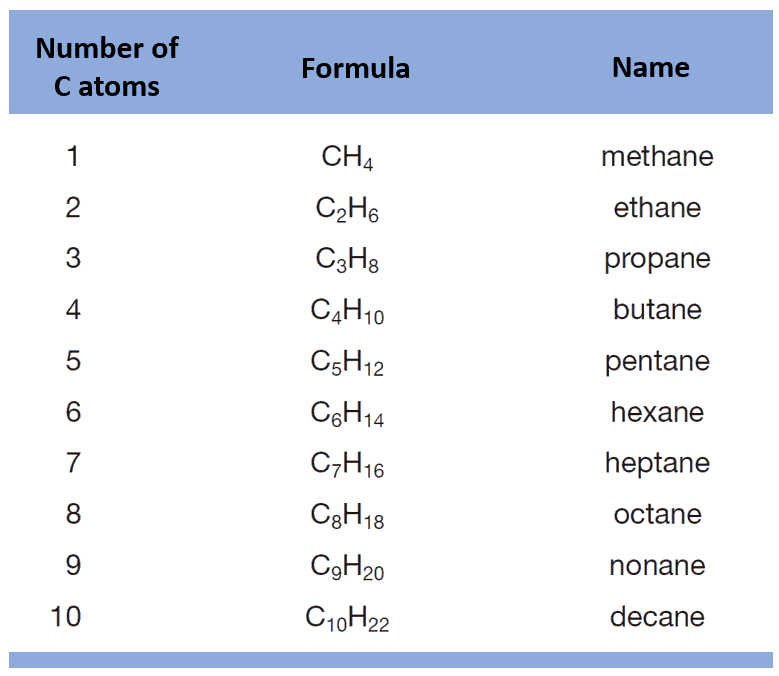
Naming alkanes and what is an alkane
An alkane is a hydrocarbon containing only single bonds
acid naming and what is an acid
AN acid is a substance that produces H1+ ions when dissolved in water
Two types
Binary acids
Hydorgen and a nonmetal
Hydro - ic acid
Oxyacid
Hydrogen and oxyanion
If oxyion ends with ate - ic
if it ends with ite - ous