Cognitive psych quizlet exam 1
 Call Kai
 Learn
Learn Practice Test
 Spaced Repetition
 Match
Match Flashcards
 Knowt Play
1/79

There's no tags or description
Looks like no tags are added yet.
Name | Mastery | Learn | Test | Matching | Spaced | Call with Kai | Chat |
|---|
No analytics yet
Send a link to your students to track their progress
80 Terms
cognitive psychology
the scientific study of the mind. cognition refers to mental processes such as perception, attention, and memory that the mind creates
Donders 1868
Measured how long it takes a person to make a decision using reaction time (RT) experiments. experiments measured interval between stimulus presentation and persons response (light flashes). simple RT v choice RT
independent variable: task type (simple or choice)
dependent variable: reaction time
choice rt - simple rt=time to make decision
choice rt = 1/10 sec longer than simple RT
mental responses cannot be measure but can be inferred from behavior of participant
wundt 1879
rise of experimental Psych. first psychology lab established at Uni of Leipzig, Germany.
developed structuralism using a method of analytic introspection
no reliable results (based off of mental thoughts)
ebbinghaus party of one
1885/1913
careful self-study and quantification of a mental process
memorized quantitative measure of mental processes
used himself
savings and savings curve
original time to learn list - time to relearn list after delay
curve shows savings as a function of retention interval.
william james
taught first psych course at Harvard University
considered many topics in cognition including thinking, consciousness, attention, memory, perception, imagination, and reasoning
observations based on the functions of his own mind, not experiments
descriptions of a wide range of experiences and wrote first psych textbook (some of his observations are still valid today)
resolution to caution with inferences
replication
watson
noted two problems with analytic introspection (wundt):
extremely variable results found per person
results are difficult to verify due to focus on invisible inner mental processes
watson & rayner 1920
little albert
demonstrated that behavior can be analyzed without any reference to the mind (can use concrete data from applying pavlovs theory to humans)
behaviorism
behaviorism
watson
dominated for decades (20 yrs) and eliminated mind as a topic of study and instead studies directly observable behavior
skinner
operant conditioning and behaviorism
tolman
the reemergrence of the mind. cognitive maps; mental conception of spatial area
skinner/chomsky and language aquisition
skinner 1957: argued children learned language through operant conditioning. children imitate speech they hear and correct speech is rewarded
chomsky 1959 (reemergrence of mind): argued that language learning does not rely soley on imitation and reinforcement. children say things they have never heard (so they cant be imitating). they also say things that are incorrect and that have not been reinforce
*language must be determined by inborn biological program
paradigms and paradigm shifts
scientific revolution is the result of paradigm shifts and can be best described by thomas kuhn’s 1962 book (structure of sceintific revolution)
cognitive revolution began in 1950s
Behaviorists’ focus on stimulus-response —> operations of the mind
information-processing approach
conceptualizes min based on computer. states that operation of mind occurs in stages

cherry 1953
subjects could understand message details presented in left ear even though they were told different messages in both ears.
broadbent 1958
developed a flow diagram to show what occurs as a person directs attention to one stimulus (mental processes)

ulrich neisser
wrote first cognitive psych textbook to provide a useful assesment of the state of the art (cog psych). most of book concerns vision and hearing AKA SENSORY. at end of book, introduced higher mental processes
atkinson and shiffrin’s 1968 model of memory
sensory memory: less than 1 sec
short term memory: a few secs limited in capacity
long-term memory: long duration, high capacity

endel tulving’s 1972 model
proposed long term memory has 3 diff components
episodic: life events
semantic: facts and info
procedural: physical actions

neuropsychology
studies the behavior of people with brain damage
electrophysiology
studies electrical responses of the nervous system, including cortical neurons
brain imaging
PET, fMRI shows which regions are active during cognition
ramon y cajal
contradicted nerve net theory by making the neruon doctrine (nervous system made with individual neruons)
types of neurons
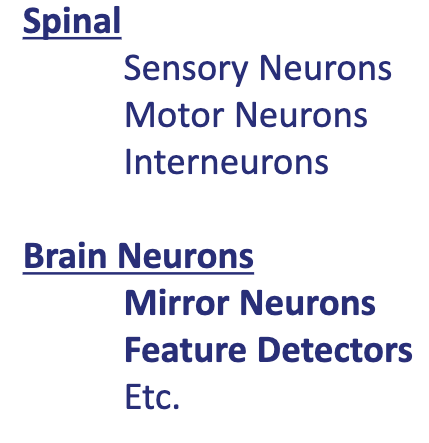
neurotransmitters
excitatory - glutamate
inhibitory - gaba
neuronal measuring

hebel and weisel 1960s
researched visual stimuli in cats
feature detectors: a type of neuron that responds best to a specific stimulus
blakemore and cooper
experience-dependent plasticity. experiment where kitten were raised in environment with only vertical stripes. visual cortex developed to only respond to vertical controus and to ignore horizontal contrours
gross and colleagues (1969, 1972)
single neuron recordings in temporal lobe of anesthetized monkeys. specialized neurons respond to body parts
neural representation and cognition
Many neurons at higher levels of the visual system fire to complex stimuli like geometrical patterns and faces.
A specific stimulus causes neural firing that is distributed across many regions of the cortex
Sensory Coding
Specificity coding:
• Stimulus representation by firing specifically tuned neurons
specialized to respond only to a specific stimulus.
Population coding:
• Stimulus representation by the firing pattern of many neurons.
Sparse coding:
• Stimulus representation by a firing pattern of a small group of
neurons, with the majority remaining silent.
brain orientation
localization determined by neruopsychology
damage to brocas frontal lo

Patient L.G. by Turnbull 1997
preserved object recognition but could not orient object upright.
lost visuo-spatial abilities and is unable to determine the canonical rotient of object because her intact ventral object recognition system operates in an orientation-independent manner.
patient D.M. by Turnbull (1997)
unable to name objects, but able to orient them upright
lost acess to stored visual knowledge but retains visuo-spatial functions which are adequate to determine the probable canonical orientation of many objects
single neuron recording
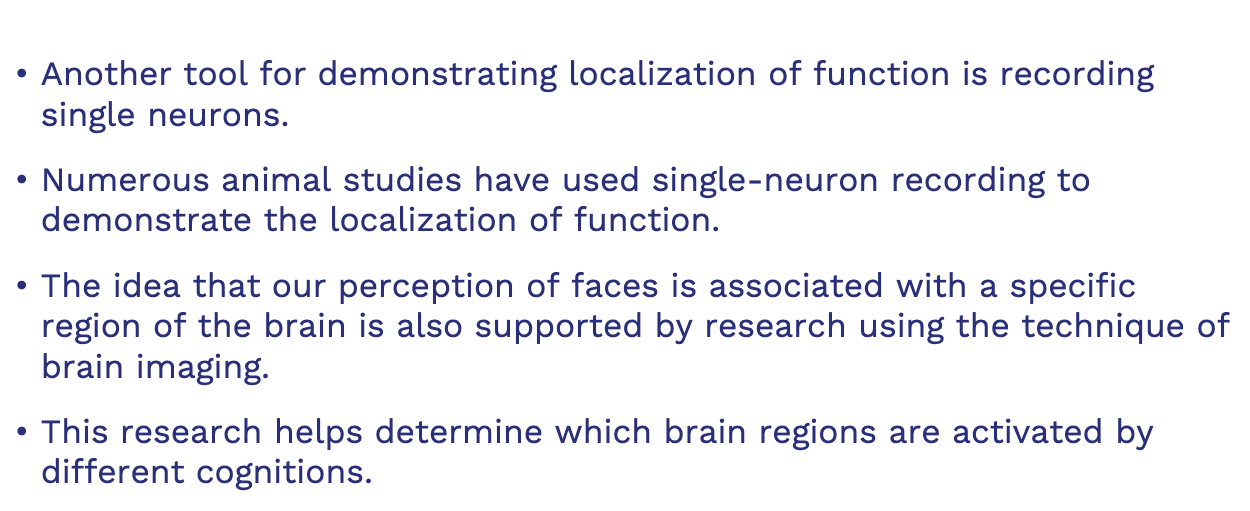
fusiform face area (FFA)
responds specifically to faces. damage causes prosopagnosia
parahippocampal palce area (PPA)
responds specifically to places indoor/outdoor scene
extrastriate body area (EBA)
is activated by bodies (top) but not by other stimuli (bottom)
research method in cog psych

imaging brain structure and activity

neural networks
interconnected areas of the brain that communicate with each other (connectome)
structural connectivity
the brain “wiring diagram” created by axons that connect brain areas
as unique to individuals as fingerprints
functional connectivity
how groups of neurons within the connectome function in relation to types of cognition
determined by the amount of correlated neural activity in two brain areas
six common functional networks
visual - vision and visual perception
somato-motor - movement and trust
dorsal attention - attention to visual stimuli and spatial locations
salience - survival
default mode - mind wandering, cognitive activity related to personal life story, social functions, monitoring internal emotional states

default mode network (DMN)
this mode of brain function occurs at rest
it is one of the brain’s largest networks

sensation
reception
perception
interpretation
Transduction and Perception

W.E.I.R.D. Heinrich, Heine, Norenzayan (2010)
a famous optical illusion where two lines of the exact same physical length appear to be different sizes because of the arrowheads or fins placed at their ends
feature detectors
-- Perceptions can change based on added information
– Involves a process similar to reasoning or problem solving
—specialized neurons in the brain's visual cortex or computational algorithms in computer vision that respond to specific properties of a stimulus like edges, lines, or motion
– Perceptions occur in conjunction with actions
pattern
bottom-up processing
building up from individual components
ex. using puzzle pieces to build a puzzle
top-down processing
perceptions modified by experiences of expectations
ex. reading a mistyped word as the actual word. reading ‘sam edts a cookie’ as ‘sam eats a cookie’
navon 1977
global vs local evidence for global precedence
which shows that the human brain naturally identifies a large overall shape (the global level) before noticing the smaller parts that make it up (the local level)

human perception
Environmental energy stimulating the receptors.
• Parts are identified and put together, and then recognition occurs.
• The sequence of events from eye to brain (or any sensory neuron to
the brain) is called bottom-up processing.
Knowledge and expectations the observer brings to the situation
influence interpretation.
• Previous knowledge enables people to identify objects and situate
identify objects and situations quickly.
• This influence is called top-down processing
top down processing in human perception
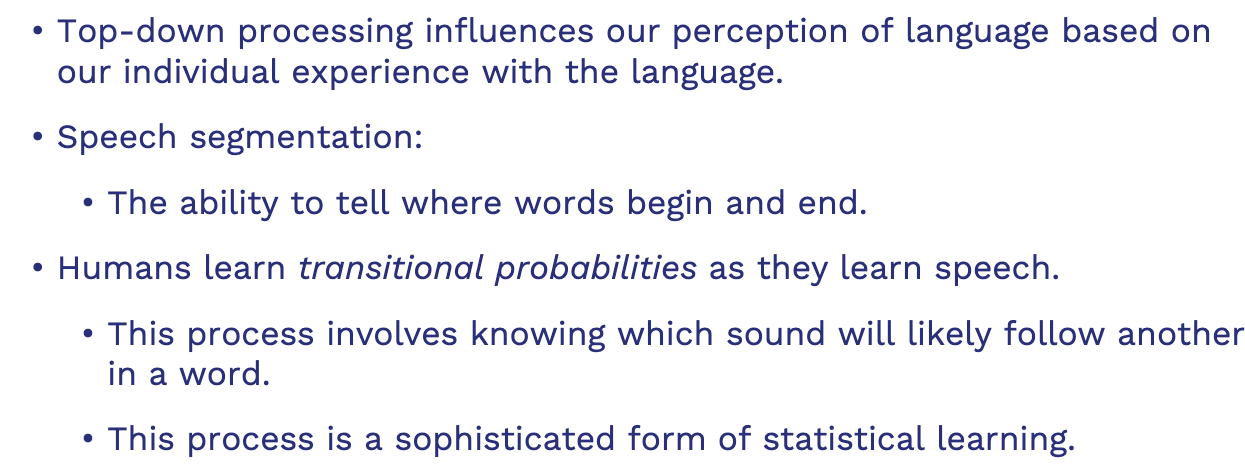
influences perception of langauge based off of our individual experience
speech segmentation: the ability to tell where words end and begin
humans learn transitional probabilities as they learn speech (this is when they can predict which sound will follow another in a word)
this process is a sophisticated form of statistical learning (conditional probabilities)
why is it so diffult to design a perceiving machine
Objects look different from
different viewpoints.
• Achieving viewpoint
invariance is very labor-
intensive for computer
processing systems.
• Scenes contain high-
level information,
requiring reasoning about
context to interpret.

Four general conceptions

Helmholtz’s Theory of Unconscious Inference
He proposed the likelihood principle: We perceive the object most likely to have caused a stimulus pattern.
• This judgment occurs by a process called unconscious inference. Our
perceptions result from unconscious assumptions or inferences that we make about the environment.
unconscious inference
how our brain resolves the inherent ambiguity of sensory data to construct what we actively perceive

perceptual organization
Structuralism ("Old" view): Assumes perception is built up by adding together individual, elementary sensations (just a collection of black-and-white patches or blobs).
Gestalt principles ("New" view): Proposes that the mind perceives the whole configuration ("the whole is different from the sum of its parts"), allowing you to suddenly recognize the integrated shape of a Dalmatian dog.
mac wertherimer gesalt principles of organization
rejected the idea of adding up sensations to form perceptions
they propose that perceptual organization involves rules for grouping small elements of a scene
the principle of good continuation states that lines tend to be seen as flowing the smoothest path
law of pragnanz is the principle of the importance of simplicity or good integrity
principle of similarity: similar things are perceived as grouped
principle of proximity: things nearby are grouped
perception is determined by specific organizing principles, not just dark and light stimuli activating the retina
experience plays a minor role compared to their intrinsic, “built-in” principles
experience can influence perception but is not the key driver
oblique effect, regularities of environment
vertical and horizontals are more easily perceived than other orientations
light-from-above assumption, regularities of environment
we assume light comes from above because this is common in our environment
we perceived shadows as specific information about depth and distance
semantic regularities, regularities of environment
the meaning of a given scene is related to what happens within that scene
characteristic associated with functions carried out in different types of scenes
scene schema
it is knowledge of what a given scene ordinarily contains
in the jewelry case at Tiffany’s would expect to see a plate of fish and chips or diamond rings
bayesian inference
two factors influence estimated probability of a given outcome
the prior probability
the likelihood of a given outcome
calculating the probability of something based on prior knowledge of conditions related to the events
top-down processing
– Unconscious inference
– Environmental regularities
– Bayesian inference
bottom-up processing
– Gestalt principles
neural basis of knowledge
some neurons respond best to things that occur regularly in the environment
neurons become tuned to respond best to what we commonly experience
horizontals and verticals (oblique effect) (survival advantage natural selection?)
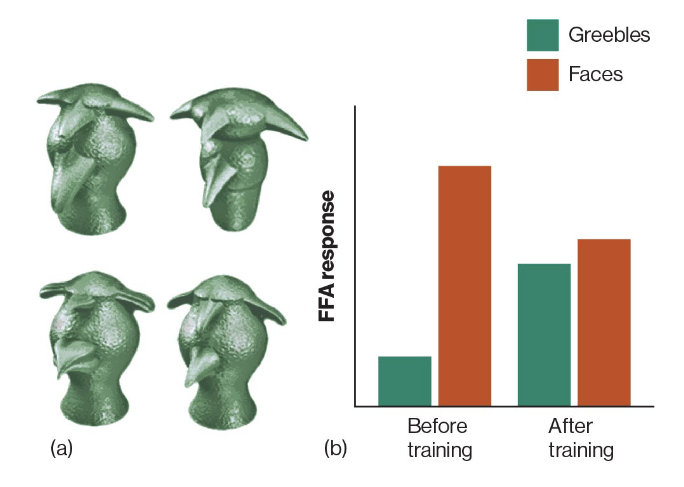
FFA and Learning
• Gauthier et al. (1999)
• FFA (fusiform face area)
• neurons activate to new stimuli, like Greebles, when exposed over time
experience based plasticity may play a role in determining neurons’ response
experiment demonstrated that the brain's Fusiform Face Area (FFA) adapts through experience to recognize complex, non-face objects when a person develops visual expertise (or in this case Grebbles)
Perception and Action: Behavior
Determining the identity of an object: what ventral pathway (lower part of brain)
Determining the location of an object: where dorsal pathway (upper part of brain)

Ungerleider and Mishkin (1982): monkey brain ablation experiment
temporal = failed at object discrimination ‘what’/ventral
parietal = failed landmark test ‘where’/dorsal

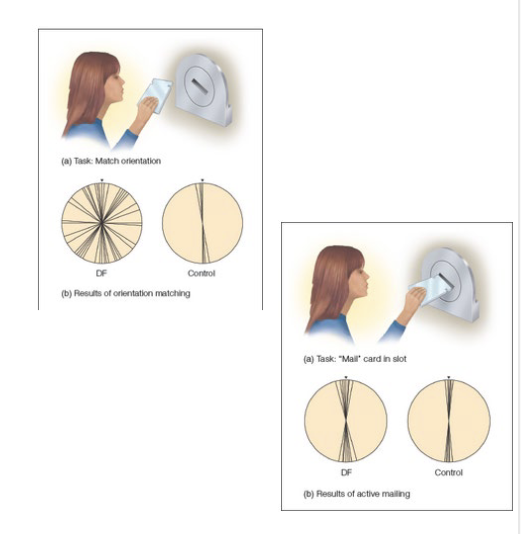
Milner and Goodale (1995)
• Patient D.F.
• Temporal lobe damage (carbon monoxide)
• Unable to perform mail slot task when matching orientations
• Able to do it when asked to “mail” a letter
mario Iacoboni (2005) intention
• Mirror Neurons
• fMRI research has found evidence of a mirror neuron system in the brain
showed participants three films (one picked up cup with coffee from clean table, second picked up cup from messy table, third picked up isolated cup). area of brain with mirror neurons was most activated for the two intention films (specifically the first one). found that mirror neurons area is involved with understanding intention behind actions shown in films. also found that mirror neurons also codes the “why” of actions and respond respond differently to different intentions.
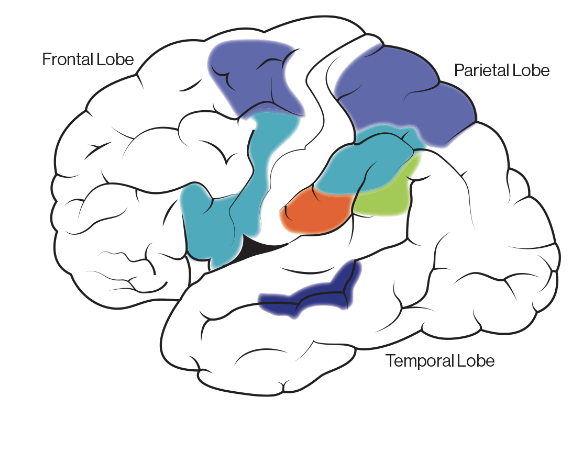
hallucinations
Perceptions without sensations; top-down processing
principle of good continuation
states that lines tend to be seen as flowing the smoothest path
law of pragnanz
every stimulus pattern is seen in such a way that the resulting structure is as simple as possible
principle of similarity
similar things are perceived as grouped
principle of proximity
things nearby are grouped together
palmer
presented image of kitchen and image of various objects (got kitchen associated items correct the most)
illustrate how our knowledge about the environment can influence our perception
freebee
freebeeeee