MIDTERM: MMAT, HDD (copy)
 Call Kai
 Learn
Learn Practice Test
 Spaced Repetition
 Match
Match Flashcards
 Knowt Play
1/14

There's no tags or description
Looks like no tags are added yet.
Name | Mastery | Learn | Test | Matching | Spaced | Call with Kai | Chat |
|---|
No analytics yet
Send a link to your students to track their progress
15 Terms
Define MMAT
MMAT stands for Mean Memory Access Time. It represents the average time it takes for the CPU to get a word of data.
Does MMAT vary?
Yes, MMAT can vary depending on how far the CPU needs to go in order to get a word of data. If the CPU finds the word in cache, it is very fast, otherwise, if it is forced to go to RAM, it will be much slower. So the average time depends on how often each case happens.
What does a hit mean?
A hit means that the word was found in cache
What does a miss mean?
A miss means that the word was not found in cache, so the CPU is forced to check main memory for it instead. Once it does this, it loads that word and any neighbors into the cache for future use.
What is the formula used for calculating MMAT?
MMMAT = C+(1-h)M
C = the cache access time
h = the hit rate
M = main memory access time
OR
MMAT = total time/# of requests
Calculate the MMAT if the cache access time is 6ns, the MM access time is 100 ns, the hit rate is 0.
MMAT = 6 ns + (1-0) x 100 ns = 106ns
L1 access time is 3ns, L2 access time is 10 ns, MM access time is 80 ns. The CPU makes 300 memory requests. Out of these requests, 210 hits are in L1, 80 hits are in L2. What is the MMAT?
Time for L1 hits = 210 hits × 3 = 630 ns
Time for L2 hits = 80 hits × 10 = 800 ns
Time for L3 hits = 10 hits x 80 = 800 ns
(We know there are only 10 hits remaining for L3 because 300-210-80 = 10)
total time = 630 + 800 + 800 = 2230 ns
Therefore, MMAT = 2230 ns/300 requests
What is a HDD?
An HDD is a non-volatile, magnetic storage device.
Describe and draw the structure of an HDD.
An HDD is made up of multiple circular, magnetic coated platters stacked on top of each other that rotate at a constant speed. Data is stored inside the magnetic material.
On each circular platter, you have Tracks, which represent a single ring, and Sectors, which is a small arc/slice of that ring that represents the smallest addressable unit a disk can read or write to in a single operation.
A cylinder refers to the set of tracks that are the same radius apart on all surfaces.
Above each of the platters is a read/write head. The read/write head can move in or out radially to select different tracks. All of the heads are mounted on the same arm, so when the arm moves, all of the heads move simultaneously. The set of tracks that all line up under the head at the same time are known as the cylinder.
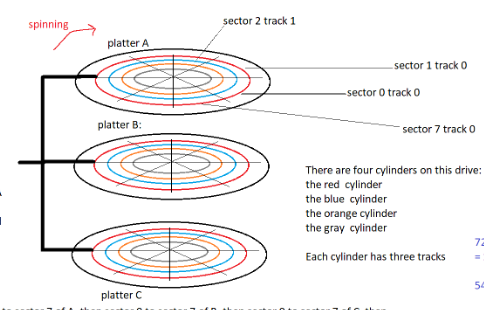
What is included in a track?
A track includes magnetic bits some fixed distance from the center. Each track contains 8 sectors, and each sector is made up of a header, data, footer, and gap between other sectors.
What is seek time? What is worst-case seek time?
Seek time is the time it takes to reach the target track/sector. The further away the head is, the longer the seek time will be. The worst-case seek times refer to the time it takes to move from one extreme of the disk to another.
What is the rotational latency?
Rotational latency is the time you wait for the platter to spin so that the desired sector can come under the head. Rotational Latency is usually a fixed value that is measured in RPM (Revolutions per Minute).
How long does it take to read a disk with 10,000 cylinders, each containing four tracks of 2048 sectors? First, all the sectors of track 0 are to be read starting at sector 0, then all the sectors of track 1 starting at sector 0, and so on. The rotation time is 10 msec, and a seek takes 1 msec between adjacent cylinders and 20 msec for the worst case. Switching between tracks of a cylinder can be done instantaneously.
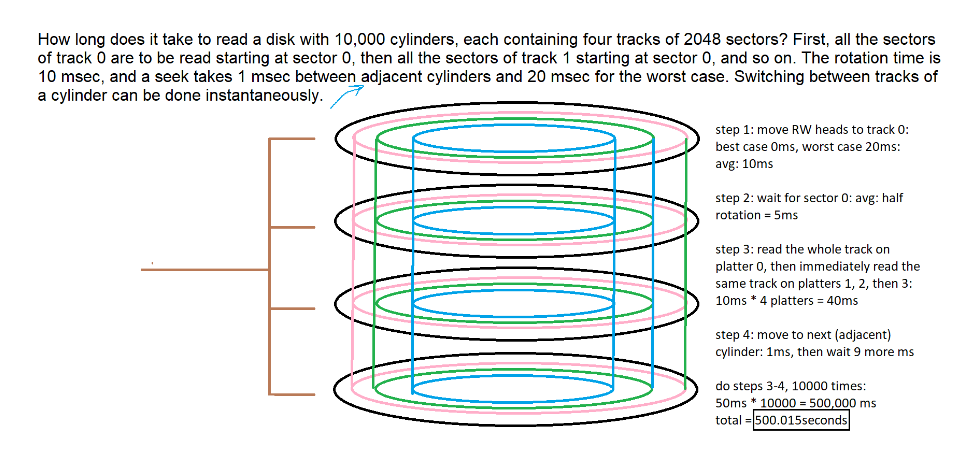

Ignore the crossed out sections, those were not included in the answer.