Mental wellbeing
 Call Kai
 Learn
Learn Practice Test
 Spaced Repetition
 Match
Match Flashcards
 Knowt Play
1/138

Earn XP
Description and Tags
Ch 8
Name | Mastery | Learn | Test | Matching | Spaced | Call with Kai | Chat |
|---|
No analytics yet
Send a link to your students to track their progress
139 Terms
Examples of being mentally healthy involves
● generally positive state of mental wellbeing,
●ability to cope with and manage life’s challenges,
●working productively,
●striving to fulfil one’s goals and potential,
●sense of connection to others
Mentally healthy people demonstrate high levels of:
●functioning
●resilience to life’s stressors
●social and emotional wellbeing
Functioning
refers to how well an individual independently performs or operates in their environment
Functioning in terms of:
●interpersonal relationships
e.g. ability to interact with and get along with others
●school and work settings
e.g. productive and achieving goals
●participating in hobbies in spare time
●daily living skills
e.g. self-care
●cognitive skills
e.g. learning, communicating, logical and clear thinking
●emotions
e.g. dealing with +’ve and -’ve emotions
Social wellbeing is based on
The ability to have satisfying relationships and interactions with others
Social Wellbeing involves
●develop and maintain healthy relationships
●socially interact with others appropriately
●respect and understand others
●respect the cultural identities of others
●competently resolve conflicts
●effectively manage unhealthy relationships
●spend time with loved ones
●feel self-confident alone or with others
Emotional wellbeing
The ability to control emotions and express them appropriately and comfortably
A person with a high level of emotional wellbeing is likely to be willing and able to:
High emotional wellbeing =
understanding, regulating and appropriately expressing emotions
managing stress
making decisions
coping with setbacks
seeking support when needed
resilience
The ability to cope with and manage change and uncertainty and restore positive functioning.
Characteristics of resilient people
●a strong belief in their abilities to accomplish tasks and succeed (self-efficacy);
●high self-esteem;
●approaching adversity and stress with a sense of optimism, opportunity and hope;
●being adaptable and flexible;
●being organised;
●having problem-solving skills;
●and having the ability to make realistic plans and carry them out.
Social and Emotional Wellbeing (SEWB) for ATSI people is_______ and _______ framework for wellbeing
multidimensional , holistic
What is are the 7 main parts of SEWB for ATSI peoples?
●body and behaviour
●mind and emotions
●family and kinship
●community
●culture
●Country and land
●spirituality and ancestors
Mental wellbeing definition (txt book)
our state of mind, our enjoyment of life, and our ability to cope with the normal stresses of everyday life and develop to our potential.
is mental wellbeing a singular fixed state?
No, it is a continuum, which fluctuates due to the interactive influence of internal and external factors.
When is a persons level of functioning most evident?
In observable behaviours to meet the ordinary demands of everyday life
Explain functioning as a continuum
Functioning varies in level or degree.
High functioning may range from a high level (superior functioning, competent function)
to a moderate level of functioning (due to temporary mental health problem)
to a low level (poor impaired functioning)

Adaptive behaviour
Any behaviour that enables the individual to adjust to the environemnt appropriately and effectively.
Maladaptive Behaviour
Any behaviour that is detrimental, counterproductive, or otherwise interefers with I’s ability to adjust to the environment.
What is persistent maladaptive behaviour associated with?
Low level of functioning.
The term social and emotional wellbeing (SEWB) is used by_________ to describe the _____
Aboriginal and Torres Strait Islander people
physical, social, emotional, spiritual and cultural wellbeing of a person.
Why is SEWB for ATSI people important?
Reflects the collectivist culture of ATSI people
encompasses all elements of being ATSI that are not evident in the mainstream view of mental health and wellbeing.
What does connection to body and behaviours involve in SEWB for ATSI people
All aspects of physical health and wellbeing.
What does connection to mind and emotions involve in SEWB for ATSI people
Emphases I’s personal experince of mental wellbeing, and their ability to manage thoughts and feelings.
What does connection to family and kinship involve in SEWB for ATSI people
Recognises family and kinship systems have always been central to functioning of ATSI peoples lives.
What does connection to community involve in SEWB for ATSI people
Emphasises connection to communal space, creating opportunities to connect with one another.
What does connection to culture involve in SEWB for ATSI people
Refers to I’s strong sense
of cultural identity and cultural values through
connection to ATSI
heritage. Includes all knowledge systems, ways
of knowing, and cultural traditions and practices.
What does connection to country involve in SEWB for ATSI people
ATSI people’s traditional or spiritual association and the
deep sense of belonging to land.
Recognises relationship with Country
underpins all other forms of relational wellbeing.
Being on and caring for Country has positive physical
and mental health outcomes for ATSI people.
What does connection to spirit, spirituality and ancestors involve in SEWB for ATSI people
Recognises sacred and interconnective relationship
between Country, human and non-human beings,
as well as the past, present and future.
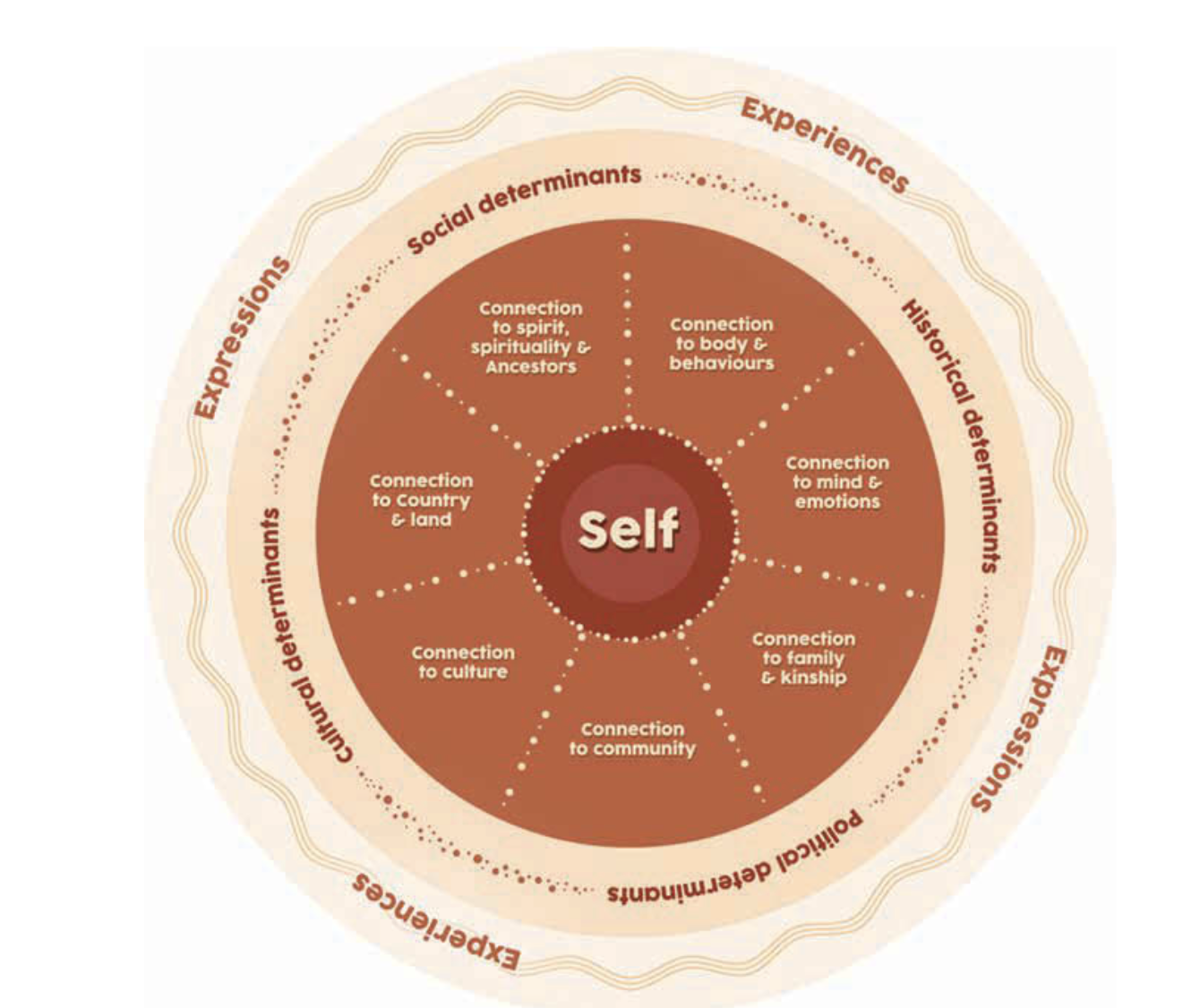
SEWB factors for ATSI people
●Body and behaviour
●mind and emotions
●family and kinship
●community
●culture
●Country and land
●spirituality and ancestors
SEWB factors for ATSI people Acrostic
Barbie and Braquelle
Made and Evaded
Family and Kinship
Caringly,
Careful
Conscious and Longing
(for)
Spaghetti and Anchovies
Mental Wellbeing as a continuum
Implies two opposite ends, optimum health and mental disorder
Where can a person sit on the mental wellbeing continuum
A person can sit anywhere between the two ends. Moving up and down the scale over time, regardless if they are diagnosed with a mental illness.
What is a mental health problem
Adversely affect the way a person thinks, feels and/or behaviours, typically to a lesser extent and of shorter duration than a mental disorder.
Examples of mental health problems
Relationship
school
work
health-related stress
trouble making friends
lack of motivation to complete specific tasks
(None of these things on their own would be considered a disorder.)
Mental disorders
Mental health state that involves a combination of thoughts, feelings and/or behaviours associated with:
●significant personal distress
●significant impaired functioning
Main internal and external factors of mental health
Internal:
Biological
Psychological
External:
Social
Biopsychosocial model (BPS)
Way of describing and explaining how biological, psychological and social factors combine and interact to influence a person’s mental health (and disorder).

main biological factors and examples
Physiological, anatomical and genetic factors, such as:
●brain structures
●age
●family history
●neurotransmitters
●hormones
By Age Fifty No Hair
main psychological factors + acronym
●personality
●emotions
●thoughts and thinking styles
●perceptions
●coping strategies
PET PC
main social factors and examples
Factors that are external to the person, such as
●family and friends
●societal expectations
●support services
●early experiences
●physical environment
Fun and Frivolous, Sophie Egg, Supports Sally, Enticing Extra, Private Eating
Cumulative risk
Refers to the increased risk of developing a mental disorder
occurs from exposure to multiple biological, psychological and/or social risk factors simultaneously.
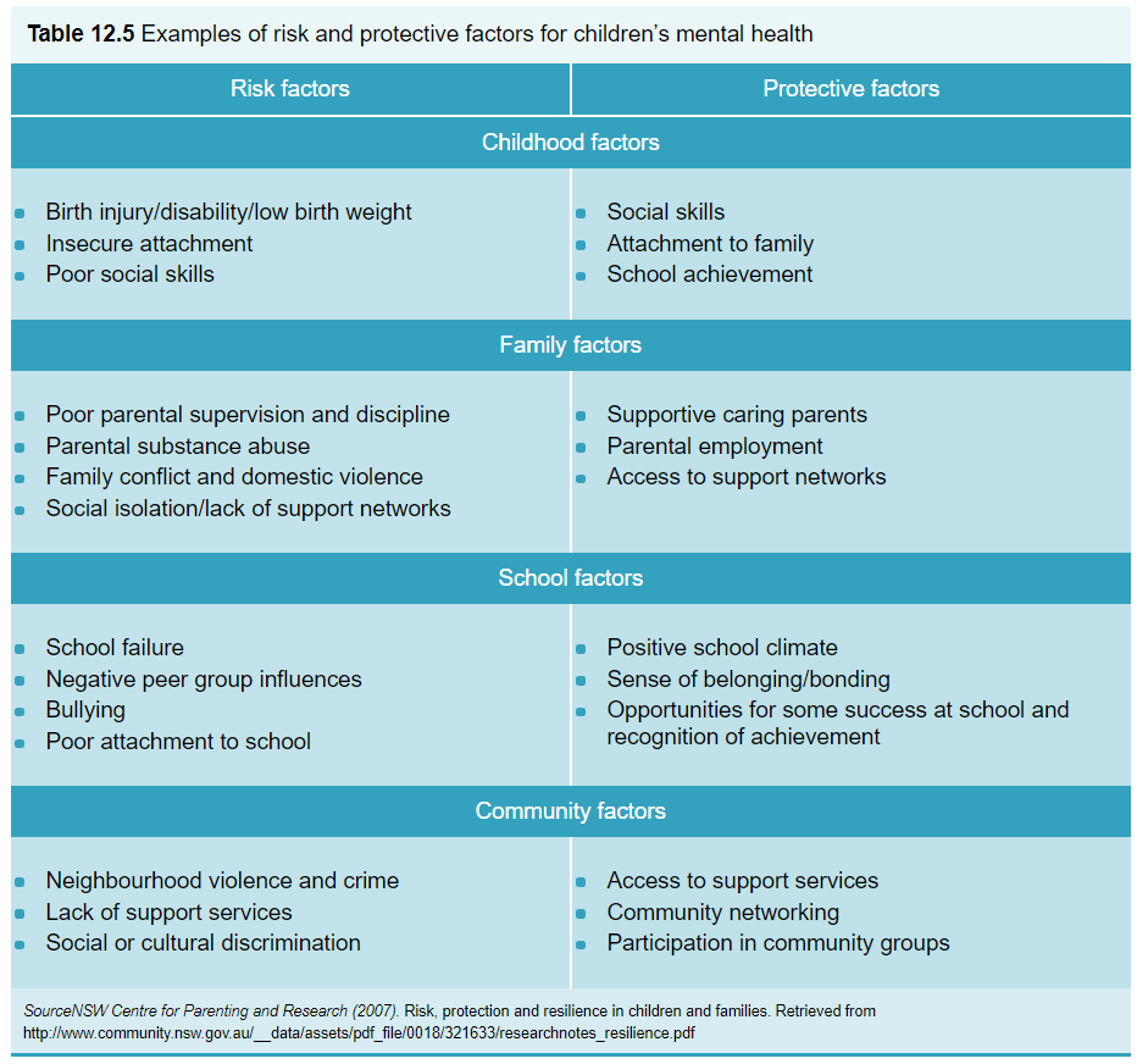
List the main areas of cumulative risk and protective factors
Childhood Factors
Family Factors
School Factors
Community Factors
Examples of risk and protective factors for mental health
Stress
State of physiological and psychological arousal produced by internal or external stressors
perceived as challenging or exceeding an individual’s ability or resources to cope.
Anxiety
State of physiological and psychological arousal associated with feelings of:
apprehension, worry, or uneasiness that something is wrong or something unpleasant is about to happen.
Is anxiety normal
It is normal to experience anxiety in certain situations.
Specific phobia
A mental disorder characterised by excessive or unreasonable fear of a particular object or situation (phobic stimulus)
Differences between Stress and Anxiety,
Stress is linked to an identifiable stressor, whereas anxiety is not necessarily linked to a specific stimulus.
What is the key difference between phobia and anxiety?
A phobia involves an identifiable, specific object or situation, whereas anxiety can occur without a specific identifiable stimulus.
Can stress be positive?
Yes. Eustress is positive stress that can enhance performance or motivation, whereas distress is negative stress.
Is anxiety always unpleasant?
Yes. Anxiety is characterised by unpleasant feelings of apprehension or discomfort.
Are stress and anxiety mental disorders?
Not necessarily. Stress and anxiety are normal experiences and are not, on their own, mental disorders.
Is specific phobia a mental disorder?
Yes. Specific phobia is a diagnosable mental disorder.
How do stress, anxiety and phobia differ?
Stress: reaction to an identifiable stressor; can be positive (eustress) or negative (distress).
Anxiety: general apprehension/discomfort; does not necessarily have an identifiable stimulus and is unpleasant.
Specific phobia: intense fear of a specific object/situation; is a diagnosable mental disorder.

What behaviours do people with a specific phobia typically demonstrateA
Avoidance behaviour
Anticipatory anxiety
Panic attack
Anticipatory anxiety
Gradual rise in anxiety as a person thinks about, or “anticipates” being exposed to a phobic stimulus.
How does anticipatory anxiety differ between people with a phobia and those who dont
Phobia = may be incapacitated by it
Typical person = person might feel nervous before doing public speaking.
Panic attack
Period of sudden onset of intense fear or terror, associated with feelings of impending doom
During a panic attack what are some physiological experiences
shortness of breath or smothering sensations
a racing or pounding heart
sweating
trembling
tightness in the chest
feeling dizzy, unsteady, lightheaded or faint
nausea
During a panic attack what are some psychological experiences
feelings of:
going crazy
losing control
dying
smothering sensations
Specific phobia Biopsychosocial model

What are the biological risk factors for specific phobia
GABA dysfunction
long-term potentiation (LTP)
What are the psychological risk factors for specific phobia?
Precipitation by classical conditioning
perpetuation by operant conditioning
cognitive biases including memory bias and catastrophic thinking.
What are the social risk factors for specific phobia?
Specific environmental triggers; stigma around seeking treatment.
What are the biological interventions for specific phobia?
Short-acting anti-anxiety benzodiazepine agents (GABA agonists)
breathing retraining
What are the psychological interventions for specific phobia?
Cognitive behavioural therapy (CBT)
systematic desensitisation
What are the social interventions for specific phobia?
Psychoeducation for families/supporters, with reference to challenging unrealistic/anxious thoughts and not encouraging avoidance behaviours.
What are the biological protective factors for maintaining wellbeing?
Adequate nutritional intake and hydration
adequate sleep.
What are the psychological protective factors for maintaining wellbeing?
Cognitive behavioural strategies
mindfulness meditation.
What are the social protective factors for maintaining wellbeing?
Support from family, friends and community that is authentic and energising.
Table for Specific Phobia: Risk Factors, Interventions and Protective Factors for Maintaining Wellbeing
BIOLOGICAL | PSYCHOLOGICAL | SOCIAL | |
Risk factors for specific phobia | •GABA dysfunction •Long-term potentiation (LTP) | •Precipitation by classical conditioning •Perpetuation by operant conditioning •Cognitive biases including memory bias and catastrophic thinking | •Specific environmental triggers •Stigma around seeking treatment |
Interventions for specific phobia (Ch 9) | •Short-acting anti-anxiety benzodiazepine agents (GABA agonists) •Breathing retraining | •Cognitive behavioural therapy (CBT) •Systematic desensitisation | •Psychoeducation for families / supporters, with reference to challenging unrealistic / anxious thoughts and not encouraging avoidance behaviours |
Protective factors for maintaining wellbeing (Ch 10) | •Adequate nutritional intake and hydration •Adequate sleep | •Cognitive behavioural strategies •Mindfulness meditation | •Support from family, friends and community that is authentic and energising |
GABA:
primary inhibitory neurotransmitter in the CNS
GABA function
decreases the frequency of the postsynaptic cell firing an action potential
(calming agent)
GABA dysfunction
low levels of GABA
GABA dysfunction is associated with
Increased anxiety, (E.g. experienced during a phobia)
Influences on GABA Levels?
●genetic inheritance,
●central nervous system damage,
●high caffeine intake.
●exposure to prolonged stress,
●nutritional deficiencies in vitamin B6 and citric acid,
GC HEN
How to answer Q’s about GABA dsyfunctions
GABA is an inhibitory neurotransmitter that dampens brain activity / calms the nervous system
When there are inadequate amounts of GABA, nervous system excitation is not calmed
Therefore, GABA dysfunction causes an overactive stress response
Therefore, it can increase anxiety in relation to a phobic stimulus
Long-term potentiation (LTP)
Strengthens connections in neural pathways = enhanced / effective synaptic transmission
how does LTP tie into phobias?
LTP can neurologically strengthen the association between a phobic stimulus and a fear or anxiety response
How to answer Q’s about LTP
LTP is the long-lasting strengthening of neural synapses through repeated co-firing of neurons
When we experience anxiety in response to a phobic stimulus, the neural networks associated with fear/anxiety and the phobic stimulus are activated concurrently
This strengthens the association between the phobic stimulus and anxiety over time, contributing to the development of specific phobia
2 psychological risk factors for specific phobia
Precipitating factors
Perpetuating factors
Precipitating factors for a specific phobia
The events that trigger a specific phobia to actually occur.
Perpetuating factors for a specific phobia
Keep people from recovering once they already have specific phobia
What behavioural learning process is precipitating for specific phobia
Classical conditioning
what behavioural learning process is related to perpetuating factors
Operant conditoning
Classical conditioning model
Before:
NS → X (neutral stimulus has no effect)
UCS → UCR (unconditioned stimulus reflexively causes a response)
During:
NS + UCS → UCR (repeated pairings of neutral stimulus and UCS)
After:
CS → CR (previously neutral stimulus now produces the response)
Operant conditioning model
Antecedent:
Stimulus that precedes / triggers the behaviour.
Behaviour:
Voluntary behaviour is performed.
Consequence:
●Reinforcement by applying pleasant stimulus (positive reinforcement) or removing unpleasant stimulus (negative reinforcement). Behaviour is increased.
●Punishment by applying unpleasant stimulus (positive punishment) or removing pleasant stimulus (response cost). Behaviour is reduced.
How is a specific phobia perpeutated by operant conditioning.
The phobia can be strengthened over time through operant conditioning. We are motivated to avoid unpleasant consequences such as anxiety.
In operant conditioning what is the consequence of avoidance behaviours in specific phobias.
negatively reinforced
the person experiences relief from their anxiety (removal of an unpleasant stimulus).
Cognitive Bias
a predisposition to think in a certain way.
Cognitive Bias why we have them, but, whats wrong with them
Evolved to help us process information more efficiently.
BUT they can also lead to inaccurate thinking.
2 types of cognitive biases for specific phobia.
●Memory bias
●Catastrophic thinking
Specific phobia memory bias
refers to fearful individuals preferentially attending to, interpreting, and remembering threat-relevant information.
People with Specific phobia and memory bias are more likely to
Ignore info that phobic stimulus is benign, focus on phobic stimulus is harmful
Interpret ambiguous info as phobic stimulus is threatening
Recall info that phobic stimulus is harmful easier that info that its not
Catastrophic thinking
Involves overestimating, exaggerating or magnifying an object, activity or situation and predicting the worst possible outcome
Specific environmental triggers
refer to stimuli or experiences in a person’s environment that prompt an extreme stress response, leading to the development of a phobia.
What are specific environmental triggers that can contribute to the development of specific phobia?
Direct experience of a traumatic/negative event involving the phobic stimulus (e.g. being bitten by a dog).
Observing another person experience a traumatic event (e.g. seeing someone bitten by a dog).
Learning fear information indirectly, such as through films, news or stories.
Stigma around seeking treatment
refers to the decreased likelihood of accessing interventions to prevent or treat their phobia due to experiencing shame, disgrace or social disapproval.
what is Stigma around seeking treatment likely to do to a specific phobia
Perpetuate specific phobia
How can stigma around seeking treatment perpetuate specific phobia?
Reduced help-seeking → less treatment/support → symptoms continue or worsen.
Ridicule → person may avoid seeking help.
irrational = hard to empathise
Functioning normally outside the phobia → phobia seen as less serious.