Biochemistry Section B
 Call Kai
 Learn
Learn Practice Test
 Spaced Repetition
 Match
Match Flashcards
 Knowt Play
1/99

There's no tags or description
Looks like no tags are added yet.
Name | Mastery | Learn | Test | Matching | Spaced | Call with Kai | Chat |
|---|
No analytics yet
Send a link to your students to track their progress
100 Terms
What is the Gibbs Free Energy equation?
ΔG = ΔH − TΔS
ΔG = Gibbs free energy
ΔH = enthalpy
T = temperature (Kelvin)
ΔS = entropy
What value must ΔG have for a reaction to be spontaneous?
ΔG < 0 (negative)
What is enthalpy (ΔH)? When does it favor a reaction?
ΔH = heat (energy) of the system. A reaction is favored when ΔH < 0 (heat is released).
What is entropy (ΔS)? When does it favor a reaction?
ΔS = randomness/disorder of the system. A reaction is favored when ΔS > 0 (disorder increases).
What biological processes commonly affect enthalpy (ΔH)?
- Molecular interactions (bonds/interactions)
- Solvation
- Electrochemical processes (electron/ion transport)
What biological processes decrease entropy (ΔS)?
- Caging of water around hydrophobic molecules
- Folding of proteins/DNA/RNA
- Solvation (e.g., gas → liquid)
These decrease disorder, making ΔS less favorable.
What combination of ΔH and ΔS most strongly favors a spontaneous reaction?
ΔH < 0 and ΔS > 0 → ΔG becomes negative.
Can a reaction still be spontaneous if only ΔH or ΔS is favorable?
Yep. A favorable ΔH can offset an unfavorable ΔS, or a favorable ΔS can offset an unfavorable ΔH.
What is the main takeaway of Gibbs Free Energy?
Reactions are driven by ΔG. A reaction is spontaneous when ΔG < 0, usually because enthalpy decreases and/or entropy increases.
What are the four types of noncovalent interactions?
- Hydrogen bonds
- Ionic (charge-charge) interactions
- Hydrophobic interactions (hydrophobic effect)
- van der Waals interactions
Why are noncovalent interactions important?
They are individually weak but collectively strong, allowing stable structures that can still be flexible and reversible.
How do noncovalent interactions affect macromolecules?
They determine macromolecular structure, and structure determines function.
Why are weak (noncovalent) interactions beneficial?
They allow greater structural complexity and flexibility while remaining strong when many interactions act together.
What is a hydrogen bond?
An attraction between a hydrogen covalently bonded to O, N, or F and a lone pair on another O, N, or F atom.
What determines the strength of a hydrogen bond?
Direction (alignment). The straighter the bond, the stronger the hydrogen bond.
What causes hydrogen bonds to form?
Charge polarity. The partially positive (δ⁺) hydrogen is attracted to the partially negative (δ⁻) electronegative atom (usually O, N, or F).
What type of interaction are hydrogen bonds primarily?
Approximately 90% electrostatic and 10% covalent.
How do hydrogen bonds affect the properties of water?
They give water a:
- High boiling point
- High freezing point
- High heat of vaporization
What are van der Waals interactions?
When two uncharged atoms are brought very close together, their surrounding electron clouds influence each other. Random variations in the positions of the electrons around one nucleus may create a transient electric dipole, which induces a transient, opposite electric dipole in the nearby atom. The two dipoles weakly attract each other, bringing the two nuclei closer
What are ionic interactions?
Interactions between charged molecules. Opposite charges attract and similar charges repel
What is the hydrophobic effect?
Nonpolar solutes interact poorly with surrounding water molecules, causing water to form a cage around the solute.
This allows nonpolar solutes to stick together and reduce the breaking of water:water interactions.
How does the hydrophobic effect influence entropy?
It decreases entropy and makes the reaction less spontaneous.
What is solvation by water?
The process of water surrounding and interacting with a solute through polar interactions (hydrogen bonds and ionic interactions) to dissolve it.
What type of solutes does water interact with?
Polar and ionic solutes. Water is polar, so "like dissolves like." It does not interact well with nonpolar molecules.
What are the three types of solutes in water?
Hydrophilic
Hydrophobic
Amphipathic
What are hydrophilic solutes? How do they dissolve in water?
Polar or ionic molecules (e.g., OH, C=O, COO⁻, NH₃⁺) that readily dissolve by forming hydrogen bonds or ionic interactions with water.
What are hydrophobic solutes? How do they dissolve in water?
Nonpolar molecules (e.g., hydrocarbon chains and aromatic rings) that do not dissolve well because they cannot form favorable interactions with water.
What are amphipathic solutes? How do they dissolve in water?
Molecules with both hydrophilic and hydrophobic regions. The polar region interacts with water, while the nonpolar region avoids it.
Identify hydrophobic, hydrophilic, and amphipathic groups
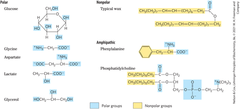
How do uncharged organic molecules dissolve in water?
By hydrogen bonding with water through C=O, O-H, and N-H groups, allowing otherwise uncharged molecules to dissolve.
What is electrostatic solvation?
Water dissolves charged molecules and salts by replacing solute-solute interactions with water-solute interactions.
Why is water good at dissolving charged molecules?
Because of its high dielectric constant and polar nature, which stabilize charged ions.
Why does dissolving salts favor solvation?
Breaking the crystal lattice into free ions increases entropy (ΔS), making dissolution more favorable.
How do nonpolar gases interact with water?
They are poorly soluble because they cannot form favorable electrostatic interactions or increase entropy.
Why do nonpolar molecules aggregate in water?
Clustering reduces the amount of water that must form ordered cages, increasing entropy.
How do amphipathic molecules interact with water?
They orient so the hydrophilic heads face water while the hydrophobic tails are shielded from water.
What two structures do amphipathic molecules commonly form?
Micelles
Bilayers
What is a micelle?
A spherical structure with hydrophilic heads outward and hydrophobic tails inward, formed from wedge-shaped molecules.
What is a bilayer?
A sheet of two lipid layers with hydrophobic tails facing inward and hydrophilic heads facing water, formed from cylindrical molecules.
What is the biological importance of bilayers?
They form the basic structure of cell and organelle membranes.
What is neutral pH?
pH = 7
[H+] = [OH−] = 10^−7
What happens under acidic conditions?
[H+] > [OH−] and pH < 7
What happens under basic conditions?
[H+] < [OH−] and pH > 7
How is pH calculated from H⁺ concentration?
pH = −log[H+]
(H⁺ must be in molar, M.)
How is pH calculated from OH⁻ concentration?
pOH = −log[OH−]
pH = 14 − pOH
How do you calculate H⁺ concentration from pH?
[H+] = 10^−pH
Example: pH = 4 → [H+] = 10^−4
What must you do before calculating pH if concentration is given in mM or μM?
Convert the concentration to molar (M) first.
1 mM = 10^−3 M
1 μM = 10^−6 M
Metric conversions to know for pH calculations
1 M = 1000 mM = 1,000,000 μM
1 mM = 10^−3 M
1 μM = 10^−6 M
Example: What is the pH of 100 μM HCl?
Convert: 100 μM x 10^-6 = 10^−4 M
Strong acid → [H+] = 10^−4 M
pH = 4
What is a conjugate acid-base pair?
Two species that differ by one H⁺ (proton).
HA ⇌ {H+} + {A−}
HA = acid
A⁻ = conjugate base
What is Ka?
The acid dissociation constant, a measure of an acid's tendency to donate a proton.
Larger Ka = stronger acid
What is the Ka equation?
Ka = [H+][A−] / [HA]
What is pKa?
pKa = −logKa
How is acid strength related to Ka and pKa?
Large Ka → low pKa → strong acid
Small Ka → high pKa → weak acid
How is dissociation related to acid strength?
Stronger acids dissociate more readily:
HA→ H+ + A−
When are HA and A⁻ equal?
At 50% dissociation (half-equivalence point).
What happens to the Ka equation when HA = A⁻?
HA and A⁻ cancel: Ka = [H+]
When are pH and pKa equal?
At 50% dissociation (half-equivalence point).
pH = pKa
How is pKa determined experimentally?
This point is determined by how much strong base was added to get the acid to dissociate to 50%. The stronger the acid, the less base is needed to deprotonate it. If less base was needed to deprotonate it, we have a lower pKa/pH
What does the midpoint of a titration curve represent?
50% dissociation
HA = A⁻
pH = pKa
Maximum buffering
What is a buffer?
A solution of a weak acid and its conjugate base (or weak base and its conjugate acid) that resists changes in pH.
Where is buffering strongest?
At the midpoint of the titration curve, where:
HA = A⁻
pH = pKa
What is the effective buffering range?
pKa ±1 pH unit
How do you choose a buffer?
Choose a buffer whose pKa is close to the desired pH.
How does pH affect a weak acid?
Low pH: protonated (HA), neutral
High pH: deprotonated (A⁻), negatively charged
How does pH affect a weak base?
Low pH: protonated (BH⁺), positively charged
High pH: deprotonated (B), neutral
What is the Henderson-Hasselbalch equation?
pH = pKa + log [A-]/[HA]
When pH=pKa, the buffering solution works best.
When pH is not equal to pKa, what can the Henderson-Hasselbalch equation calculate?
The ratio of conjugate base to conjugate acid, allowing you to determine the fraction protonated or deprotonated.
Find the fraction deprotonated using the Henderson-Hasselbalch Equation, given acetic acid has a pKa of 4.8 in a pH of 7
7 = 4.8 + log ([A]/[HA])
2.2 = log ([A]/[HA])
10^2.2 = [A]/[HA]
158 [A] per 1 [HA]
158/158+1 = 0.997 x 100 = 99.7% deprotonated
What do we measure using the HH equation when pH is increased/decreased?
When pH and pKa are equal, we know that conj acid and conj base are equal. It is 50% deprotonated. If we increase or decrease pH, we can determine the change in deprotonation/protonation of the acid.
How do we know if an acid is deprotonated or protonated when solutes are added?
We need to find the buffering zone and know the pKa of this zone. The pKa will indicate the pH. Knowing the pH of the titration zone will allow us to know if the acid was protonated or deprotonated at new pHs.
If pH increases above the buffering zone, what happens to a weak acid?
It loses H⁺ and becomes deprotonated (A⁻).
When we run HH equation, the concentration represents the amount of acid deprotonated
If pH decreases below the buffering zone, what happens to a weak acid?
It gains H⁺ and becomes protonated (HA).
When we run HH equation, the concentration represents the amount of acid protonated.
How much does H⁺ concentration change for every 1 pH unit?
Each 1 pH unit = 10-fold change in [H+]
How effective is a buffer as you move away from the pKa?
At pKa: 1:1 acid/base (maximum buffering)
±1 pH: 10:1 or 1:10 (still effective)
±2 pH: 100:1 or 1:100 (poor buffer)
±3 pH: 1000:1 or 1:1000 (essentially ineffective)
What is an important buffer in the blood?
Bicarbonate (HCO3-)
How is bicarbonate formed?
Bicarbonate is formed when dissolved CO₂ reacts with water to form carbonic acid (H₂CO₃), which then dissociates into H⁺ and HCO₃⁻.
Explain the equilibrium reaction between carbon dioxide and bicarbonate.
CO2 (g) ↔ CO2 (aq) ↔ H2CO3 ↔ H+ + HCO3−
CO₂ dissolves in blood.
CO₂ + H₂O forms carbonic acid (H₂CO₃).
H₂CO₃ dissociates into H⁺ and HCO₃⁻.
In the lungs, the reaction reverses and CO₂ is exhaled.
How can bicarbonate be an effective buffer if blood pH is 7.4 and the pKa of carbonic acid is ~3.7?
Although the pKa is much lower than blood pH, the carbonic acid/bicarbonate system is linked to the lungs, which provide a large reservoir of CO₂ that can be rapidly removed or retained. This makes it an effective physiological buffer.
How are the lungs related to the blood buffer system?
The lungs regulate CO₂.
↑ Ventilation → ↓ CO₂ → ↓ H⁺ → ↑ pH
↓ Ventilation → ↑ CO₂ → ↑ H⁺ → ↓ pH
How are the kidneys related to the blood buffer system?
The kidneys regulate HCO₃⁻ by reabsorbing or excreting bicarbonate and secreting H⁺, helping maintain blood pH.
What is acidosis?
When aterial blood has a pH less than 7.35
How do the lungs relate to acidosis?
In respiratory acidosis, the lungs fail to remove enough CO₂.
↑ CO₂ → ↑ H₂CO₃ → ↑ H⁺ → ↓ pH
Common causes: COPD, asthma, respiratory depression, etc.
How do the kidneys relate to acidosis?
In metabolic acidosis, the kidneys may fail to maintain normal bicarbonate levels or the body may lose HCO₃⁻.
↓ HCO₃⁻ → ↓ buffering → ↓ pH
Kidneys normally compensate by retaining HCO₃⁻ and excreting H⁺.
Can polar molecules cross the cell membrane?
Polar molecules generally cannot cross the lipid bilayer without a transporter or channel.
Can nonpolar molecules cross the cell membrane?
Yep, small nonpolar molecules diffuse freely through the lipid bilayer.
How do weak acids and weak bases cross cell membranes?
The uncharged (non-ionized) form crosses the membrane. Once inside, it can gain or lose H⁺ depending on the pH.
Example: Anesthetics
How do free amino acids act as both acids and bases?
They contain both a carboxyl group (acid) and an amino group (base), allowing them to donate or accept H⁺.
What is a zwitterion?
An amino acid with both a positive and negative charge, giving it an overall net charge of 0.
Which amino acids have acidic side chains?
Histidine, Aspartate, Glutamate
Which amino acids have basic side chains?
Tyrosine, Cysteine, Lysine, Arginine
Why are proteins sensitive to pH?
Changes in pH change the charge state of amino acids, which can alter protein structure and function.
What bonds are important for protein structure? Why?
Noncovalent bonds, they are more responsive to the environment
What are the four components attached to the α-carbon of an amino acid?
An amino group, carboxyl group, hydrogen, and R (side chain).
What is the α-carbon?
The central carbon of an amino acid that is bonded to the amino group, carboxyl group, hydrogen, and R group.
Why are most amino acids chiral?
Their α-carbon is attached to four different groups.
Which amino acid is the exception to chirality? Why?
Glycine: its R group is H, so the α-carbon has two hydrogens and is not chiral.
What are enantiomers?
Two mirror-image forms of a chiral molecule (L and D forms).
Which amino acid configuration is found in proteins?
L-amino acids.
How do you identify an L-amino acid in a Fischer projection?
With the carboxyl group on top, the amino group is on the left.