ANS 230 Exam 1
 Call Kai
 Learn
Learn Practice Test
 Spaced Repetition
 Match
Match Flashcards
 Knowt Play
1/213

There's no tags or description
Looks like no tags are added yet.
Name | Mastery | Learn | Test | Matching | Spaced | Call with Kai | Chat |
|---|
No analytics yet
Send a link to your students to track their progress
214 Terms
What is nutrition?
Choices we make about food that affect individual cells to the environment
Sum of processes by which an animal takes in a utilities food
Science that interprets interaction of nutrients that affects different physiological stages
Why does nutrition matter
Biological reasons: Need to know nutrient requirements for health
Management: Feed and feeding strategies
Economic: Feed costs and ROI
-Feed is the largest variable cost in animal production
How much of operating budget is feed costs
More than 70%
What does nutrition directly influence
Productivity, efficiency, and profitability
What does feed efficiency measure
How much of nutrient is being retained by animal and how much is wasted/excreted
What does small changes in feed efficiency scale to
Billions of dollars
Size of agriculture GDP
Share is small but societal impact is large
More efficient=
less waste
How does agriculture reduce poverty
Reduces poverty more effectively than any other sector
Ag growth is 2-4 x more effective in raising income than other sectors
What are animals related to plant energy? Why?
Biochemical converters of plant-derived nutrients
Animals cannot synthesize energy
Only source of energy/glucose
Plants
Only sustainable reaction
Photosynthesis
Photosynthesis formula

What disciplines does nutrition use
Biology: enzymes, tissues, regulation
Chemistry: bonds, re-dox
Physics: energy transfer, heat loss
What is catabolic and anabolic? Do they require energy? Transform what to what
Catabolic: breaking down molecules
Releases energy (exergonic)
glucose → ATP
Anabolic: reassembling molecules
Requires energy (endergonic)
amino acids → muscle protein

What is metabolism
Interconversion of nutrients to supply energy
Major source of inefficiency
Heat loss
Define 5 major nutrition processes
Ingestion: feed intake
Digestion/Absorption: breakdown and uptake
Metabolism: chemical transformations
Assimilation: use for structure/functions
Excretion: waste removal
What factors can we not control
Feed intake
Don’t know if they will eat the diet
What is energy not
Energy is not a nutrient!
It is an entity within a nutrient
How is energy measured
ATP
What is redox potential? Reduction vs oxidation? Measured in what?
Tendency of chemicals (nutrients) to gain/lose electrons
Reduced: gain electrons
Oxidized: lose electrons
Measured in volts (V) or millivolts (mV)
ATP generation depends on what
Controlled oxidation of nutrients
Who is Antoine Lavoisier
Father of nutrition and chemistry
Established link between respiration, oxidation, and energy metabolism
Founder of calorimetry and energy systems
What are the principles of nutrition
Physiology differs but energy laws do not
First law of thermodynamics
Energy/mass can not be created or destroyed, it is always conserved
Energy out=energy in but it can change form
Intake formula
Intake = retained-lost
Retained: milk, eggs, meat
Lost: feces, urine, methane
3 principles of nutrition
Balance: correct portions
Quality: nutrient composition
Bioavailability: usable fraction
What factors affect nutrient use by animals
Intake: palatability, access
Gut environment: microbiome, pH
Digestion and absorption: enzymes, transit time
Why do chemistry matter in biology
All biological processes driven by chemical interactions
Biologically important molecules?
Glucose, amino acids, fatty acids
What determines function at molecular level
Structure
Structural organizational pyramid

Smallest independently functional unit of body
Cell
Where is energy? In what bond?
Carbon bonds
Sometimes hydrogen
Prokaryotic vs eukaryotic cells
Prokaryotic cell: simple, no membrane-bound nucleus or organelles, unicellular
-Bacteria
-Archaea
Eukaryotic cell: complex, membrane-bound nucleus and specialized organelles
-Animals
-Plants
-Fungi
-Protists
Size of animal and bacterial cell
Bacteria: 0.5 - 5 µm in diameter
Animal: 10 - 100 µm in diameter
Animal cell is 10-20 times larger and 1000 times greater volume
Bacteria cell=marble Animal cell=grapefruit or tennis ball
What are the six nutrients
1) Carbohydrates: CHO, energy (glucose, starch)
2) Proteins: AA, energy, enzymes, structure, signaling
3) Lipids: energy (long term), membranes, insulation
4) Water: temp regulation, solvent for rxs
5) Minerals: structural (Ca, P) vs regulatory (Na, K)
6) Vitamins: cofactors in metabolism
What nutrients for energy
Carbs and lipids
Protein goes into energetic pathway but shouldn’t be included to meet energy requirements
Nutrients may be what
Source of energy (carbs, proteins, lipids)
Macro vs micro (how much of nutrient is required)
Organic or inorganic (minerals and H2O because lack C)
What is a dispensable nutrient
Not needed in diet because is made by animal
Still essential
What is a indispensable nutrient
Must be provided because cannot be made by animals
Conditionally indispensable means it can’t be made by animal in sufficient quantities
What are some species specific indispensable amino acids
Taurine: indispensable for cats due to limited synthesis
Arginine: conditionally indispensable during severe illness, trauma, or genetic conditions like sickle cell anemia
Glutamine: needed in higher amounts during stress (surgery, burns) for gut health and immune function
What are some species specific indispensable vitamins and minerals
Vitamin C: guinea pigs and primates can’t make it
B vitamins (B12): microbes produce most B vitamins (only microbes make B12); rabbits practice coprophagy to re-ingest nutrients
Factors that influence conditionally indispensable nutrients
Growth and life stage: neonates often need nutrients (arginine, glutamine, choline) that adults can make
Disease/stress: trauma, infection, or metabolic disorders overwhelm synthesis pathways (arginine, glutamine in sepsis)
Dietary imbalance: poor quality protein or lack of precursors
Animal vs plant cells

Animal vs plant cell: energy
Plants: autotrophic using chloroplasts for photosynthesis which turns sunlight into glucose
Animals: heterotrophic using mitochondria for cellular respiration (glucose to ATP)
Animal vs plant cell: structural support
Plants: rigid cell wall made of cellulose provides shape and protection and prevents bursting in water
Animals: flexible cell membrane phospholipid bilayer only (no cell wall) which allows movement, shape changes, and immune functions
Animal vs plant cell: water and waste management
Plants: large central vacuole maintains turgor pressure (firmness) and stores water/nutrients/waste
Animals: multiple small vacuoles/vesicles that rely on lysosomes for waste breakdown
Animal vs plant cell: communication
Plants: plasmodesmata (channels through cell walls) for cell to cell communication
Animals: gap junctions allowing flexibility in tissue structure (muscle, nerves)
Animal vs plant cell: energy storage
Plants: store energy as starch
Animals: store energy as glycogen (glucose) or triglycerides (excess glucose)
What do plant and animal cell have in common
Eukaryotes with cell nucleus that houses chromosomes
How do place synthesize amino acids
From inorganic N (reduces nitrates in soil)
Legumes can fix atmospheric nitrogen to make amino acids
What percent of air we breathe is nitrogen
70%
What is energy
Property of systems (not a substance)
Capacity to do work - physical, chemical, or biological
Key principles of energy
It can be transferred (heat, work, radiation)
It can be transformed
Total energy is conserved (1st law of thermodynamics)
What drives all reactions in body
ATP
What do all reactions release
Heat
What is the 2nd law of thermodynamics
In any energy transfer the entropy (disorder) increases
-Not 100% efficient
-Chemical reactions release heat, heat is dissipated from the body
Metabolism efficiency related to generation of heat
How is energy measured in animals
By their metabolic rate
What is metabolic rate? What units is it usually expressed in? How is it calculated? Direct vs indirect calorimetry
Amount of energy an animals uses over a specific time
Calories (kcal) per unit time - joules in other countries
Calculated by measuring O2 consumed and CO2 produced (indirect calorimetry)
-Direct measures heat produced from animal
C vs c
C: kilocalories = 1000 calories
c: calories
What does basal metabolic rate stand for
Maintenance
Energy expenditure 3 main categories most to least
1) Resting metabolism (maintenance) - 60%
2) Physical activity
3) Thermic effect: energy required for digestion, absorption, and nutrient processing
How can basal metabolic rate be broken down
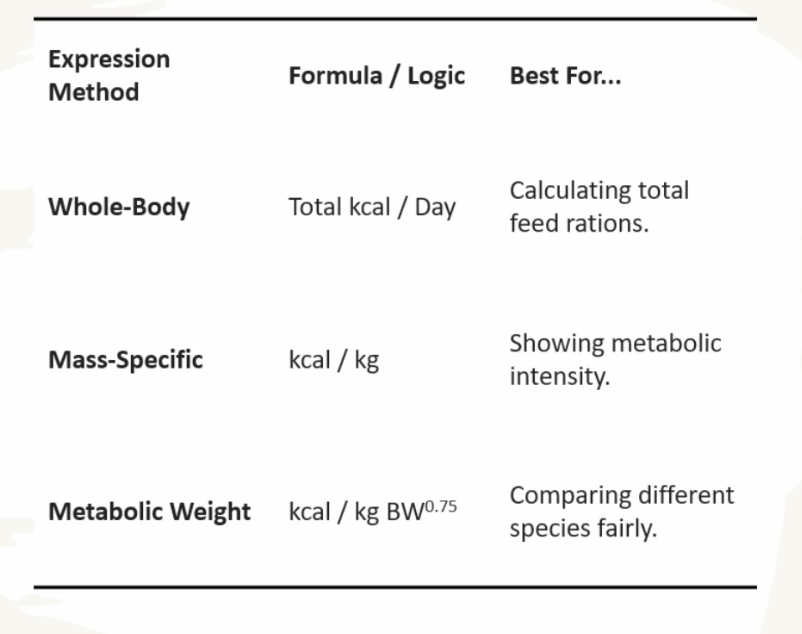
Per Animal (Whole-Body BMR)
-Total energy expenditure (24 hr)
-kcal/day
-Useful to determine energy required
Per Unit of BW (Mass-Specific BMR)
gg
-BMR relative to animal’s BW
-kcal/kg BW/d
Per Unit of Metabolic BW (BW 0.75)
-Most accurate to compare different species (accounts for surface area and volume ratios)
-kcal/kg BW 0.75/d
What is each BMR method used for
Does elephant or mouse have higher BMR
Per Animal: elephant
Per Unit of BW: mouse
Why do smaller animals have higher BMR
Small animal have lower mass=higher BMR b/c larger surface area to volume loses heat faster so more energy is needed to maintain internal temp
-Takes a lot of time for heat to leave the animal if they are larger
Heat lost through surface area (skin)
Heat is generated in volume (body tissues)
Small animals have more surface area per unit of body mass so they lose heat and burn energy faster → higher BMR per gram of body mass
What is BMR also referred to as
Fasting catabolism
-Body breaks down its own tissue reserves, no external energy provided
-Energy expanded in fasting animal
-Estimated by heat production measured by direct or indirect calorimetry in respiration chamber
Conditions needed to assess BMR
Animal must be awake
Complete physical and mental rest
Post absorptive state - not actively digesting food (fasting)
Thermoneutral environment
How do endotherms use heat that comes from byproduct of metabolism
Use metabolic heat to maintain stable internal body temp
BMR defintion
Baseline rate of energy used in a resting, fasting animal at neutral temps
What happens to metabolic rate with activity
Increases - more active animals burn more energy
What is torpor
When animals can dramatically lower their metabolism
Hibernation: winter torpor
Estivation: summer torpor
Which animal has highest metabolic rate
Hummingbird
Goes into torpor every night to lower metabolism
How to calculate metabolic body weight
Body weight to the power of 0.75
BMR chart
Metabolic body weight BMR numbers are so close together so good for comparing species

What can help slow aging
Environment:
Colder temperatures → slower heartbeats and metabolic rates
Antarctic glass sponge: 10,000 years
Size:
Larger animals almost always live longer than smaller ones
Some small animals made up of cells that can’t divide and be replaced when damaged so their bodies expire more quickly
Smaller animals prone to predators so reproduce more quickly and in greater numbers
Exceptions: bats, birds, turtles
Genetic differences:
How an organism’s cells respond to threats
Animal with slowest metabolism? What do they eat? How do that combat this with body feature? How long to process meal? Bathroom? How much less muscle mass than animals their size? Body temp
3-toed sloths
Rely on leaves exclusively and they are hard to digest and absorb energy from
To combat this they have a multi-chambered stomach that takes up 1/3 of their body
Can spend 1-3 weeks processing a meal
Don’t move much - descend once a week for bathroom
30% less muscle mass than animals their size
Body temp can fluctuate more than most mammals
Energy formula in animals
Reverse of that in plants

Carbs in plant and animal cells
Plants: sugars and starch (cell contents)
Plants: cellulose/hemicellulose (cell wall)
Animals: carbs (CHO) = major energy source
Carbohydrates empirical formula
Cm (H2O)n
How much of plant matter is carbs
60-90% of plant dry matter
How much energy in cellulose
80% of energy on planet in cellulose
How do we classify carbohydrates
Monomer type — Chemical identity
Degree of polymerization (DP) — Size and solubility
Linkage type (α vs β) - geometry of bond — Strength and digestibility
Discuss monomer type
Homo-polysaccharide: made of the same sugar units (monomers), usually glucose
Hetero-polysaccharide: made of different kinds of polysaccharides
Discuss Degree of polymerization (DP)
How long is the molecule
Oligo: 3-10 units
Poly: several units
Linear or branched
Discuss Linkage type (α vs β) - geometry of bond
Most critical for digestibility
α linkages: starch - easier to digest
-Both hydroxyl groups (OH) point on the linking carbons point in same direction
-Bond forms straight or parallel linkage across same plane
-Starch and glycogen - easily broken down
β linkages: cellulose
-Hydroxyl groups are on opposite sides of plane from each other
-Bond connects diagonally across plane
-Cellulose
Chemically identical but structurally different
Alpha vs beta glucose
Alpha: both hydroxyls pointing down
Beta: hydroxyls pointing opposite directions

Do pigs and cows eat starch or cellulose
Pigs: starch
Cows: cellulose - microbes to break it down, in majority of forages
How many carbons in glucose
6
Major dietary carbs table

What is soluble fiber
Instead of plant cell (starch and protein) - doesn’t include cell wall made of cellulose and hemicellulose
Structural vs nonstructural polysaccharides
Structural: cell wall so cellulose and hemicellulose
Nonstructural: inside cell so starch and protein
What are monosaccharides? Is it water soluble? Two common types?
Smallest carbs (> or = 3 C)
Highly water soluble
Glucose, galactose
Arabinose, xylose
What are 5 and 6 carbon molecules called
5: Pentoses
6: Hexoses
What are these molecules

Glucose
Fructose
Galactose
All monomers and single molecules
Where is glucose, fructose, and galactose found? Why does it matter

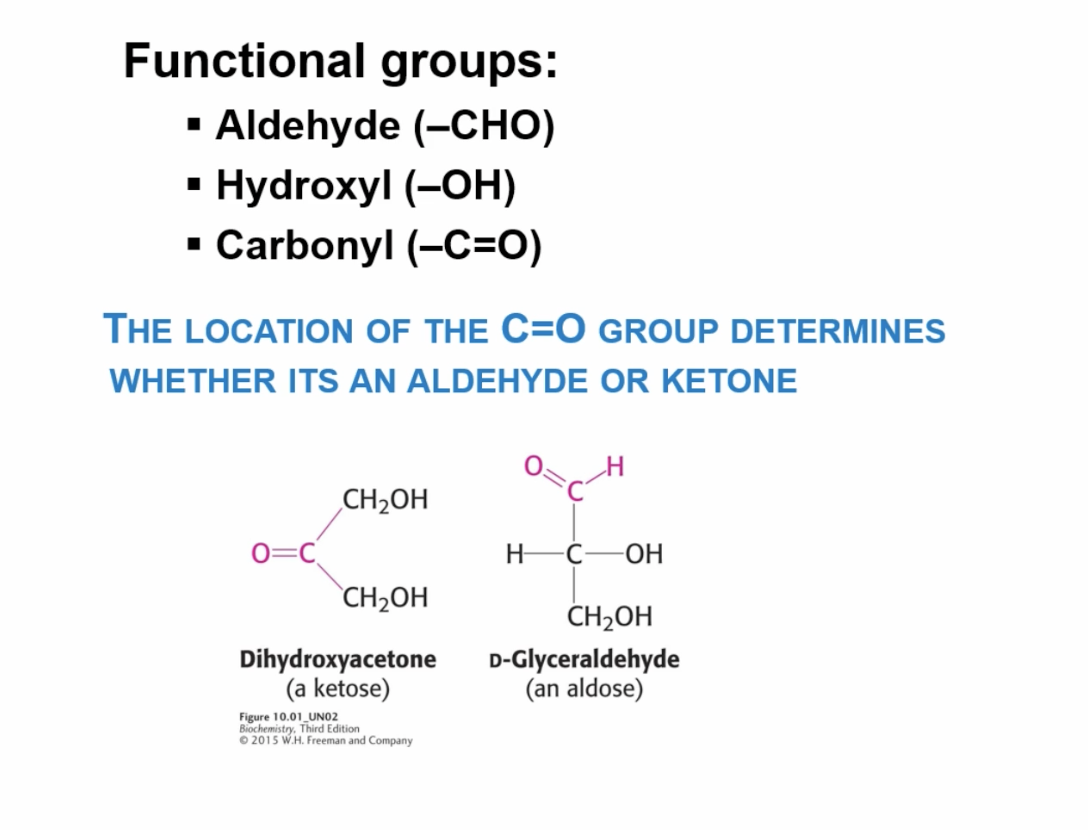
3 functional groups you need to know
Carbonyl bond on inside = ketose sugar
Carbonyl bond on terminal end = aldose sugar
What is ketosis
When body switches from burning carbs to burning fat
Breaks down fatty acids (liver bodies) for energy
Too many or too few ketone bodies indicate issues with metabolism