Suturing
 Call Kai
 Learn
Learn Practice Test
 Spaced Repetition
 Match
Match Flashcards
 Knowt Play
1/60

There's no tags or description
Looks like no tags are added yet.
Name | Mastery | Learn | Test | Matching | Spaced | Call with Kai | Chat |
|---|
No analytics yet
Send a link to your students to track their progress
61 Terms
Wounds that require sutures
wounds through the dermis and are likely to scar excessively if not closed with edges opposed
More than 0.25 inch deep, 0.75 inch long
Wounds that continue to bleed after 15 minutes
Contraindications to Sutures
Abscess or cellulitis, high contamination, deep puncture or stab, wound that cannot be irrigated adequately, significant delay in presentation (>24 hours), most animal and human bites
Need to check what patient history for sutures
tetanus immunization status (within last 10 years = need Tdap)
high tetanus prone wounds = soil (garden hoe)
clean
cutting breakfast food
contaminated
garden dirt
“golden period” - 6 to 8 hrs
increased chance of infection after 8 hours
Delay
Body - 12 hrs (max time for body lacerations to be repaired)
Face - 24 hrs (have more time d/t increased blood supply)
Bite wounds management
Copious irrigation (always use saline)
tetanus immunizations
assess for rabies exposure
suturing not recommended in most cases (few to no sutures for minor cases not to lock infection in)
sterility vs clean gloves
same outcomes in both
— here in US standard practice to use sterility
Best practice for clean wounds
meticulous cleansing and copious irrigation
Goals of wound care
Eliminate complications
Restore Functioning
Reduce Scarring
(proline sutures = most common used by plastic surgeons)
avoid sun/sunscreen or tape over scar
scar reducing cream (me derma)
Chance of foreign body in laceration?
get Xray before suturing
Glass shows up well on xray
if wood may need ultrasound
Scalp Laceration
careful examination
if white area on laceration of scalp feel it with gloved hand to see if it feels like tendon or bone
Galea = tendon sheath of scalp that connects frontal muscle to the occipital muscle
IF IT FEELS LIKE BONE = then galea is cut and separated - MUST BRING BACK TOGETHER WITH ABSORABLE SUTURES BEFORE REPAIRING SKIN
If you don’t fix it with cause cosmetic deformity from frontal muscles and increase risk for osteomyelitis of skull
Hand Considerations
know hand dominance
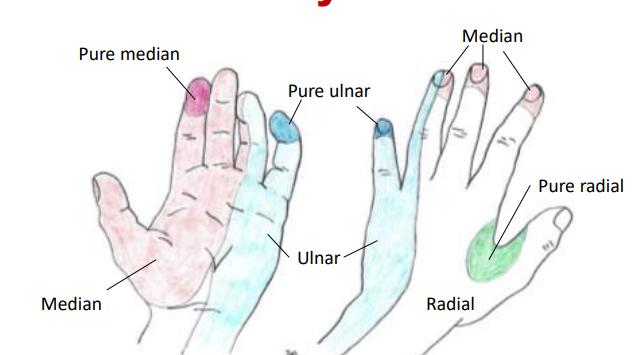
Check motor and sensory function
Radial, ulnar, median nerves
Dorsiflex, abduct, oppose (make OK sign with hand)
NO deep or buried sutures in hand (may hit tendon)
extensor and flexor tendons
if extensor tendon lacerated it does not retract (send to ortho for repair)
flexor tendon
Image of extensor tendons
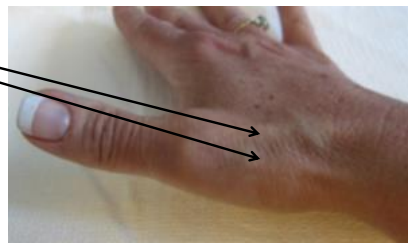
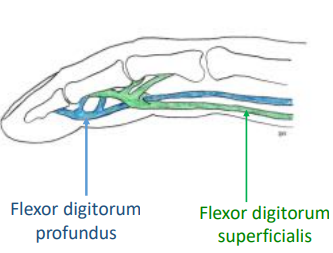
How to test Motor and flexor tendons in hand
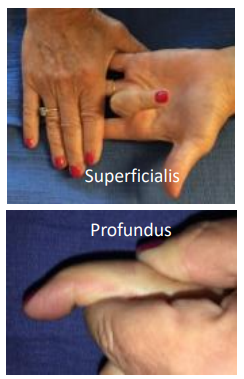
Superficial = bend finger at PIP while holding other three fingers down
Profundus = isolated PIP and bend at DIP joint
D = bend at DIP joint which is distal
Sensory function of hand
Dog bites
crushing injury
irrigate copiously and prophylactic antibiotic
10-15% of dog bites become infected
Pasteurella species
Cat Bites
treacherous fangs (bite goes deep and sometimes closes)
50% of bites become infected Pasteurella species
infection risk increases by double if over 8 hours
Dog bite wound repair
keep sutures loose not to trap infection
Abx for bites
Augmentin #1
Doxycycline or Bactrim (2nd options)
Animals that carry rabies
dogs, cats, ferrets, racoons, skunks, foxes, and bats (most large animals besides bats)
How to do Rabies immunizations
Four doses of rabies vaccine
1mL in IM deltoid
Day 0,3,7,14
Rabies Immunoglobulin 20 units/kg
Give day 0
administer into wound and remainder in IM deltoid
Leg and Foot Considerations
Less vasculature over tibia and higher tension
KEEP EXTERMITY ELEVATED
Foot
forefoot is more prone to complications
Plantar surface puncture wounds
2-8% complications
Rubber soled shoe - pseudomonas (must cover patient with fluroquinolone if through rubber shoe)
What are to inject anesthesia in skin
B/w dermis and subcutaneous layers
Interferes with neural depolarization & transmission of impulses along axons
1% lidocaine (amide)
Blocks pain stimuli
Leaves pressure & touch sensation intact
Duration: local, 20-30 min
2% lidocaine
Blocks all awareness of stimuli, including press and touch
No longer recommended due to increased risk for toxicity with minimal benefit
What hair color does not take up lidocaine well
red
Maximal single doses
Lidocaine (Xylocaine) 1% and 2%
Avg 70 kg adult = 30 mL
4.5 mg/kg
2% = 15 mL max dose
Maximal single dose
Lidocaine with epi 1%
avg 70 kg adult = 50 mL
7 mg/kg
Maximal single dose
Bupivacaine, Marcaine, Sensorcaine 0.25-0.5%
LONG ACTING
avg 70 kg adult = 70mL
3 mg/kg of 0.25%
Topical anesthesia dose
2-5 mL of mixture
Guidelines for local anesthetic
Don’t allow patient to view injection
Aspirate before injection if near vessel
Begin with topical dripping of med
drip medication over wound to help numb it
inject withing wound
Lidocaine burning buffer
Lidocaine is an acid pH 4.05-6.49
ADD 1mL of Na bicarb to 10 mL of 1% lidocaine to help neutralize and reduce burning sensation
slow injection
room temp
When to use epinephrine with Lidocaine
To decrease bleeding
Scalp, cheek, forehead
Prolong duration (lidocaine lasts longer)
DO NOT inject epi in terminal vasculature areas:
tips of fingers, toes, penis, nose, ears
Alternatives if lidocaine is not available
inject something to dilate vessels (sterile normal saline)
1% Benadryl = 50mg/mL Benadryl in 4 mL NSS
Local ice
When and where to use topical anesthesia
LET = lidocaine/epi/tetracine
DO NOT use on mucous membranes
Wick into wounds
Occlusive dressing and pressure are helpful
it is ready when blanced
20-to-30-minute wait time
Pain Ease
very inexpensive
spray for 10 seconds and lasts for 60 seconds
approved for minor open wounds
good when stapling scalp
Preparing and cleansing wound
1ST aestheticize wound then clean
Cleaning inside wound = normal saline
Cleaning around wound:
betadine = bactericidal for gram + & -
Hibiclens (CHG) - antibacterial agent for gram + (do not use in open wounds)
Hydrogen peroxide - oxygen bubbles remove new cells from granulation tissue and delays healing (not recommended)
Steps to wound irrigation
NSS 100-300 mL
use splash shield or 4×4 gauze
high pressure (5-70 psi) of saline superior to low-pressure streams such as bulb syringe (0.5-1 psi)
Considerations for healing wound
all wounds leave a scar
sunscreen for at least 1 year
history of keloid formation (always use proline for sutures to avoid keloid formation)
aged & long-term corticosteroid use
frail thin skin
Most common suture material
nylon ($1.30 / package) cheap
Best suture material
proline but $9 / package
Must align landmarks
Natural creases, Vermilion border, eyebrows
never shave eyebrows
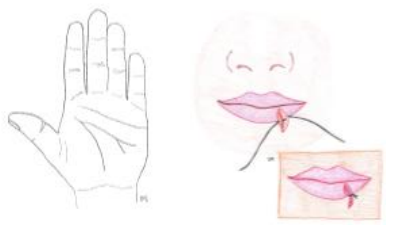
lacerations along skin tension lines
heal easier
Gelfoam
used to repair avulsive laceration (won’t stop bleeding)
apply to wound and hold pressure for several minutes; observe for 5 to 10 minutes (if still bleeding add more on top of one another)
keep gelfoam on for 7-10 days and let fall off naturally
DO NOT soak off
expensive / package
When to use Strei-stips
good for surface lacerations, nonmotion areas
avoid areas of bending or prone to getting wet
can use with both sutures or Dermabond
use benzoin or mastisol for additional adhesion
when to use steri strips
helpful on skin tears for thin frail skin
Tissue glue (Dermabond)
KEY POINT: thin to win
Cleanse and dry wound area
Apply two to three thin layers of tissue glue
avoid oozing into wound
dry between each layer to bond skin edges (5-10 sec dry time)
bonding strength is 2.5” = 7 days of sutures
Dermabond Safety in eye lacerations
Low tension, < 4 cm
Moist gauze over eye
Trendelenburg position
Antibiotic ointment over lashes (ointment dissolves glue)
Comes in prepared vials
Spontaneously peels in 5-10 days
ProPen no longer available
Staples
great for scalp
do not use in hands, feet, face
proper alignment = ½ cm
warn patient about noise
do not press into wound; line arrow up with wound laceration
always pull trigger all the way back until you hear a click
Removing Staples
go in center of staples
use rocking motion
Helpful hints for suture placement
comfortable position
adequate lighting
sew towards yourself
go into flap first if present
three instruments for sutures
suture with needle
needle holders
scissors
(possibly forceps if available)
best technique for sutures
good supination
How to select size of suture
Small needles — fine repairs, e.g., face
Larger needles — bigger bites
More zeros (6-0) — smaller, thin suture
Smaller suture — less tensile strength
Types of suture needles
Two basic configurations:
Tapered (round) - used in surgery
Cutting (reverse cutting) - what we will use
Letters
FS — For skin
CE — Cutting edge
P — Plastic
Absorbable Suture names and locations
Chromic, Dexon, Vicryl •
Below the skin •
Special areas — inside the mouth •
Situations in which later removal difficult •
Eliminate trauma of suture removal
NON absorbable sutures
Nylon-Ethilon
Prolene - for hairy or keloid areas
Silk
What size needle/thread on area of body?
5-0 anywhere on the body
4-0 on a larger joint
6-0 on face
Scalp = 4-0 or staples
Face = 6-0
Joints = 4-0
Extremities = 4-0 or 5-0
KEY PRINCIPLE wound eversion vs inversion
Correct = eversion
enter skin at 90 degree angle
wound edges should slightly evert
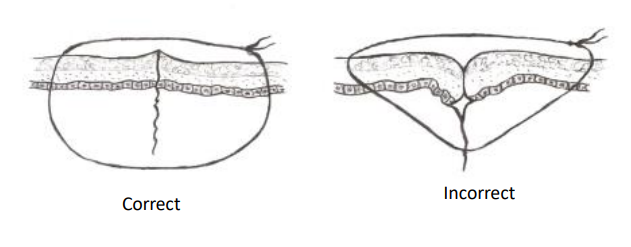
How to have best cosmetic results
smallest size needle
good wound eversion
prolene suture
Why do you want knots all to one side of wound?
bacterial grow in knots so you want to move knots away from wound
When to remove sutures
face/neck = 3-5 days
scalp/body = 7-10 days
joints = 10-14 days
Key steps in suture placement
2-1-1-1
move hands in opposite directions:
pull the needle holder toward you, then push the needle holder away
Wrap the long thread toward the tail
Aftercare for suture placement
Keep clean & dry for 24-48 hours
Gently wash with mild soap and water
Keep covered when ‘out’
Sparing use of antibiotic ointment
Suture removal as scheduled
5 days face
7-10 days body
10-14 days large joint