Nerve Impulse & Synapse
 Call Kai
 Learn
Learn Practice Test
 Spaced Repetition
 Match
Match Flashcards
 Knowt Play
1/42

There's no tags or description
Looks like no tags are added yet.
Name | Mastery | Learn | Test | Matching | Spaced | Call with Kai | Chat |
|---|
No analytics yet
Send a link to your students to track their progress
43 Terms
3 types of stimulus
Internal
External
Energy source
2 types of receptors
Sense organs
Transducer
Do sensory systems have afferent or efferent pathways
Afferent
Afferent direction
Afferent is anything that collects information and send it to the CNS
Do motor systems have afferent or efferent pathways
Efferent
Role of receptors
Receptors collect data and convert it to the language of the nervous system
Role of somatic senses
Enables body to feel, ache, chill
Responsible for touch and pain
How does the nose detect smell
Hairs are connected to afferent neurons
Nose converts chemicals to action potentials
Receptors of somatic senses location
Broadly distributed
How specific are receptors for somatic senses
Not very- they respond to many kinds of stimuli
Role of somatosensory pathway
Convey type and location of the sensory stimulus
Somatosensory pathway neuron roles
Typically 3 neurons involved:
Primary sensory afferent neurons
Receptor (sensory neuron)(goes to the thalamus)
Neurons 1 gets it to the spinal cord
Neuron 2 gets it to the thalamus
Neuron 3 gets it to the cortex
Role of thalamus
The thalamus is a sorting centre (recognises where the signal is coming from and its frequency
Where do cell bodies of all sensory neurons sit
Dorsal route ganglia
Internal stimuli of somatic senses
Touch
Temperature
Pain
Itch
Proprioception
Pathway
The amount of space on the sensory cortex devoted to each body part is proportional to what?
The sensitivity of that part of the body
Sensory signals from the left side of the body go to what part of the brain
Right cerebral hemisphere and sensory areas of cerebral cortex
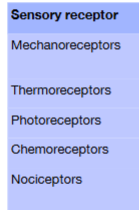
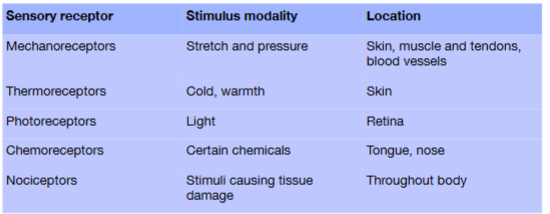
What stimulus modality & location is linked to what sensory receptor
is there ever any overlap of receptive fields of sensory units responding to different modalities
yes, often
Stimulus associated with rods & cones
Light
Adequate stimulus
The stimulus to which a specific receptor is specifically sensitive
Can sensors respond to stimuli that aren’t their adequate stimuli
Yes
For the eyes the adequate stimulus is light
This doesn't mean the receptors can't respond to other stimulus but it's best at recognising its adequate stimulus
4 steps for generating a sensation
Ion channels in specialised receptor membranes open/close for stimulus
Current flows through ion channels (creates graded change in membrane potential)
Action potentials are generated if receptor potential reaches threshold
Action potentials propagate along afferent neurons and cause release of neurotransmitter
Do primary sensory neurons fire action as stimulus is present?
Some do, others adapt
Adaptation of sensory receptors
Sensory receptors decrease in sensitivity to stimulus of constant strength (action potential frequency decreases)
Difference between rapidly adapting & slowly adapting sensory receptors
Rapidly adapting: Receptors signal changes in stimulus intensity
Slowly adapting: Receptors signal the continued presence of the stimulus
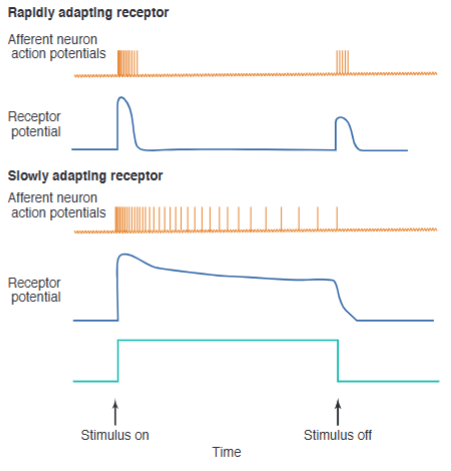
Example of a slowly adapting receptors
Pain receptors
What is AP (Action Potential) Propagation
How electrical signals travel along the axon of a neuron
Process of AP Propagation
Local current spread: ions spread along the axon, causing electronic conduction
Depolarisation of nearby part of membrane
A spike is initiated
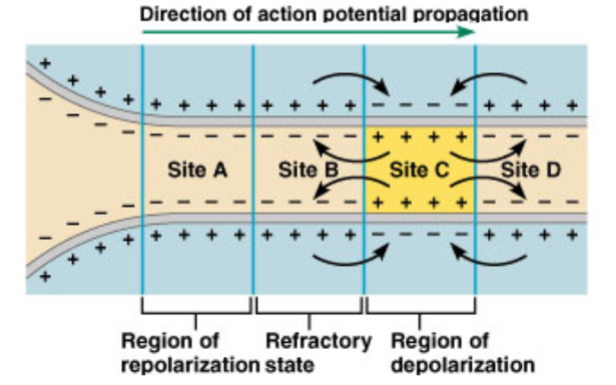
How many directions can axons fire in
Can fire in both directions but typically fire in 1
Unmyelinated axon AP propagation happens by ________ conduction
Continuous
Myelinated axon AP propagation happens by ________ conduction
Saltatory conduction
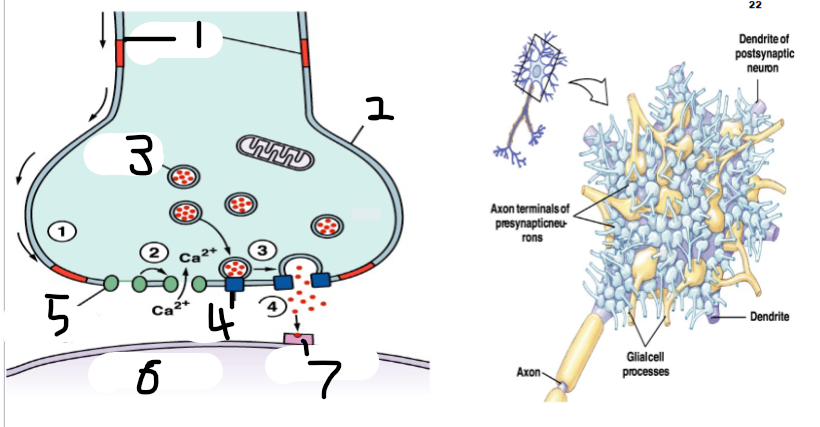
Action potentials
Axon terminal
Synaptic vesicle
Docking Protein
Voltage gated Ca2+ channel
Postsynaptic cell
Receptor
Where are neurotransmitter molecules synthesised & packaged
Vesicles
Where in a chemical synapse does an action potential first arrive
Presynaptic terminal
When an action potential arrives at the presynaptic terminal and the Ca2+ channels open, what direction does the Ca2+ go
Enters the synapse
What does a rise in Ca2+ trigger
Fusion of synaptic vesicles with the presynaptic membrane
Where do transmitter molecules go
Diffuse across the synaptic cleft and bind to specific receptors on the postsynaptic cell
What activates the post synaptic cell
Bound receptors
Fate of neurotransmitter after post synaptic cell is activated
Breaks down
Is taken up by the presynaptic terminal / other cells / diffuses away from the synapse
Effect of EPSP (Excitory post synaptic potential) & IPSP (Inhibitory post synaptic potential)
EPSP increases likelihood of a polarising change in PSP
IPSP decreases likelihood of a polarising change in PSP
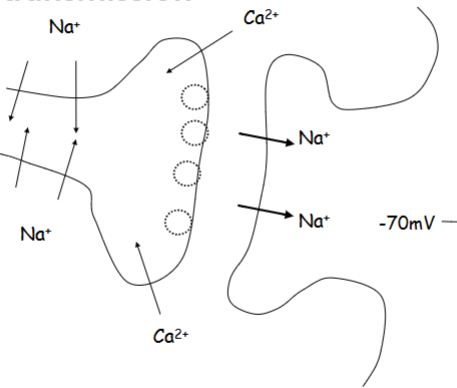
Is this an excitatory transmission or an inhibitory transmission
Excitatory
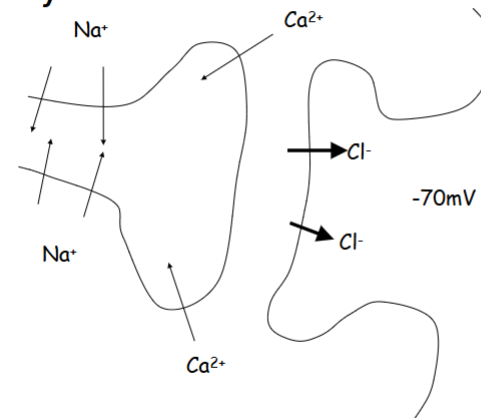
Is this an excitatory transmission or an inhibitory transmission
Inhibitory