1 : UNDERSTANDING THE MENTAL HEALTH CONTINUUM
 Call Kai
 Learn
Learn Practice Test
 Spaced Repetition
 Match
Match Flashcards
 Knowt Play
1/43

There's no tags or description
Looks like no tags are added yet.
Name | Mastery | Learn | Test | Matching | Spaced | Call with Kai | Chat |
|---|
No analytics yet
Send a link to your students to track their progress
44 Terms
Stigma
A cluster of negative attitudes and beliefs that motivate the general public to fear, reject, avoid, and discriminate against people with mental illnesses.
42
___% of people with mental illness face stigma and discrimination at least once a month
58
___% of sufferers say the stigma and discrimination is as damaging or harded to deal with than the illness itself
Stigma
internal, kahit walang ginagawa is na label na
Discrimination
may intent to make harm
Prejudice
perception, an unfair opinion or feeling formed about a person or group before knowing the facts
STIGMA
it is the use of negative labels to identify a person living with mental illness. It is often a barrier and it results into discrimination that discourages individual and their families from getting the help they need
Financial Constraints
Self-stigma
Social stigma
What are the 3 barriers in seeking psychological help? (Martinez)
Financial Constraints
It is one of the barriers in seeking psychological help in which due to high cost of service, lack of health, insurancem or precarious employment conditions individuals are unable to seek professional help.
Self-stigma
It is one of the barriers in seeking psychological help with associated fear of negative judgement and sense of shame.
Social stigma
It is one of the barriers in seeking psychological help that puts the family’s reputation at stakes or places one’s cultural group in bad light.
Mental health ay “arte” at “gawa-gawa” lang
Mental health conditions is a sign of weakness
People with mental illness are dangerous
It’s okay not to be okay
Common Myths in Mental Health
Mental Health
It is the way we think and feel and our ability to deal with ups and downs. A state in which individuals realize their potential, can cope with normal stresses of life, can work productively, and fruitfully, and is able to contribute to the community
BioPsychoSocial Framework
An approach to describing and explaining how the biological, psychological, and social factors combine and interact to influence physical and mental health.
Mental Distress
It is the inner signal of anxiety or stress that a person has when something in their environment is demanding that they adapt to a challenge.
Mental Distress: Emotional Vulnerability
Willingness and ability to address and articulate emotions. Vulnerability requires an emotional exposure and a self awareness.
Mental Health Problems
may arise when a person is faced with a much larger stressors than usual. These occur as part of normal life and are not mental illnesses. MH problems causes intense emotions we feel which is also accompanied by substantial difficulties in other domains such as:
a. Cognitive: “I don’t know if I go on in life.”
b. Physical: “sleep problems, loss of energy”
c. Behavioral: “social withdrawal, angry outburst”
Intelligence Quotient
Emotional Quotient
Adaptability Quotient
Social Quotient
Mental Distress: What Intelligence Is Most Useful?
Intelligence Quotient
comprehension ability, solve math, logical question, memorize things, and recall subject matters
Emotional Quotient
ability to maintain or be at peace with others, keep to time, be responsible, be honest, respect boundaries, be humble, genuine and considerate
Adaptability Quotient
ability to go overcome adversity in life and come out keeping the wits
Social Quotient
ability to build a network of friends and maintain it over a long period of time
This model shows that competency components; knowledge and attitude, the visible parts of the iceberg are the easiest elements to change. Those below the iceberg that drives the person’s attitude are harder to change. Performance is driven less by knowledge and hard skills but more by attitude.
COMPETENCY ICEBERG MODEL (Mclleland)
90%
How many percentage in EQ, AQ, and SQ (Values and Beliefs)
10%
How many percentage for IQ (Knowledge and Skills)
Mental Illness
A medical condition diagnosed by trained health professional using internationally established diagnostic criteria. Mental illnesses are the result of changes that arise in usual brain function as a result of a complex interplay between a person’s genes and environment.
Mental Health Continuum
The mental health continuum is a dynamic spectrum that shows mental health as a moving range from complete well-being and flourishing to severe mental illness or crisis. Everyone moves back and forth along this line during life based on stress, life events, and support
Mental Health Continuum
A model that starts from Normal, Reacting, Injured, to ill and may moves back and forth
The Dual Continuum Model (McKean, 2011)
shows that mental health and mental illness are two separate, distinct axes rather than opposite ends of a single scale. You can have a mental illness and still experience high well-being, or have no mental illness yet lack positive well-being.
struggling
What do you call if a person has:
optimal mental health + without mental illness?
complete mental illness
What do you call if a person has:
Poor mental health + with mental illness
Complete Mental Health
what do you call if a person has:
Optimal Mental Health + Without Mental Illness
Incomplete Mental Health
what do you call if a person has:
Poor Mental Health + Without Mental Illness
flourishing
also known as optimal mental health
languishing
also known as poor mental health
dual continuum
The _______ provides a contemporary view of mental health and wellbeing, showing that mental health and mental illness are separate and distinct concepts.
mental health
In this model, ________ is conceptualised as positive feelings and positive functioning.
flourishing
High mental health can be thought of as ‘_________’
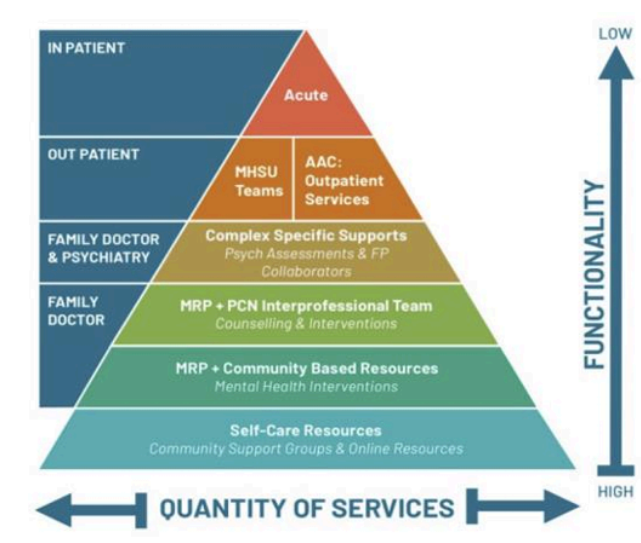
TIER 1
Population-based health promotion and prevention functions targeted at the general population
TIER 2
Early Intervention and Self-Management functions targeted to people at risk
TIER 3
Treatment planning, risk/crisis management and support functions targeted to individuals with
identified problems.
TIER 4
Specialized care functions targeted to people assessed/diagnosed as in need of more intensive or specialized care.
TIER 5
Highly specialized care functions targeted to individuals with complex problems
Mental Health Tier