Psychology U4 AOS 2
 Call Kai
 Learn
Learn Practice Test
 Spaced Repetition
 Match
Match Flashcards
 Knowt Play
1/71

There's no tags or description
Looks like no tags are added yet.
Name | Mastery | Learn | Test | Matching | Spaced | Call with Kai | Chat |
|---|
No analytics yet
Send a link to your students to track their progress
72 Terms
Wellbeing
Mental wellbeing
List the different ways of considering mental wellbeing
Wellbeing a state in which an individual is mentally, physically, and socially healthy and secure
Mental wellbeing an individual’s psychological state, including their ability to think, process information, regulate emotions and cope with the normal stresses of everyday life

Levels of functioning
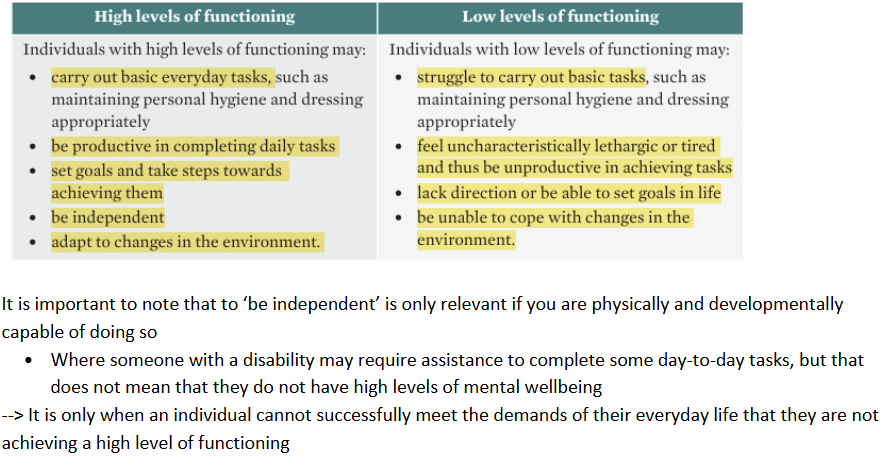
Compare high vs low levels of functioning
Levels of functioning the degree to which an individual can complete day-to-day tasks in an independent and effective manner
Adaptive behaviours
Maladaptive/dysfunctional behaviours
Adaptive behaviours are behaviours that allow individuals to adapt/adjust/change to the demands of daily life
Maladaptive/dysfunctional behaviours are behaviours that interfere or impair with a person's ability to carry out their usual activities
Resilience
Compare high vs low levels of resilience
Resilience refers to the ability to cope with and adapt well to life stressors and restore positive functioning following difficult times

T or F? Being resilient means that your life is without difficulty or distress
False.
Being resilient does not mean that your life is without difficulty or distress, or that you are always happy --> rather, high levels of resilience lead to mental wellbeing as you are able to respond effectively to stressors, overcome them, or adapt to them
Social wellbeing
Compare high vs low levels of Social wellbeing
Social wellbeing involves the ability for an individual to form and maintain meaningful bonds with others, socially interact in appropriate ways and adapt to different social situations
Strong social wellbeing helps individuals to gain confidence and create positive interactions in a social setting, and enables them to build strong support networks, which leads to overall better mental wellbeing

Emotional wellbeing
Compare high vs low levels of emotional wellbeing
Emotional wellbeing involves the ability for an individual to appropriately control and express their own emotions in an adaptive way, as well as understand the emotions of others
Other things in high levels of emotional wellbeing:
Accept mistakes or setbacks and learn from them
Make decisions with minimum worry, stress or anxiety
Manage stress using appropriate coping skills
Take responsibility for their actions

T or F? Individuals with strong emotional wellbeing still experience negative emotions as they are an inevitable part of life
Individuals with strong emotional wellbeing still experience negative emotions as they are an inevitable part of life - however, they can still be considered to have high levels of emotional wellbeing, and thus mental wellbeing, if they are able to effectively manage these emotions and appropriately express them
Social and emotional wellbeing (SEWB) + describe the framework
Social and emotional wellbeing (SEWB) is a framework that includes all elements of being, and therefore wellbeing, for Aboriginal and Torres Strait Islander peoples
The SEWB framework is:
Multidimensional, meaning that it is made up of different components
Holistic meaning it is an approach to wellbeing that considers the whole person, including their mental, physical, spiritual, and social needs
All dimensions are interconnected
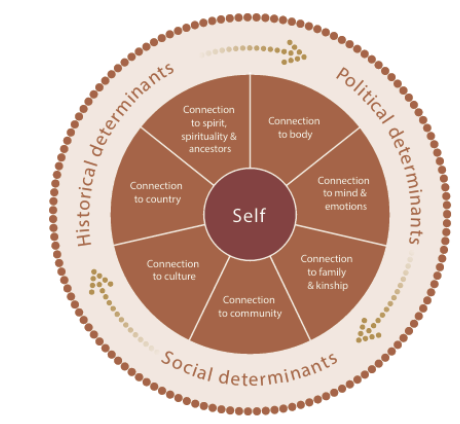
List the 7 dimensions in the emotional and wellbeing model
Mnemonic to remember:
“Friendly Children Celebrate Christmas Before Making Snowmen
F → Family & kinship
C → Community
C → Culture
C → Country & land
B → Body and behaviours
M → Mind & emotions
S → Spirit, spirituality & ancestors
Explain each dimension
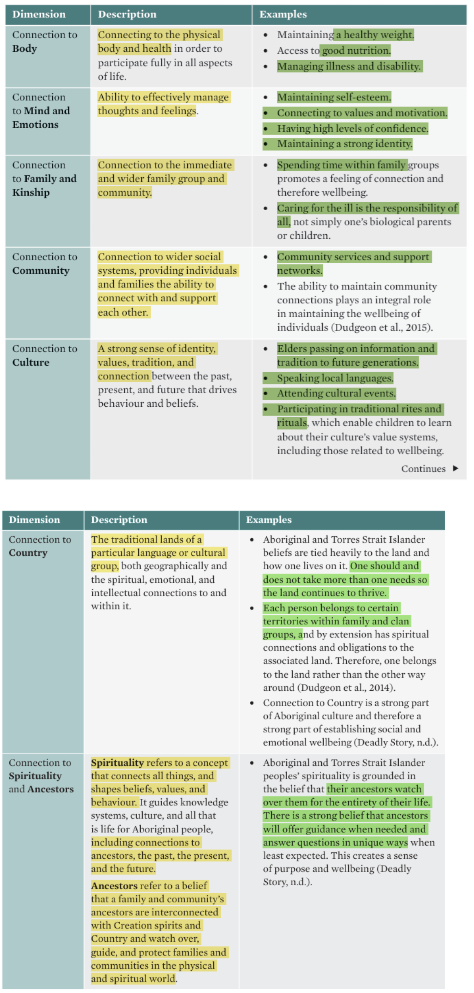
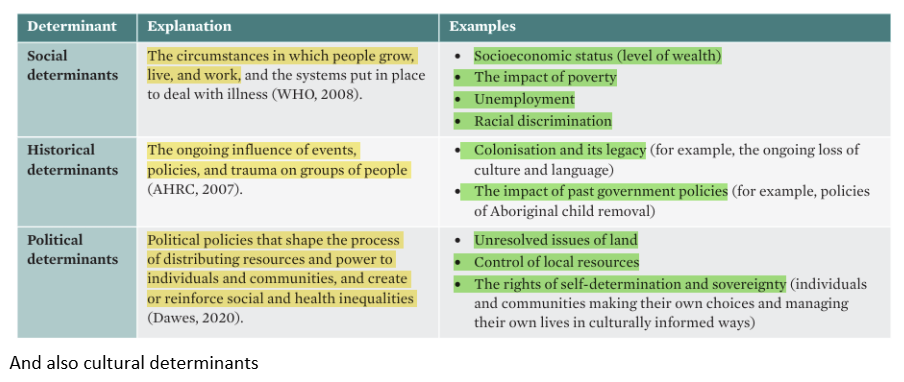
Identify + explain the determinants
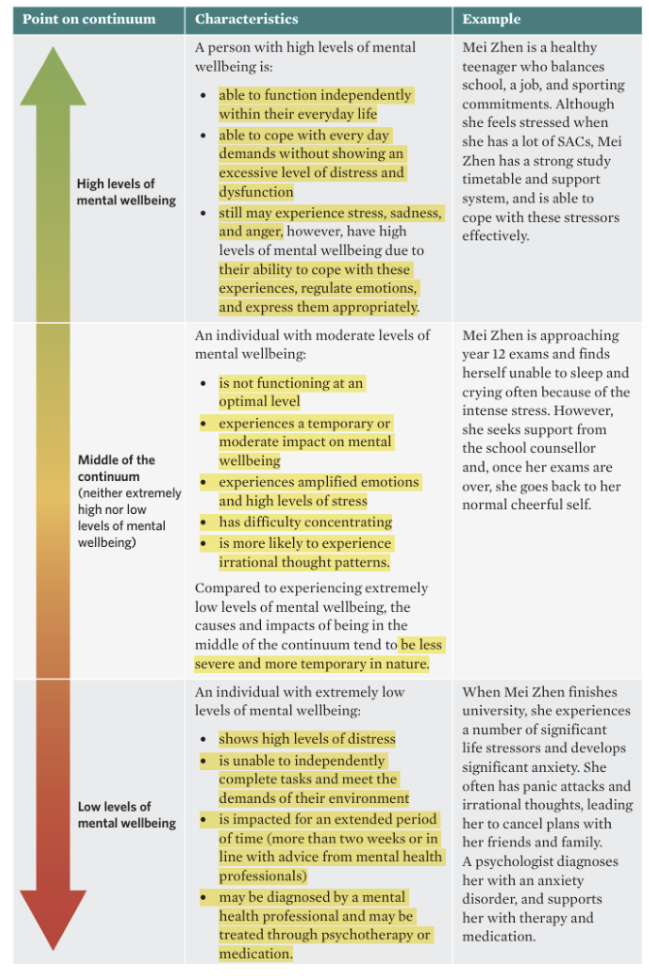
mental wellbeing continuum
T or F? Is mental wellbeing dynamic (constantly changing)
The mental wellbeing continuum refers to a tool used to track fluctuating mental wellbeing, ranging from high levels of mental wellbeing to low levels of mental wellbeing
T. As mental wellbeing is a dynamic (constantly changing) state, an individual’s placement on the continuum is not fixed and can shift over time
Internal factors + what do they include
External factors + what do they include
Internal factors are factors that arise from within the individual
These include biological factors such as genetics and hormones
Psychological factors such as personality and coping skills
External factors are factors that arise from an individual’s environment/outside a person
These include social factors such as interpersonal relationships, school and work-based factors and level of income

Mentally healthy
Mental health problem
Mental disorder/illness
Mentally healthy: feeling positive and functioning well in everyday life, resilience to life's stressors, and high levels of social and emotional wellbeing
Mental health problem: a problem that interferes with functioning but is relatively moderate in severity and tends to be temporary --> a person can feel low, irritable, confused, angry, lacking motivation or become withdrawn
Mental disorder/illness: diagnosable disorder that tends to be more serious, longer-lasting and required treatment – associated with significant personal distress and impairment to everyday functioning
A person who has a mental disorder experiences the 3 Ds. Identify + explain each
Distress – unpleasant emotions (e.g. sadness, anxiety, feeling overwhelmed)
Dysfunction – inability to cope with daily activities
Deviance – thoughts and behaviours that are not typical for that person or culture
Stress
Is it always on low levels of mental wellbeing
Stress is a state of psychological and physiological arousal produced by internal or external stressors that are perceived by the person as challenging or exceeding their ability or resources to cope
Stress is a normal part of life, and is not necessarily a sign of low levels of mental wellbeing
When an individual does not feel as though they have adequate resources to cope with a stressor --> this can lower an individual’s level of mental wellbeing
Anxiety
Is it present-oriented or future-oriented?
Anxiety is a state of psychological and physiological arousal that involves feelings of worry and apprehension that something wrong or unpleasant is about to happen
Anxiety is usually future-oriented, meaning that it involves worrying about events that may happen in the future + anticipation of future threat
--> Note that anxiety here is referred to in terms of the emotion (‘feeling anxious’), rather than in terms of a diagnosed anxiety disorder
Similarities between stress and anxiety
People will experience both stress and anxiety from time to time, and it is an expected part of daily life
They usually don’t interrupt daily functioning + are not always a sign of low mental wellbeing
Some stress and anxiety can be adaptive for functioning as they can motivate/alert people to take action – faster reaction
Anxiety disorder
Symptoms
Anxiety disorder is a term used to describe a group of mental health problems characterised by chronic feelings of anxiety, distress, nervousness and apprehension or fear about the future with a negative effect
Severe anxiety has intense physiological responses including:
Shortness of breath
Sweating
Trembling
Nausea
Stomach cramps
Dizziness
Feelings of suffocating
Specific phobia
What are they associated with?
Which NS is dominant when exposed to phobic stimulus?
Specific phobia is a diagnosable anxiety disorder that is categorised by persistent excessive and disproportionate fear when encountering or anticipating the encounter of a particular stimulus (object, activity, situation)
They are associated with:
An individual going to great lengths to avoid their phobic stimulus
Significant disruption to an individual’s daily functioning
Low levels of mental wellbeing when encountering or attempting to avoid the phobic stimulus
When exposed to their phobic stimulus, an individual's sympathetic NS is dominant, which can result in physiological stress responses including:
increased heart rate
rapid breathing
increased perspiration
dilated pupils
In some cases, a person can experience a panic attack in response to phobic stimulus – which is a period of sudden onset of intense fear or terror, often associated with feelings of impending doom
Can you do a summary of the similarities and differences between stress, phobia and anxiety:
Role of NS
Type of stimulus (whether known or not)
Associated emotions
Eustress or distress
Adaptive or maladaptive?
Place of mental wellbeing continuum
Normal?
Mental disorder?

Biopsychosocial approach
Biological factors
Psychological factors
Social factors
The biopsychosocial approach is a holistic, interdisciplinary framework used to consider how the interaction between biological, psychological and social factors influence mental wellbeing
Biological factors are internal, genetic, and/or physiologically based factors
Psychological factors are internal factors relating to an individual’s mental processes, including their cognition, affect, thoughts, beliefs, and attitudes
Social factors are external factors relating to an individual’s interactions with others and their external environment
List the different contributing factors to specific phobias
Biological
Psychological
Social

GABA (Gamma-amino butyric acid)
Why is it necessary
GABA (Gamma-amino butyric acid) is the main inhibitory neurotransmitter in the human nervous system --> it decreases the likelihood of postsynaptic neurons firing when GABA binds to receptors
The inhibitory action of GABA counterbalances the excitatory activity of glutamate and vice versa --> as it prevents the over excitation and uncontrolled firing by having an inhibitory/calming effect
GABA dysfunction + factors that could affect the level of GABA in a person’s brain include
GABA dysfunction refers to the insufficient neural transmission or reception of GABA in the body
--> This can be due to a low level or production of GABA, or an insufficient reception or transmission of GABA across the synapse or overproduction of glutamate
Factors that could affect the level of GABA in a person’s brain include:
• Genetic inheritance
• CNS damage
• Prolonged exposure to stress
• Nutritional deficiencies in B6 and citric acid
• High caffeine intake
GABA dysfunction can contribute to the development of phobia because:
GABA dysfunction may cause someone’s flight-or-fight-or-freeze or anxiety response to be activated more easily than someone with adequate GABA levels --> meaning for some people, the stress response is more easily triggered by certain stimuli
Recurrent stress responses to specific stimuli can lead to the development of a phobia
Long-term potentiation + how does it lead to the development of a phobia
Long-term potentiation is the long-lasting and experience-dependent strengthening of synaptic connections that are regularly coactivated
--> This contributes to the development of phobias by strengthening the association between neural signals involved in perceiving a stimulus and neural signals involved in activating the fear response
--> Where through their repeated coactivation, the signals involved in perceiving a phobic stimulus more readily trigger the activation of the neural signals responsible for the fear response

Note
A person with a phobia may have an easily-activated stress-response
When exposed to sudden danger or a threat, the amygdala is activated quickly and without conscious control of the brain. The person experiences a strong emotion – a strong fear response to the phobic stimulus
Precipitating factors
Explain how classical conditioning can precipitate specific phobia
Precipitating factors are factors that increase the susceptibility to and contribute to the occurrence of developing a specific phobia
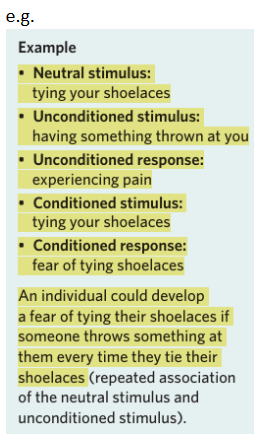
Classical conditioning can precipitate specific phobia as phobias can be learned, and therefore developed, through classical conditioning
In terms of classical conditioning:
What becomes a phobic stimulus would initially be the neutral stimulus (NS)
Through repeated association with an unconditioned stimulus (UCS) that naturally induces fear, the NS becomes the conditioned stimulus (CS)/ phobic stimulus, producing the conditioned response (CR) which is the phobic/fear response
Does classical conditioning always require repeated pairings to precipitate a specific phobia?
Note that it has also been suggested that classical conditioning can precipitate a specific phobia without repeated pairings of the neutral stimulus and unconditioned stimulus
--> Where if the experience is highly traumatic, an individual can be conditioned to experience a fear response after one pairing of the neutral stimulus and unconditioned stimulus
Perpetuating factors
Explain how operant conditioning can perpetuate phobias
Perpetuating factors are factors that inhibit a person’s ability to recover from a specific phobia
Operant conditioning perpetuates phobias by preventing an individual from overcoming them
This occurs by (note that this is only for negative reinforcement)
An individual with a phobia will generally avoid contact with their phobic stimulus at all costs
By avoiding confrontation with the phobic stimulus, a person is negatively reinforced through this avoidance in not having to deal with their fear response
Over time, this reinforcement strengthens or maintains the phobic response, making avoidance behaviours more likely to be repeated and preventing recovery through this cycle
e.g. Negative reinforcement
Josh avoids the fear and anxiety producing phobic stimulus (spiders)
Avoidance behaviour reduces or removes the unpleasant feelings of fear and anxiety.
Consequently, an avoidance response to any phobic stimulus will likely strengthen the avoidance behaviour through negative reinforcement, and the person is likely to continue avoiding their phobic stimulus in the future.
e.g. positive reinforcement
Samir and his parents went for a walk and came across a small lake. Samir ‘saw something moving’ in the lake and reacted with terror and started crying.
Samir’s mother promptly reassured him and gave him a big hug. To help him ‘feel better’, Samir’s father gave him a piggy-back all the way back to their camping ground and then drove him into town to buy Samir his favourite chocolate ice-cream.
Their responses may have inadvertently provided positive reinforcement for Samir’s fear response in the form of reassurance --> this would likely strengthen Samir’s fear response or increase the likelihood that he behaves fearfully the next time he encounters a lake or body of water.
Cognitive bias/distortion
Memory bias/selective memory
A cognitive bias/distortion ) is a tendency to think in a way that involves errors of judgment and faulty decision-making.
Memory bias/selective memory is a type of cognitive bias caused by inaccurate or exaggerated memory
As phobias are often caused by traumatic events, people may remember the trauma as extremely significant or harmful, and this impacts their present cognitions about the related stimuli
e.g.
People with arachnophobia (fear of spiders) may recall the size of a spider they encountered as much bigger than it was in reality
--> This inaccurate memory of the spider’s size may serve to justify their extreme fear of spiders and the threat they pose after the encounter, allowing their phobic fears to persist over time in their mind
Note
A memory bias results in a tendency for memory recall of a phobic stimulus or experience to be better for negative or threatening information than for positive or neutral information
For example, a person with a phobia of horses will tend to remember the one and only time they were chased by a horse but forget about all other times when horses showed no response to their presence.
Catastrophic thinking
Catastrophic thinking is a type of cognitive bias which involves overestimating, exaggerating or magnifying an object or situation and predicting the worst possible outcome.
When catastrophic thinking occurs, individuals experience heightened feelings of helplessness and underestimate their ability to cope with the situation.
e.g.
People with arachnophobia (fear of spiders) may think that if they encounter any type of spider, they will get bitten and die
a person with a fear of driving may think that if they get into a car they will definitely have a crash and die.
Specific environmental triggers
Different environmental triggers
Specific environmental triggers refer to stimuli or experiences in a person’s environment that evoke an extreme stress response, leading to the development of a phobia
There are a few different types of environmental triggers, including:
direct confrontation with a traumatic stimulus or event (e.g. being bitten by a snake)
observing another person having a direct confrontation with a traumatic stimulus or event (e.g. watching someone be threatened with a weapon)
learning about a potentially dangerous or traumatic stimulus or event indirectly (e.g. by watching a movie about threatening motorcycle gangs)
Stigma + how does this help maintain/perpetuate a phobia?
Stigma refers to the feeling of shame or disgrace experienced by an individual for a characteristic that differentiates them from others
Stigma around seeking treatment refers to the sense of shame a person might feel about getting professional help for their phobia --> where leaving one’s phobia untreated also perpetuates and maintains of specific phobia
Evidence-based interventions
Evidence-based interventions are treatments that have been found to be effective on the basis of valid and reliable research studies
List biological interventions

AGONIST
ANTAGONIST
AGONIST – chemical (drug or substance) that acts like or mimics a neurotransmitter
ANTAGONIST – chemical (drug or substance) that blocks a neurotransmitter from binding to a receptor site, inhibiting/preventing the neurotransmitters from having its usual effect on the post-synaptic neuron.
Benzodiazepines
Are they an agonist or antagonist? For which specific neurotransmitter?
Benzodiazepines are a type of medication that depresses central nervous system activity and is often used as a short-acting anti-anxiety medication
They have both anti-anxiety and sleep-inducing properties
They are commonly referred to a sedatives, tranquillisers or depressants
They are considered to be GABA agonists, where they bind to the same receptor sites as GABA and are likely to cause the same inhibitory effect on the post-synaptic neuron
How do Benzodiazepines help reduce anxiety?
Benzodiazepines bind to GABA receptor sites and mimic the effects of GABA to increase its inhibitory response
By inducing inhibitory responses, the rapid excitatory communication between neurons in the fear response is reduced, relieving the anxiety it causes and leading to the relaxation of muscles
A benzodiazepine may be described as short-acting, intermediate-acting or long-acting. What do these mean?
Short-acting means that benzodiazepine remains in the bloodstream and is cleared from the body in a short period of time
long-acting benzodiazepine may accumulate in the bloodstream or take a much longer period of time to leave the body.
What are some side-effects of using benzodiazepines?
There are relatively few side-effects of using benzodiazepines in the short term
however, there are potential negative consequences associated with their long-term use as they can reduce alertness, reduce concentration, decrease reaction time and can be addictive + can make some people more impulsive and more likely to take risks
Are benzodiazepines a good long-tern solution? Why/why not?
As benzodiazepines treat the symptoms and not the cause of anxiety
Once medication is stopped, symptoms may return if the underlying cause of the anxiety — the specific phobia — has not been addressed
Further, the use of benzodiazepine alone may alleviate symptoms but does not actually teach any non-drug dependent coping skills for dealing with anxiety
could mention previous long-term side-effects
Breathing retraining + what does it generally involve?
Breathing retraining is a method used to teach breathing control techniques that may reduce physiological arousal
generally involves slow, regular breathes in through the nose and out the mouth at a controlled rate as opposed to fast and/or irregular, shallow chest breathing or the rapid, deep breathing of hyperventilation
Discuss what happens to someone’s breathing when facing their phobic stimulus
What are the negatives of having this type of breathing?
When someone with specific phobia is facing their phobic stimulus, they often experience uncontrolled rapid fast, shallow breathing as their sympathetic nervous system becomes dominant
--> this can lead to hyperventilation and the engagement of other sympathetic nervous system responses, and in turn, increased anxiety and fear
When a person over-breathes they take in more air than the body actually needs. This can upset the balance of oxygen and carbon dioxide, resulting in a low level of carbon dioxide in the blood.
Too little carbon dioxide can cause reactions associated with a panic attack, such as:
dizziness
light-headedness
blurred vision
pins and needles
The goal of breathing retraining is to:
slow respiration/breathing rate
promote a normal, regular breathing pattern
prevent over-breathing
maintain the correct balance of oxygen and carbon dioxide in the blood
--> Promotes relaxation, reduce anxiety and stress

List psychological interventions
Note that the psychological interventions discussed can be described as psychotherapeutic treatments which address dysfunctional emotions, thoughts, and behaviours through therapeutic communication
As such, these treatments are psychological in nature rather than medical, and are used for mental-related conditions

Cognitive behavioural therapy (CBT)
Cognitive behavioural therapy (CBT) is a form of psychotherapy that is used to help an individual to identify their maladaptive thoughts and behaviours that perpetuate a phobia and then change (adapt/modify) these to be more adaptive (helpful, beneficial) thoughts and behaviours.
Avoidance behaviour
Safety behaviour
Avoidance behaviour is any action that helps to avert any contact, exposure or engagement with the feared object or situation --> perpetuate a person's phobia
Safety behaviour refers to actions that involve a willingness to have contact with the phobic stimulus providing certain precautions are in place (eg: someone who is fearful of insects may wear a hat, long trousers and boots when gardening).
CBT involves a cognitive and a behavioural component, describe what these involve:
The cognitive component involves:
identifying negative thoughts and feelings (cognitions) about the issue
replacing these negative thoughts and feelings with more positive ones
The behavioural component involves:
identifying negative behaviours relating to the issue
developing and maintaining more positive behaviours relating to the issue
e.g.
an individual who believes that they will die in a plane crash will be asked to consider that it is statistically unlikely
healthier behaviours are also recommended, such as going out and not performing avoidance behaviours, as well as employing relaxation techniques
Systematic desensitisation
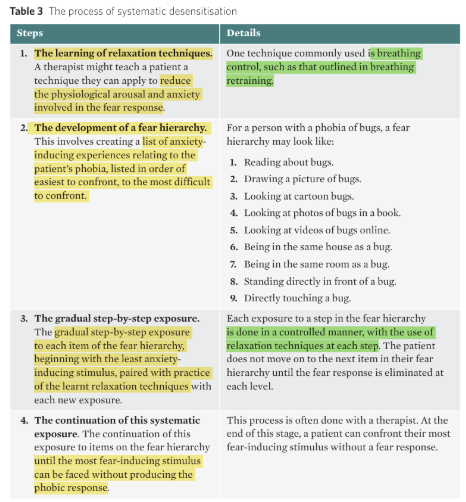
Systematic desensitisation is a therapy technique used to overcome phobia that involves gradual and repeated exposure to a phobic stimulus in a safe and controlled way while the person uses relaxation techniques until their fear is replaced by a relaxation response
Systematic desensitisation applies the principles of classical conditioning as it involves unlearning the connection between anxiety and a specific phobia (extinction of a fear response), and reassociating feelings of relaxation with that particular object or situation.
Explain process of systematic desensitisation:
Different relaxation techniques:
breathing retraining
slow breathing techniques
progressive muscle relaxation
visual imagery
Note that no advancement is made to the next item on the fear hierarchy until relaxation is achieved.
List social interventions

Psychoeducation + what info can it include?
Psychoeducation involves teaching families and supporters of individuals with mental health disorders how to better understand, deal with, and treat their disorder
The more a person is educated about their mental disorder and how it affects their own life, the more control that person tends to have over their disorder and the more likely they are to actively participate in self-management of their disorder.
A psychoeducation program for a specific phobia may include information about:
The nature of the disorder – how it develops, how it perpetuates and recovery patterns
The role of phobic stimuli
What a specific phobia is like for an individual, both physiologically and psychologically, such as fight-flight-freeze reactions and avoidance and/or safety behaviours
Impact on family and friends
Types of therapies and treatment interventions
Cost and effectiveness of treatment therapies
Medication – how it works, the benefits and side effects of medication
Breathing retraining, exercise, relaxation techniques and importance of a healthy lifestyle
Importance of support networks
Dealing with stigma surrounding phobias
There are two important components of psychoeducation that are taught to families and supporters:
Challenging unrealistic or anxious thoughts of the individual + not encouraging avoidance behaviours
Note that a specific phobia is best managed when using a combination of biological, psychological, and social evidence-based interventions
Risk factors
Protective factors + what are the 2 ways in which they could work
Risk factors are factors that increase the likelihood of an individual experiencing a mental health problem or a mental health disorder
Protective factors are factors that decrease the likelihood of a person developing a mental health problem or disorder
Protective factors can work in two ways by:
Reducing the risk of low levels of mental wellbeing or developing a mental health disorder
increasing the likelihood of high levels of mental wellbeing
List the biopsychosocial protective factors for mental wellbeing

Biological protective factors
Outline what’s a good diet
Outline what’s a bad diet
Biological protective factors refer to influences that stem from an individual’s brain and/or body that can maintain or promote mental wellbeing
Adequate nutrition and hydration is when the type and amount of food and drink that an individual consumes meet their physical needs
By prioritizing the consumption of unprocessed foods, adequate nutritional intake and sufficient water intake, the risk of mental health disorders can be reduced, thus promoting higher levels of mental wellbeing – where it can improve mood, maintain healthy brain functioning and help people cope with adversity
A healthy diet that helps reduce the risk of experiencing mental health disorders include:
Fruits
Vegetables
Legumes
nuts and seeds
Balanced diet that provides sufficient energy
Proteins for growth and maintenance of body cells
Mineral and vitamins for growth and regulation of body processes
Fats and carbs for energy
Best to avoid these foods that can increase the risk of experiencing mental health disorders:
highly processed foods
alcohol
added sugar, salt, and saturated and trans fats
Outline why water is important
How much water should people drink?
Water is very important as it forms the basis of blood, digestive juices, urine, perspiration
Water is needed to make neurotransmitters and hormones
Dehydration can lead to irritability and affect mental performance
Avoid caffeine is recommended for people with anxiety as it can increase anxiety and contribute to insomnia
In terms of hydration, it is recommended that individuals drink 2–3 litres of water per day (although this is dependent on individual characteristics, such as body weight and sex)
Sleep
What is NREM sleep responsible for?
What is REM sleep responsible for?
What are cons of inadequate sleep
Sleep is a regular and naturally occurring altered state of consciousness that involves a loss of awareness and disengagement with internal and external stimuli
NREM sleep plays a role in restoring the body
REM sleep plays a role in restoring mental processes
Inadequate sleep can lead to changes in emotions, being irritable, anxious, depressed and moody, difficulty concentrating, poor behaviour control
Research suggests there is a link between poor sleep (sleep deprivation and/or sleep-related problems) and mental illness
Good sleep is likely to reduce the likelihood of mental health disorders and promote mental wellbeing, therefore acting as a protective factor
Adequate nutrition, hydration and sleep have a bidirectional relationship with mental wellbeing
--> This means that while nutrition and sleep can influence mental wellbeing, mental wellbeing can influence nutrition and sleep
Strategies to help get better night sleep schedule
Stick to sleep schedule – go to bed and wake up at the same time each day
Exercise regularly (but not too close to bedtime)
Don't drink caffeine in evening
Avoid blue-light screens before bed
Quiet, dark, cool room
Psychological protective factors
Cognitive behavioural strategies
Psychological protective factors refer to influences that relate to mental processes that can maintain and promote mental wellbeing
Cognitive behavioural strategies
Cognitive behavioural strategies are techniques that utilise traits of cognitive behavioural therapy, particularly recognising and changing dysfunctional thought and behavioural patterns
These strategies can be used to promote mental wellbeing by acknowledging and changing thoughts and behaviours that impair mental wellbeing
Cognitive behavioural therapy involves a cognitive and a behavioural component:
The cognitive component involves:
identifying dysfunctional feelings and thoughts (cognitions) about the issue
replacing these dysfunctional feelings and thoughts with more functional ones
The behavioural component involves:
identifying dysfunctional behaviours relating to the issue
developing and maintaining more functional behaviours relating to the issue
Mindfulness meditation + it’s benefits
Mindfulness meditation is meditation practice in which an individual focuses attention to the present moment, including their current feelings, thoughts, breathing and surroundings, without judgement
Research suggests that mindfulness meditation can benefit mental wellbeing, where it can:
improve emotional reactivity
reduce the likelihood of rumination (repeatedly considering negative thoughts)
reduce stress
improve memory
Decrease activation of the amygdala – responsible for activation of stress response
Increase in activation of prefrontal cortex, responsible for awareness, concentration and decision-making
Social protective factors
Support
Social protective factors refer to influences that exist in an individual’s social environment that can maintain and promote mental wellbeing
Support refers to genuine and effective assistance provided by family, friends, and community
It can provide comfort and reassurance and can encourage individuals to develop different strategies to promote their mental wellbeing
And has to be authentic (provided in genuine manner by which supporter is true to themselves and genuine in their interactions with others) and energising
Four types of social support:
Emotional support (physical comfort, hug, listening, emphasising)
Esteem support (expressions of confidence or encouragement)
Informational support (advice-giving)
Tangible support (providing meals, financial support, taking care)
Culture
What are the two important cultural determinants of wellbeing
Culture is a strong sense of identity, values, tradition, and connection between the past, present and future that drives behaviour and beliefs
Cultural continuity
Self-determination
Cultural continuity
Cultural continuity is the ability to pass down and preserve cultural knowledge, historical traditions/practices, and values over generations
This can be achieved through a variety of cultural practices, including engaging with arts, crafts, music, dance, theatre, writing, storytelling, languages, food, and much more
Cultural continuity can be disrupted or destroyed if cultural practices are not allowed to continue
For Aboriginal and Torres Strait Islander peoples, this occurred with the arrival of the British first fleet in 1788
Self-determination
Self-determination refers to the inherent rights of all peoples to have complete choice, participation and control over their own lives and economic, social and cultural development without outside interference
It relates to having the power and freedom to make decisions about your own life, community and future, rather than having decisions imposed by others
Note:
Self-determination can include endeavours such as:
Aboriginal community-controlled organisations
Resistance campaigns
Activism for equal human rights
Education and justice reforms
Established partnerships between communities, governments, and non-government organisations, which is any not-for-profit organisation that exists to address a political or social issue
Constitutional recognition for Aboriginal and Torres Strait Islander peoples --> This will recognise Aboriginal and Torres Strait Islander peoples as the First Nations of Australia and empower Aboriginal and Torres Strait Islander peoples to determine their own futures
Which one of these is demonstrating cultural continuity and self-determination
Teaching young people their traditional language, stories and cultural practices
The community deciding how its health, education or cultural programs should be run
Teaching young people their traditional language, stories and cultural practices → cultural continuity
The community deciding how its health, education or cultural programs should be run → self-determination