ANSC 301 - Exam 3
0.0(0)
Studied by 1 person Call Kai
 Learn
Learn Practice Test
 Spaced Repetition
 Match
Match Flashcards
 Knowt Play
Card Sorting
1/184

Earn XP
Description and Tags
Last updated 3:15 PM on 11/2/22
Name | Mastery | Learn | Test | Matching | Spaced | Call with Kai | Chat |
|---|
No analytics yet
Send a link to your students to track their progress
185 Terms
1
New cards
Will animals that are not fed well reproduce optimally or at all?
No, only healthy animals reproduce and optimum reproduction requires optimum nutrition
2
New cards
What is required before an animal will become fertile?
Puberty is only reached after a certain stage of growth; body size is more important than age
3
New cards
What predicts age at puberty?
Puberty occurs at minimum size NOT a certain age
4
New cards
What hormone signals energy status that allows reproductive cycles to start? What hormones does it change in the brain?
Leptin; Increases GnRH, LH, and FSH which restores fertility, sperm count, and advances puberty
5
New cards
Why would there generally be a negative relationship between fertility and milk production in dairy cows?
Higher production in early lactation causes negative energy balance and body fat loss which delays estrous cycles and lowers fertility
6
New cards
What maternal tissues contribute to the requirement for pregnancy?
Uterus, placenta, mammary tissues
7
New cards
What two factors are important to know to determine the impact of a pregnancy on the mother/dam?
Ratio fetal weight/maternal weight
Gestation length
Gestation length
8
New cards
What period of gestation are nutrient requirements the highest? Why?
The last trimester; Nutrients for the fetus increase drastically, overtaking the demand of the uterus and placenta
9
New cards
Is under or over-feeding an issue in early pregnancy?
Both are an issue, as both can cause increased embryo mortality
10
New cards
Why do we not want to over feed during late gestation?
Overfatness at parturition (birth) further complicates effects of negative energy balance during lactation and metabolic disease
11
New cards
If an animal is underfed during late gestation who gets higher priority for the nutrients- mom or fetus?
Fetus
12
New cards
What is fetal programming and the “Barker Hypothesis”?
Condition of undernutrition in utero have been linked to increased obesity and insulin resistance, known as the thrifty phenotype
13
New cards
What is the biological explanation of fetal programming and the “Barker Hypothesis”?
Epigenetics, or the modification of DNA by methylation
14
New cards
What is a key tissue that helps keep young animals warm? How is the mitochondria and the electron transport chain involved? Is this mechanism present in adults?
Brown adipose tissue (BAT) that have abundant mitochondria in which the electron transport chain is used to pump H+ into the intermembrane space of mitochondria, H+ can then flow back out into the matrix through uncoupling protein 1 which creates heat and doesn’t make ATP
BAT is found in deep muscles in adults
BAT is found in deep muscles in adults
15
New cards
Where will a newborn animal get its blood glucose?
Dietary source is lactose, gluconeogenesis, and liver glycogen mobilization immediately after births (glycogen -> glucose)
16
New cards
Is protein deposition high or low in a young animal? How does milk support this?
Young; milk protein is rich in essential amino acids which gives it a high biological value
17
New cards
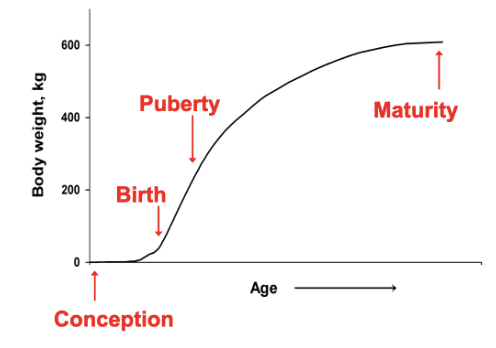
What does a normal growth curve look like?
Generic growth curve has rapid growth early in life that slows over time
18
New cards
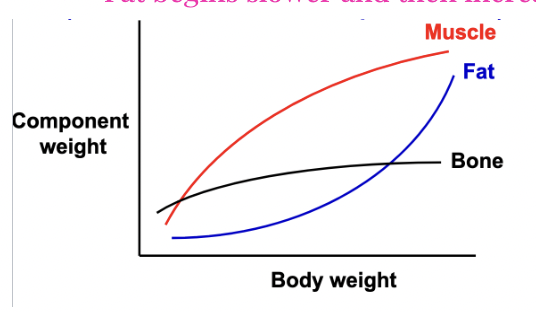
What does the growth curve look like for bone, muscle and fat?
As body weight increases:
- Muscle and bone increase more rapidly and then level off
- Fat begins slower and then increases rapidly
- Muscle and bone increase more rapidly and then level off
- Fat begins slower and then increases rapidly
19
New cards
What do proteins contain that make them unique?
Nitrogen
20
New cards
What is true protein vs non-protein N?
True protein - Amino acids and chains of amino acids (protein)
Non-protein N - Ammonia and urea
Non-protein N - Ammonia and urea
21
New cards
Does the concentration of proteins change much over development?
No, proteins are rather constant percent of the body on a free basis
22
New cards
What is the largest protein depot in the body?
Body fluids such as blood
23
New cards
What does protein turn-over mean? Why is body protein turned-over?
Protein turnover is the continuous replacement of proteins done to enable changes in protein composition and ensure proteins are function; Does not require much energy
24
New cards
Do all proteins have the same turn-over?
Turnover rates vary widely with biological roles
25
New cards
What happens to AA during protein turnover?
75-80% are reutilized for new protein synthesis while the remaining 20-25% have amino group removed, with C skeletons being metabolized and ammonia being detoxified
26
New cards
How do we make proteins?
Protein synthesis requires the expression of mRNA for the protein and then synthesis of protein on a ribosome
27
New cards
What tissue has the highest rate of protein synthesis, gut or muscle?
Gut, because of rapid cell loss
28
New cards
How would you increase protein deposition even if protein degradation was increased?
Increase protein synthesis greater than protein degradation
29
New cards
What optical form of amino acids are found in normal feeds?
L-isomers
30
New cards
Why do synthetic amino acids differ in their ability to meet an amino acid requirement?
D-isomers must be converted to L-isomer by deamination and re-amination, must be able to be transaminated
31
New cards
What is transamination? What is formed?
Transfer of the amino group of one amino acid to the c-skeleton of a keto-acid that forms new amino acids
32
New cards
What is a glucogenic amino acid? Ketogenic AA?
Glucogenic amino acid - An amino acid that can be converted into glucose through gluconeogenesis
Ketogenic amino acid - An amino acid that can be converted into ketone bodies
Ketogenic amino acid - An amino acid that can be converted into ketone bodies
33
New cards
What is an essential and non-essential AA?
Essential amino acid - Amino acids cannot be made by the body and therefore must come from food
Non-essential amino acid - Amino acids that can be made by the body if they do not come from food/are not included in diet; diet will provide most, but does not have to
Non-essential amino acid - Amino acids that can be made by the body if they do not come from food/are not included in diet; diet will provide most, but does not have to
34
New cards
What is used and what is produced during deamination?
Removal of the amino group from C-skeleton of an AA
Amino acid + H2O + coenzyme -> keto acid + ammonia + coenzyme-2H
Amino acid + H2O + coenzyme -> keto acid + ammonia + coenzyme-2H
35
New cards
What needs to be detoxified after deamination? What cycles do this?
Ammonia, the urea cycle and uric acid cycle
36
New cards
What are the benefits of the Uric Acid cycle?
Uric acid is fairly insoluble and non-toxic which is desirable for embryos while in eggs
Feces are excreted as a dry mass, which minimizes water in bladder, minimal water loss important adaptation to a very dry environment
Feces are excreted as a dry mass, which minimizes water in bladder, minimal water loss important adaptation to a very dry environment
37
New cards
When is amino acid catabolism increased?
Dietary protein intake exceeds requirement; composition of absorbed amino acids is unbalanced; gluconeogenesis from amino acids is increased when carbs are not available
38
New cards
What does muscle do with AA after a meal?
After a protein rich meal peripheral muscles extract AA and excess AA not used for protein synthesis are degraded
39
New cards
What does muscle do with AA during a fast?
40
New cards
A protein requirement is actually a requirement for?
Amino acids for tissues
41
New cards
Would two proteins that differ in their amino acid profiles have the same effect on growth?
No, the mixture of amino acid must match the composition of the proteins being synthesized for growth; To reach the same protein deposition as a protein with an ideal AA balance, a poorer AA balanced protein must have a greater intake
42
New cards
What is biological value? If a protein has a less ideal amino acid profile, will it have a high or low biological value?
The ability of a specific dietary protein to supply amino acids in the relative amounts required for protein synthesis by body tissue
Low biological value
Low biological value
43
New cards
Is biological value of a protein the same for an animal growing vs lactating?
No, biological value is not fixed, but varies with the varying needs of different species and physiological and nutritional states
44
New cards
What do we mean by an ideal protein?
A protein with an optimal EAA pattern that precisely meets the physiological needs of animals
45
New cards
If one amino acid is provided at 50% of requirement, but all others are adequate, what would you expect for performance/growth?
Performance/growth would be limited, as the deficient amino acid would be the first limiting amino acid, from which growth cannot continue without
46
New cards
Does one feed have an ideal amino acid profile? Rank plant proteins, microbial proteins, and animal proteins.
No, from best to worst - microbial proteins, animal proteins (fish, blood), plant proteins (corn gluten, soybean)
47
New cards
What are two feeds called that when mixed together have an amino acid profile better than either alone?
Complementary feeds
48
New cards
How are proteins broken down? What do we absorb?
Proteins are digested by enzymes in the stomach and small intestine into peptides and amino acids that are absorbed via passive (peptide and some AA) and active (some AA) transporters
49
New cards
What is an AA antagonism?
Growth depression from an excess of one AA that can be revered by adding a second AA
Unlike imbalance, the supplemental AA need not be limiting
Unlike imbalance, the supplemental AA need not be limiting
50
New cards
What is an AA toxicity?
Growth depression from an excess of one AA that cannot be reversed by adding a second AA
51
New cards
What is an AA imbalance?
Deficit of one or several AA that can cause depression ingrowth or production and can be reversed by addition of small amounts of the AA
52
New cards
What happens if we have a slight protein deficiency?
Reduced growth rate, increased fat, low milk or egg production, poor feed efficiency
53
New cards
What happens if we have a severe protein deficiency?
Reduced growth rate, weight loss, scruffy hair and other standard deficiency signs
54
New cards
What happens if we have too much dietary protein?
High feed costs, normal growth, enlarged kidneys, excess water intake, can contribute to infertility especially in ruminants
55
New cards
What are the environmental emissions from feeding excess protein?
Contribution to N pollution in water from leaching into ground and runoff into surface water, contribution to ammonia emission from urease in feces creating ammonia when mixed
56
New cards
What is the main contributor to ammonia emissions in the US?
Livestock
57
New cards
Is the dairy cow the most extreme example of lactation?
58
New cards
What is unique about the kangaroo?
When a kangaroo is nursing two joey's at once, it can make milk with different composition for the differently aged joey's
59
New cards
What is unique about the Northern Elephant Seal? How does their milk composition differ from a cow?
The seal does not eat or drink during lactation and loses 42% of body weight during lactation; milk is much higher in fat and higher in protein the cow's milk
60
New cards
To determine amount of a nutrient required for milk synthesis (say Ca) we need to know milk yield and ?
Milk nutrient concentration
61
New cards
Does milk composition match growth rate and requirement of the offspring? What are some examples?
62
New cards
How do we classify sugars?
Classified by the number of "sugars" in them;
ex. monosaccharides, disaccharides, trisaccharides, polysaccharides
ex. monosaccharides, disaccharides, trisaccharides, polysaccharides
63
New cards
What happens to glucose requirement during lactation? Where does the cow get this glucose?
Glucose requirement increases from gluconeogenesis of VFA propionate
64
New cards
What is the link between milk protein and milk lactose?
65
New cards
Do all animals have the same amount of casein (the protein that makes cheese)?
No, varies between species
66
New cards
What happens to energy requirements during lactation? Where does the energy come from?
Energy requirements increase
Rapid mobilization of endogenous reserves, especially fat (calcium, protein)
Slower increase in maximum voluntary intake in many animals
Rapid mobilization of endogenous reserves, especially fat (calcium, protein)
Slower increase in maximum voluntary intake in many animals
67
New cards
When we release fatty acids from adipose tissue how are they transported in blood? Are they quickly or slowly used?
Nonesterified fatty acids (NEFA) are transported in blood bound with plasma albumin and are used quickly
68
New cards
Where and how do we complete oxidize fatty acids? What cells are not able to do this?
Fatty acids are oxidized in the mitochondria
RBC - no mitochondria
Brain and testes - barriers
RBC - no mitochondria
Brain and testes - barriers
69
New cards
What are the key steps of beta-oxidation?
Fatty acids are activated to fatty acyl-CoA
Two carbon-acetyl Co-A is formed in each round
Two carbon-acetyl Co-A is formed in each round
70
New cards
When are we not able to completely oxidize acetyl-coA coming from beta-oxidation?
When low oxaloacetate inhibits the citric acid cycle
71
New cards
What do we do with the acetyl-CoA? What tissue does this occur in?
The acetyl-CoA enters the citric acid cycle to form oxaloacetate in mitochondria or is used in ketone synthesis in the liver
72
New cards
When an animal has high ketones, what can we smell on their breath?
Acetone
73
New cards
If the liver is taking up more fatty acids than it can export as vLDL, oxidize completely, or make ketones out of, what does it do with them?
It is stored in the liver as triglycerides which increase fat storage but decreases liver function
74
New cards
What can ketones be used for by other tissues in the body?
Ketone bodies can be used by most tissues as an alternate energy source
75
New cards
Where can we look for ketones to determine if an animal is ketotic?
Ketones first rise in blood, then urine, then milk; Can be measured quickly with test strips
76
New cards
What are four things that can contribute to metabolic diseases?
Failure to adapt to new physiological state
Very low intake
Hormone deficiency/imbalance
Obesity
Very low intake
Hormone deficiency/imbalance
Obesity
77
New cards
What is a primary metabolic disease?
Symptoms directly related to primary dysfunction
ex. type I diabetes causes inadequate pancreatic secretion of insulin
ex. type I diabetes causes inadequate pancreatic secretion of insulin
78
New cards
What is a secondary metabolic disease?
Symptoms indirectly related to primary dysfunction
ex. secondary ketosis in dairy cows caused by decreased intake due to milk fever, mastitis, etc.
ex. secondary ketosis in dairy cows caused by decreased intake due to milk fever, mastitis, etc.
79
New cards
Do we have to treat the secondary metabolic disease?
Only have to treat secondary metabolic disease if cannot find the primary problem
80
New cards
What happens if we only treat the secondary metabolic disease?
Problem will not resolve and must continually treat the secondary disease
81
New cards
What causes lactation ketosis?
Can't keep up to demand for lactation, normally occurs in early lactation before intake increases
82
New cards
What causes pregnancy toxemia?
Can't keep up with demand for fetal growth in ewes carrying twins or triplets
Low blood glucose, high ketones and metabolic acidosis leads to decreased intake, milk yield, and increased weight loss and sometimes increase in excitability or more often apathy
Recumbency or death if not treated
Low blood glucose, high ketones and metabolic acidosis leads to decreased intake, milk yield, and increased weight loss and sometimes increase in excitability or more often apathy
Recumbency or death if not treated
83
New cards
What happens in Feline Hepatic Lipidosis? What increases the risk? What is the short and long-term treatment?
Excess NEFA mobilizes from adipose tissue which is then taken up by the liver, limiting the ability of the liver to oxidize or export fatty acids as TAG in VLVDL leads to fat accumulations in the liver
84
New cards
What increases the risk of Feline Hepatic Lipidosis?
More common in older, obese cats, more often female than males, and is usually caused by prolonged anorexia
85
New cards
What is the short and long-term treatment for Feline Hepatic Lipidosis?
Restore energy intake, tube feeding, slowly reduce weight of obese cats, minimize stress
86
New cards
What is a common description of lipids?
A diverse range of compounds that have non-polar groups that make them relatively insoluble in water
87
New cards
Which lipids have the highest energy density?
Triglycerides
88
New cards
Which lipids have very little nutritional value?
89
New cards
Which lipid do we make to store energy?
Triglycerides are used to store energy in plants and animals
90
New cards
Which lipid do mostly find in forages? Are they as energy dense as triglycerides?
Glycolipids that are less energy dense than triglycerides since they have a glycerol backbone and two fatty acids compared to the three fatty acids in triglycerides
91
New cards
What do we use phospholipids for in cells? Are they as energy dense as triglycerides?
Used for cell membrane structure, integrity, and transport and as a second messenger in intracellular transduction (signaling) or hormone actions
Less energy dense than triglycerides
Less energy dense than triglycerides
92
New cards
What are some examples of steroid derived compounds?
Cholesterol, vitamin C, and steroid hormones
93
New cards
How can fatty acids be different from each other? Are these important to their metabolism?
Fatty acids are characterized by the number of carbons (chain length), number of double bonds (saturation), and the location and orientation of these bonds which are important to how it is metabolizes, how it is used and if it is bioactive
94
New cards
Where do we find trans fatty acids? Are they all bad?
Trans bonds are only found in industrial processed oils and ruminant fat (not found in plants)
Industrial sources are bad for humans, but ruminant sources are likely healthy for humans
Industrial sources are bad for humans, but ruminant sources are likely healthy for humans
95
New cards
What is palmitic acid, stearic acid, oleic acid, linoleic acid, linolenic acid? Are arachidonic acid, EPA, and DHA omega-3 or omega-6 FA?
Common fatty acids
96
New cards
What oil is high in palmitic acid?
Palm oil
97
New cards
What oil is high in oleic acid?
Olive oil
98
New cards
What oil is high in omega-6 FA?
Corn oil and soybean oil
99
New cards
What oil is highest in omega-3 FA?
Flax oil
100
New cards
What common oil is considered more “balanced” because of more omega 3 and less omega-6?
Canola oil