Audition Test 3 - Cochlear Potentials
 Call Kai
 Learn
Learn Practice Test
 Spaced Repetition
 Match
Match Flashcards
 Knowt Play
1/62

There's no tags or description
Looks like no tags are added yet.
Name | Mastery | Learn | Test | Matching | Spaced | Call with Kai | Chat |
|---|
No analytics yet
Send a link to your students to track their progress
63 Terms
What are 3 types of potentials?
endocochlear potential
receptor potential
neuro-action potential
What is another name for the endocochlear potential?
Endolymphatic Potential
How are endocochlear potentials recorded?
Recorded locally. (That means located at the spot whereas other methods we are measuring as close as possible)
What type of signal is an endocochlear potential?
A DC signal (direct current - no change in direction)
What is the tip size of micro electrodes?
thin tips
What is the tip size of macro electrodes?
large tips
What is the impedance of micro electrodes? What does this result in?
High impedance (resistance)
This means larger spatial attenuation (reduction of force, amplitude, etc) and therefore better spatial selectivity
What is spatial selectivity?
- How specific the info is to a tiny space
- microelectrodes have really good spatial selectivity because their tips are super thin and they read info only from a single cell
Are microelectrodes invasive?
yes, since the thin tips are fragile we need to do surgery
Are macro electrodes invasive?
less invasive --> usually placed far away from the target, normally on the surface of the body so this is not invasive
What do micro-electrodes record in relation to closeness of the target?
only cells near the tip can be recorded (have to be close to the target)
What do macro-electrodes record in relation to closeness of the target?
able to record the signal from far away from the target
What kind of graph or "wave" is used?
EcochG
Electrocochlography
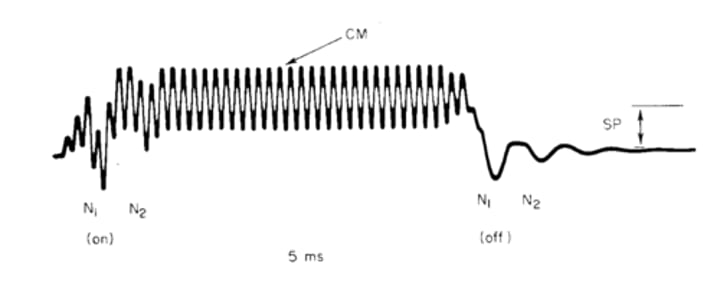
What kind of stimuli is played in an Electrocochlography?
tone burst
Where are the measurements taken from for a Electrocochlography?
round window
What are the three sections on an Electrocochlography?
cochlear microphonics, summating potential, compound action potential
How is the CM (cochlear microphonics) related to the acoustic signal?
it mimics the acoustic signal
What does the cochlear microphonic work as?
as a microphone
How is the cochlear microphonic related to the receptor potential?
The stereocilia deflection leads to the receptor potential of the hair cell and the CM reflects this.
Where is the cochlear microphonic generated?
In the organ of corti
What is an AC signal? What is a DC signal?
AC: alternating current - alternating in direction
DC: direct current - no change in direction
What is an example of an AC signal in real life ? What is the example of a DC signal in real life?
AC signal can be the signals carried in radios or electrical wire; DC can be the battery in a flashlight or our laptop
What are the two signals in the cochlea that are alternating current?
CM --> AC membrane potential
CAP (compound action potential) --> neuronal response
What are the two signals in the cochlea that are direct current?
Endocochlear Potential
Summating Potential --> this is the DC membrane potential of His
What happens to the potential when there is a deflection change in the stereocilia (ie. The steps of polarizing)
A deflection leads to the potential changing from resting, depolarizing, repolarizing, hyperpolarizing, repolarizing repeatedly
What is CM generated as?
as the AC membrane potential of HCs
The CM is the ____ _____ to deflection of stereocilia
cochlear response
What are two ways to record the CM?
intracellular and extracellular
What is a linear relationship in regards to input and output?
A linear relationship generally means that when you put something in the input, it is also growing in the output.
What does it mean that the CM has a non-linear input output relationship relative to the stimulus (sound level)?
A non-linear in this case means that while the intensity level (the stimulus dB) is increased, the CM amplitude also increases BUT it does reach a point where it will not increase and eventually at higher intensity levels will "roll-over" which means the amplitude of the CM will decrease at those levels
What is the take-home message of the relationship between sound level and CM signal?
NOT LINEAR
What are the four characteristics of the CM?
Copies the input signal waveform, no latency (no delay), cochlear status sensitivity (require healthy cochlea), non-linear
What are the three pieces of evidence supporting that the source of the CM are the hair cells?
1) Short latency indicating it is not a higher brain process
2) Intracellular recording of OHC receptor potential represents CM waveform, largest amplitude
3) Elimination CM (in the lab) the CM has a very small amplitude (if we destroy OHC, CM will be more than 90% gone)
Which hair cells is related to CM?
outer hair cell
What is a compound action potential?
It comes from the auditory nerve and is made of many of the individual fiber discharges (sum of ApPs from different ANFs and different nodes)
Why do we only see a CAP at the onset and offset of sound?
- at onset, all the neurons fire in sync because they are just being exposed to the stimulus
- at offset there is a big change as well so they stop in sync
- other than that they don't necessarily form perfectly in sync and that matters for whether or not you see the CAP
What is N1? What is N2? (on graph)
N1 is measuring fibres between the hair cells and SGN, there is a delay before they actually hear the sound
N2 is from the SGN to cochlear nuclei, the delay is even bigger because the body of these neurons are really big so there is bigger jumps from over myelin and it takes a while to travel
Where are the action potentials generated?
The N1 is from the SGN dendrites; the N2 is from the SGN axons.
What is the difference between N1 and N2?
The N1 latency is about 1ms and the N2 is 1.5-2ms (ie. The N2 is later)
What are three factors that lead to better synchrony? (Or characteristics):
1) high frequency region ANF's (due to higher speed of travelling wave and narrower region involved) --> faster means all the neurons will be excited at almost the same time
2) transient (temporal feature of stimuli) signal gives a better response (the signal with a fast change in time, such as clicks)
3) myelination --> conduction speed of APs is faster and less varied across neurons
What does it mean if the CAP is not synchronized?
Could possibly mean a disorder, auditory neuropathy
How does the summating potential (SP) look on the CM graph?
It is an elevation of the baseline
Why does the summating potential have this appearance on CM graph?
- The potassium accumulation in the hair cell during sound stimulation (it moves in through the MET potential).
- side point: with a high frequency signal, the stereocilia are moving back and forth faster so there is less time to remove the potassium from inside the hair cell which means you can see the SP more easily
Where are SP generated from?
equally from outer and inner hair cell
What is the latency of the SP like?
no latency from the signal
What kind of potential is the SP?
a receptor potential
What does it mean that the cochlea is a sound generator?
The cochlea makes a sound that is heard in the ear canal
What are the two main categories of OAE's?
Spontaneous and evoked
What are the four types of evoked OAE’s?
1) Transient evoked (TEOAE)
2) stimulus evoked (OAE)
3) distortion products (DPOAE)
4) electrically evoked (EEOAE)
Where are the sounds produced from?
By the outer hair cell of the cochlea.
How is the Transient Evoked OAE recorded?
A earpiece is used where there is a plug to block out the external noise and then there is also a tubing to deliver sound; There is a microphone and speaker component since you are delivering sound via the speaker and the microphone is recording the response from the ear
Who has the TEOAE?
everyone with normal ears
What are two factors affecting latency? Describe the relationship of each of these factors to have shorter latency.
Two factors: signal frequency and signal intensity.
Shorter latency is with a higher frequency and higher intensity.
What is the shape of the intensity function? What does this mean?
Non linear meaning that while the response of the TEOAE will increase with the intensity, eventually, at higher intensity levels, the response will actually not increase (gets saturated). Remember we are dealing with the OHC for this measurement and we know that the active mechanism is larger and gain is larger at a lower sound level.
How does the evoked spectrum compare to the stimuli?
The spectrum is narrower than its stimuli.
What is the DPOAE in brief?
The DPOAE stands for Distortion Product Otoacoustic emissions and is essentially named based on the fact that there are "distortion products" or an output (what is measured coming out of the ear) that was not present in the input (the signal we are presenting to the ear). Therefore, in addition to the two frequencies presented appearing in the output, there is also another frequency
How does the DPOAE show that the cochlea is non-linear?
It is non-linear since there is not a one-to-one in input and output if you are getting a new product in the output.
What is the formula for the product produced with DPOAE?
2F1-F2 where F1 is less than F2.
How are DPOAE generated?
The sounds are generated from inside the cochlea but not clear yet on how.
What are the main clinical uses of OAE?
A screening tool to see outer hair cell function; evaluating brainstem function by using OAE suppression (in development, not currently used)
Where are OHC innervated from?
Cochlear efferent system from the superior olivary complex
What do suppression tests help to evaluate?
Presenting sound to the contralateral ear means that the OAE can be suppressed and theoretically should be able to evaluate the integrity of the brainstem (ie. is there an issue in that level)
What is the limitation to suppression tests?
The limitation is the poor signal to noise ratio and the variation in response