Alcohol production (3.3.5.1)
 Call Kai
 Learn
Learn Practice Test
 Spaced Repetition
 Match
Match Flashcards
 Knowt Play
1/4

There's no tags or description
Looks like no tags are added yet.
Name | Mastery | Learn | Test | Matching | Spaced | Call with Kai | Chat |
|---|
No analytics yet
Send a link to your students to track their progress
5 Terms
How are alcohols produced by hydration and what are the conditions?
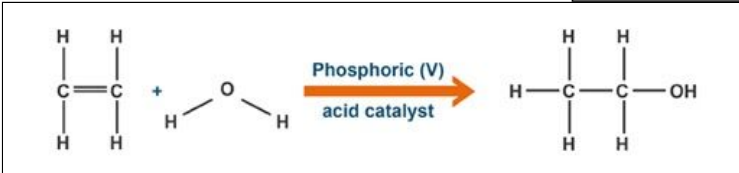
Alcohols can be produced industrially via the hydration of alkenes. It proceeds by an electrophilic addition.
Mechanism:

Conditions:
Temperature - 600K
Pressure - 6000-7000 kPa
Catalyst - H3PO4
Equation:
How is ethanol produced by fermentation and what are the conditions?
Ethanol can be produced industrially via the fermentation of glucose. In this process, enzymes break down the starch from crops into sugar, which is then fermented into alcohol.
Equation:
C6H12O6 (aq) → 2C2H5OH (aq) + 2CO2 (g)
Glucose →ethanol + carbon dioxide
Conditions:
Absence of oxygen (so fermentation can occur)
Presence of yeast
Temperature is 37 - 40°C (optimum for enzymes)
What are the pros and cons of hydration of ethene for ethanol production?
Pros:
It is a continuous process so quicker
High percentage yield
Low labour requirements as few workers need to operate system
Process doesn’t use up farming land
Cons:
It is energy intensive due to high temperature and pressure
Produce from a nonrenewable resource (crude oil)
What are the pros and cons of the fermentation of glucose for ethanol production?
Pros:
Cheaper than hydration as carried out at lower temperatures
Produced from renewable resources
Cons:
It must be fermented in batches so the reaction vessels have to be emptied, cleaned and restocked repeatedly, making it a slow process
Low percentage yield as high concentrations of ethanol are toxic to yeast cells (why its a batch process) so fractional distillation is needed to purify final product
Land used for growing biomass for fermentation is also needed for food production
What is biofuel and how can ethanol be turned into it?
Biofuel - fuel made from biomass
Ethanol produced via fermentation can be fractionally distilled and can be used as biomass (since it is made from sugars). It is said to be carbon neutral as the CO2 given out is equal to the CO2 taken in by the crops when they are growing. However it can be argued it isn’t carbon neutral as purification of the final product requires energy from fossil-fuel power stations.