NCEA Level 2 Biology - Genetic Variation and Change
 Call Kai
 Learn
Learn Practice Test
 Spaced Repetition
 Match
Match Flashcards
 Knowt Play
1/49

There's no tags or description
Looks like no tags are added yet.
Name | Mastery | Learn | Test | Matching | Spaced | Call with Kai | Chat |
|---|
No analytics yet
Send a link to your students to track their progress
50 Terms
Gene
A section of DNA that codes for a particular trait or characteristic
Alleles
Alternative forms of a gene
Meiosis
A type of cell division that occurs in the ovaries and testes to make gametes for sexual reproduction. Produces 4 haploid cells (half the number of chromosomes as the parent cell). Meiosis results in variation due to crossing over, independent assortment and segregation
Crossing over (genetic recombination)
Where homologous chromosomes line up at the cell equator and information is physically swapped. Segments of chromatids break and reattach to the other chromatid. Because of crossing over each gamete produced will have different combinations of alleles
Recombinants
Mix from parents
Non-recombinants
Chromosome unaltered by crossing over
Independent assortment
Occurs when homologous pairs of chromosomes randomly line up at the equator and are assorted into gametes (meiosis I). This means it is completely random which combination of alleles end up in a particular gamete. This results in cells having different combinations of chromosomes
Segregation
Homologous pairs are pulled apart by a spindle to opposite poles of the cell. This is called segregation, and each chromosome pair segregates independently of each other pair resulting in each pole having a random mix of chromosomes
Mutations
Mutations are a permanent change in the DNA in a gene or chromosome. They are the ultimate source of variation because they can create new alleles. Most mutations occur in somatic cells and are not inherited, only mutations in gametes are passed onto the next generation. The fitness of a mutation describes its value to the survival and reproductive success of the organism
Harmful Mutations
These mutations are harmful because, by altering the DNA sequence, they upset the structure and function of the protein they code for, producing a disorder in the organism that significantly lowers its survival and reproductive capabilities
Neutral Mutations
Some mutations are neither harmful nor beneficial to the organism in which they occur. These are called neutral or silent mutations. A mutation may have no adaptive value when it occurs, but this may change in the future. Neutral mutations may therefore be very important in an evolutionary sense
Beneficial Mutations
A mutation in an organism's genome that has a beneficial effect. It affects the organism in some way as to increase its chances of reproductive success, and therefore the chance of the mutation in question being passed along
Block Mutations
Block mutations (or chromosome mutations) are changes in the structure of a chromosome involving large pieces being rearranged. Whole groups of genes are affected. Some block mutations occur as a result of errors in crossing over during meiosis. Mutagens also cause block mutations
Types of block mutations
- Inversion
- Translocation
- Duplication
- Deletion
Inversion
Pieces of chromosome are flipped so the genes appear in reverse order
Translocation
Pieces of chromosome are moved from one chromosome into another
Duplication
Pieces of chromosome are repeated so there are duplicate segments
Deletion
Pieces of chromosome are lost
Changes in chromosome number
- Aneuploidy
- Polyploidy
Aneuploidy
A condition where one or more chromosomes are missing or added to the normal somatic cell number (e.g. Down syndrome). Aneuploidies usually result from non-disjunction during meiosis
Non-disjunction in meiosis
The meiotic spindle normally distributes chromosomes to daughter cells without error. However, mistakes can occur during meiosis in which the chromosomes, or sister chromatids, fail to separate properly. This is called non-disjunction and results in abnormal numbers of chromosomes passing to the gametes
Polyploidy
The multiplication of entire sets of chromosomes
Incomplete dominance
Neither allele is completely dominant over the other. The heterozygote shows a blend of the two phenotypes
Co-dominance
Both alleles are expressed equally and independently in the phenotype. The heterozygote shows both of the phenotypes
Lethal alleles
Alleles that produce a phenotypic effect that causes the death of the organism. Lethal alleles arise due to a mutation in an essential gene
Sex-linked genes
Genes carried on the sex chromosomes are called sex-linked genes. Most sex-linked genes are located on the X chromosome as the Y chromosome is smaller and has fewer genes. Males cannot be "carriers" of sex-linked genes. If they have one copy of the recessive allele, they will be affected by the condition
Pedigrees
Pedigrees show the inheritance of a trait over two or more generations. They can be used to find out if a trait is autosomal or sex-linked and whether it is dominant or recessive
What type of family tree is it?
1. If there are no affected females or if the ratio of affected males to females differs it must be a sex-linked trait
2. If two unaffected individuals produce an affected offspring, it must be autosomal recessive
3. If neither of the above apply and the ratio of affected to unaffected individuals is about the same, it will be autosomal dominant
Linkage
Linkage refers to genes that are found on the same chromosome. All of the genes on one chromosome are described as a linkage group. Linked genes tend to be inherited together and fewer genetic combinations of their alleles are possible. Linkage reduces the variety of offspring that can be produced. When more offspring show the parental phenotypes than expected in a dihybrid cross, it is due to linkage
Unlinked genes
Unlinked genes are assorted independently during meiosis to give 4 possible allele combinations in the gametes
Linked genes
Linked genes are inherited together during meiosis to give only 2 possible allele combinations in the gametes. Linked genes can be separated by crossing over during meiosis. The further apart 2 genes are on a chromosome, the greater the change that crossing over will occur between them
Calculating cross-over frequency
Crossover value (%) = (number of recombinants (mix from parents) / total number of offspring) x 100
Evolution
A change in the gene pool of a population over time
Gene pool
All of the different genes and their alleles present in the population of a particular species at any one time
Microevolution
Changes in the proportions of different alleles in a population from generation to generation
Macroevolution
The descent of different species from a common ancestor over hundreds or thousands of generations
Natural selection
The process by which beneficial phenotypes in a population are preserved because they are selected for while unfavourable phenotypes tend to be lost because they are selected against. Natural selection provides selection pressures which act on a population. Individuals that have alleles that give them a survival advantage are more likely to survive, reproduce and pass on successful alleles to the next generation. Individuals that have alleles that don't give them a survival advantage are more likely to die and their alleles are lost from the population as they will be unable to reproduce
Types of natural selection
- Stabilising natural selection
- Directional natural selection
- Disruptive natural selection
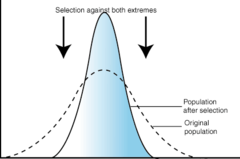
Stabilising natural selection
Favours the average phenotype (e.g. birth weight in babies - remains in 3-4 kg range as anything below are weaker and more likely to die, and above have difficulty being born and are also more likely to die)
Directional natural selection
Favours one extreme phenotype over the others (e.g. peppered moths and long necks in giraffes)

Disruptive natural selection
Favours both extreme phenotypes at the expense of the average. It is associated with a fluctuating environment and results in the development of quite different forms of a trait in a population, and can even lead to the development of 2 or more different species from the one original species

Factors affecting the gene pool
The gene pool is all of the different genes and their alleles present in the population of a particular species at any one time. Factors affecting it are:
- Natural selection
- Population size
- Gene flow
- Mate selection
- Mutations
How natural selection affects the gene pool
Natural selection changes the gene pool by removing individuals with less favourable alleles. Over time, it results in populations which are better adapted to the environment. It reduces variation in the gene pool
How population size affects the gene pool
The larger a population, the more stable its gene pool. If a population is small, removing a few individuals may have a significant effect on the gene pool, reducing variation and decreasing the population's chance of surviving if environmental conditions change
How gene flow affects the gene pool
Immigration - new alleles are brought into the gene pool as new individuals enter the population. This increases genetic variation
Emigration - when individuals leave the population some alleles may be lost. This decreases genetic variation in the gene pool
How mate selection affects the gene pool
Random mating results in little change in the gene pool. However, in many species the individuals select a mate. This changes the gene pool because certain phenotypes are favoured and they become more common
How mutation affects the gene pool
Mutation is the ultimate source of variation in a population. It produces new alleles in the population that can be acted on by natural selection. If the mutations are beneficial the individuals will survive and pass on their mutations so that the mutant alleles will increase in the population over time. If the mutation is not beneficial then the individual is less likely to survive, reproduce and pass on its mutation therefore it will not be included in the gene pool
Genetic drift
Change in allele frequencies of a population due to chance events. Genetic drift occurs in all populations, but it has a much greater effect on the gene pool when the population is small. It can result in alleles being lost from the gene pool (0% frequency) or fixed as the only allele present for a particular gene (100% frequency).
There are 2 types of genetic drift:
- Bottle neck effect
- Founder effect
Bottle neck effect
Disasters such as fire or drought etc can reduce a population to just a few survivors who don't really represent the original gene pool. If one survivor has a rare allele this will no longer be rare in following generations. Some alleles can be lost forever

Founder effect
Occurs when only a few individuals from a population move into a new area. They may not possess a representative sample of the available genes from that species' gene pool. Isolated populations that have descended from these 'founder ancestors' often have very different genes from the same species elsewhere
