cell-cell interactions : TGF-beta and FGF signalling
 Call Kai
 Learn
Learn Practice Test
 Spaced Repetition
 Match
Match Flashcards
 Knowt Play
1/90

There's no tags or description
Looks like no tags are added yet.
Name | Mastery | Learn | Test | Matching | Spaced | Call with Kai | Chat |
|---|
No analytics yet
Send a link to your students to track their progress
91 Terms
Describe the two main branches of TGF-β signalling and how the transduction pathway works
Describe receptor tyrosine kinase activation and the Ras/MAPK signalling pathway
Describe the signal transduction pathways used by FGF receptors; role of HSPGs in FGF signalling
Describe examples of how signalling pathways can be experimentally manipulated
What are common features in signal transduction pathways?
reception, transduction and response
What type of protein is Grb2 vs Sos?
scaffold/adaptor protein vs GEF
Describe the 3 steps of signal transduction
reception - ligand (growth factor, signaling molecule) binds to a cell surface
receptor and activates it
transduction - receptor activation activates a cascade of secondary messenger molecules, which transmit the ‘message’ from the membrane to the nucleus.
response - transcription factor is activated and induces the transcription of specific target genes.
What tends to be the end result of signal transduction pathways?
change in gene transcription, repertoire of proteins and change in cell status
What does the TGF-beta superfamily consist of?
30 dimeric ligands classed into 2 main subfamilies : TGF-beta-like family and BMP-like family
How many subunits do ligands of the TGF-beta superfamily have?
2 so dimeric either homo or heterogenous
What are 3 groups of ligands within the TGF-beta-like family?
TGF-betas (1, 2, 3), activins (activin A/AB/B and inhibin A/B) and Nodal
What are 3 groups of ligands within the BMP-like family within the TGF-beta superfamily?
BMPs 1-10 and 15, GDFs 1-15 and AMH
Which proteins are effectors in both of the canonical TGF-beta signalling pathway?
Smad proteins
Which smad proteins mediate downstream signalling of TGF-beta-like family ligands binding receptors?
smad2/3
Which smad proteins mediate downstream signalling of BMP-like family ligands binding receptors?
Smad 1/5/8
Which smad protein is termed a co-smad?
smad4
What are canonical vs non-canonical downstream signalling pathways of TGF-beta ligands and their receptors?
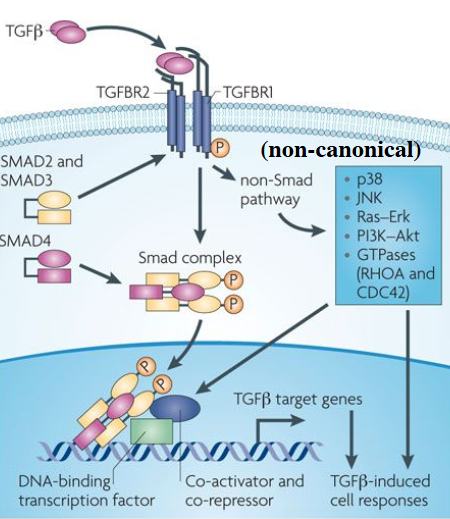
canonical is smad complex formation // non-canonical ie non-smad pathways eg p38, JNK, Ras-Erk, PI3K-Akt, GTPases eg RhoA and Cdc42
Describe a TGF-beta ligand-receptor complex and its activation
dimeric FGF superfamily ligand binds 2 type 2 receptors which each recruit through phosphorylation on serine/threonine residues of a type 1 receptor
complex formed of dimeric ligand + 2 type 1 receptors + 2 type 2 receptors
What type of enzyme are TGF-beta receptors? Which receptor activates which in the complex?
serine/threonine kinases
type 2 receptor phosphorylates type 1 receptor in GS domain on serine/threonine residues
What is a smad complex made up of with TGF-beta-like ligands binding and activating a ligand-receptor complex?
phosphorylated smad2 and 3 + smad 4 cosmad
What does an activated smad complex activate? Through what mechanism?
DNA-binding transcription factors = expression of TGF-beta target genes
translocation from cytoplasm to nucleus
Give an overview of smad signalling
dimerised TGF-beta-like ligand binds type 2 receptors which phosphorylate type 1 receptor - once complex formed, smad complex is formed through phosphorylation by type 1 receptor of Smad2 and 3 and assemble with smad4, enter nucleus to finally go on to activate target genes
What is a common theme in signal transduction that leads to a change in cellular responses?
components change their subcellular localisation leading to activation of the pathway - either smad complex binding DNA upstream of target genes or second messengers eg p38, GTPases etc that modulate co-activators/repressors
What acts as secondary messengers in Smad signalling?
Smad proteins activated by type 1 receptor phosphorylation
What do non-canonical pathways activated by TGF-beta receptors activate?
co-activator and co-repressors of DNA-binding transcription factors - modulate TGF-beta target genes and so cell responses too
What are some examples of BMP antagonists ?
chordin, noggin, follistatin
How is BMP signalling controlled?
through inhibition via ligand traps
Which smads are involved in inhibiting the formation of smad1/5/8 complexes? Which receptors modulate the former smads?
Smad 6/7 - type II receptors eg ActRII, ActRIIB, BMPRII
What are antagonists/ligand traps of BMP and GDF ligand binding?
Cerberus 1, COCO, DAN (NBL1), Gremlin1, PRDC, BMP-3, Sclerostin, chordin, noggin etc
Which BMP ligand is an antagonist/ligand trap to type II receptors? Which ones are agonists?
3
2, 4, 5, 6, 7, 8, 9, 10, 15
How can smad proteins be used to visualise TGF-beta ligands activating receptors?
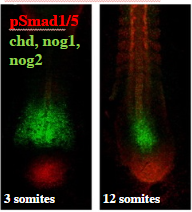
by immunofluorescence to visualise phosphorylated Smad proteins
When using immunofluorescence to study Smad phosphorylation, what would it look like in a cell where smad1/5 is activated as well as chordin, noggin1 and 2 eg?
Smad 1/5 will not overlap with ligand traps chd, nog1, nog2 because the latter inhibit the pathway activation = no active smad proteins
Using genetic engineering to analyse TGF-beta signalling, what are 2 types of mutations in Type 1 receptors eg that can be induced to study signalling?
LOF or GOF by introducing a single amino acid mutation in the GS domain of a type 1 receptor which is the domain that gets phosphorylated and activates the kinase domain that phosphorylates Smad proteins - shows effect of loss or excessive signalling of specific pathway = infer role of signalling
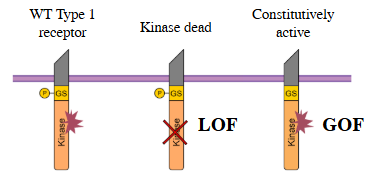
What is a constitutively active type 1 receptor?
does not require ligand binding for active phosphorylation activating smads
How can zebrafish and other model organisms be used to dissect clinically relevant signalling pathways? Example?
knockout shows what smad signalling is required for and resulting phenotypes of their absence
Cripto/Nodal mutant = no mesoderm, only neural tissue made = squint/cyclops mutant zebrafish
translates that nodal and cripto are essential for smad2/3 signalling = mesoderm
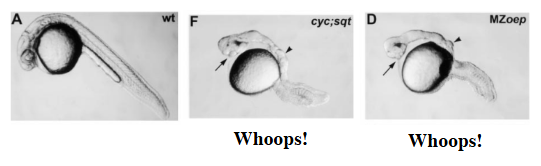
What are the roles of nodal and cripto in mesoderm formation?
nodal ligand = smad2/3 = mesoderm
cripto is a nodal co-receptor
loss of either = no mesoderm = cyc/sqt and oep mutants
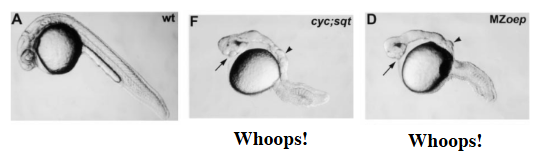
What can rescue oep (cripto) mutant zebrafish?
injection of activated type 1 receptor mRNA - allows crypto to be made and bind receptor ligand complex at the cell membrane = proper function of receptor complex
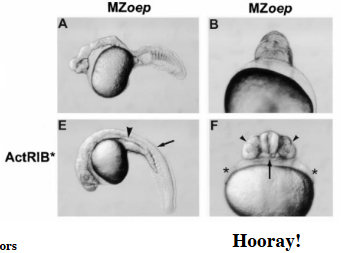
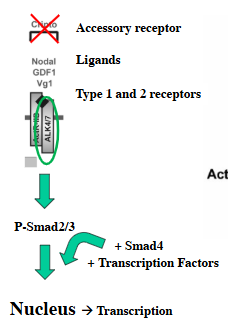
Describe downstream signalling being rescued in oep mutants ?
cripto ligand no longer required for receptor activation so Smad2/3 signalling rescued as long as nodal also present
In what stages of development do the TGF-beta superfamily of ligands and their signalling pathways play a role?
early and late development eg gastrulation, branching, postnatal growth and cancer
What allows fine tuning of signal output in TGF-beta signalling? What stage of development is this critical for?
existence of several inhibitors
cell fate specification in early embryogenesis
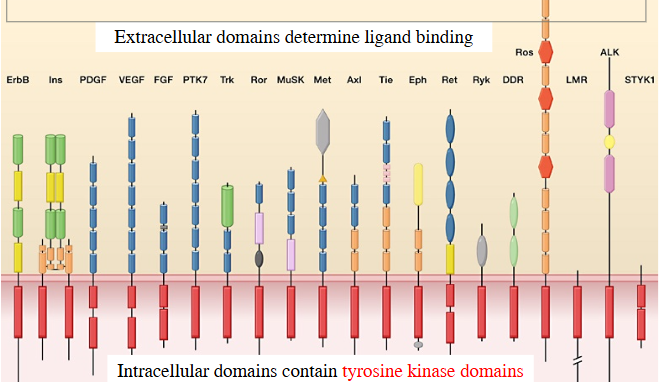
What are receptor tyrosine kinases?
large family of cell surface signalling receptors with either an intrinsic or associated kinase domain
How many RTK genes exist in humans and subfamilies ?
58 genes into 20 subfamilies
Are RTKs highly specific to one ligand?
some are specific for one ligand and vice versa and others interact with many ligands and vice versa
Are RTKs monomers or dimers when unbound?
most are monomers except Insulin receptors which are dimers when unbound
Name some types of RTK ligands
EGF, insulin, IGF-like eg IGF-1 and IGF-2, nerve growth factor, platelet-derived growth factor, ephrins A and B etc
Name some responses to RTK signalling activity
proliferation of cells, carbohydrate utilisation and protein synthesis, cell growth and survival, neuronal growth and survival, guide cell and axon migration
What determines the ligand binding site of an RTK?
Ec domains
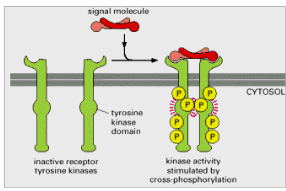
Describe canonical RTK receptor activation
The ligand usually dimerises, facilitating receptor dimerisation (or oligomerisation)
Once positioned correctly, the kinase domains cross-phosphorylate each other. This often
Increases the activity of the kinase
Stabilises the receptor in the active state (ligand independent)
Causes the kinase to phosphorylate other tyrosines in the receptor to create “docking sites”
When binding an RTK, does a ligand tend to be dimerised or a monomer? What does ligand binding facilitate in both cases?
sometimes 2 monomers bind but tends to be a dimerised ligand that binds
receptor dimerisation
How are docking sites on RTKs created for protein binding to occur?
phosphorylation of tyrosine residues on the IC domain of an RTK are docking sites for proteins because they become “sticky“ to cytoplasmic proteins
Describe canonical RTK transduction?
Phosphorylated tyrosines act as docking sites for downstream signalling proteins
SH2 (Src homology 2) domain recognises this short phosphopeptide:
phosphotyrosine – glutamic acid – glutamic acid – isoleucine
What are some examples of proteins that bind to RTKs ICly?
PI 3-kinase (inositol lipid pathway), GTPase-activating protein (RAS/MAP kinase pathway), PLC-gamma (inositol lipid pathway)
Describe the structure of proteins that bind RTKs
SH2 domain which binds the RTK ICly
SH3 mediating additional protein-protein interactions
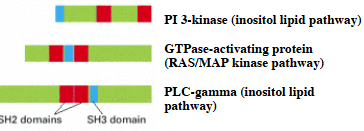
What does SH2 stand for?
Src homology 2
What phosphopeptides does the SH2 domain recognise?
phosphotyrosine – glutamic acid – glutamic acid – isoleucine
What are the 2 states of the small GTPase Ras? What does it therefore act as?
cycles between active GTP bound and inactive GDP bound states
molecular switch
Which proteins mediate Ras function?
GEFs and GAPs - guanine nucleotide exchange factors and GTPase-activating proteins
Explain how the Ras pathway illustrates docking leading to signal transduction
Binding of GRB2 and Sos couples receptor to inactive Ras
Sos is a guanine nucleotide exchange factor (GEF)
Sos promotes dissociation of GDP from Ras; GTP binds Ras and then it dissociates from Sos
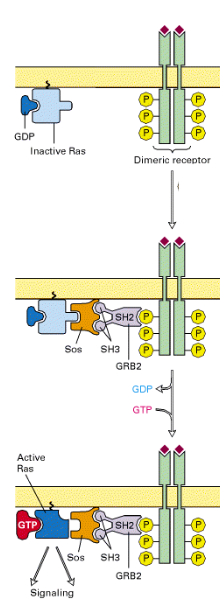
What is one of the first proteins that tends to bind the newly sticky IC domain of an RTK?
GRB2 then Sos
Describe the signal transduction pathway of RTKs Ras-Raf-Mek-Mapk
activated by Raf ie Map kinase kinase kinase - activated by Ras bound to GTP - activated by sos activated by grb2 activated by dimerisation of RTK activated by dimerised ligand binding – overall outcome is changes in transcription, phosphorylation of other second messengers perpetuating the signal
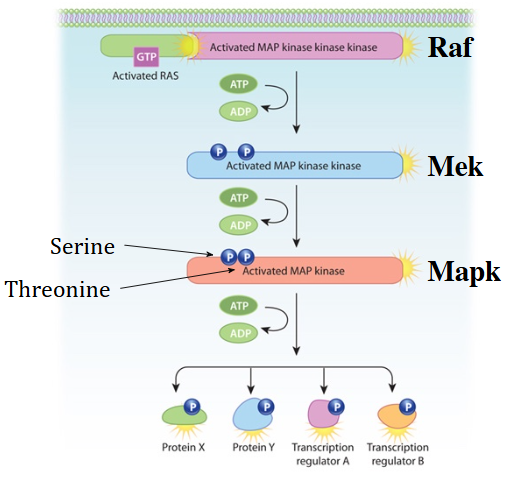
What is the benefit of Mek and Mapk requiring dual phosphorylation for activation?
safety mechanism ensuring that accidental activation does not occur
Describe the FGF ligand family
22 members of monomer ligands split into 3 subfamilies that bind only 4 different types of RTKs- FGFR1-4
What are the 3 types of FGFs depending on their method of signalling?
paracrine, intracrine and endocrine
For instance, what is the role of the FGF8 ligand?
limb formation and development + mesoderm formation
Describe the structure of an FGF receptor
EC domain: D1, D2 - heparin-binding site and D3 domains are Ig-like domains + accid box
TM domain
IC kinase domain
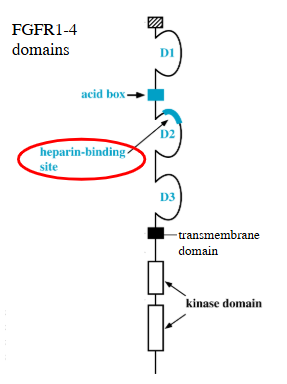
Which domain of an FGFR do ligands bind?
D2 and D3
What is the function of D2 and D3 in FGFRs?
both are Ig-like domains making up the ligand binding site - D2 is co-activator site heparin-binding site and D3 determines ligand specificity
What is the function of the acid box in FGFRs?
repressor of the receptor that insures repression in the absence of a ligand to avoid constitutive activity of the receptor
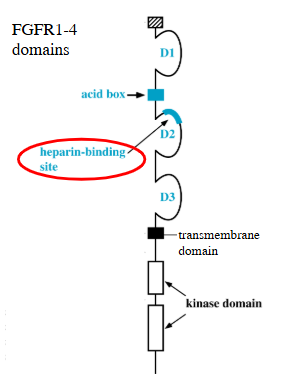
Where is the heparin-binding site located and what is its function?
site where heparan sulfate proteoglycans bind - co-receptors so formation of this complex is essential for activity of the receptor
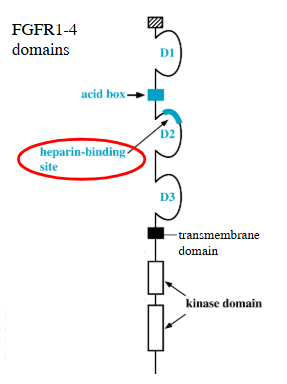
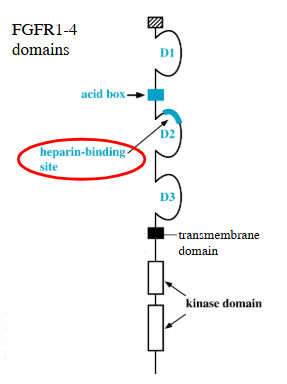
What is the role of D3 on an FGFR?
ligand binding site that determines specificity
What does FGF stand for?
fibroblast growth factor
What are HSPGs and what is their role in FGF signalling?
heparan sulfate proteoglycans - EC modifiers of cell-cell signalling
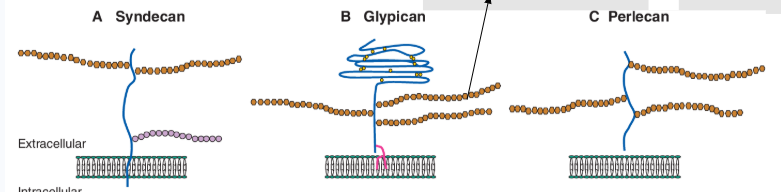
Describe the structure of HSPGs
Protein core: transmembrane, tethered or secreted (not membrane bound)
Long chains of sugars called heparan attached to protein core
How can an HSPG be modified? What does modification result in?
many ways especially covalently by sulphation
could result in a “code” that creates binding sites for specific proteins (e.g. FGF2)
What is the charge of a HSPG?
polyanionic so negative charge
How do HSPGs act as a code?
modification of their sequence of addition of a sugar sequence provides a code to determine specific binding to ligands eg FGF2
Describe 3 major families of HSPGs
syndecans - TM
glypicans - GPI-anchored to cell membrane
perlecans - ECM component
Define sulphation
addition of a sulfate group to a molecule
What types of FGFs have high vs low affinity for HSPGs? How does this affect the manner in which the FGF ligands signal?
paracrine have high affinity so are retained near the cell membrane and act locally due to HSPG cell surface association // endocrine have low affinity so diffuse into bloodstream easily
Can a paracrine FGF ligand bind an FGFR in the absence of proteoglycans and result in signalling?
NO - required for signalling
What is the charge of proteoglycans vs FGF ligands and FGFRs?
negative vs positive - critical for their interaction (FGFR D2 domain has basic residues = positive charge)
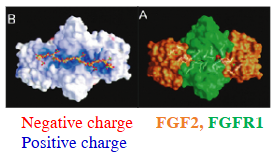
What is the function of the positively charged canyon of an FGFR and positive surface of an FGF ligand?
create an "electrostatic sandwich" that captures the negatively charged heparin/heparan sulfate, which is crucial for stabilizing the FGF-FGFR signaling complex
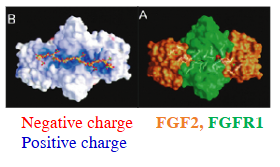
Describe a HSPG-FGF2-FGFR1 complex
FGF bound to HSPG due to their opposite charges, then bind an activate FGFR1 which is modified and kinase domains activate = downstream signalling
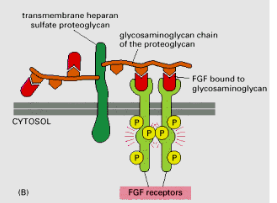
Describe various cell responses to FGF signalling
cell proliferation, cell survival, cell motility
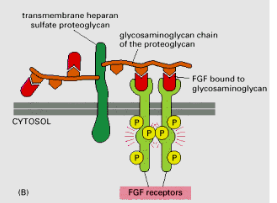
What would be some pathways that could get activated by this signalling and what cellular behaviours would each trigger?
MAPK = FOS tf to enter nucleus = cell proliferation
Akt = FOXO tf to translocate to nucleus = cell survival
Calcineurin = NFAT tf activation = cell motility
Which pathway is canonically activated by FGF signalling?
Mapk and FOS transcription factor
Which 2 main types of disease are most common from FGF signalling?
congenital diseases and cancers
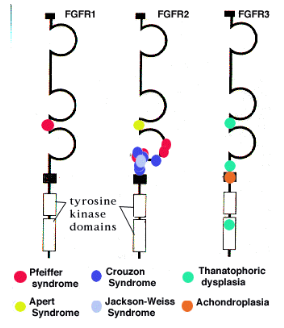
What types of congenital diseases arise from mutations in FGFRs?
Apert syndrome, Pfeiffer syndrome and achondroplasia (dwarfism)
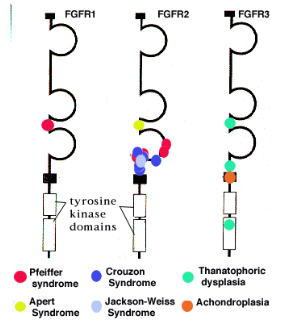
Which receptors is Pfeiffer syndrome associated with?
FGFR1 and 2
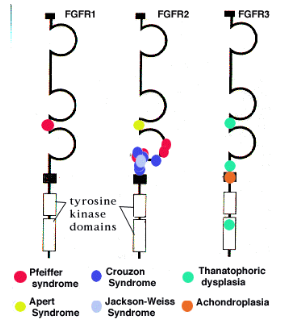
Which receptors carry the most mutations, responsible for crouzon syndrome, pfeiffer syndrome, apert syndrome, jackson-weiss syndrome?
FGFR2
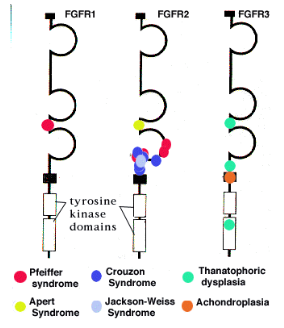
Which 2 congenital diseases are associated with FGFR3 s?
thanatophoric dysplasia and achondroplasia