Enzymes
 Call Kai
 Learn
Learn Practice Test
 Spaced Repetition
 Match
Match Flashcards
 Knowt Play
1/48

There's no tags or description
Looks like no tags are added yet.
Name | Mastery | Learn | Test | Matching | Spaced | Call with Kai | Chat |
|---|
No analytics yet
Send a link to your students to track their progress
49 Terms
What are the key characteristics of enzymes?
- Higher reaction rates: 10^6 to 10^12 greater than uncatalyzed reactions
- Milder reaction conditions: physiologically relevant conditions
- Greater reaction specificity: Precise interaction of substrate and enzyme (enzyme-substrate complex)
- Capacity for regulation: allosteric control, covalent modifications, turnover of enzyme (synthesis and degradation)
- Accelerate the rate reaching equilibrium, not the composition of product and reactants in equilibrium
Early biochemists named enzymes based on the....
Type of reaction they catalyzed
What is a dehydrogenase
Enzymes that remove the elements H2 or H- plus H+
What are the common suffixes for enzymes?
-ase, -dehydrogenase, -protease, and -isomerase
What are some exceptions to the current naming of enzymes?
Pepsin, trypsin, and amylase are examples of the older nomenclature that persists.
What four factors can enzymes be named after?
- Substrate, source, regulation, or mechanism of action.
- Ex. Xanthin oxidase, pancreatic ribonuclease, hormone-sensitive lipase, cysteine protease.
What are used to identify multiple forms or isozymes of an enzyme?
- Alphanumeric designators
- Ex. RNA polymerase III and Protein Kinase CB
What are the six classes of enzymes?
Oxidoreductases, Transferases, Hydrolases, Lyases, Isomerases, Ligases
What type of reaction do oxidoreductase enzymes perform? What is an example?
- Oxidation-reduction reactions
- Ex. Lactate dehydrogenase
What type of reaction do transferases perform? What is an example?
- Group transfer
- Ex. Nucleoside monophosphate kinase (NMP kinase)
What type of reaction do Hydrolases perform? What is an example?
- Hydrolysis reactions (transfer of functional groups to water)
- Ex. Chymotrypsin
What type of reaction do Lyases perform? What is an example?
- Addition or removal of groups to form double bonds
- Ex. Fumarase
What type of reaction do Isomerases perform? What is an example?
- Isomerization (intramolecular group transfer)
- Ex. Triose Phosphate Isomerase
What type of reaction do Ligases perform? What is an example?
- Ligation of two substrates at the expense of ATP hydrolysis
- Aminoacyl-tRNA synthetase
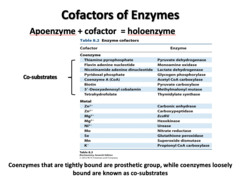
What makes up a holoenzyme?
Apoenzyme + cofactor
What is a prosthetic group?
Cofactors that are tightly bound
What are cosubstrates?
Coenzymes that are loosely bound
Filler: Dr. Soares will discuss what cofactors we will need to know on the study guide.
What is the active site of an enzyme?
A 3D cleft, or crevice formed by side chains of different amino acids from different parts of the sequence
How do substrates bind to the active site?
By weak non-covalent interactions.
What determines the specificity of an enzyme?
Th exact orientation of the side chains in the active site
What factors affect catalytic power?
The proximity of the bound substrates and the orientation of these molecules towards one another.
What two theories explain the specificity of enzymes?
- Lock and Key theory
- Induced fit models
What is the Lock and Key model?
- Older Fisher model
- Substrate interacts with the enzyme by short range weak interactions.
- Substrate matching shape to fit into the active site, analogous to a lock and key
What is the Induced fit model
- More recent Koshland model
- The active site of the enzyme takes on a complementary shape to the transition state, once the substrate is bound.
- Dynamic process.
- More accepted model
What determines the spontaneity of the reaction?
The free energy difference (delta G) between the products and reactants
What determines the rate of the reaction?
Energy required to initiate the conversion of reactants to products (Activation Energy)
Transition state
- Has a higher free energy than the products or substrates
- Due to bonds being maximally strained in the substrate due to unstable and strained electronic configurations
- Difference in energy between the substrate and transition state is known as the activation energy
- The final change of the energy is unaffected by the activation energy since the energy is returned when the products are formed.
Activation Energy
- Enzymes lower the activation energy without changing the delta G for the reaction.
- Allows for more molecules to reach the transition state
- The transition stage is stabilized by progressive formation of weak and tighter bonds (electrostatic interactions and by covalent intermediates)
- The transition state can either collapse back to the substrate or form the product
If ΔG0 is a negative number, Keq will be _______ than unity, and the concentration of products at equilibrium will _________ that of the substrates.
greater
exceed
If ΔG0 is positive, Keq will be ______ than unity, and the formation of _______ will be favored.
less
substrates
It can only provide information about the _______ and _________ state of the reaction
direction
equilibrium
The velocity of a reaction is dependent on the __________
Concentration of the substrate
Michaelis Menten Equation

At very low substrate concentration, [S] is less than KM, V0 = (Vmax/KM)[S]; the rate is .....
directly proportional to the substrate concentration .
At high substrate concentration, when [S] is greater than KM, V0 = Vmax; the rate is....
maximal, independent of substrate concentration.
When [S] = KM, then V0 = Vmax/2. Thus, KM is equal to the substrate concentration at which the reaction rate is....
half its maximal value.
A Higher KM implies the substrate has a ______ affinity for the enzyme
low
A low KM implies a _______ affinity for the enzyme.
higher
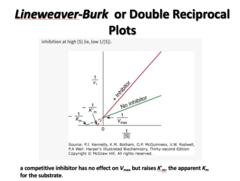
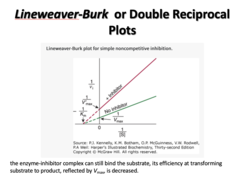
Lineweaver-Burk or Double Reciprocal plots
- Vmax can be accurately determined using the double reciprocal plots
- Useful for distinguishing between competitive and non-competitive inhibition.
A competitive inhibitor would intersect with the no inhibitor line on the _____ axis
Y
A non-competitive inhibitor would intersect the no inhibitor line on the ____ axis
X
What is an irreversible inhibitor?
Dissociates very slowly from an enzyme because it is tightly bound to the enzyme by covalent or non-covalent interactions
What is a reversible inhibitor?
- Inhibitor that can be reversed
- Classified as competitive, uncompetitive, or non-competitive inhibition
What is competitive inhibition?
- Competitive inhibitor competes with the substrate for the active site.
- Increasing the overall concentration of the substrate can overcome the inhibition.
- The Km increases in the presence of the inhibitor, while the Vmax remains the same.
What is non-competitive inhibition?
- Non-competitive inhibitors do not compete for the substrate binding site.
- Increasing the substrate concentration has no effect on the inhibition.
- The Km remains the same, while the Vmax decreases in the presence of the inhibitor.
What is uncompetitive inhibition?
- Uncompetitive inhibitors bind to the enzyme-substrate complex.
- Overall it decreases the Vmax and the Km of the enzyme.
What are allosteric enzymes?
- Enzymes consisting two or more subunits that exhibit cooperativity
- Substrate binding to one subunit facilitates binding of substrates to other subunits
- Does not obey Michaelis-Mentin Kinetics
- Displays Sigmoid plots rather than hyperbola plots
- Allosteric enzymes are key regulators of metabolic pathways
Biomedical Importance
- Kinetic analysis can reveal the number and order of the individual steps by which enzymes transform substrates into products and, in conjunction with site-directed mutagenesis, kinetic analyses can reveal details of the catalytic mechanism of a given enzyme.
- The appearance or a surge in the levels of particular enzymes serves as clinical indicators for pathologies such as myocardial infarctions, prostate cancer, and damage to the liver.