ECONOMICS SAC 2
 Call Kai
 Learn
Learn Practice Test
 Spaced Repetition
 Match
Match Flashcards
 Knowt Play
1/132

There's no tags or description
Looks like no tags are added yet.
Name | Mastery | Learn | Test | Matching | Spaced | Call with Kai | Chat |
|---|
No analytics yet
Send a link to your students to track their progress
133 Terms
What is the purpose of economic activity?
To produce goods and services that satisfy human wants and needs and improve living standards.
Q: What is macroeconomics?
The study of the economy as a whole, including growth, unemployment, inflation and trade.
Q: What is economic activity?
A: The production, distribution and consumption of goods and services.

Q: How can economic activity be measured?
A: By total production, total income or total expenditure.
Q: Give examples of economic activity.
A: Manufacturing, retail sales, healthcare, education, construction and tourism.

Q: What is non-economic activity?
A: Activities that do not involve market production or income generation.
Q: Give examples of non-economic activity.
A: Volunteering, unpaid housework, caring for family members and home gardening.

Q: What is Gross Domestic Product (GDP)?
A: The total value of goods and services produced within a country in a given period.
Q: What are the three ways of measuring GDP?
A: Production approach, income approach and expenditure approach.

Q: Why is GDP important?
A: It measures the level of economic activity in an economy.
Q: What is economic growth?
A: An increase in the economy's capacity to produce goods and services over time.

Q: How is economic growth measured?
A: By changes in real GDP.
Q: How can economic growth be expressed?
A: As an increase in total production or as a percentage change in real GDP.
Q: What is nominal GDP?
A: GDP measured at current prices.
Q: What is real GDP?
A: GDP measured at constant prices (chain volume GDP).
Q: Formula for nominal GDP?
A: Current prices × current quantities.
Q: Formula for real GDP?
A: Constant prices × current quantities.

Q: What does it mean if inflation is faster than nominal GDP growth?
A: Real GDP falls and economic activity decreases.
Q: What does it mean if nominal GDP grows faster than inflation?
A: Real GDP increases and economic activity rises.
Q: What does it mean if nominal GDP grows faster than real GDP?
A: Part of the increase is due to inflation.
Q: Why is real GDP the best measure of growth?
A: It removes the effect of inflation.

Q: Why is real GDP a better indicator of living standards than nominal GDP?
A: It reflects actual increases in production and purchasing power.
Q: What is GDP per capita?
A: Real GDP divided by the population.

Q: Why is GDP per capita important?
A: It indicates average material living standards.

Q: What are material living standards (MLS)?
A: The ability to consume goods and services.
Q: What are non-material living standards (NMLS)?
A: Quality of life factors such as health, education, leisure and the environment.

Q: Define material living standards.
A: Access to income, goods, services and economic resources.
Q: Define non-material living standards.
A: Social, environmental and personal wellbeing.

Q: How can increased economic activity improve MLS?
A: Higher incomes, more employment and greater consumption.

Q: How can increased economic activity improve NMLS?
A: Better healthcare, education and public services.

Q: Costs of increased economic activity for MLS?
A: Inflation and income inequality.

Q: Costs of increased economic activity for NMLS?
A: Pollution, congestion, environmental damage and stress.

Q: Benefits of decreased economic activity for NMLS?
A: Less pollution and congestion.

Q: Costs of decreased economic activity for MLS and NMLS?
A: Lower incomes, unemployment and reduced wellbeing.
Q: What is the five-sector circular flow model?
A: A model showing the flow of income, spending and resources between households, businesses, government, financial institutions and the external sector.
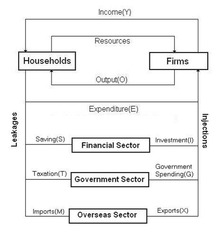
Q: Difference between the three-sector and five-sector models?
A: The five-sector model adds the financial sector and the external sector.
Q: What are the five sectors?
A: Households, businesses, government, financial institutions and the external sector.
Q: What are the leakages?
A: Savings, taxes and imports.
Q: What are the injections?
A: Investment, government spending and exports.

Q: Household sector roles?
A: Supplies factors of production and consumes goods and services.

Q: Business sector roles?
A: Produces goods and services and demands factors of production.
Q: Government sector roles?
A: Collects taxes and spends on public goods and services.
Q: Financial sector roles?
A: Receives savings and provides loans for investment.
Q: External sector roles?
A: Purchases exports and supplies imports.
Q: What is Flow 1?
A: Resources from households to businesses.

Q: What is Flow 2?
A: Goods and services from businesses to households.

Q: What is Flow 3?
A: Income from businesses to households.

Q: What is Flow 4?
A: Consumer spending from households to businesses.

Q: What happens in the circular flow model when economic activity increases?
A: Injections rise, income and spending increase and GDP expands.

Q: What happens when economic activity decreases?
A: Leakages rise relative to injections, reducing income, spending and GDP.
Q: What is the business cycle?
A: The pattern of economic expansion and contraction over time.
Q: What does growth below 0% mean?
A: Negative economic growth.

Q: What is an expansion?
A: Rising GDP, employment and investment.

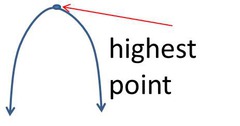
Q: What is a peak?
A: The highest point of economic activity.
Q: What is a contraction?
A: Falling GDP and economic activity.

Q: What is a trough?
A: The lowest point of economic activity.

Q: What is domestic economic stability?
A: Sustainable economic growth with low inflation and low unemployment.

Q: What is a recession?
A: Two consecutive quarters of negative real GDP growth.

Q: What is a depression?
A: A prolonged and severe downturn in economic activity.
Q: What causes the business cycle?
A: Changes in aggregate demand and aggregate supply.
Q: What is stagflation?
A: High inflation combined with low growth and high unemployment.
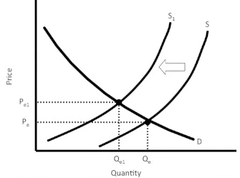
Q: What can cause stagflation?
A: Supply shocks such as rising oil prices or natural disasters.
Q: What are leading indicators?
A: Indicators that predict future economic activity.

Q: Examples of leading indicators?
A: Building approvals, consumer confidence and business confidence.
Q: What are coincident indicators?
A: Indicators that move with the economy.

Q: Examples of coincident indicators?
A: Retail sales, GDP and employment.

Q: What are lagging indicators?
A: Indicators that change after economic activity changes.

Q: Examples of lagging indicators?
A: Unemployment and inflation.

Q: How do indicators relate to the business cycle?
A: They help identify current conditions and predict future phases.

Q: What is the relationship between AD and GDP?
A: Higher aggregate demand generally increases GDP.

Q: Unemployment during a peak?
A: Low.

Q: Unemployment during a trough?
A: High.

Q: Inflation during a peak?
A: High or rising.

Q: Inflation during a trough?
A: Low or falling.

Q: What is aggregate demand (AD)?
A: The total spending on domestically produced goods and services.

Q: What are the components of AD?
A: Consumption (C), investment (I), government spending (G) and net exports (X−M).

Q: What is consumption spending?
A: Household spending on goods and services.
Q: What are the four types of consumption spending?
A: Durable goods, non-durable goods, services and housing-related consumption.

Q: What is private investment spending?
A: Business spending on capital goods, buildings and inventories.

Q: Why is investment spending volatile?
A: It is sensitive to confidence and interest rates.

Q: What is G1 spending?
A: Government spending on goods and services.

Q: What is G2 spending?
A: Government investment spending on infrastructure.

Q: Why are welfare payments excluded from G?
A: They are transfer payments, not payments for current production.

Q: What are net exports?
A: Exports minus imports.

: What are AD factors
A: Factors that influence total spending in the economy.
Q: Examples of AD factors?
A: Interest rates, disposable income, confidence, exchange rates and overseas growth.

Q: How do stronger AD conditions affect economic activity?
A: Spending rises, income increases and GDP grows.

Q: How do weaker AD conditions affect economic activity?
A: Spending falls, income declines and GDP slows.

Q: Key factors affecting consumption spending?
A: Disposable income, consumer confidence, interest rates, population growth and government policy.

Q: Key factors affecting investment spending?
A: Business confidence, interest rates and company tax rates.
Q: Key factors affecting government spending?
A: Unemployment, inflation, population growth and government debt.

Q: Key factors affecting net exports?
A: Exchange rates, overseas growth, inflation, local economic activity and natural disasters.
Q: Major demand-side factors?
A: Real disposable income, consumer confidence, business confidence, overseas growth, interest rates, exchange rates and income tax rates.

Q: What is aggregate supply (AS)?
A: The total quantity of goods and services businesses are willing and able to produce.

Q: Why is aggregate supply important?
A: It determines the economy's productive capacity and long-term growth.

Q: What is productive capacity?
A: The maximum output an economy can produce sustainably.
Q: What are aggregate supply-side factors?
A: Factors affecting production costs and productive capacity.
Q: Key AS factors?
A: Labour, capital, natural resources, productivity, costs, regulations, exchange rates and supply chains.
Q: How do favourable AS factors affect economic activity?
A: Increase productivity, lower costs and raise GDP.
Q: How do unfavourable AS factors affect economic activity?
A: Reduce output and increase production costs.