1. Hallmarks of cancer
 Call Kai
 Learn
Learn Practice Test
 Spaced Repetition
 Match
Match Flashcards
 Knowt Play
1/25

There's no tags or description
Looks like no tags are added yet.
Name | Mastery | Learn | Test | Matching | Spaced | Call with Kai | Chat |
|---|
No analytics yet
Send a link to your students to track their progress
26 Terms
What is cancer
Not one disease
a multistep process
starts with one cell
Multiple cell types involved
Cancer cells are less responsive to regulatory circuits of cellular proliferation and cell death
The three types of hallmarks
Core hallmarks
Enabling characteristics
Emerging hallmarks
Core hallmarks
Fundamental characteristics of cancer cells (these hallmarks make the cell a cancer cell)
Enabling characteristics
Conditions that facilitate the hallmarks, not specific to cancer cells
Emerging hallmarks
Newer cancer-associated characteristics for which the exact role in cancer development needs to be confirmed.
What are the six core hallmarks (2011)
Sustaining proliferative signaling (growth and survival)
Evading growth suppressors (growth and survival)
Enabling replicative immortality (growth and survival)
Activating invasion & metastasis
Inducing angiogenesis
Resisting cell death (growth and survival)
Cell cycle
Proliferation
Differentiation—specialization of the cell
Replication
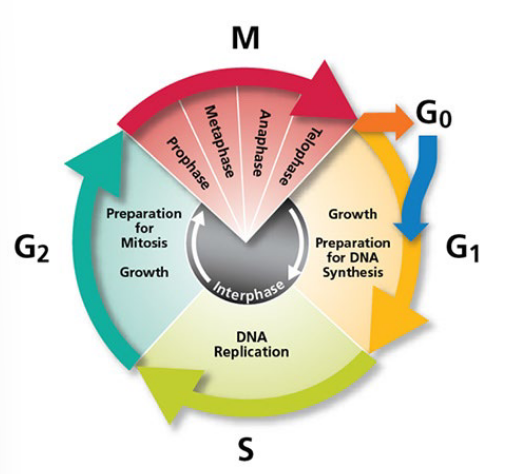
Halmark: Sustaining proliferative signaling
More cells are caused by growth factors
More cells are created during cancer by producing more growth factors.
Increase in synthesis of growth factors by tumor cells
Increase in synthesis of growth factors by neighboring cells
Increase in receptors at cell surface (that can catch the growth factors)
Structural alterations of the receptors increases the response
Activation downstream pathways
Example of sustaining proliferative signaling
EGF: Epidermal growth factor
Hallmark: Evading growth suppressors
As if there is no break
Proliferation suppressors = tumor suppressor genes
Example: Retinoblastoma-associated (RB) protein
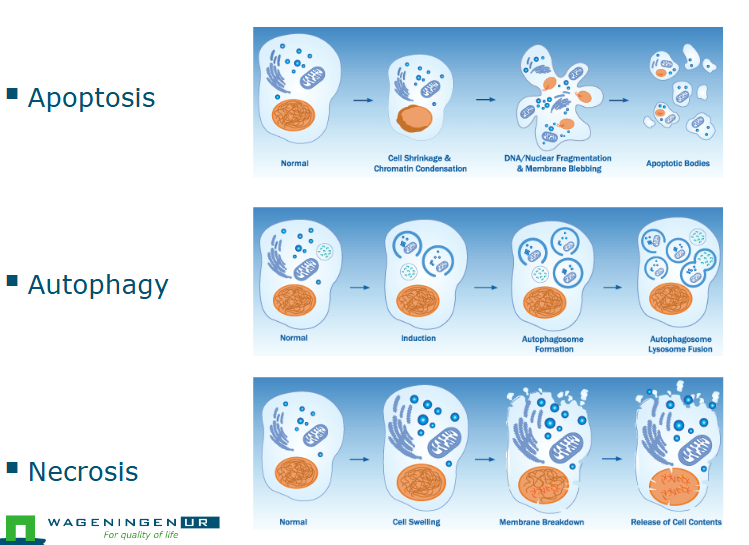
Hallmark: resisting cell death
Apoptosis: cell is turned into very small bodies and dies.
Autophagy: Cell organs are engulfed and creates autophagosome
Necrosis: Membrane is broken down.
All are resisted but there is more necrosis.
Hallmark: Enabling replicative immortality
Normal cells: divide and therefore their telomeres become shorter
In cancer cells this does not happen, and therefore they have unlimited replication
This is because the telomeres extend
Cancer cells have high telomerase
Angiogenesis
The formation of new blood vessels
Therefore, this is important for the spreading of cancer
This is because cancer cells need oxygen.
By removing blood vessels around the tumor, the tumor can be shrunken.
Early stage event
Inducing angiogenesis
Hypoxia-induced expression of VEGF by tumor cells
Stimulation of angiogensis by VEGF
Rapid tumor growth and metastasis
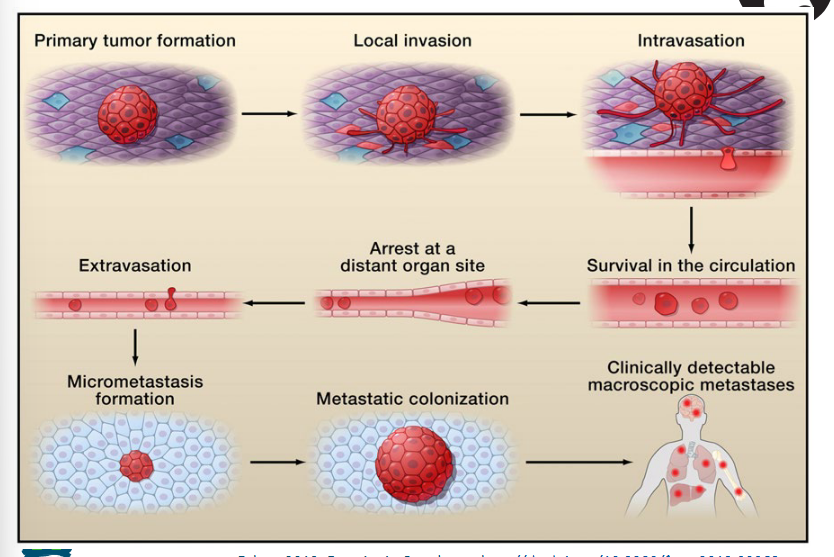
Metastasis
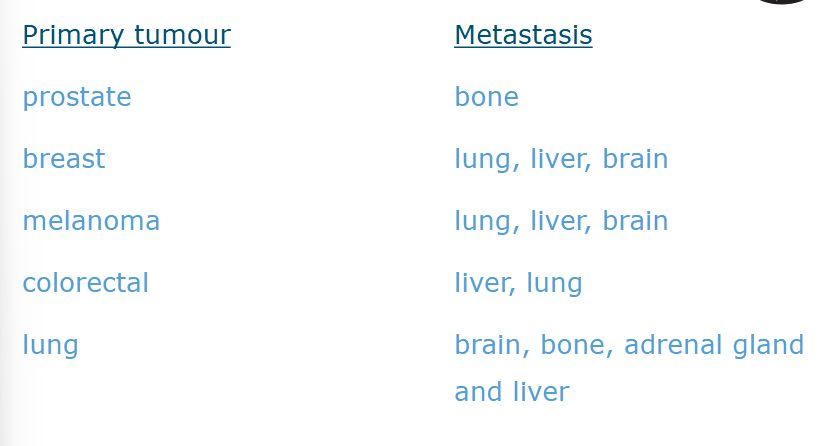
Invasion metastasis
Key words:
Intravasation: Moving into the blood stream
Extravasation:
Macro-metastasis: Creation of a new tumor
Epithelial-to-mesenchymal transition

Tumor suppressor vs. oncogene
is p53 oncogene or tumor suppressor?
Tumor suppressor gene - cell cycle arrest + apoptosis
is EGFR oncogene or tumor suppressor?
Oncogene - because it is in favor of growth (Growth factor)
Is RB oncogene or tumor suppressor?
Tumor suppressor gene - cell cycle arrest
Driver vs passenger mutation
Passenger mutation:
Passenger mutation has no effect on neoplastic process
Number of passenger mutations correlates with age (during normal growth)
Predominantly in self-renewing tissues
Driver mutation:
Driver gene mutation = a mutation conferring a selective growth advantage for the cell
Impacts ratio cell birth : cell death
Tumor - promoting inflammation
Infiltration of immune cells
Supplying bioactive molecules to microenvironment
Tumor inhibition as well as tumor promotion
Emerging characterstics (2011)
Deregulating celular energetics
avoiding immune destruction
New emerging characteristics
Unlocking phenotypic plasticity
Senescent cells (about affecting the immortality of neighboring cells)
Epigentics
Polymorphic microbes = ‘different faces’
Markers for proliferation
Ki67 protein
Marker (protein) for cell proliferation
Expressed during active phases cell cycle
Detection by immunohistochemistry
Prognostic marker in some routine clinical work