Chapter 1 (Anatomy & Physiology: An Integrative Approach 2nd Edition)
 Call Kai
 Learn
Learn Practice Test
 Spaced Repetition
 Match
Match Flashcards
 Knowt Play
1/176

There's no tags or description
Looks like no tags are added yet.
Name | Mastery | Learn | Test | Matching | Spaced | Call with Kai | Chat |
|---|
No analytics yet
Send a link to your students to track their progress
177 Terms
anatomy
the study of structure and form
anatome
to cut apart or dissect
anatomists
scientists who study the structure and form of organisms
physiology
the study of function of the body parts
physiologists
scientists who examine how organs and body systems function under normal circumstances
microscopic anatomy
examines structures that cannot be seen by the unaided eye
cytology
(cell ; study) is the study of body cells and their internal structure
histology
(web, tissue) is the study of tissues
Gross anatomy
investigates the structure and relationships of body parts that are visible to the unaided eye
systemic anatomy
studies the anatomy of each functional body system
regional anatomy
examines all the structures in a particular region of the body as a complete unit
surface anatomy
both superficial anatomic markings and the internal body structures that relate to the skin covering them
comparative anatomy
examines similarities and differences in the anatomy of different species
embryology
(young one) discipline concerned with developmental changes occurring from conception to brith
pathologic anatomy
examines all anatomic changes resulting from disease
radiographic anatomy
investigates the relationships among internal structures that may be visualized by specific scanning procedures
cardiovascular physiology
functioning of heart, blood vessels, and blood
neurophysiology
examines how nerve impulses travel throughout the nervous system
respiratory physiology
studies how respiratory gases are transferred by gas exchange between lungs and blood vessels
reproductive physiology
explores how regulation of reproductive hormones can drive the reproductive cycle and influence sex cell production and maturation
pathophysiology
investigates the relationship between the functioning of an organ system and disease or injury to that organ system
anatomists
focus on the form and structures
physiologists
focus on the function of the small intestine
organization
all organisms exhibit a complex structure and order
metabolism
all organisms engage in it; the sum of all of the chemical reactions that occur within the body
anabolism
(a raising up) small molecules are joined to form larger molecules
catabolism
(a casting down) large molecules are broken down into smaller molecules
Growth and Development
increased size and increased specialization as related to form and function
Responsiveness
the ability to sense and react to stimuli
Stimuli
changes in the external and internal environment
Regulation
an organism must be able to adjust or direct internal bodily function during environmental changes
Reproduction
all organisms produce new cells for growth, maintenance, and repair
Somatic Cells
(Body) cells divide by mitosis
Sex Cells
(Gametes) produced by meiosis
Chemical level
simplest level; involves atoms and molecules
Cellular Level
consists of cells
Tissue Level
consists of tissues
Organ Level
composed of organs
Organ system level
contains related organs that work together to coordinate activities and achieve a common functino
Organismal Level
The highest level of structural organization in the body
Simplest to Most Complex
1. Atom
2. Molecule
3. Macromolecule
4. Organelle
5. Cellular Level
6. Tissue Level
7.Organ Level
8.Organ System Level
9. Organism
Integumentary System
Provides protection, regulates body temperature, site of cutaneous receptors, and some glands, synthesizes vitamin D, prevents water loss
Muscular System
Produces body movement, generates heat when muscles contract.
Skeletal System
Provides support and protection, site of hemopoiesis (blood cell production), stores calcium and phosphorus, provides sites for muscle attachment.
Nervous System
a regulatory system that controls muscles and some glands and responds to sensory stimuli; responsible for consciousness, intelligence, and memory.
Endocrine System
Consists of glands and cell clusters that secrete hormones, which regular development, growth and metabolism; maintain homeostasis of blood composition and volume, control digestive processes, and control reproduction
Lymphatic System
Transports and filters lymph (interstitial fluid transported through lymph vessels) and participates in an immune response when necessary
Cardiovascular System
Consists of the heart and blood vessels, the heart moves blood through blood vessels in order to distribute hormones, nutrients, gases, and pick up waste prodcuts.
Respiratory System
Responsible for exchange of gases (oxygen and carbon dioxide) between blood and the air in the lungs
Urinary System
Filters the blood to remove waste products and biologically active molecules, concentrates waste products in the form of urine, and expels urine from the body
Digestive System
Mechanically and chemically digests the food materials, absorbs nutrients, and expels waste products
Male Reproductive System
Produce male sex cells (sperm) and male hormones (testosterone) transfers sperm to female
Female Reproductive System
Produces female sex cells (oocytes) and female hormones (estrogen and progesterone), receives sperm from male, site of fertilization of oocyte, site of growth and development of embryo and fetus, produces and secretes breast milk for nourishment of newborn
Anatomic Position
stands upright with the feet parallel and flat on the floor, the upper limbs are at the sides of the body, and the palms face anteriorly toward the front; the head is level, and the eyes look forward toward the observer.
Anatomic Position and Body Planes
1. Coronal Section
2. Transverse Section
3. Midsaggital
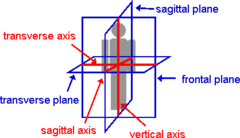
Coronal Plane
(frontal plane) divides the body or organ into anterior and posterior parts (frontal and back)
Transverse Plane
(cross-sectional plane) a horizontal plane that divides the body or organ into superior and inferior parts (top and bottom)
Midsaggital Plane
(median plane) a vertical plan that divides the body or organ into left and right halves
Sagittal Plane
Divides a structure into unequal left and right portions
Oblique Plane
minor planes
Anterior
in front of ; toward the front surface
Posterior
in the back of; toward the back surface
Dorsal
at the back side of the human body
Ventral
at the belly sides of the human body
Superior
closer to the head
Inferior
closer to the feet
Cranial (cephalic)
at the head end
Caudal
at the rear or tail end
Rostral
toward the nose or mouth
Medial
toward the mid-line of the body
Lateral
away from the mid-line of the body
Deep
on the inside, internal to another structure
Superficial
on the outside
Proximal
closer to point of attachment to trunk
Distal
farther away from the point of attachment to trunk
abdominal
region inferior to the thorax (chest) and superior to the hip bones
antebrachial
forearm (portion of upper limb between the elbow and wrist)
antecubital
region anterior to the elbow; also know as the cubital region
auricular
visible surface structures of the ear
axillary
armpit
brachial
arm ( the portion of the upper limb between the shoulder and elbow)
buccal
cheek
calcaneal
heel of the foot
carpal
wrist
cephalic
head
cervical
neck
coxal
hip
cranial
skull
crural
leg (portion of lower limb between knee and ankle)
deltoid
shoulder
digital
fingers or toes (phalangeal)
dorsal / dorsum
back
facial
face
femoral
thigh
fibular
lateral aspect of leg
frontal
forehead
gluteal
buttock
hallux
great toe
inguinal
groin
lumbar
relation to the loins, or the inferior part of the back, between the ribs and pelvis