L4 - Chromium Magmatic Ore Deposits
 Call Kai
 Learn
Learn Practice Test
 Spaced Repetition
 Match
Match Flashcards
 Knowt Play
1/57

There's no tags or description
Looks like no tags are added yet.
Name | Mastery | Learn | Test | Matching | Spaced | Call with Kai | Chat |
|---|
No analytics yet
Send a link to your students to track their progress
58 Terms
What rock type are Chromium and PGE ores almost exclusively associated with?
Almost exclusively found associated with basic and ultrabasic plutonic rocks
What is the source of the magmas and metals of Chromite deposits?
The peridotitic upper mantle
How are metals (PGE and Chromite) transported?
The metals are transported as dissolved ions in the magmas
What happens to the metal ions as they are transported?
They saturate/concentrate in the carrier phase
What is the trap for a Chromium Deposit?
The trap is typically a stratiform layer (~1m-thick) on the floor of a fractionating mafic layered intrusion (MLI)
What does MLI mean?
A Layered Mafic Intrusion
Where do a vast majority of Cr extracted from magmatic ores come from?
From the mines in South Africa (Bushveld Complex)
Does Canada have any producing or potential chromite mines?
No producing
Substantial low-grade reserves are found in the Bird River Sill (Manitoba)
Mineral exploration activity in northern Ontario (“Ring of Fire“)
What is Chromites Formula?
(Fe, Mg)(Cr,Al)2O4
What is the density of chromite?
5.1 g/cm3
How does the density of chromite compare to basaltic magma? What effect does this have during magmatic cooling?
Basaltic magma = 2.65-2.75 g/cm3
Chromite = 5.1g/cm3
Therefore, chromite will sink in basaltic magma
What are chromite’s characteristics in hand specimen?
Iron black to brownish black in colour
Sub-metallic lustre
May be weakly magnetic

What are the characteristics of chromite in a thin section?
Dark grey to brownish in color
low reflectance
isotropic
typically euhedral grains when separated by silicate minerals
equigranular when massive

What modal abundance is required to make Chromitite?
> 50 modal %
Massive accumulation of chromite
What is Ferrochrome?
>40% Cr2O3
high Cr/Fe
used in steel making
What are lower Cr/Fe ores used for?
High temperature manufacturing
pigments
wood preservatives
electroplating
What is the minimum % of Cr in stainless steel? Can you replace this with another element?
Minimum of 11% Cr (averages ~17%)
No substitute
Where do most chromite deposits occur within ultramafic layered mafic intrusions?
Associated predominantly with the lower ultramafic parts of intrusions
What time periods/age do the hosting intrusions of chromite deposits almost exclusively form?
Paleoproterozoic (>2.0 Ga) to Eoarchean (3.8 Ga) in age
Found in many Archean crustal fragments worldwide
Where are the oldest chromite deposits found?
West Greenland (Ivisartoq, 3.8 Ga)
What were the parent magmas of the chromite intrusions?
Komatites
High temperature
High-MgO silicate magmas
Only formed early in Earth’s history
Is chromite an early or late phase mineral in the Bowen Reaction Series?
Early Phase
One of the earliest minerals to crystallize
Is chromite typically a rock-forming or accessory mineral?
Accessory mineral
Where is the Stillwater Complex and what is it’s age?
Montana, USA
2.709 Ga
What is a cumulate?
Minerals crystallized, separated, and accumulated from magma through fractional crystallization (FC)
What is the Stillwater Complex, and what is it composed of?
Stillwater complex = Large Mafic-Ultramafic Intrusion (LMI) composed of cumulates
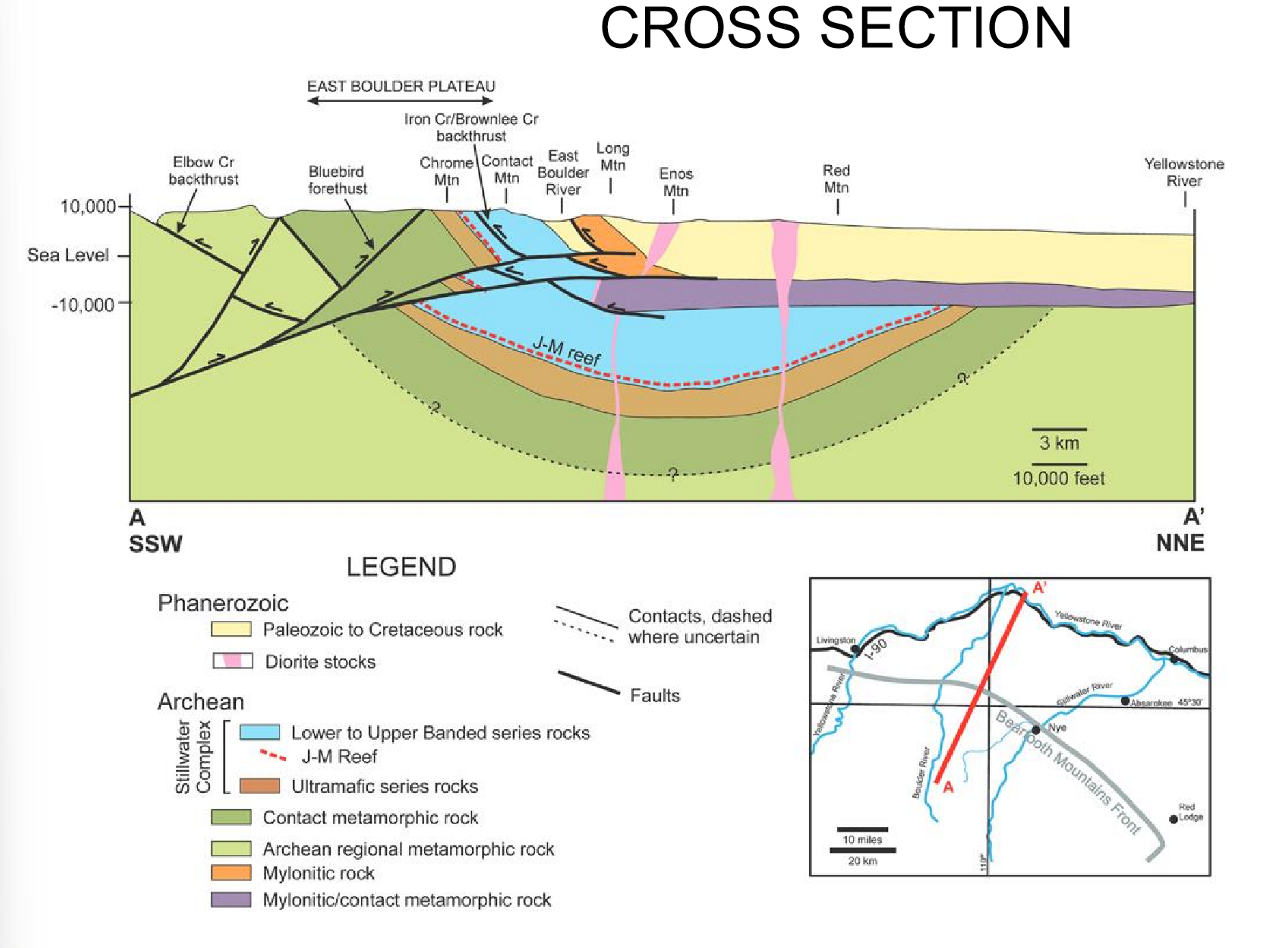
Where in this x-section is the chromite?
Disseminated stratiform chromitite layers occur in the Ultramafic Series (Brown unit)
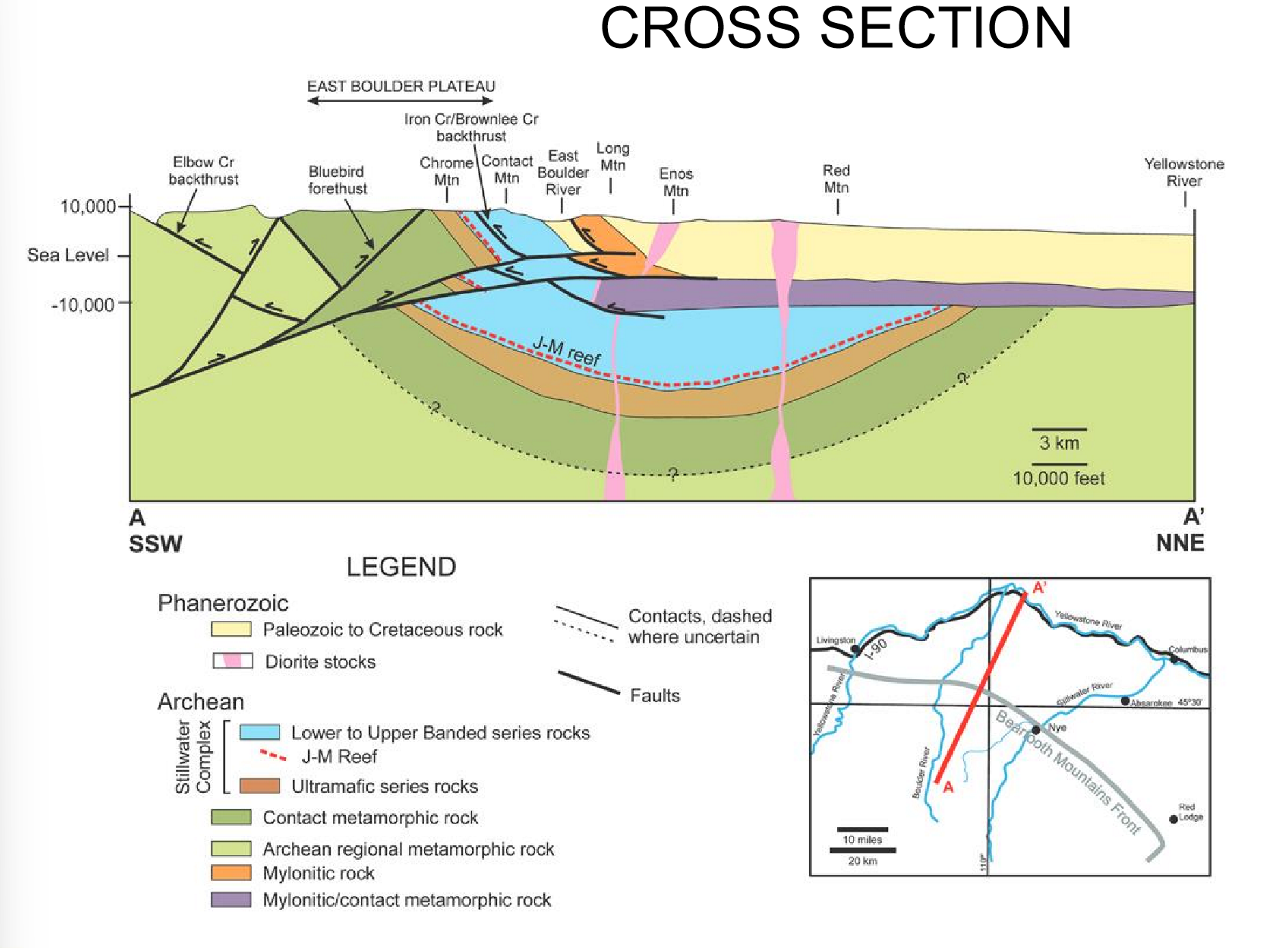
Where is the PGE sulphide zone?
J-M Reef occurs in the Banded Zone (Blue unit) where plagioclase is the dominant mineral
What rocks are in the Banded Series?
Composed of plagioclase cumulates:
Norite
Gabbronorite
Olivine-bearing rocks
two thick anorthosites (J-M PGE Reef and Picket Pin Pt-Pd Zone)

What is Bronzitite?
orthopyroxenite
What rocks are in the Ultramafic series?
A lower Peridotite Zone with 15-21 cycles of cumulates
dunite
harzburgite
chromitite
orthopyroxenite
Upper Bronzitite Zone
Orthopyroxinite

What rocks are in the Basal series?
Early formed cumulates (contaminated) plus minor sulphide-bearing norite

What is the Stillwater G Chromitite?
The thickest Chromite seam in the Stillwater Complex, ranging from 0.7-2 meters in thickness
What Cyclic unit does Chromitite G occur in?
Cyclic unit 10
What zone of the intrusion does Chromitite G occur in?
Peridotite Zone
What is the Cr2O3 wt% average of chromitite G? Is this a low or high grade?
ore averages 20-22 wt% Cr2O3
low grade
Why might fine-grained chromitite be an issue?
Need to concentrate somehow
How many cyclic units are in the Peridotite Zone of the Ultramafic series?
~15 cyclic units
What does a cyclic unit represent?
Represents the sequence of minerals, from high-T to lower T, that crystallize from basaltic magma undergoing fractional crystallization (FC)
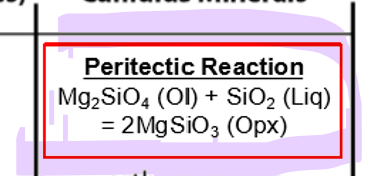
What is the peritectic reaction formula of chromite?
Ol + Liq = Opx
What are the two ways to cause chromite saturation?
Magma mixing (can shift melt to a chromite-stable area for a short amount of time)
Crustal contamination (+ SiO2 = stable chromite zone)

Where is the largest LMI in the world? What age did it form?
Bushveld Complex - Paleoproterozoic (2.057 Ga)
How thick is the Bushveld Complex?
7-9 km
What are the known resources from the Bushveld Complex?
PGE, chromium, and vanadium
What percent of the world’s chromium supply in mined from the Bushveld Complex?
>50%
What is the difference between Stillwater and Bushveld in terms of what chromitites are associated with?
Stillwater = chromitites associated with ultramafic rocks
Bushveld = chromitites associated with ultramafic and grabbroic/anorthositic (plag-bearing rocks)
How was the Bushveld Complex formed?
Filled by repeated injections of mafic magma throughout the construction of the lower critical zones
Followed by several major injections that built the thick main and upper zones
What does the critical zone mark in the Bushveld Complex?
Marks the transition from ultramafic cumulates to plagioclase bearing cumulates

How many distinctive stratiform chromite layers are in the critical zone of the bushveld complex?
15
What are the names of the 3 groups the critical zone is divided into?
Lower Group
Middle Group
Upper Group
Where are the cyclic units of chromite located in the bushveld complex?
Present in the Upper Critical Zone
Not in the Lower critical zone
What Chromitite layers are able to be mined? Why?
Layers: LG6, MG1, MG2
Why?
sufficiently thick (~1 meter)
High Cr/Fe (>1.4)

Why might Chromite layer UG2 be mined when it has a lower Cr/Fe (1.4)?
It is a by-product of PGE mining

What triggers Chromite Crystallization?
Chromite-olivine cotectic during FC
Chromite-only field
New magma injections are chromite rich slurries of chromite crystallized at depth
What are some ways for mafic-ultramafic magma to be in the chromite stability field?
Magma mixing
Crustal contamination (addition of SiO2)
Pressure change (pressure drops = control mineral stability in melts)
Redox changes (magma changes its relative oxidation state, and chromite contains iron; therefore, it is sensitive to redox)
What is the proportion of chromite forming along the Ol and Chromite cotectic line during FC?
0.1-1%

How does Crustal Contamination and magma mixing occur in this diagram?
Hot primitive magma intrusion = magma mixing
Magma interacting with surrounding country rock = crustal contamination
