OMM Exam 1 Lab Material: Comprehensive Overview of Treatment Techniques
 Call Kai
 Learn
Learn Practice Test
 Spaced Repetition
 Match
Match Flashcards
 Knowt Play
1/53

There's no tags or description
Looks like no tags are added yet.
Name | Mastery | Learn | Test | Matching | Spaced | Call with Kai | Chat |
|---|
No analytics yet
Send a link to your students to track their progress
54 Terms
Auscultate
(NOT PALPATE)
aside from inspection, what is your first step in GI Physcial exam
Lift hand
Palpate painful area last
(DO NOT SLIDE)
how do you palpate the abdomen
Blumberg Sign
assessment technique elicited during abdominal assessment to check for peritonitis
rebound tenderness
Murphy's Sign
•Pain elicited while palpating liver during inspiration, causing it to halt
No
should spleen be palpable?
Markel (or Markle) Sign/Heel Jar/Heel Tap/Tap Test
•Pain elicited in the abdomen when the heel is tapped
HVLA
•An osteopathic technique employing a rapid, therapeutic force of brief duration that travels a short distance within the anatomic range of motion of a joint, and that engages the restrictive barrier of an articular somatic dysfunction in one or more planes of motion to elicit release of restriction. Also know as thrust technique.
Side-bending
in neutral dysfunctions, _________________ comes first
Rotation
in non-neutral dysfunctions, ______________ comes first
Left Side
you are performing HVLA and the diagnosis is:
L1-5 N SLRR
What side should they lay on?
L3
you are performing HVLA and the diagnosis is:
L1-5 N SLRR
what level should you localize to?
Perpendicular
in HVLA, the final positioning is to rotate the apex vertebrae and the complete pelvis until the orientation of the lumbar facets are _________________ to the floor
Right
you are performing HVLA and the diagnosis is:
L4 F/E RrSr
What side should they lay on?
D
(Torso rotated to the right and hips rotated to the left)
A 33-year-old female presents to and urgent care with low back pain. She states it started acting up after teaching her third kickboxing class this week. She denies noticing it during class but noticed it as she was getting out of her car after returning home. She denies radiculopathy, muscle weakness, or unexplained weight loss. On physical exam you notice that the transverse process of L2 is deeper on the right. You notice that it becomes deeper with flexion and less deep with extension. You elect to treat this with high velocity, low amplitude (HVLA) using the lateral recumbent method with sidebending side towards the table, in doing so how do you want to position your patient?
A. Torso rotated to the left and hips in neutral
B. Torso rotated to the left and hips rotated to the left
C. Torso rotated to the left and hips rotated to the right
D. Torso rotated to the right and hips rotated to the left
E. Torso rotated to the right and hips rotated to the right
A
(L4 E RSl)
1. A 25-year-old male presents to your office with low back pain. He states he woke up with it after a more vigorous than normal workout at the gym the day before. He denies radiculopathy, muscle weakness, or unexplained weight loss. On physical exam you notice that he has bilateral lumbar paraspinal hypertonicity. You note:
- The transverse process (TP) of L5 is deep on the left side while the TP of L4 is deep on the right.
- With the hyperflexed position, the L4 TPs become more asymmetric while the L5 TPs become more symmetric.
- With the hyperextended position, the L4 TPs become more symmetric while the L5 TPs become more asymmetric.
Based on this information, you diagnose your patient with the following somatic disfunction:
A. L4 E RSl
B. L4 F RSr
C. L5 E RSl
D. L5 E RSr
E. L5 F RSl
Hamstring Test
what should you usually do BEFORE the standing flexion test?
Superior
for the pubic symphysis,
Place your fingers on the ________________ aspect of the pubic tubercle to diagnose sup./inf.
Anterior
for the pubic symphysis,
Place your fingers on the ________________ aspect of the pubic tubercle to diagnose ant./post.
Under
position of thumbs on the PSIS during prone diagnosis
Posterior and Superior
Anterior Rotation carries the ischial tuberosity _______________ and ______________
Anterior and Inferior
Posterior rotation carries the ischial tuberosity __________________ and ____________________
-ASIS
-PSIS
-Pubic Tubercle
what are the 3 MINIMAL things necessary to look at for a full pelvic diagnosis
-Ipsilateral leg off table and hip extended
-Physician presses down on knee while pt tries to flex hip
-Repeat 3-5 times
Posterior Innominate ME Treatment
-Flex knee and hip (ipsilateral)
-pt extends hip for 3-5 seconds
-Repeat 3-5 times
Anterior Innominate ME Treatment
-Pt holds affected side at malleoli
-Slightly aBduct leg
-internally rotate until tension
-lean back and create moderate traction
-Pt breathes and increase traction with each exhale
-repeat 5-7 times
-after last time, have pt cough
Upslipped Innominate ME Treatment
Anterior Innominate and Inferior Pubic Shear
What diagnosis is this treatment for?
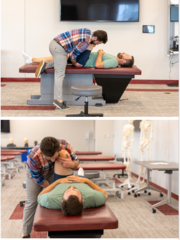
Posterior Innominate and Superior Pubic Shear
What diagnosis is this treatment for?
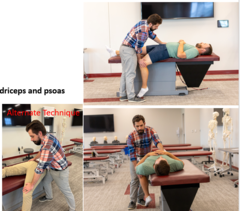
Upslipped Innominate
What diagnosis is this treatment for?
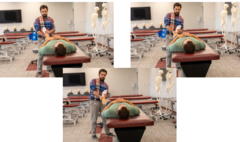
Downslipped Innominate
What diagnosis is this treatment for?

-Internally rotate and ADDuct pt leg
-Add inferior traction
-Pt presses heel against physician
-repeat 2-3 times
or
Have pt hop on affected leg
Downslipped Innominate ME Treatment
-Ipsilateral knee is flexed and aBDucted
-Dr. has one hand on knee and one on ASIS
-pt ADDucts hip against resistance
-repeat 3-5 times
Inflared Innominate ME Treatment
Inflared Innominate
What diagnosis is this treatment for?
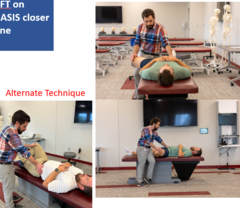
Outflared Innominate
What diagnosis is this treatment for?

-Ipsilateral knee/hip is flexed and ADDucted
-Dr. holds knee and PSIS
-Pt ABDucts against resistance
-Repeat 3-5 times
Outflared Innominate ME Treatment
Symphysis Spread Technique
• knees ADDucted & hips flexed.
•Patient ABDucts at the knees while the physician applies an Isometric pressure for 3-5 seconds.
•Repeat 3 times
then
•Patient supine with knees bent, hips flexed & slightly ext rotated.
•Physician ABDucts the patients bilateral knees.
•Patient Isometrically ADDucts the knees.
•Repeat 2 times with increasing distance.
Symphysis Spread Technique
What is this technique?

D
(Hip extensors)
A 43-year-old female presents to your office with a 3-day history of bilateral hip pain. She denies any trauma. Physical exam reveals:
- Standing flexion test: the left PSIS moves first while the right PSIS moves more
- Left ASIS superior to the right
- Right PSIS superior to the left
Using the supine muscle energy technique, what is the major muscle group used by the patient for isometric contraction in the treatment of the somatic dysfunction?
A. Hip ADductors
B. Hip ABductors
C. Hip flexors
D. Hip extensors
E. Hip internal rotators
D
(Posterior on the left & anterior on the right)
A 53-year-old female presents to your office with a 4-day history of right hip pain. She denies any trauma or radiculopathy. Physical exam reveals an inferior ASIS on the right and an inferior PSIS on the left. As you are presenting this to your preceptor you realize that you forgot a significant element of assessing the pelvis. What are the possible diagnoses from the finds that you have?
A. Anterior on the left & posterior on the right
B. Downslip on the left & upslip on the right
C. Downslip on the left & posterior on the right
D. Posterior on the left & anterior on the right
E. Upslip on the left & downslip on the right
L/L or R/R Torsion
What diagnosis is this treatment for?

R/L or L/R Torsion
What diagnosis is this treatment for?
Unilateral Sacral Flexion
What diagnosis is this treatment for?

Unilateral Sacral Extension
What diagnosis is this treatment for?
Bilateral Sacral Extension
What diagnosis is this treatment for?

Bilateral Sacral Flexion
What diagnosis is this treatment for?
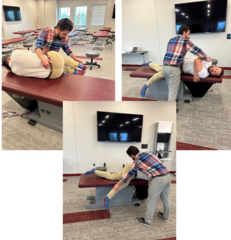
-Pt lateral recumbant
-Side of oblique axis on table
-Monitor lumbosacral junction and other hand on pts knees
-have pt hug table
-Have pt push up against your hand
L/L or R/R Torsion Treatment
-Pt in lateral recumbant
-side of oblique axis on table
-knees bent, flex the hips
-Monitor lumbosacral junction and other hand on pts knees
-draw shoulder to table
-Have pt push against ur hand
L/R or R/L Torsion Treatment
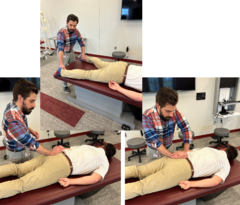
-Pt prone
-Thenar eminence on ILA of dysfunctional side
-Abduct ipsilateral leg and internally rotate
-Exert anterior/superior pressure during exhalation (resisting flexion)
Unilateral Sacral Flexion treatment
-Pt prone
-Thenar eminence on base of sacrum of dysfunctional side
-Abduct ipsilateral leg and internally rotate
-Exert anterior/inferior pressure during inhalation (resisting extension)
Unilateral Sacral Extension treatment
Pregnancy
Obesity
Backward bending
what are some causes of a Bilateral Sacral Flexion?
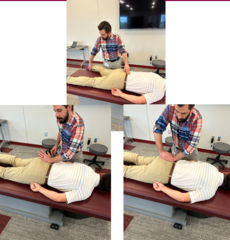
-Pt prone
-Leg abducted and internally rotated
-put your heel of hands on ILAs, applying anterior pressure
-Pt holds inhalation
Bilateral Sacral Flexion treatment
Pratfall
Forward bending
Studying hunched over
causes of Bilateral Sacral Extension
-Pt prone
-Thenar eminence on sacral base
-Abduct both legs and internally rotate
-pt holds exhalation
-exert a downward pressure over sacral base during inhalation
Bilateral Sacral Extension Treatment
-Flex knee and hip (ipsilateral)
-pt extends hip for 3-5 seconds
-Repeat 3-5 times
Inferior Pubic Shear ME Treatment
-Ipsilateral leg off table and hip extended
-Physician presses down on knee while pt tries to flex hip
-Repeat 3-5 times
Superior Pubic Shear ME Treatment