Wk 2 L18: misc hormones
 Call Kai
 Learn
Learn Practice Test
 Spaced Repetition
 Match
Match Flashcards
 Knowt Play
1/14

There's no tags or description
Looks like no tags are added yet.
Name | Mastery | Learn | Test | Matching | Spaced | Call with Kai | Chat |
|---|
No analytics yet
Send a link to your students to track their progress
15 Terms
The two main hormones released by the posterior pituitary are
Oxytocin
Anti-Diuretic Hormone (ADH)
Oxytocin and Anti-Diuretic Hormone (ADH)
small peptides produced in the hypothalamus → packaged in secretory granules → transported down the axon down the infundibular stalk
Stored in the posterior pituitary
Released posterior pituitary in response to stimuli detected in the hypothalamic nuclei.
Anti-Diuretic Hormone (ADH)(vasopressin)
acts through vasopressin type-2 (V 2 ) receptors
Main stimulus of ADH secretion
Increased plasma osmolarity(hypothalamic osmoreceptors)
Decreased blood pressure (aortic and carotid baroreceptors)
ADH expression and function
V₂ receptors are expressed in the distal and collecting ducts
regulates the kidneys’ ability to regulate urine volume and osmolarity → concentrated urine in a low volume
Stimulation and action of oxytocin
G protein-coupled receptors in the myometrium (uterus) and myoepithelial cells of the mammary alveoli
Main stimulus of OT secretion: Cervical dilation(parturition), Suckling of teats(lactation)
Oxytocin effects
stimulates the force and frequency of uterine contractions during parturition
stimulates the ejection of milk by contracting myoepithelial cells surrounding the
alveoli containing milk
The pineal gland is a small structure located?
at the caudal end of the roof of the third ventricle
Function of the pineal gland
neuroendocrine transducer, converting light-dark signals into hormonal responses that regulate reproductive cycles
Function of Pinealocytes
produce melatonin (MLT), a monoamine hormone derived from tryptophan
The central nervous system, pineal gland, hypothalamus, and pituitary gland work in
coordination to regulate seasonal breeding
Anatomy of the pineal gland

The pineal gland and relation to the suprachiasmatic nucleus (SCN)
The gland is innervated by the autonomic nervous system and closely linked to the
suprachiasmatic nucleus (SCN) of the hypothalamus.
The SCN, in response to light detected by the eyes, sends signals to the pineal gland to regulate melatonin production
Where is the SCN?
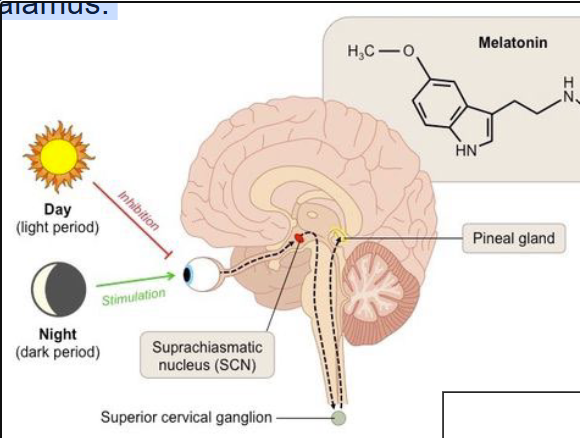
How does melatonin work?
Melatonin (MLT) is secreted at night and released into the cerebrospinal fluid,
signaling darkness to the body.
MLT has G protein-coupled receptors (MLT 1 and MLT 2) located in the hypothalamus.
MLT binds to these receptors to modulate GnRH secretion
Main functions and effects of melatonin in horses
helps regulate seasonal changes, especially reproduction.
As long-day breeders, horses are more likely to mate in spring and summer when daylight increases
Melatonin levels drop during longer days, which triggers reproductive hormones and promotes estrus (heat) and fertility