Alfred Adler
 Studied by 0 people
 Call Kai
 Learn
Learn Practice Test
 Spaced Repetition
 Match
Match Flashcards
 Knowt Play
1/19

There's no tags or description
Looks like no tags are added yet.
Name | Mastery | Learn | Test | Matching | Spaced |
|---|
No study sessions yet.
20 Terms
Explain how Adler developed his insights into organ inferiority and compensation.
Adler’s early medical practice led to his insights into organ inferiorities and compensation. His clients included circus people, and he was inspired by the performers’ unusual strengths and weaknesses.
Describe people’s largest motivating force, according to Adler.
Adler believed that the largest motivating force influencing people’s behaviour was their desire to strive for perfection (sometimes labelled striving for success or striving for superiority).
Describe what it means to strive for success or superiority.
Adler suggested that psychologically healthy individuals strive for success, while psychologically unhealthy individuals strive for superiority. This distinction reflects Adler's belief that healthy striving is motivated by a desire to contribute to humanity, whereas unhealthy striving is often characterized by a focus on personal power and dominance over others.
Indicate which personality traits might be related to striving for success or superiority.
Striving for success might be related to traits such as social interest, empathy, cooperation, and confidence. In contrast, striving for superiority might be related to traits such as self-centeredness, competitiveness, dominance, and arrogance.
Describe teleology.
According to Adler, teleology means that we are motivated by our future, rather than being driven by the past. We are drawn towards our goals, our purposes, our ideals. Teleology means explaining behaviour in terms of its purpose, goal, or end result rather than its cause.
Define fictional finalism.
Fictional finalism, a concept borrowed from Hans Vaihinger’s “As If” philosophy, suggests that people use fictions in their day to day life, beliefs about the future that may not be literally true but help guide present behaviour. The fiction lies in the fact that these goals are not inherently true, and finalism refers to the teleology of it, meaning they are future-oriented beliefs that influence how a person thinks and acts in the present moment.
Explain Adler’s idea of social interest.
Adler believed that social interest is an innate disposition that must be nurtured by one’s environment in order to fully develop. He defined social interest not in terms of particular social behaviours (like extraversion), but in the much broader sense of being useful to others. According to Adler, a lack of social concern is the very definition of mental illness.
Indicate where one’s social interest originates from.
Adler believed that social interest originates from an innate disposition that must be nurtured to survive. For example, infants can show empathy without being taught, such as when one baby cries and the other babies all begin to cry as well. However, this inborn tendency is not enough on its own. Because empathy can be emotionally taxing in a hard world, it must be nurtured and supported by parents and society in order to help this natural inclination blossom into genuine social interest.
Explain when a person’s style of life develops.
A person's style of life (their unique way of dealing with problems and relationships) is typically formed by about five years of age.
Define inferiority complex and superiority complex.
When people are unable to overcome life challenges, they can develop an inferiority complex. This can include feeling helpless, having low self-esteem, or suffering from the imposter syndrome. Sometimes people might try to overcompensate for their feelings of inferiority and may develop an exaggerated sense of superiority and arrogance. This is called a superiority complex.
Describe the 3 childhood situations that contribute to a faulty lifestyle.
Organ Inferiorities and Early Childhood Diseases: Children born with physical weaknesses or illnesses may become overly self-focused. Most develop strong feelings of inferiority, some overcompensate with a superiority complex, and only a few are able to truly compensate in a healthy way.
Pampering: The pampered child fails in two ways. First, they do not learn to do anything for themselves, which makes them learn that they are inferior. Second, they do not learn how to interact with others except by giving commands, causing them to be disliked by society for their entitled behaviour.
Neglect: The neglected child also learns that they are inferior, but in a different way. They are told and shown by others that that they are of no value. As a result, they become selfish, mistrustful, and emotionally detached.
Describe Adler’s theory of psychological types, and explain how it relates to the four types proposed by the ancient Greeks.
Ruling Type: Aggressive, selfish, and dominant individuals who strive for control over others.
Leaning Type: Dependent and passive individuals who rely on others for support and reassurance rather than taking responsibility for themselves.
Avoiding Type: Isolated individuals who avoid the issues in their lives instead of confronting them.
Socially Useful Type: The healthiest type, characterized by cooperation, social interest, and contribution to the welfare of others.
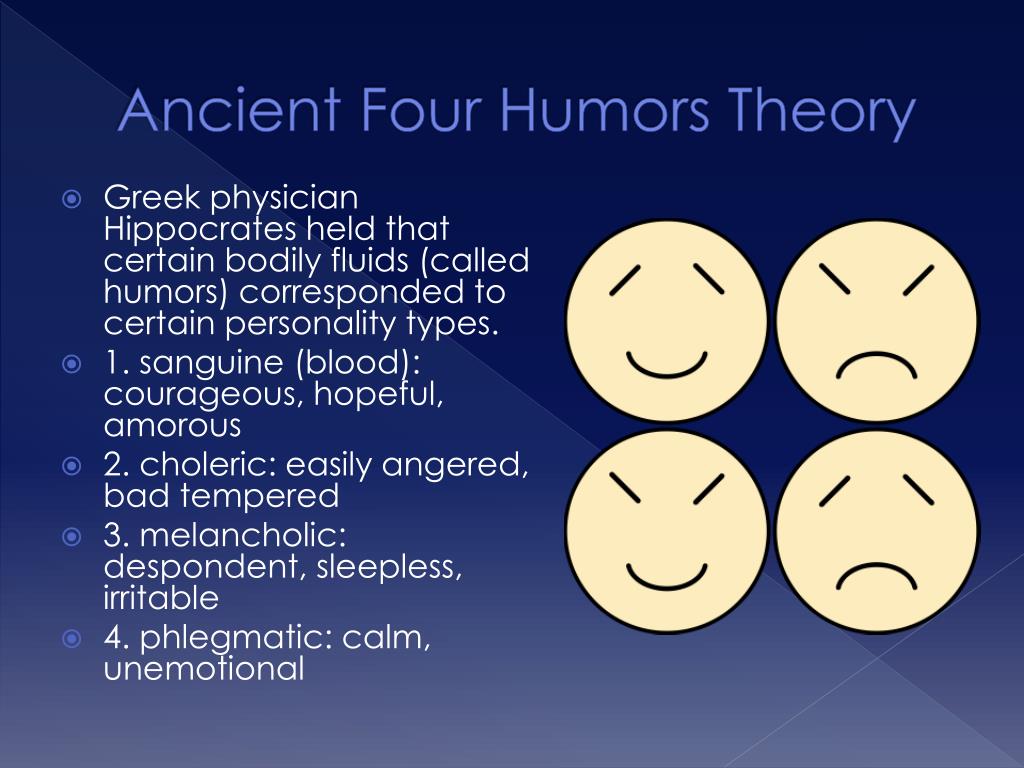
Adler noted that his four types looked very much like the four types proposed by the ancient Greeks: the ruling type corresponds to the choleric temperament, the leaning type corresponds to the phlegmatic temperament, the avoiding type corresponds to the melancholic temperament, and the socially useful type corresponds to the sanguine temperament.
Describe Adler’s theory about birth-order.
Adler believed that birth order plays an important role in shaping personality because each child experiences the family environment differently.
Only Child: Most likely to be pampered, receive special care and attention (sometimes too much).
Firstborn: Feels "dethroned" by younger siblings, most likely to become problem children.
Second/Middle Child: Competitive, always trying to surpass the older child.
Youngest Child: Tends to be pampered, may feel inferior as the youngest but also can be driven to exceed all the "pace-setters" ahead.
Indicate whether empirical research support Adler’s ideas about birth order.
There is limited empirical support for Adler’s ideas about birth order and personality. One major reason is that controlled studies on birth order are difficult to conduct. Because researchers cannot randomly assign individuals to their birth order, most studies rely on correlational methods, which creates issues such as the directionality problem (we cannot know whether birth order causes certain traits or vice versa) and the third-variable problem (variables such as gender of siblings, family income, and family size also influence personality).
Describe between-family vs. within-family research designs.
What researchers have tried to do is conduct different types of designs when studying birth order effects. The first is a between-family design, where individuals from different families are compared. These studies generally do not find much empirical support for Adler’s theories because there are too many confounding variables between families that are difficult to control for. Researchers have also tried to control for those differences by conducting within-family designs, where respondents are compared to their own siblings. These studies can confirm some of Adler’s ideas, but not all. Overall, the research shows that birth order does not reliably predict one’s personality.
Describe the steps Adler would take to diagnose people’s problematic behaviour.
Adler’s approach to diagnosing problematic behaviour focused on uncovering the "fictions" that shape a person’s lifestyle. To do this, he would first gather basic information about the patient, such as their birth-order position. Next, he might examine the patient for any organic causes that could contribute to their problems. Adler would often ask the patient to reveal their earliest childhood memory, as he believed these memories provide clues to the patient’s style of life. He might also ask about childhood problems, dreams, and observe nonverbal behaviours such as posture, gestures, body language, or even sleeping position, as these could all provide useful clues about the patient’s personality. Adler also paid attention to exogenous factors, external events that may have triggered the patient’s problems, such as stress at school, emotional breakup, etc. Importantly, Adler used a lot of plain guess-work in his approach to diagnosis. He believed that empathy and intuition could guide the process of diagnosis when clinical data alone was insufficient.
Describe Adler’s therapeutic technique.
Adler’s therapeutic technique involved face-to-face conversation to avoid an authoritarian dynamic. Adler believed that the patient must come to understand the maladaptive nature of their lifestyle and its roots in self-centred fictions on their own terms. Basically, insight cannot be forced. It is the patient, not the therapist, who is ultimately responsible for change. However, the therapist is responsible for awakening the patient’s sense of social interest, which the patient can then transfer to others.
Indicate how Adler’s theory of personality is similar to and/or different from Freud’s.
For similarities, both believed that personality is established early in life and that dreams reveal important insights about the unconscious. Both viewed neurosis as rooted in unresolved psychological conflicts and believed that early experiences play a major role in shaping personality.
For differences, Freud’s theory was reductionist, dividing personality into the id, ego, and superego, whereas Adler saw people as unified wholes. Freud believed that behaviour is driven by past experiences, while Adler viewed motivation as more future-oriented. Freud's theory of neurosis was rooted in the concept of fixation, while Adler viewed neurosis as a matter of unresolved feelings of inferiority and lack of social interest. Freud interpreted resistance as a sign of repression, while Adler interpreted resistance as one’s unwillingness to give up their faulty lifestyle. Freud pioneered the concept of the “couch” in psychotherapy, while Adler conducted more face-to-face sessions. Finally, Adler viewed dreams as expressions of one’s style of life, focusing on their objective meaning, whereas Freud emphasized the hidden sexual symbols in dreams.
Indicate how Adler’s theory of personality is similar to and/or different from Jung’s.
For similarities, both Adler and Jung were neo-Freudians who emphasized teleology, rather than Freud’s focus on past causes. Both rejected Freud’s division of the mind into id, ego, and superego, and both believed that human beings strive toward personal growth and self-realization rather than being mechanically driven by instincts.
For differences, Adler emphasized striving for perfection and overcoming inferiority as key to a healthy personality, while Jung focused on individuation and the integration of opposites. Adler’s work centred on social relationships, family, and community, while Jung concentrated more on mythology, symbols, spirituality, and collective imagery. In therapy, Adler sought to understand a person’s lifestyle and promote social usefulness, whereas Jung helped individuals integrate unconscious material through the exploration of dreams, symbols, and archetypes.
Evaluate Adler's theory through the lens of a "scientific theory" (considering key principles such as testability, falsifiability, empirical support, predictive power).
Adler’s theory is difficult to test or falsify, as many of its central concepts, such as striving for perfection, compensation, feelings of inferiority, and social interest, are not directly measurable or manipulable. His teleological approach, which explains behaviour in terms of future goals and ideals rather than past causes, limits its experimental testability. Much of his ideas were anecdotal, such as his theory of birth order, which also lacks empirical support. Because of this, Adler’s theory has low predictive power, though it remains valuable for his simple theoretical structure.