Measures of Variability
 Call Kai
 Learn
Learn Practice Test
 Spaced Repetition
 Match
Match Flashcards
 Knowt Play
1/18

There's no tags or description
Looks like no tags are added yet.
Name | Mastery | Learn | Test | Matching | Spaced | Call with Kai | Chat |
|---|
No analytics yet
Send a link to your students to track their progress
19 Terms
variability
a measure of how “close together” or “far apart” scores are in a dataset
what does it mean if scores are closer together
these scores are more similar which indicates low variability since the distribution is more narrow, so the people that produced the scores are likely to be more similar
what does it mean if scores are farther apart
the scores are more different which indicates higher variability since the distribution is wider, so the people that produced the scores are likely to be less similar
range
the difference between the largest and smallest values in a dataset
how to find the range
MAX-MIN
if the range is smaller what does that mean
the values are more similar
if the range is bigger what does that mean
the values are more different
is range sensitive to outliers
yes, extremely which is why it is good to get a quick sense of the spread but not to be used reliably
variance
a numerical measure of how far, on average, a score in the dataset falls from the mean of all scores
population variance
it is a parameter, greek letters are used
sample variance
it is a statistic (estimate)
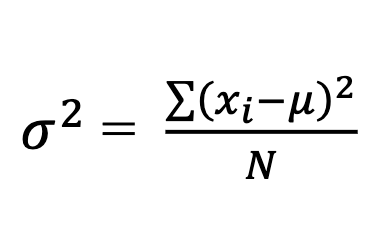
what does this equation calculate for
population variance

what does this equation calculate for
sample variance
steps for calculating sample variance (S2)
1) calculate the mean of the data set
2) calculate the deviation of every score value from the mean (the distance of every score from the mean)
3) square all of the deviations
4) add all of the squared deviations
5) divide by “n-1”

what step of calculating the sample variance (S2) is this
calculate the mean of the dataset
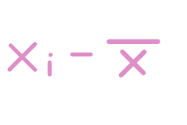
what step of calculating the sample variance (S2) is this
calculate the deviation of every score value from the mean (the distance of every score from the mean)

what step of calculating the sample variance (S2) is this
square all of the deviations

what step of calculating the sample variance (S2) is this
add all of the squared deviations
what step of calculating the sample variance (S2) is this
divide by “n-1”
