4.
 Call Kai
 Learn
Learn Practice Test
 Spaced Repetition
 Match
Match Flashcards
 Knowt Play
1/27

Earn XP
Description and Tags
objectives of firms, bariers to entry and exit, business efficiency (allocative, productive, dynamic and x-efficiency), shifting cost curves, shifting revenue curves, perfect competition
Name | Mastery | Learn | Test | Matching | Spaced | Call with Kai | Chat |
|---|
No analytics yet
Send a link to your students to track their progress
28 Terms
what is predatory pricing
when a firm undercuts its rival on purpose, sacrificing profit in order to get rid of competitors
what is the principle agent problem
a divorce of ownership and control, the owners are the principles and the managers are the agents who run the day to day operations
where does sales maximisation occur
AC=AR
business wants to be as large as possible without increasing costs
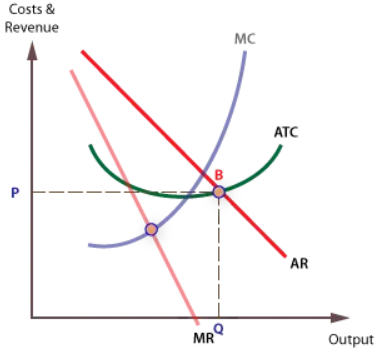
why would a firm want to achieve sales maximisation
economies of scale
limit price - set breakeven price to minimise no of competitors that enter market
flood the market - make consumers aware of your product to the point they develop loyalty to your product
objectives of public sector organisations
maximise the public interest (P=Mc)
pursue CSR
what is a barrier to entry
any obstacle that prevents a new firm from entering the market
what are the 4 groups involved in barriers to entry
LoydsTSB - (used to be the name of Lloyds bank)
L - legal
T - technical
S - strategic
B - brand loyalty
name 2 specific barriers within legal
patents, permits and insurance
what is red tape (component of legal)
excessive paperwork and bureaucracy
name 2 specific barriers to entry in technical
industry specific barriers e.g. high start-up costs, sunk costs
what are sunk costs
costs which cannot be recovered when a firm leaves the market e.g. advertising
name 2 specific barriers to entry in strategic
already withing the market but aim to undercut rivals
predatory pricing and heavy advertising
barriers to entry of brand loyalty
people’s go to place tp buy g/s so they are unlikely to buy from another firm
what are barriers to exit
any obstacle that prevents a firm leaving the market
give 2 examples of barriers to exit
undervaluation of assets - bought items but they are selling for much cheaper
penalties for leaving contracts early - gas, electric and rent contracts require money sum to break off
what is the basic economics problem
what how and who to produce for
what are the 4 types of efficiencies
allocative, productive, x and dynamic efficiency
what is allocative efficiency
when resources follow consumer demand where society surplus and net social benefit is maximised
demand = supply
MSB = MSC

what is productive efficiency
when a firm is operating at the lowest point on their AC curve, giving them full exploitation of economies of scale
MC = AC
what is x - efficiency
business is minimising their waste - production takes place on AC curve

why would a business have x - inefficiency
monopolist - have competitive drive so more likely to do it
public sector firms - no profit drive so more likely to do it
what is dynamic efficiency
reinvestment or long run SNP e.g. capital and innovation
what is the difference between static and dynamic efficiency
dynamic efficiency occurs overtime but static ones are all of the efficiencies that occur at a set point
when there is a change in fixed costs which curve do you shift
the AC curve - whenever fixed costs change there is no change in the rate of change in total costs
when there is a change in variable costs which curve do you shift
shift AC and MC upwards
what are characteristics of a perfectly competitive market
many buyers and sellers
homogenous goods 9firms are price takers)
no barriers to entry/exit
perfect information
firms are profit maximisers
in a perfect market is normal profit long run or short run
long run
in a perfect market are other types of profit excluding normal, short run or long rn
short run