Chapter 13 - Problem solving & creativity
 Studied by 0 people
 Call Kai
 Learn
Learn Practice Test
 Spaced Repetition
 Match
Match Flashcards
 Knowt Play
1/29

There's no tags or description
Looks like no tags are added yet.
Name | Mastery | Learn | Test | Matching | Spaced |
|---|
No study sessions yet.
30 Terms
Problem Solving
An effort to overcome obstacles obstructing the path to a solution. Process of finding solutions to problems encountered in life.
Mental representation: form a representation of the current state to understand the problem and its constraints
Memory retrieval: defines whether we have a problem or not; knowledge of similar problems
Heuristics and algorithms
Barriers
Problem-solving in the brain
Prefrontal cortex in frontal lobe
Intuitive vs. intentional thinking to solve problems
Brain may rely on past experiences to problem-solve (can limit discovery of new solutions)
Can require a lot of mental energy (release of adrenaline, flight, flight, or freeze mode)
Problem-solving Cycle (definition)
mental process of navigating challenges that involves identifying the problem, devising a strategy, and implementing a solution
Characterized by two polar states:
Initial state: the situation at the outset in which to problem is not yet solved
Goal state: condition under which the problem has been solved
Obstacle: factors that prevent us from solving our problem
When we attempt to overcome obstacles, we engage in the problem-solving cycle
The problem-solving cycle (6 steps)
Identify and define the problem
Formulate a strategy
Gather and organize information
Implement the solution
Monitor progress
Evaluate the results
Identify and define the problem (step 1) - problem solving cycle
recognize that a problem exists and clearly define the problem
outlining the problem’s boundaries, goals, and constraints
Formulate a strategy (step 2) - problem solving cycle
using different cognitive strategies to address the problem
Algorithms (step-by-step procedures)
Heuristics
Breaking problem into smaller parts
Gather and organize information (step 3) - problem solving cycle
collect and analyze all relevant resources needed to implement the strategy
collect data, facts, and knowledge related to the problem
consider time, effort, and resources required for solving the problem
Implement the solution (step 4) - problem solving cycle
put the chosen strategy into action
Monitor progress (step 5) - problem solving cycle
check the implementation of chosen solution and make adjustments as needed
Evaluate the results (step 6) - problem solving cycle
assess effectiveness of chosen solution
return to earlier step if needed
identify areas for improvement in future problem-solving efforts
Types of problems
categorized according to whether they have clear paths to a solution of not
Well-structured problems
Ill-structured problems
Well-structured problems
have clear paths to solutions
Transformation problems: problems that require a series of moves to reach a final goal state
Problem space: all possible actions that can be applied to solving a problem, within the constraints that apply to the solution of the problem
Track cognitive changes: give insight into how we solve, plan, search, and select a move
How we use heuristics and search strategies
Hobbits and orcs move problem
Well-Structured Problem-Solving Strategies
Heuristics: narrows your search through the problem space and still leads you to the problem’s solution
Errors with heuristics: Inadvertently moving backwards, Making illegal moves, Not realizing the nature of the next legal move
Algorithms: step-by-step procedures that guarantee a solution when followed precisely
•Involves a defined set of rules and instructions
•Accuracy over speed (more time-consuming)
•Guaranteed solution
•Ex. Following a recipe exactly as indicated
Ill-structured problems
no clear statement of how the goal should be characterized or what operations might serve to reach that goal
Productive thinking: insights that go beyond the bounds of existing associations
To solve ill-structured problems, you must break away from existing associations and see the problem in an entirely new light
Justification skills: problems can be represented in different ways and often have alternative solutions
Insight
may need to solve the problem in a novel way
Types of problem-solving heuristic
Working backwards
Guess and check
Means-end analysis
Working backwards (type of problem-solving heuristic)
starting with the final goal and working backwards to the beginning
example: losing an item and retracing your steps
Guess and check (type of problem-solving heuristic)
making a guess and checking if it’s correct, and adjusting the guess as needed
example: moving a ring over to the third column but then realizing it dosen’t work, so you reserve the step and try a different option
Means-End Analysis (type of problem-solving heuristic)
Comparing current situation to the desired outcome and taking steps to reduce the difference, in no particular order.
example: You need to get to work on time.
Difference between where I am and where I need to be? Distance. What changes distance? My car. My car needs gas. Must leave early to get gas before work…
Isomorphic Problems
Problems that have the same structure or underlying pattern, but the details are different
•Ex. Hobbits and orcs vs. Tower of Hanoi
•Ex. The example from a textbook vs. a problem on an exam
How problems are presented does matter (Kotovsky et al., 1985)
Present participants with isomorphic variations of Tower of Hanoi
•Some forms of the problem took up to 16 times as long to solve
•Major determinant was how the problem was presented
Different problems can put different demands on our working memory
Insight
a distinctive and sometimes seemingly sudden understanding of a problem or strategy that aids in solving the problem
Feels sudden but often the result of prior thought and hard work
Involves identifying and combining old and new information to gain a novel view of the problem
Sleep is shown to increase the likelihood of producing insight
Right anterior superior-temporal gyrus shows activity when experiencing insight
Before insights become conscious, activity in the right hemisphere can be observed
Mental Entrenchment
Mental set: cognitive bias where we approach problems with a specific framework or strategy based on past experiences
Fixate on a strategy that normally works well in solving many problems, but does not work well in solving that specific problem
Functional fixedness: specific fixation on a particular use of an object
Inability to realize that an object could have multiple uses and functions
Transfer
carryover knowledge, skills, and strategies from one problem situation to another
Positive transfer
when the solution of an earlier problem makes it easier to solve a new problem
Negative transfer
when solving an earlier problem makes it harder to solve a later one
How can we avoid negative transfer?
Incubation: putting the problem aside for a while without consciously thinking about it
Problem is still being processed subconsciously
Involves taking a break from the stages of problem solving
Beneficial when we have time to solve a problem
Help relieve mental fixation and foster the problem-solving process
Creative breakthroughs
Mind-Body Connection
Embodied cognition: theory that the mind influences the body, and the body influences the mind
Feedback from our bodies can influence our thought processes
Participants perform physical movements while completing the Two String problem (Thomas & Lleras, 2009)
Results: After 16 minutes, 85% of the swing group participants had solved the problem, whereas only 62% of the stretch group participants found a solution
Not consciously aware of the connection between physical exercises and insight, but the physical movements had an impact on their problem solving
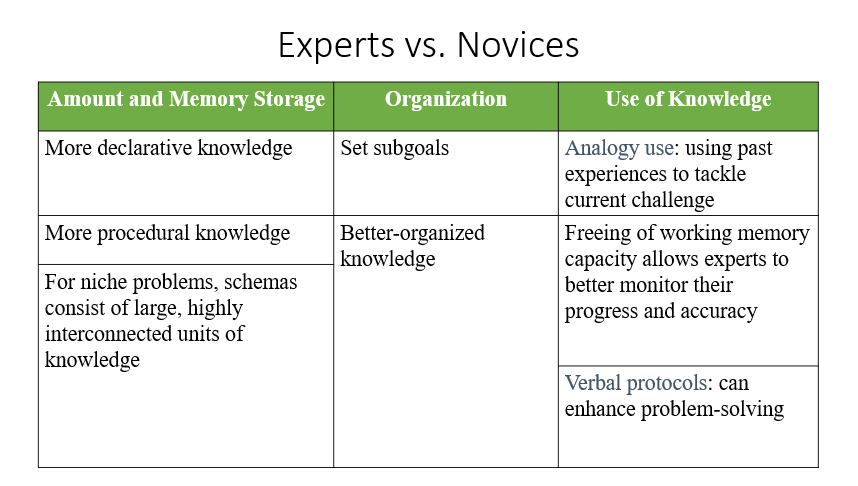
Experts vs. Novices
Automaticity can hinder problem solving for experts by making them less flexible to problems that appear structurally different from the norm
Creativity
Process of using attention, memory, and problem-solving to produce something that is both original and worthwhile
Study as a cognitive process and how it relates to problem solving and insight
End result can take many forms
•Scientific theory
•Dance sequence
•Story
Characteristics Among Creative Individuals - Patterns of Behavior
Show creative productivity: build on and diverge from what they know to create and innovate approaches and products. |
Have creative lifestyles: characterized by flexibility, nonstereotyped behavior, and nonconforming attitudes. |
Expertise and commitment to creative endeavor: dedicated and motivated to become an expert. |
Characteristics Among Creative Individuals - Personality Characteristics
Flexible beliefs and broadly accepting attitudes towards other cultures, races, religions. |
More likely to be dominant and hostile than less creative individuals. |
Self-confident & self-accepting. |
Impulsive, ambitious, and driven. |
Intrinsically motivated (extrinsic motivation hinders creativity). |
Open to new experiences. |