Penetration, Aspiration, variations that impact the swallow, Predysphagia, + EXAM OVERVIEW
 Call Kai
 Learn
Learn Practice Test
 Spaced Repetition
 Match
Match Flashcards
 Knowt Play
1/18

There's no tags or description
Looks like no tags are added yet.
Name | Mastery | Learn | Test | Matching | Spaced | Call with Kai | Chat |
|---|
No analytics yet
Send a link to your students to track their progress
19 Terms
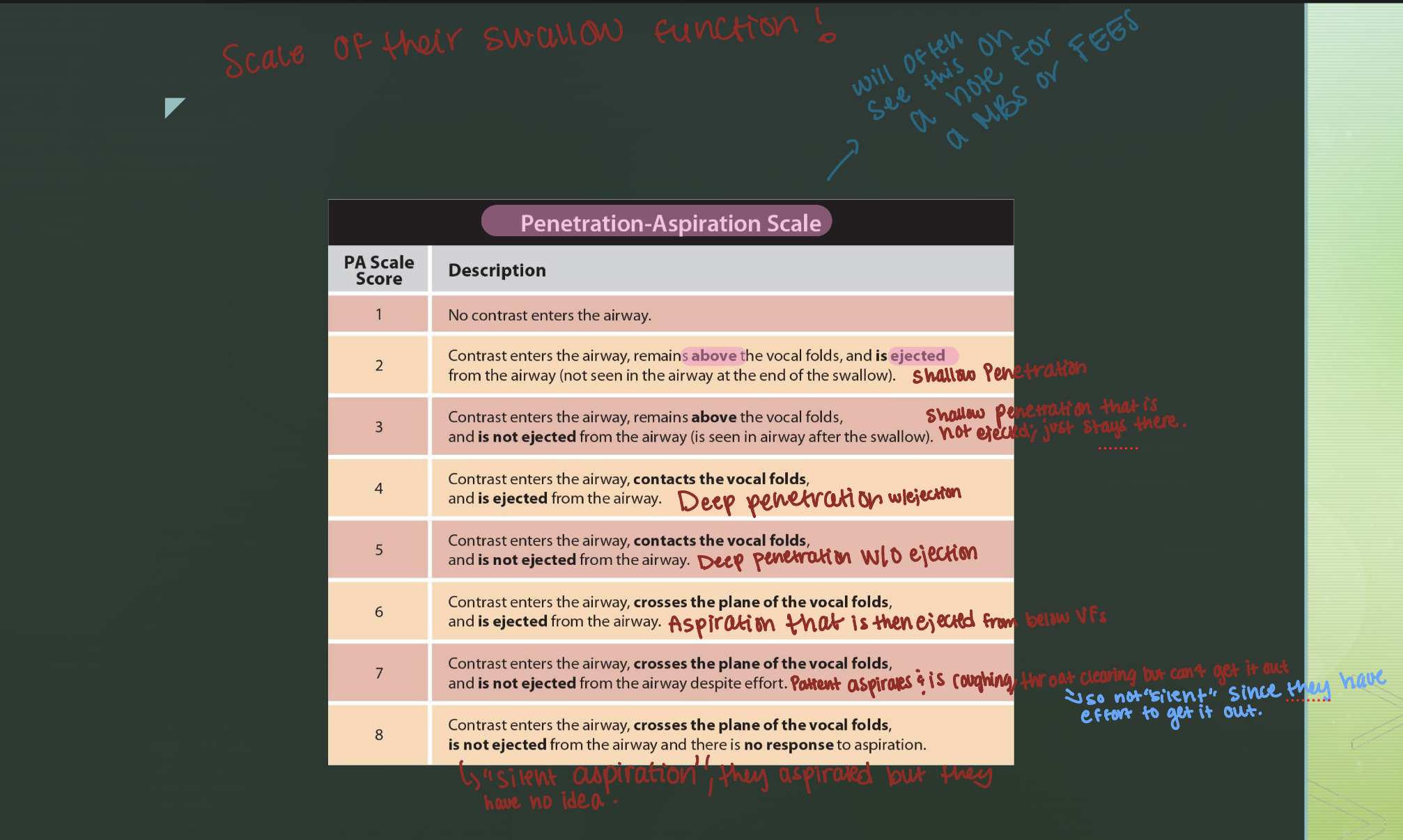
Penetration (2)
Shallow Penetration: enters the laryngeal vestibule (entrance of larynx), but does go deep enough to contact the VFs.
Deep Penetration: contacts/hits the VFs (may show up as a flat line sitting on top of VFs
Aspiration (3) + silent aspiration
Material passes BELOW THE VF
Flash aspiration: usually seen when pt aspirates prior to swallow; bolus passes the VFs, we aspirate, but only shortly because at the height of the swallow the aspirated material is ejected
Trace Aspiration: small amount of material remains past the level of the VFs/enters the airway
Gross Aspiration: large amount of material enters the (lower) airway
Silent aspiration: Material passes below the vocal folds without triggering a protective cough or throat-clear reflex, commonly seen in patients with reduced laryngopharyngeal sensation/lesion that impacts sensory input→ stroke, or Parkinson's disease
Swallowing is both Automatic and Voluntary
swallowing is not a fixed reflex!
swallowing has a strong sensory motor connection; sensory information helps the brain determine how muscles should respond to what is being swallowed.
Higher brain structures modify the brainstem’s swallowing patterns based on: 4
What is being swallowed: Thin liquids or puree (different things going on in your mouth when you are drinking water v eating mashed potatoes)
How much is being swallowing: tsp trial or large sip
Sensory information: hot, cold, fizzy
Personal intentional actions (are we trying to hold bolus b4 swallowing or do a swallowing exercise?)
Swallowing is flexible
Swallowing is a continuous integrated process that can occur in different patterns depending on the situatoin
Motor equivalence: nervous system can use different combinations of muscles and movements to accomplish the same goal (different people can use slightly different muscle patterns while still swallowing safely)
A swallow can be functional and abnormal! 3 ways
Things that can be a normal variation for some patients: 3
Posterior spillage prior to swallow initiation
Mild pharyngeal residue post swallow
Flash penetration
Bolus Characteristics that impact the swallow (4)
swallowing mechanism adjusts based on the food and liquid characteristics:
Bolus Size: larger bolus=longer oral and pharyngeal transit time; earlier movement of swallowing structures; longer UES opening bc of larger bolus; produce more pharyngeal pressure; longer swallowing apnea period because taking more time.
Consistency/Viscosity: More thick=more lingual force; more pressure to propel it; longer pharyngeal contractions; more swallow to clear bolus orally and/or pharyngeally
Temperature: controversial- cold water “increasing” speed of swallowing response; cold water may irritate esophagus; hot water can relax the LES making reflux worse because open; also just patient preference- may be easier to swallow if patient prefers room temp water.
Taste: strong flavor, sour taste carbonation, can increase salivary flow/salivation and increase submittal muscle activity
No two people swallow the same: 6++
Swallowing varies bc of:
age
body positioning (e.g., chin tuck, patients hemiplegic/can’t move one side→ doing head turn can help them swallow safely)
anatomy: does patient have ACDF (cervical disc fusion)→ can cause swelling of pharynx; CP bar? removed tongue because of head/neck cancer?
Motor strategies: are they doing swallowing exercises?
cognitive status: Cognitively impaired? dementia? super impulsive (e.g., TBI- slamming food down)
Prior sx HX
AND AND AND
Presbyphagia
Normal aging can cause swallow to become SLOWER and LESS EFFICIENT; however, does not automatically mean dysphagia
Common Age-related changes:
slower tongue movement
reduced chewing strength: dentures, partials, edentulous( no teeth), sporadic dentition (few teeth)
can cause longer oral phase bc taking longer to chew, or maybe dentures don’t fit well. if we have hard time chewing, may just need softer foods; also may not have great oral care, can impact oral phase.
Longer oral transit
reduced oral/pharyngeal sensation
delayed hyoid movement
reduced hyolaryngeal excursion
longer pharyngeal transit
more residue after swallowing, more swallows needed to clear bolus (as you get older, may take 2-3 swallows which is normal 🙂.
reduced UES opening
When Presdysphagia becomes a problem
impaired swallow may be functional under normal circumstances but may cause SIGNIFICANT issues when hospitalized (or illness, injured malnutrition, diseased (aka when immunocompromised)
e.g., a patient can be chronically aspirating at home and be fine/not get PNA, but if you have an illness, constant aspiration, dysphagia may be more concerning and cause PNA
Medications that impact swallow function
medications can indirectly or directly impact the swallow function by causing
****XEROSTOMIA: Dry mouth (SSRIS, Decongestions, etc)
N/V
Poor PO intake/poor appetite
coughing
throat irritation
Dyskinesia: involuntary erratic movements → coordination/oral management issues with all that movement
Reduced sensation (e.g., local anesthetic-novacain→ cause difficulty orally transiting bolus)
EXAM QUESTION PRACTICE
FOCUS ON THESE BELOW
S/S of esophageal dysphagia
what makes us think it is esophageal vs. pharyngeal vs oral → pt presents with c/o x
Even though we don’t DX esophageal Dysphagia, why is knowing s/s important
Referred sensations/Globus sensation: sensation that food is stuck in throat even though may be seeing retention down in chest.
Reflux: Sensation that food is coming back up
Odynophagia: Pain upon swallowing
Common signs on a MBS:
Regurgitation to pharynx (back flow of bolus back to pharynx from esophagus)
Ineffective peristalsis: takes forever for bolus to move up and down esophagus instead of moving smoothly.
Poor clearance from esophagus: bolus does not completely empty from the esophagus into the stomach.
ALSO if diagnosed with GERD: Gastroesophageal reflux disease- chronic acid reflux
3 pillars of aspiration
functionally what does that look like
example: given a case of pt: 82 yrs old, chronically aspirating, no respiratory compromise. But now is hospital with COPD and a lot of oxygen. Now are we concerned about his chronic aspiration? EXPLAIN WHY
See practice questions
Why are secretions important + Secretion management
what does it look like when a patient is not managing their secretions appropriately
Secretions are important because:
antibacterial: keeps us healthy by keeping our mouth at a healthy microbiome, saliva attacks illness + helps manage disease
swallow function: helps break down bolus into a cohesive mass that is safe to swallow
what does inappropriate secretion management look like?
drooling
choking
overproducing
just not swallowing it** this is the case most of the time.
possible dxs: cerebral palsy, ALS, stroke, tbi
How would decreased oral sensation vs decreased oral strength impact the oral phase differently?
If a pt has decreased oral sensation, may:
not adequately perceive the bolus or residue and may lead to delayed or ineffective oral management (i.e., delayed bolus recognition, difficulty detecting residue, reduced awareness of pocketing)
If a pt. has decreased oral strength:
patient knows how to engage in appropriate oral preparation and transport but lack the muscular capability to effectively manipulate and transport the bolus posteriorly (i.e., difficulty forming the bolus, inefficient mastication/manipulation of the bolus or AP transit, anterior spillage)
Both may lead to aspiration, but easier to teach a patient with strength deficits compensatory strategies because their sensation is still intact. Without intact sensory feedback, patients cannot easily gauge when or how to adjust their swallow voluntarily
. Decreased Oral Sensation (Deficit of Awareness & Feedback)
When sensory receptors in the oral mucosa, tongue, teeth, or inner cheeks (CN V, VII, IX) are impaired, the patient loses feedback regarding bolus location, size, viscosity, and boundaries
Silent Pocketing / Squirreling: Food slips into the anterior or lateral sulci (between the teeth and cheeks) and pools there without the patient realizing it. Because they cannot feel the retained food, they do not attempt to clear it.
Premature Spillage: Inability to sense the bolus on the tongue dorsum or at the palatoglossal seal leads to unperceived, uncontrolled loss of food/liquid over the base of the tongue into the pharynx before the pharyngeal swallow response is triggered.
Drooling / Anterior Loss (Sensory Cause): Reduced sensation in the lips or lower face decreases the spontaneous reflex to swallow, leading to unperceived anterior leakage of saliva or liquids.
Impaired Masticatory Modulation: Lacking sensory feedback from periodontal and joint mechanoreceptors, the patient cannot automatically adjust chewing force, speed, or tongue trajectories to match the texture of the bolus.
Delayed Oral Transit Initiation: Without adequate sensory stimulation reaching the brainstem threshold, the patient may hold the bolus passively in the mouth ("bolus hold" / apraxia-like delay) without initiating posterior propulsion.
2. Decreased Oral Strength (Deficit of Motor Execution & Force)
When muscles of facial expression, mastication, or lingual movement (CN V, VII, XII) are weak or paretic, the patient may fully perceive the bolus but lacks the muscular force to manipulate and propel it.
Incomplete Mastication: Weakness in the muscles of mastication (masseter, temporalis, pterygoids) causes inefficient grinding and mashing of solid food, resulting in an unformed, non-cohesive bolus
Prolonged Oral Transit & "Tongue Pumping": Weakness in intrinsic and extrinsic tongue muscles prevents the tongue from making firm, sequential front-to-back pressure against the hard palate. The patient may exhibit repetitive lingual rocking/pumping or piecemeal swallowing to force small portions of the bolus back
Widespread Oral Residue / Stasis: Heavy coating or residual food remains on the hard palate, tongue dorsum, or floor of the mouth despite the patient consciously trying to clear it.
Inability to Clear Sulci: Even if the patient feels food pocketed in their cheek (intact sensation), lingual or buccal weakness prevents them from physically sweeping the sulcus clear with their tongue.
Anterior Loss (Motor Cause): Weakness of the orbicularis oris muscle prevents a tight labial seal, allowing food or liquid to spill out anteriorly during chewing or transport.
How could the pt’s respiratory status increase aspiration risk?
Think 3 pillars of aspiration, think swallow apnea→ e.g., if patient has trouble coordinating that breath cycle swallow, that’s why recommendation is NPO
Having impaired respiratory illness can increases the chances of developing aspiration PNA due to impaired health status which weakens immunity/health reserve of the patients. Additionally, healthy lungs can often clear minor aspirated material through normal reflexive actions such as coughing. if a patient is on oxygen (e.g., HFNC), can lead to xerostomia (dry mouth) from reduced salivary production → saliva needed for healthy mouth microbiome and can reduce oral care health?
Additionally, patients with a compromised respiratory status likely have trouble coordinating that breath cycle swallow: exhale-swallow-exhale patterns which helps prevent us from inhaling material into the airway and aspirating when we pause our breathing temporarily. if that cycle is impaired, (e.g., exhale-swallow-inhale or inhale-swallow-exhale) increases chances of us inhaling material into our airway and aspirating.
Presbyphagia: Normal, but when would it cause issues?
Back to 3 pillars
impaired swallow may be functional under normal circumstances but may cause SIGNIFICANT issues when hospitalized (or illness, injured malnutrition, diseased (aka when immunocompromised)
e.g., a patient can be chronically aspirating at home and be fine/not get PNA, but if you have an illness, constant aspiration, dysphagia may be more concerning and cause PNA
Being immunosuppressed is one of the pillars of PNA, so if a patient is already having issues coordinating a normal swallow/,may already be aspirating but does not develop PNA, that increases their odds of developing PNA>
Presbyphagia refers to normal, age-related shifts in swallow mechanics: such as slower transit times, reduced muscle strength, delayed hyoid movement, and increased post-swallow residue—that remain safe and functional under baseline conditions at home. However, normal aging also lowers an individual's physiological reserve, meaning that acute secondary stressors during hospitalization (such as severe infection, surgery, or fatigue) can cause this functional aged swallow to decompensate into overt aspiration risk. Across the Three Pillars of Aspiration, presbyphagia causes clinical issues when acute systemic illness impairs the lungs' capacity to clear foreign material (Pillar 1), hospital-related xerostomia or poor oral hygiene breeds pathogenic bacteria within stagnant presbyphagic residue (Pillar 2), or rapid respiratory distress disrupts swallow apnea, causing post-swallow inhalation that actively sucks pooled residue past the vocal folds into the open airway (Pillar 3).
How would you determine if a difficulty is primarily oral, pharyngeal, or esophageal?
If a patient comes in with c/o x, what do we suspect off the bat?
Determining whether a swallowing difficulty is primarily oral, pharyngeal, or esophageal involves analyzing patient-reported symptoms, conducting a clinical bedside examination, and confirming the underlying pathophysiology using instrumental testing.
1. Oral Phase Deficits (Preparation & Transport)
Oral phase impairments involve difficulty accepting, chewing, manipulating, or propelling the bolus backward into the oropharynx.
Key Clinical Signs & Symptoms:
Drooling / Anterior Loss: Poor labial seal or reduced spontaneous swallowing frequency.
Pocketing / "Squirreling": Retention of food in the lateral (buccal) or anterior sulci due to reduced cheek tone (CN VII) or oral sensation (CN V).
Impaired Mastication & Transport: Inability to chew dense solids, prolonged oral preparation/transit time, repetitive lingual pumping, or tongue rocking.
Loss of Bolus Control & Premature Spillage: Uncontrolled loss of liquid or food over the tongue base before the swallow is initiated.
Primary Bedside Assessment: Direct visual inspection of oral structures (lips, dentition, tongue, palate, and sulci), cranial nerve testing (CN V, VII, IX, XII), and observing oral bolus manipulation during oral trials.
2. Pharyngeal Phase Deficits (Airway Protection & Propulsion)
Pharyngeal phase impairments involve a breakdown in airway protection or bolus propulsion once the involuntary swallow response is triggered.
Key Clinical Signs & Symptoms:
Delayed Swallow Triggering: Bolus dwells deep in the pharynx before structural elevation begins.
Coughing or Throat Clearing: Involuntary clearing during or immediately following a swallow attempt.
"Wet" or Gurgly Vocal Quality: Voice changes post-swallow signaling material or secretions pooled on the vocal folds.
Pharyngeal Residue: Persistent coating or stasis in the valleculae, pyriform sinuses, or pharyngeal walls.
Nasal Regurgitation: Material escaping into the nasopharynx due to incomplete or mistimed velopharyngeal closure.
VF not adducting appropriately
impaired airway protection: inadequate epiglottis inversion, hyolaryngeal elevation and excursion.
CP bar on MBS: trouble for bolus to pass out of pharynx
3. Esophageal Phase Deficits (Transit to Stomach)
Esophageal impairments stem from structural narrowing, motility disorders, or sphincter dysfunction in the esophagus below the Upper Esophageal Sphincter (UES).
Key Clinical Signs & Symptoms:
Sensation of Food "Stuck": Patient reports food clinging or getting stuck in the lower neck, sternum, or chest after completing a swallow. (Note: Distal esophageal lesions frequently present as sensation in the throat/neck region).
Odynophagia: Pain during swallowing as the bolus passes through the esophagus.
Late Regurgitation or Reflux: Retrograde movement of undigested food hours after meals, heartburn, or a bad taste upon waking.
ineffective peristalsis/poor clearing into stomach (x-ray)
Achalasia: LES won’t relax and let bolus pass to stomach, just stays there
Example
Findings: Food Pocketing in Buccal cavity
Why: reduced buccal/lingual control/strength/ or sensation
Functional Consequence: Food isn’t effectively contained or cleared from the oral cavity (aside: if a patient is cognitively intact, can ask them to use swab and sweep clear from inside mouth)
clinical implication: increased risk for retained material/choking on oral residue