Chapter 2 medical terminology
 Call Kai
 Learn
Learn Practice Test
 Spaced Repetition
 Match
Match Flashcards
 Knowt Play
1/293

There's no tags or description
Looks like no tags are added yet.
Name | Mastery | Learn | Test | Matching | Spaced | Call with Kai | Chat |
|---|
No analytics yet
Send a link to your students to track their progress
294 Terms
Homeostasis
the normal dynamic process of balance needed to maintain a healthy body
organelles
structures within the cells
cytoplasm
holds the organelles of the cell
lysosome
organelle that serves a digestive function for the cell
-plasm
formation
lys/o
dissolving
-some
body
ribosome
site of protein formation; contains ribonucleic acid (RNA)
rib/o
ribose
home/o
same
-stasis
controlling, stopping
meta-
change, beyond
bol/o
throwing
-ism
state of
ana-
up, apart
cata-
down
mitochondrion (pl. mitochondria)
converts nutrients to energy in the presence of oxygen
-on
structure
mitochondri/o
mitochondria
nucleus
contains most of the genetic information, controls cell growth and replication, regulates cell metabolism, and is the cite of RNA synthesis
nucle/o
nucleus
-us
structure
tissue
is a group of similar cells from the same origin that together carry out a specific function
stromal tissue
supportive tissue
parenchymal tissue
does the actual work of the organ
epithelial tissue
acts as an internal or external covering for organs
hist/o
tissue
strom/o
stromal
en-
in
chym/o
juice
epi-
upon
thel/e
nipple
my/o
muscul/o
muscle
neur/o
nerve
cardi/o
heart
connective tissue
includes a variety of types, all of which have an internal structural network
ex: bone, blood, fat
Muscular tissue
Includes 3 types all of which share the unique property of being able to contract and relax.
ex: heart muscle, skeletal muscle, and visceral muscle
Nervous tissue
includes cells that provide transmission of information to regulate a variety of functions
ex: neurons (nerve cells)

apex (organ)
the pointed extremity of a conical structure
apic/o
apex
body(corporis) [organ]
the largest or most important part of an organ
corpor/o
som/o
somat/o
organ
fornix (organ)
any vaultlike or arched structure
fornic/o
fornix (pl. fornices)
fundus (organ)
the base or deepest part of a hollow organ that is the farthest from the mouth of the organ
fund/o
fundus
hilum (pl. hila) [organ]
recess, exit, or entrance of a duct into a gland, or of a nerve and vessels into an organ
hil/o
hilum
lumen (organ)
the space within an artery, vein, intestine, or tube
lumin/o
lumen
sinus (organ)
a cavity or channel in a bone, a dilated channel for blood, or a cavity that permits the escape of purulent (pus filled) material
antrum and sinus are synonyms
sin/o
sinus/o
sinus
vestibule (organ)
a small space or cavity at the beginning of a canal
vestibul/o
vestibule
musculoskeletal (body system)
function:
support, movement, protection
integumentary (body system)
function:
cover and protection
gastrointestinal (body system)
function:
nutrition
urinary (body system)
function:
elimination of nitrogenous waste
reproductive (body system)
function:
reproduction
blood/lymphatic/immune (body system)
function:
transportation of nutrients/waste, protection
cardiovascular (body system)
function:
transportation of blood
respiratory (body system)
function:
delivers oxygen to cells and removes carbon dioxide
nervous/behavioral (body system)
function:
receive/process information
special senses (body system)
function:
information gathering
endocrine (body system)
function:
effects changes through chemical messengers
hem/o
hemat/o
blood
Adjective form: hematic
oste/o
osse/o
bone
Adjective form: osseous, osteal
lys/o
breakdown, dissolve
Adjective form: lytic
cyt/o
cellul/o
cell
Adjective form: cellular
epitheli/o
epithelium
Adjective form: epithelial
adip/o
fat
Adjective form: adipose
myocardi/o
heart
Adjective form: myocardial
kary/o
nucle/o
nucleus
Adjective form: neural
organ/o
viscer/o
organ, viscera
Adjective form: visceral
system/o
system
Adjective form: systemic
ana-
up, apart, away
supra-
upward, above
-al
-ous
pertaining to
-ia
-ism
condition, state of
-on
structure
-us
structure
-um
structure, thing, membrane
-logy
study of
-tomy
incision, cutting
cytology
the study of cells
histology
study of tissue
anatomy
to cut apart; the study of the structure of the body
physi/o
growth
physiology
the study of growth; the study of the function of the body
pathology
the study of disease
path/o
disease
biopsy
process of viewing living tissue that has been removed for the purpose of diagnosis and/or treatment
bi/o
life, living
-opsy
process of viewing
necropsy
process of viewing dead tissue
necr/o
dead, death
autopsy
process of viewing by self; this term is commoly used to describe the examination of a dead body to determine cause(s) of death
auto-
self
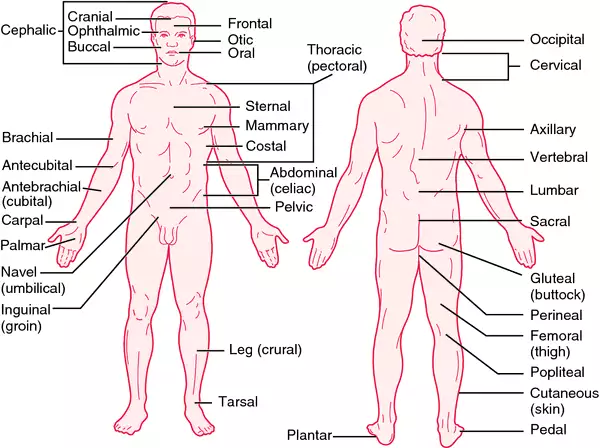
anatomic position
position in which the body stands erect with face forward, arms at the sides, palms forward, with toes pointed forward
used to describe the surface anatomy of the body, both front (ventral) and back (dorsal)
buccal
pertaining to the cheek